

Delaying a large-scale solar transition in 2026 is no longer a conservative strategy; it is a direct exposure to volatile energy markets and escalating operational costs. When you are presenting a solar project to the board, the narrative must transcend environmental sentiment to focus on the precision of long-term asset architecture. Your directors likely view a 25-year commitment with caution, fearing technology obsolescence or the perceived volatility of battery storage costs. You understand that grid instability in Pakistan requires more than just simple generation. It demands a resilient, future-proofed energy ecosystem that protects the bottom line.
This guide provides a strategic framework to master the art of securing executive approval through a data-driven approach to large-scale infrastructure. You will learn how to communicate the superior Levelized Cost of Energy (LCOE) offered by N-type TOPCon and HJT technologies. We will detail how to structure your proposal to address technical risks, integrate Nippon Lithium-ion Battery Storage Systems, and transform a utility expense into a high-performance financial asset. By following this methodical progression, you will provide the board with the clarity needed to approve a monumental energy strategy that ensures corporate longevity.
Key Takeaways
- Frame solar as a high-performance financial asset by mastering the technical nuances of LCOE and IRR metrics.
- Protect your capital from technology obsolescence by prioritizing high-efficiency HJT panels and Smart AI Inverters.
- Secure unanimous approval by following a structured, evidence-based architecture for presenting a solar project to the board.
- Mitigate grid instability in Pakistan through the strategic integration of proprietary lithium-ion storage systems.
- Evaluate EPC partners based on technical precision and a proven global track record in large-scale infrastructure.
The Strategic Narrative: Aligning Solar with Corporate ESG Goals
Successful energy transition begins with a fundamental shift in perspective. When presenting a solar project to the board, you aren't proposing a mere utility installation; you're introducing a structural hedge against the volatility of the global energy market. In Pakistan, where grid instability and fluctuating tariffs create significant operational risk, energy independence is a core component of resilience. A High-Tech Architect builds for a 30-year lifecycle. This mindset ensures that the infrastructure remains viable long after the initial payback period, prioritizing structural integrity over short-term savings. Boards today require proof that energy strategy is synonymous with risk management and long-term value preservation.
The Shift from OpEx to CapEx
Transitioning energy from an unpredictable Operating Expenditure (OpEx) to a controlled Capital Expenditure (CapEx) provides the budget predictability that directors demand. By locking in a fixed levelized cost of electricity, the corporation transforms a passive cost center into a strategic asset. Modern systems utilize Energy Orchestration. In this model, solar generation and Nippon Lithium-ion Battery Storage Systems work in tandem to manage peak loads and arbitrage grid pricing. This shift allows the CFO to forecast energy costs with precision for decades, effectively insulating the balance sheet from external shocks and utility rate hikes. It moves the organization from being a consumer of power to an owner of a high-performance energy factory.
Decarbonisation as a Competitive Advantage
Decarbonisation is now a financial imperative rather than a secondary ESG goal. Global sustainability reporting standards, such as the harmonized ISO 14064-1 and GHG Protocol updates finalized in 2026, require rigorous Scope 2 emissions tracking for all large-scale enterprises. Boards must recognize that green energy credentials directly influence corporate credit ratings and the ability to secure international partnerships. Implementing a holistic architecture through the NipponHev System allows for seamless integration of renewable generation and smart distribution. This technical prowess demonstrates to stakeholders that the firm is prepared for the transparency requirements of the modern era. It turns environmental compliance into a distinct competitive advantage that attracts sophisticated investors and high-value global clients who prioritize supply chain sustainability.
Mastering the Financial Metrics: LCOE, IRR, and NPV
When presenting a solar project to the board, the conversation must shift from environmental sentiment to capital efficiency. Directors evaluate infrastructure through the lens of Internal Rate of Return (IRR) and Net Present Value (NPV). These metrics provide a standardized way to compare energy investments against other corporate capital allocations. A project's viability hinges on its ability to generate predictable cash flows over a 25-year horizon. Leading photovoltaic providers like Sonalis design tailored commercial and investor-focused solar solutions around these exact principles to optimize financial predictability. High-performance assets, characterized by low degradation rates, protect the IRR by ensuring energy yields remain robust in the second and third decades of operation. This financial durability is what separates a short-term fix from a permanent energy asset.
Calculating the Levelized Cost of Energy
The levelized cost of energy (LCOE) is the definitive benchmark for comparing energy generation sources. It represents the total lifetime cost of the system divided by the total energy produced. Utilizing high-efficiency Nippon HJT Solar Panels lowers the LCOE by maximizing energy density and performance in high-temperature environments. However, hardware is only one variable in the equation. Consistent solar system maintenance and monitoring is essential to maintain high uptime. When system availability is maximized, the cost per kilowatt-hour drops, providing the board with a clear financial justification for the initial capital outlay. Efficiency is not just a technical spec; it's a direct driver of the project's economic floor.
Sensitivity Analysis and Risk Mitigation
Directors often harbor skepticism regarding energy price volatility and grid stability. A robust presentation includes a sensitivity analysis that models "Best Case" and "Worst Case" scenarios for energy price inflation. You must demonstrate how lithium-ion battery storage serves as a financial hedge against time-of-use (ToU) tariff spikes. By storing energy during low-cost periods and discharging during peak windows, the system mitigates the risk of escalating utility costs. For a deeper understanding of procurement standards, the EPA's Guide to Purchasing Green Power offers a framework for aligning these financial goals with corporate sustainability mandates. This level of technical precision transforms a technical proposal into a sophisticated financial strategy. Boards are increasingly concerned with the "asymmetry of inaction," where delaying a project in 2026 may result in missing critical grid-parity windows. If you require a customized financial model for your facility, request a consultation with our project development team to analyze your specific load profile and local tariff structures.
Future-Proofing the Investment: Technology Selection
Directors often hesitate to approve large-scale energy projects due to the fear of technology obsolescence. When presenting a solar project to the board, you must demonstrate that your selection is based on the 2026 global standard: N-type cell architecture. Legacy P-type PERC modules are no longer viable for long-term corporate infrastructure. They suffer from higher degradation rates and lower efficiency ceilings. By selecting high-performance N-type modules, you ensure the asset retains its value for over 25 years. This technical choice is the primary mechanism for mitigating long-term operational risk.
HJT vs. TOPCon: Selecting the Right Architecture
Choosing between TOPCon solar panels and Heterojunction (HJT) technology requires a granular understanding of site-specific conditions. TOPCon has become the dominant utility-scale standard due to its balance of cost and efficiency. However, HJT technology offers a superior temperature coefficient. In the high-temperature climates common across Pakistan, HJT modules maintain higher output levels when standard panels begin to throttle. This resilience translates to a higher energy harvest during peak summer months. An IEA analysis of solar supply chains also highlights that module selection must consider manufacturing concentration and supply chain resilience. Utilizing N-type cells minimizes Light-Induced Degradation (LID), protecting the project’s yield throughout its entire lifecycle.
Intelligent Energy Management
The hardware strategy extends beyond the panels themselves. A smart ai solar inverter acts as the central intelligence of the system. These units go beyond simple power conversion. They provide real-time data orchestration and predictive maintenance capabilities. AI-driven monitoring identifies potential failures before they result in downtime, preventing revenue loss. This level of transparency satisfies Board-level requirements for rigorous reporting and accountability. When the system can self-diagnose and optimize its own performance, it reduces the need for manual intervention and lowers long-term O&M costs. This intelligent architecture ensures that the corporation is not just buying equipment, but investing in a self-sustaining energy ecosystem.
The Presentation Architecture: A Slide-by-Slide Guide
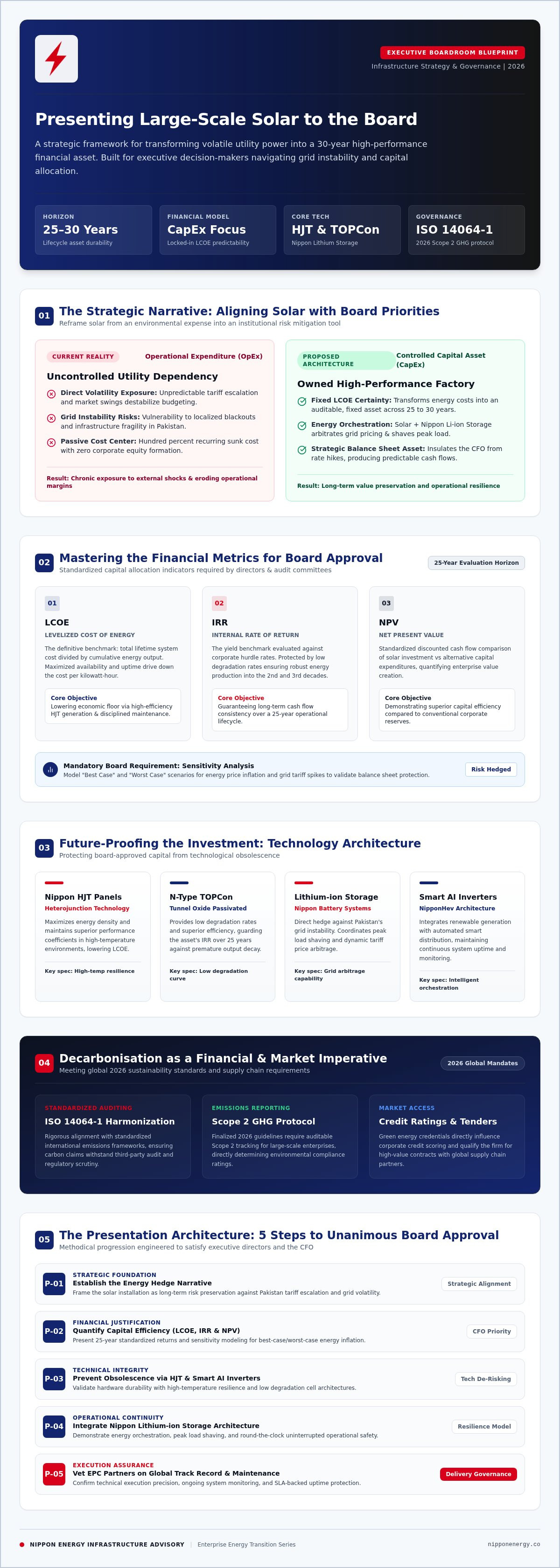
Presenting a solar project to the board requires a logical progression that mirrors an engineering blueprint. Directors don't want a generic mission statement; they want a rigorous, evidence-based argument that justifies a multi-million dollar capital allocation. The presentation should be structured to move from the macro-economic problem to the technical and financial solution, ending with a definitive plan for risk management. This structure ensures that every technical feature is directly linked to a corporate benefit, providing the clarity needed for unanimous approval.
- Slides 1-2: The Problem Space. Define the current energy volatility in Pakistan and the gap in corporate ESG compliance. Highlight the cost of inaction.
- Slides 3-5: The Technical Solution. Introduce the hardware stack, including high-efficiency panels and battery storage. Focus on how these components solve the energy deficit.
- Slides 6-8: The Financial Engine. Present the LCOE, NPV, and payback period. Use clear charts to show the transition from OpEx to a controlled asset.
- Slides 9-10: Risk Management. Detail the warranty structures, maintenance protocols, and the stability of the EPC partner.
Visualising the Data
Data visualization must be precise and accessible. Use heat maps to illustrate solar irradiance against projected energy production for your specific site. This allows the board to see the literal potential of the facility. Instead of complex technical jargon, rely on standardized metrics like the Performance Ratio (PR) and System Availability. These terms communicate reliability more effectively than raw wattage. Additionally, provide a "Carbon Payback Period" summary. This single sentence informs the board exactly when the system will have offset the carbon required for its own manufacture and installation, satisfying both financial and environmental audits.
Addressing the Top 3 Board Objections
Anticipating resistance is critical for maintaining the momentum of the presentation. Most boards will raise three primary concerns:
- Objection: "Technology is changing too fast." Answer: Heterojunction (HJT) technology is the established 2026 peak, offering the highest efficiency ceiling for the next decade.
- Objection: "Grid stability." Answer: The integration of Nippon Lithium-ion Battery Storage Systems and Smart AI Inverters ensures a firmed power supply, mitigating grid fluctuations.
- Objection: "Maintenance costs." Answer: A turnkey EPC agreement combined with automated performance monitoring minimizes human intervention and guarantees long-term system health.
Securing board approval depends on your ability to present these technical complexities as manageable business risks. If you are ready to build a bankable proposal, consult with our engineering team to develop your technical presentation.
Selecting an EPC Partner for Utility-Scale Execution
The Value of Turnkey Solutions
Fragmented vendor models often lead to performance gaps and accountability friction. Utilizing integrated solar EPC services ensures that every component, from the initial site assessment to the final grid synchronization, is managed under a single-point responsibility. This unified approach is particularly vital in complex markets like Karachi, where local grid requirements differ significantly from those in Tokyo or Riyadh. A turnkey provider possesses the technical depth to navigate these local nuances while maintaining global quality standards. It eliminates the friction between hardware suppliers and installers, guaranteeing that the projected Performance Ratio is met from day one. Single-point accountability simplifies the reporting process for executives, providing a clear line of sight into project timelines and operational benchmarks.
Ensuring 30-Year Reliability
The structural integrity of the system is the foundation of its long-term yield. Japanese engineering pedigree ensures that mounting systems and panels are designed for extreme resilience against environmental stressors. This precision prevents micro-cracking and structural degradation that can erode IRR over decades. A High-Tech Architect doesn't just build and depart. They provide continuous monitoring and lifecycle management to protect the initial capital outlay. By securing a partner that offers end-to-end development, procurement, and maintenance, the board can be confident that the asset will perform reliably until 2056 and beyond. This long-term commitment to excellence reduces the perceived risk of technology obsolescence and secures the corporation's energy future. To ensure your infrastructure meets these rigorous standards, partner with Nippon Energy for your next utility-scale project.
Securing Your Corporate Energy Future
Success in presenting a solar project to the board depends on your ability to frame energy as a high-performance financial asset rather than a utility expense. By utilizing precise metrics like LCOE and IRR, you deliver the fiscal transparency that executive leadership requires. Integrating proprietary HJT and TOPCon technology further secures the investment, ensuring the architecture remains resilient against future market shifts. This structured approach provides the clarity needed to approve a 25-year energy strategy that prioritizes long-term stability.
Reliability is guaranteed through a partner with a global EPC presence in 5+ countries and a dedicated 30-year performance monitoring framework. Our engineering pedigree provides the technical authority to mitigate risk and maximize yield across the entire lifecycle of the system. It's the right moment to empower your corporation with a future-proofed energy ecosystem that protects the bottom line for decades. Precision in planning today ensures monumental success for the next generation of your business operations.
Consult with Nippon Energy’s Project Development Team to refine your strategic proposal and secure unanimous board approval.
Frequently Asked Questions
What are the most important financial metrics for a board-level solar presentation?
Focus on Levelized Cost of Energy (LCOE), Internal Rate of Return (IRR), and Net Present Value (NPV). LCOE provides a standardized per-unit cost for comparison against utility rates. IRR demonstrates the percentage yield relative to other capital investments, while NPV calculates the total profit in today's dollars. These metrics allow directors to view solar as a high-performance financial asset. Providing a sensitivity analysis for energy inflation further strengthens your case when presenting a solar project to the board.
How do I explain solar panel degradation to non-technical board members?
Use the analogy of a high-performance engine's gradual wear. Explain that all photovoltaic systems lose a small percentage of capacity annually. However, N-type cells like Nippon HJT Solar Panels feature significantly lower degradation rates compared to legacy P-type technology. This ensures the asset produces more power in its third decade of operation, protecting the long-term IRR. Clear visuals showing the yield curve over 30 years help directors grasp the financial impact of hardware quality.
Why should a board approve lithium-ion storage alongside solar panels in 2026?
Lithium-ion storage is essential for mitigating grid instability and managing time-of-use tariff spikes in Pakistan. Co-locating Nippon Lithium-ion Battery Storage Systems allows the corporation to store excess daytime generation for use during expensive peak evening hours. This energy arbitrage significantly improves the project's Net Present Value. Storage also provides a critical buffer against power outages, ensuring operational continuity and protecting sensitive industrial equipment from sudden grid failures or load-shedding events.
How does HJT technology protect a corporate investment from becoming obsolete?
Heterojunction (HJT) technology represents the current efficiency peak for silicon-based photovoltaics. By adopting HJT now, a corporation skips the looming obsolescence of legacy PERC technology. HJT's superior temperature coefficient is particularly effective in Pakistan's climate, maintaining higher output as ambient temperatures rise. This future-proofs the investment by ensuring the hardware remains competitive with future grid-parity benchmarks, maintaining a low Levelized Cost of Energy for the full 30-year lifecycle of the infrastructure.
What is the typical payback period for a commercial solar project in 2026?
Commercial solar projects in 2026 typically see an unlevered payback period of 3 to 6 years in high-tariff regions. This duration depends on the specific load profile and the local regulatory environment in cities like Karachi or Lahore. When presenting a solar project to the board, highlight that after this brief recovery period, the facility generates virtually free electricity for the remaining 25 years. Tax adjustments and accelerated depreciation schedules can often shorten this timeline further.
How do I address concerns about solar project maintenance and long-term costs?
Address these concerns by proposing a comprehensive Solar System Maintenance and Monitoring agreement. Automated AI-driven monitoring reduces the need for manual inspections by identifying performance anomalies in real-time. This predictive approach prevents minor issues from becoming costly repairs. A turnkey EPC partner provides a single point of accountability for system health. Directors value the shift from unpredictable reactive repairs to a fixed, manageable annual operating cost that guarantees high system availability.
What role does ESG play in securing board approval for solar energy?
ESG compliance is a primary driver for approval due to tightening global reporting standards like ISO 14064-1. Decarbonizing operations through solar directly impacts Scope 2 emissions, which is critical for maintaining corporate credit ratings and international trade partnerships. Beyond environmental goals, solar infrastructure demonstrates a commitment to sustainable governance and long-term risk management. It transforms a mandatory compliance requirement into a strategic advantage that attracts institutional investors and satisfies rigorous stakeholder audits.
Can I present a solar project if my company doesn’t own the building?
You can still implement solar through Power Purchase Agreements (PPAs) or specialized roof-lease structures. These models allow a corporation to benefit from lower energy costs without the capital outlay of owning the physical asset. Alternatively, modular systems can be negotiated within long-term lease agreements. It's essential to coordinate with the property owner to ensure that the structural enhancements and grid interconnection benefit both parties while securing your firm's long-term energy price hedge.


