

In 2026, the success of a utility-scale installation is no longer determined solely by civil engineering, but by the precise management of the intelligence-hardware nexus. You recognize that as technology shifts toward high-efficiency N-type cells, the margin for error in site selection and thermal management has narrowed significantly. Developers across Pakistan often struggle with hidden hardware degradation in extreme heat or sudden O&M cost spikes that erode projected margins. Utilizing a comprehensive solar project risk assessment checklist is now a prerequisite for securing institutional financing and ensuring the structural integrity of your energy portfolio.
This technical framework provides the structured methodology needed to navigate these modern complexities. You'll gain access to a rigorous evaluation process that covers everything from HJT and TOPCon performance stability to the integration of Nippon Lithium-ion Battery Storage for grid resilience. We'll analyze how to mitigate regulatory uncertainty in the local market while aligning your project with international EPC standards. This document serves as your blueprint for proactive risk mitigation, ensuring that every kilowatt-hour generated contributes to a secure and predictable return on investment.
Key Takeaways
- Identify how the transition to N-type cells like HJT and TOPCon shifts hardware degradation risks and thermal performance requirements in high-temperature environments.
- Verify P90 irradiance data and geotechnical stability to ensure long-term structural integrity and predictable energy output for utility-scale deployments.
- Navigate Pakistan's 2026 regulatory environment by auditing PPA curtailment clauses and LCOE sensitivity to protect your project from economic volatility.
- Utilize a rigorous solar project risk assessment checklist to mitigate unforeseen O&M costs and satisfy the technical due diligence required by institutional investors.
- Implement advanced thermal management for lithium-ion storage and robust cybersecurity for AI-driven inverters to maintain operational continuity and grid stability.
The Evolving Landscape of Solar Project Risk in 2026
The risk profile of utility-scale solar has fundamentally transformed. While historical concerns focused on basic civil engineering and irradiance, 2026 demands a shift toward hardware intelligence and thermal resilience. Integrating advanced project risk management frameworks is now essential to avoid stranded assets in volatile markets. A modern solar project risk assessment checklist must prioritize N-type cell behavior under extreme ambient temperatures to ensure long-term bankability.
Technological Obsolescence and Hardware Selection
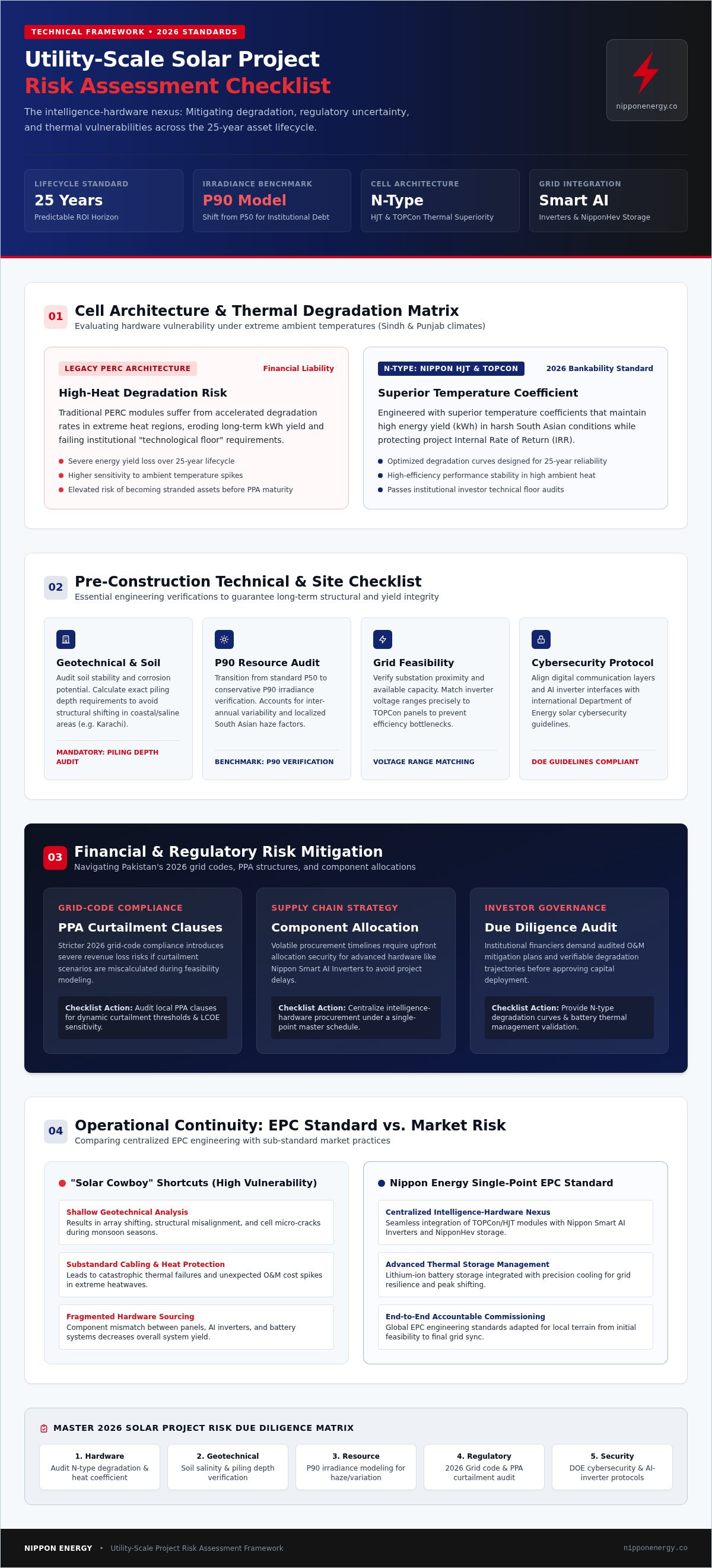
The rapid adoption of N-type architectures, specifically Nippon HJT Solar Panels and Nippon TOPCon Solar Panels, has rendered traditional PERC technology a financial liability. PERC modules suffer from higher degradation rates in high-heat regions like Sindh or Punjab, leading to significant energy yield losses over time. Nippon HJT technology utilizes a superior temperature coefficient, which translates to a higher energy yield (kWh) across a 25-year lifecycle. Choosing outdated hardware today creates a bankability crisis tomorrow; institutional investors now scrutinize the "technological floor" of projects to ensure they don't become obsolete before the power purchase agreement matures. Engineering teams must evaluate the specific degradation curves of N-type cells to protect the project's internal rate of return.
Environmental and Geopolitical Risk Factors
Regulatory shifts in South Asia and the Middle East are accelerating, with Pakistan introducing stricter grid-code compliance for utility-scale assets. Grid stability remains a critical concern, as curtailment risks can strip away a large portion of annual revenue if not modeled correctly during the feasibility stage. Your solar project risk assessment checklist must include a deep audit of the local EPC partner's technical standards. "Solar Cowboy" installers often cut corners on geotechnical analysis or cabling protection, leading to catastrophic failures during monsoon seasons or extreme heatwaves. Nippon Energy's EPC services mitigate this by applying global standards to local terrain, centralizing accountability from initial feasibility to final commissioning.
Procurement timelines in 2026 remain volatile due to global supply chain shifts. Strategic sourcing is no longer just about price; it's about securing allocation for high-efficiency components like Nippon Smart AI Inverters. A single-point EPC partner ensures that procurement delays don't derail the entire project timeline. By centralizing the intelligence-hardware nexus, developers can reduce the risk of component mismatch and ensure the NipponHev system operates at peak efficiency from day one.
Pre-Construction: Technical and Site Assessment Checklist
A robust solar project risk assessment checklist begins with the ground beneath the array. Precision in the pre-construction phase dictates the structural integrity and financial viability of the asset for its entire 25-year lifecycle. In 2026, site assessments must move beyond basic topography to include advanced geotechnical analysis. Engineers must evaluate soil stability and corrosion potential to determine exact piling depth requirements, especially in coastal or high-salinity regions like Karachi. Failure to account for these variables often leads to structural shifting, which compromises the alignment of high-precision N-type modules.
Solar resource assessment has also evolved. Relying on P50 irradiance data is no longer sufficient for institutional-grade projects; P90 verification is now the benchmark for 2026 financial modeling. This conservative approach accounts for inter-annual variability and localized haze factors common in South Asian markets. Furthermore, developers must conduct a rigorous interconnection feasibility audit. Proximity to the substation and available grid capacity are primary constraints that can derail a project if not secured early. When integrating TOPCon solar panels, it's critical to match inverter voltage ranges precisely to avoid efficiency bottlenecks. Alignment with Department of Energy solar cybersecurity guidelines ensures that the communication layers of your digitalized system are protected from the outset.
High-Efficiency Hardware Audit
The transition to N-type technology introduces specific technical risks that must be quantified. Bifacial gain potential depends heavily on the site’s albedo; a surface assessment of sand, gravel, or concrete is necessary to predict energy yield accurately. Engineers must also screen for Potential Induced Degradation (PID) and micro-crack risks, which are more pronounced in high-efficiency HJT modules during handling. Managing inverter clipping is equally vital. Sizing DC/AC ratios correctly ensures that the high current output of modern cells doesn't lead to thermal stress or lost production during peak irradiance hours.
Logistics and Procurement Security
Procurement in 2026 requires a strategic timeline that accounts for long-lead items like power transformers and Nippon Smart AI Inverters. Lead time verification is a mandatory step in any solar project risk assessment checklist to prevent costly construction delays. Quality Control (QC) protocols must extend from the factory floor to the site. This includes specialized transportation requirements for fragile, high-efficiency modules and secure on-site storage to protect high-value components from environmental damage or theft. Utilizing a single-point partner for solar EPC services ensures these logistical variables are managed under a unified accountability framework.
Financial, Regulatory, and Contractual Risk Mitigation
Securing the financial architecture of a utility-scale asset requires more than just a technical audit. It demands a rigorous solar project risk assessment checklist that accounts for 2026 macroeconomic volatility. Inflation and interest rate trends have fundamentally changed Levelized Cost of Energy (LCOE) sensitivity. Developers can't rely on static models; they must stress-test their returns against fluctuating capital costs and potential import duties in markets like Pakistan and the UAE. Proactive financial modeling ensures that the high-efficiency benefits of Nippon HJT and TOPCon technology aren't eroded by unforeseen regulatory overhead.
Power Purchase Agreement (PPA) reviews must prioritize curtailment clauses. As grids in emerging markets struggle with variable renewable energy integration, the risk of forced downtime increases. Contractual language must clearly define compensation for non-dispatch periods. Force majeure clauses also require a 2026 update to include climate-driven extreme weather events and geopolitical supply disruptions. This contractual clarity protects the investor's cash flow from events beyond their operational control.
ROI Protection and Yield Guarantees
Long-term profitability hinges on the solvency of hardware warranties and the enforcement of Performance Ratio (PR) guarantees. Precision is non-negotiable. A robust EPC contract should link payment milestones to verified output metrics. Adhering to Department of Energy solar operations and maintenance guidelines provides a standardized framework for identifying equipment failure risks before they impact the bottom line. Insurance coverage must also evolve; it's no longer enough to protect the physical asset. Modern policies should include performance-based loss of revenue protection to hedge against hardware degradation or lower-than-expected irradiance.
Permitting and Legal Clearances
The legal roadmap for utility-scale solar in Pakistan involves complex Environmental Impact Assessments (EIA) and land use rights. Zoning verification for industrial parks is a critical step in the solar project risk assessment checklist to prevent mid-construction litigation. Grid-tie approval timelines often exceed initial projections, making it vital to audit utility-side upgrade costs early. Securing these clearances isn't just a bureaucratic hurdle; it's a strategic move to ensure the NipponHev system can be commissioned without costly delays. Aligning with local content requirements also ensures eligibility for net-metering incentives and feed-in tariffs, maximizing the project's net present value.
Operational Continuity: AI and Battery Storage Risks
As solar assets move toward autonomous operation, the solar project risk assessment checklist must expand to include the digital and chemical layers of the plant. In 2026, operational continuity is no longer just about cleaning panels; it's about protecting the communication protocols of smart AI solar inverters. These devices act as the brain of the installation, making them prime targets for cyber-physical attacks. Securing these assets requires encrypted firmware updates and robust firewall configurations to prevent unauthorized grid-injection commands.
Data integrity is the foundation of remote monitoring. If sensor networks fail or reporting becomes inconsistent, the ability to detect early-stage hardware faults vanishes. This leads to a dangerous reliance on reactive maintenance, which is increasingly unsustainable given the projected 2026 labor costs in technical sectors. Transitioning to a predictive model allows for the identification of anomalies in the NipponHev system before they manifest as downtime. Precision in data acquisition ensures that long-term O&M budgets remain predictable and lean.
Managing Intelligent Energy Orchestration
AI orchestration introduces a new variable: algorithm bias. If an AI is optimized solely for short-term revenue generation, it might over-cycle the storage system, accelerating capacity fade. Developers must ensure that logic parameters prioritize long-term battery health over fleeting market spikes. Firmware update protocols are equally critical; a botched patch can cause system-wide synchronization issues. Redundancy planning for communication networks ensures that even if a local gateway fails, the plant remains under centralized control. This prevents a single point of failure from cascading into a multi-day outage.
Battery Energy Storage System (BESS) Risks
The risk of thermal runaway in lithium ion battery storage is the most significant safety concern for modern industrial deployments. High-heat environments like those found in Pakistan exacerbate this risk, demanding advanced liquid cooling and active fire suppression systems. State of Charge (SoC) accuracy is vital for cell balancing; inaccurate readings lead to uneven degradation and potential cell failure. Monitoring degradation over a 10 to 15-year horizon is essential for accurate financial forecasting and end-of-life planning. To ensure your storage assets are protected by world-class engineering, explore our Nippon Lithium-ion Battery Storage Systems designed for extreme climates.
Strategic Risk De-risking with Nippon EPC Services
Mitigating the variables identified in a solar project risk assessment checklist requires a unified execution strategy. Fragmented project delivery, where hardware procurement and site engineering are handled by separate entities, often leads to performance gaps and accountability voids. Nippon Energy eliminates these friction points through the NipponHev system. This integrated architecture ensures that every component, from N-type cells to AI-driven inverters, is engineered to operate as a singular, optimized unit. By centralizing the intelligence-hardware nexus, we provide developers with the structural certainty needed to protect long-term ROI.
Our end-to-end solar EPC services bridge the gap between Japanese engineering precision and the specific environmental demands of the Pakistan market. From the high-humidity coastal zones of Karachi to the extreme thermal loads of the interior, our systems are custom-engineered for resilience. This localized expertise is paired with comprehensive solar system maintenance and performance monitoring. We don't just commission a plant; we manage its performance lifecycle. Continuous monitoring allows us to identify degradation trends early, ensuring the project remains aligned with the technical benchmarks established during the initial feasibility phase.
The Nippon Advantage in High-Performance Solar
The core of our advantage lies in proprietary hardware integration and in-house technical support. We provide bankable performance reports that satisfy the rigorous due diligence requirements of institutional lenders and project financiers. Instead of relying on generic third-party data, we use real-time analytics from our existing utility-scale deployments to validate energy yield projections. Our O&M strategies leverage AI-driven predictive analytics to anticipate component fatigue. This proactive stance reduces unplanned downtime and ensures the superior temperature coefficients of our HJT and TOPCon modules are fully utilized throughout the year.
Next Steps: Launching Your 2026 Solar Initiative
Transitioning from a solar project risk assessment checklist to a commissioned asset begins with a comprehensive site feasibility study. This initial audit quantifies the albedo potential, grid capacity, and geotechnical stability discussed in previous sections. Integrating Nippon HJT panels allows you to achieve maximum energy density, which is critical for projects with limited land footprints or high interconnection costs. We invite you to contact Nippon Energy for a custom risk assessment consultation. Our technical team will work with you to parameterize your project's specific risks and design a turnkey solution that balances visionary ambition with grounded engineering authority.
Architecting Resilience in the 2026 Solar Landscape
The transition to N-type architectures and AI-integrated storage has fundamentally redefined the parameters of utility-scale success. Utilizing a rigorous solar project risk assessment checklist allows you to bridge the gap between visionary energy goals and grounded engineering reality. You've identified that mitigating thermal degradation in high-heat regions and modeling for regulatory volatility are essential steps for protecting the 25-year lifecycle of your investment. Precision in the pre-construction phase ensures that your infrastructure remains bankable and efficient throughout its operational life.
Nippon Energy provides the technical prowess and global scale required to navigate these complexities. Our Japanese-engineered HJT and TOPCon technology is supported by a significant project footprint across Asia and the Middle East. With comprehensive 25-year performance warranties; we offer the stability needed to secure long-term ROI in the Pakistan market. Proactive risk management is the only path to sustainable growth in this intelligent energy era.
Partner with Nippon Energy for Professional Solar EPC Services to transform these technical frameworks into high-performance operational assets. Your journey toward energy independence deserves the precision of a world-class architect.
Frequently Asked Questions
What are the most common technical risks in solar project development?
Technical risks primarily include component mismatch, rapid hardware degradation, and inefficient grid synchronization. In 2026, the complexity of integrating high-efficiency N-type modules with digitalized power electronics increases the likelihood of system bottlenecks. A comprehensive solar project risk assessment checklist identifies these vulnerabilities early. Failure to account for localized environmental stressors or poor geotechnical analysis can lead to structural shifting or electrical faults, which ultimately erodes the project's long-term energy yield and financial viability.
How do high temperatures affect solar panel risk and performance?
High ambient temperatures increase internal resistance and accelerate the degradation of photovoltaic cells. Standard PERC modules often experience significant efficiency drops in regions like Karachi or Lahore due to high temperature coefficients. Nippon HJT and TOPCon panels are engineered with superior thermal resilience, allowing them to maintain higher energy output during peak heat. Without proper thermal management and hardware selection, excessive heat leads to micro-cracks and potential induced degradation, compromising the asset's structural integrity.
What is the difference between a solar feasibility study and a risk assessment?
A solar feasibility study determines if a project is viable based on resource availability and financial modeling. In contrast, a risk assessment identifies specific technical, financial, and regulatory variables that could derail those projections. While a feasibility study provides the "go/no-go" signal, a solar project risk assessment checklist creates the mitigation roadmap. It parameterizes threats like grid curtailment or supply chain delays, ensuring that the project remains bankable throughout its entire 25-year operational lifecycle.
How can I mitigate the risk of solar panel degradation over 25 years?
Mitigation requires a combination of high-tier hardware selection and proactive system maintenance. Utilizing Nippon HJT panels is a primary strategy, as their N-type architecture offers lower annual degradation rates compared to P-type alternatives. Implementing the NipponHev system allows for real-time performance monitoring and early detection of anomalies. Regular cleaning and electrical audits prevent small faults from escalating into permanent cell damage, ensuring the installation meets its performance ratio guarantees for the full duration of the project.
Why is cybersecurity important for modern AI-managed solar inverters?
Cybersecurity is critical because modern AI-managed solar inverters function as grid-connected digital hubs. These devices manage energy orchestration and grid synchronization, making them potential targets for unauthorized access or cyber-physical attacks. Protecting the communication layer prevents malicious actors from manipulating power output or causing system-wide shutdowns. Robust encryption and regular firmware patches are essential to maintain operational continuity and protect the physical infrastructure from digital vulnerabilities that could lead to catastrophic equipment failure.
What are the regulatory risks for solar projects in Pakistan in 2026?
Regulatory risks in Pakistan center on evolving net-metering policies, import duties, and grid curtailment clauses. The 2026 landscape requires developers to account for potential shifts in feed-in tariffs and localized content requirements that may impact procurement costs. Grid instability remains a concern, making it vital to negotiate clear force majeure and non-dispatch compensation in power purchase agreements. Staying aligned with current NEPRA guidelines and provincial energy regulations is mandatory for ensuring long-term project compliance and revenue security.
How does choosing an EPC partner reduce project financial risk?
Selecting a professional EPC partner centralizes accountability and reduces the risk of costly construction delays or component mismatch. Nippon Energy provides end-to-end solar EPC services, ensuring that hardware procurement, engineering, and commissioning are handled under a single technical standard. This integration de-risks the project by providing institutional-grade performance reports and bankable warranties. By managing the intelligence-hardware nexus, an experienced partner protects the developer from unforeseen O&M spikes and ensures predictable returns on investment.
What insurance is required for utility-scale solar projects?
Utility-scale projects require a combination of physical asset protection and performance-based coverage. Standard policies cover damage from natural disasters, theft, or fire, but modern projects also benefit from business interruption insurance to hedge against revenue loss during downtime. Additionally, performance guarantees or warranty-backed insurance protect against hardware degradation that exceeds projected limits. Ensuring your insurance portfolio aligns with global EPC standards is a vital step in any solar project risk assessment checklist to satisfy institutional lenders and equity partners.


