

What if the multi-million dollar solar asset you commission today is architecturally obsolete before its first decade of service? In volatile global energy markets spanning from Tokyo, Dubai, Riyadh, and Berlin to regional hubs like Lahore and Karachi, the gap between a low-cost installation and a high-performance power plant is widening. You likely recognize that securing a stable energy future requires more than just a surface-level quote. It demands a rigorous evaluation of technical specifications and long-term reliability. The complexity of modern energy systems means that the specific questions to ask a commercial solar installer determine whether your investment yields a bankable asset or a liability prone to degradation.
This article provides the precision of a high-tech architect’s due diligence checklist to help you secure a minimized Levelized Cost of Energy (LCOE). You’ll gain the clarity needed to distinguish between HJT and TOPCon efficiency claims while ensuring 25-year performance security. We’ll preview the critical technical benchmarks, from EPC project management reliability to the structural resilience of advanced Nippon Energy solar panels in extreme heat. This comprehensive framework ensures your commercial solar transition is built on engineering excellence rather than mere marketing promises.
Key Takeaways
- Identify the critical distinctions between general contractors and specialized Solar EPC partners to ensure your project adheres to rigorous international engineering standards.
- Analyze how advanced cell architectures like HJT and TOPCon directly influence your 25-year ROI by maintaining efficiency in Pakistan's high-temperature environments.
- Equip yourself with the precise technical questions to ask a commercial solar installer to ensure supply chain transparency and prevent operational disruptions during construction.
- Decipher the fine print of performance guarantees to understand exactly which components are covered and how predictive maintenance secures your asset.
- Transition your financial evaluation from simple installation costs to a comprehensive Levelized Cost of Energy (LCOE) model that accounts for total lifecycle value.
Evaluating Credentials: Is the Installer a True EPC Partner?
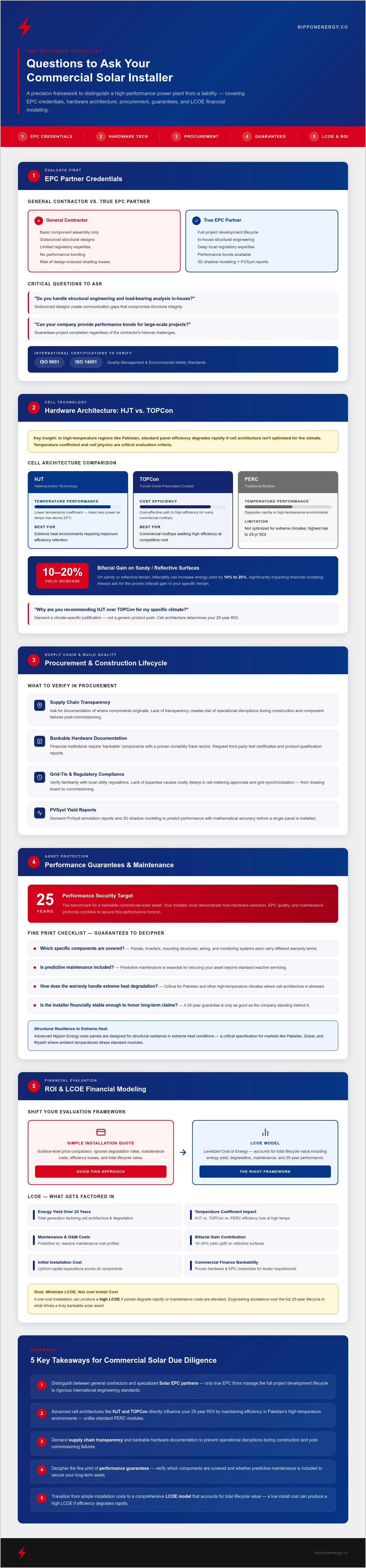
Selecting a partner for a multi-megawatt installation is a high-stakes decision that defines your facility's energy profile for decades. Many businesses fail to distinguish between a general electrical contractor and a specialized Engineering, Procurement, and Construction (EPC) firm. A true EPC partner manages the entire project development lifecycle, ensuring that technical specifications translate into actual energy yield. When formulating your questions to ask a commercial solar installer, you must verify their ability to handle complex system integration rather than just basic component assembly.
Look for international certifications such as ISO 9001 or ISO 14001, which indicate a commitment to standardized quality management and environmental safety. In your regional market, familiarity with local utility regulations and grid-tie requirements is non-negotiable. A partner without deep regulatory expertise can lead to costly delays in net metering approvals or grid synchronization. This expertise ensures your project moves from the drawing board to the commissioning phase without technical or legal friction.
Engineering and Design Capabilities
Precision begins at the design stage. You should ask: "Do you handle structural engineering and load-bearing analysis in-house?" Outsourced designs often lead to communication gaps that compromise the structural integrity of your facility. A high-tier partner provides 3D shadow modeling and PVSyst yield reports to predict performance with mathematical accuracy. This level of detail is essential for calculating a reliable levelized cost of electricity (LCOE). In-house engineering ensures that every Nippon Energy solar panel is positioned for maximum irradiance, which directly reduces the risk of design-induced shading losses.
Financial Stability and Bankability
The longevity of your solar asset depends on the installer's financial health. Ask: "Can your company provide performance bonds for large-scale projects?" This protection guarantees that the project reaches completion regardless of the contractor's internal challenges. Additionally, inquire about the bankability of their hardware. Financial institutions prioritize 'bankable' components that have a proven track record of durability. When you include these questions to ask a commercial solar installer, you filter for partners who offer more than just low prices. Utilizing solar epc services from a globally recognized leader ensures that your project meets the stringent criteria required for commercial financing and 25-year performance security.
Hardware Architecture: Questions on HJT, TOPCon, and AI
The hardware selection phase defines your project’s long-term bankability. In high-temperature regions like Pakistan, the efficiency of standard panels degrades rapidly if the architecture isn't optimized for the climate. You must focus your questions to ask a commercial solar installer on the temperature coefficient and cell physics. Technologies like Heterojunction (HJT) and Tunnel Oxide Passivated Contact (TOPCon) offer superior performance in extreme heat compared to traditional PERC modules. According to the U.S. Department of Energy Solar Energy Technologies Office, advancements in these cell architectures are critical for reaching higher efficiency limits while ensuring long-term structural resilience.
Cell Technology and Efficiency Standards
Precision in cell selection determines the 25-year ROI of your asset. Ask: "Why are you recommending HJT over TOPCon for my specific climate?" While HJT typically offers a lower temperature coefficient, meaning it loses less power as temperatures rise above 25°C, TOPCon solar panels provide a highly cost-effective path to high efficiency for many commercial rooftops. You also need to verify the bifacial gain. Ask: "What is the proven bifacial gain of these modules in our terrain?" On sandy or reflective surfaces, bifaciality can increase energy yield by 10% to 20%, significantly impacting your financial modeling.
Inverter Intelligence and Storage Integration
Modern energy architecture requires more than just DC to AC conversion. A smart ai solar inverter functions as an intelligent energy orchestrator, dynamically managing loads and grid interactions to maximize efficiency. Ask: "Does the inverter support AI-driven grid-forming and frequency regulation?" This capability is vital for industrial sites where power quality is paramount. Integrating lithium ion battery storage allows for peak-shaving, which reduces expensive demand charges from the utility. Ask: "How does the storage system interface with our existing Building Management System (BMS)?" Seamless integration ensures that your energy asset works in harmony with your operational needs. For those seeking a future-proofed installation, reviewing the technical specifications of Nippon Energy's hardware suite provides a benchmark for industrial excellence.
The Procurement and Construction Lifecycle
The construction phase represents the transition from theoretical engineering to physical reality. It's the period where your capital is most exposed to logistical and operational risks. When evaluating potential partners, your questions to ask a commercial solar installer must probe their ability to maintain project momentum without compromising on-site safety or quality standards. A robust procurement strategy ensures that high-performance components arrive on schedule and are integrated with architectural precision. Without this level of oversight, even the most advanced technology can suffer from installation errors that diminish long-term yield.
Supply Chain and Logistics Control
Supply chain transparency is the cornerstone of turnkey accountability. Ask: "Do you have a direct relationship with the hardware manufacturer?" This is critical because intermediaries often lack the leverage to resolve production bottlenecks. You should also ask: "How do you mitigate shipping delays for critical components like HJT panels?" In the 2026 market, securing priority allocation for N-type modules requires a partner with global procurement reach. Efficient logistics management prevents the idling of on-site labor, which can otherwise inflate project costs and delay your energy savings. When evaluating international supply channels or working to explore Solar Component and Hardware Distribution networks across key hubs, verifying inventory reliability is paramount. A direct line to the factory ensures that the technical integrity of the modules is maintained from the production line to the project site.
On-Site Safety and Quality Assurance
Industrial solar installations involve high-voltage DC systems that demand rigorous safety protocols. Ask: "What are your specific safety protocols for high-voltage industrial installations?" and "How many third-party inspections are performed before commissioning?" These steps verify that the build complies with international standards such as IEC and UL. The U.S. Department of Energy Solar Energy Technologies Office provides extensive guidelines on installer qualifications and safety benchmarks that high-tier EPC firms should mirror. Quality control doesn't end with installation; it continues through a structured commissioning process that includes thermal imaging of arrays and string-level performance testing to identify potential faults before they impact production.
The final stage of the lifecycle is grid synchronization. In Pakistan, this involves navigating NEPRA’s technical requirements for net metering and grid-tie approvals. Your installer should provide a clear timeline for this phase to ensure that your business begins generating a return on investment immediately after the physical build is complete. Managing these complex logistics while maintaining business-as-usual operations is the hallmark of a world-class EPC partner. It's about delivering a bankable asset with minimal disruption to your daily enterprise.
Long-Term Performance: Maintenance and Guarantees
A commercial solar project is not a one-time purchase but a 25-year energy commitment. While many providers promise long-term security, the technical reality of those guarantees often varies based on the underlying cell architecture. When refining your questions to ask a commercial solar installer, you must look beyond the marketing headlines of '25-year coverage' and interrogate the specific degradation curves of the hardware. In Pakistan's harsh environmental conditions, dust accumulation and thermal stress can accelerate equipment aging if a robust maintenance framework isn't in place from day one.
Warranty and Performance Security
Precision in warranty terms is what separates a bankable asset from a financial risk. You should ask: "Is the linear power warranty backed by a third-party insurance provider?" This ensures that your asset's performance remains insured even if the manufacturer faces market volatility. You must also ask: "What is the guaranteed maximum annual degradation rate?" HJT technology typically offers superior long-term performance security because its symmetrical structure reduces internal stress. For a high-performance system in 2026, you should expect a first-year degradation of less than 1% and subsequent annual losses significantly lower than traditional PERC modules. This technical resilience directly protects your long-term energy yield.
Operations and Maintenance (O&M) Framework
Operations and maintenance have evolved from reactive repairs to predictive intelligence. You must ask: "What is your response time for an inverter-level failure?" In a commercial setting, every hour of downtime translates into lost revenue. Modern O&M should include AI-driven performance tracking that identifies underperforming strings before they impact your bottom line. Ask: "Do you provide thermographic drone inspections as part of solar system maintenance?" These inspections use infrared technology to detect hotspots or micro-cracks that are invisible to the naked eye.
The value of AI in 2026 lies in its ability to analyze vast datasets to predict component failure before it occurs. This shift from reactive to predictive maintenance ensures that your Levelized Cost of Energy remains optimized throughout the system's lifecycle. To ensure your investment remains a high-yielding power plant, consult with the experts at Nippon Energy's maintenance solutions for a comprehensive O&M strategy that prioritizes longevity and technical excellence.
Financial Modeling: ROI and LCOE Justification
Securing corporate CAPEX approval for a large-scale solar project requires a transition from simple savings estimates to rigorous financial modeling. While basic installers focus on monthly bill reductions, a high-tech architect evaluates the total lifecycle value of the power asset. In Pakistan, where energy prices and regulatory frameworks fluctuate, your questions to ask a commercial solar installer must center on the Levelized Cost of Energy (LCOE). This metric accounts for the total cost of building and operating the system over its 25-year lifespan relative to its total energy output. High-efficiency hardware like Nippon HJT panels may involve a higher initial investment; however, their superior yield and lower degradation result in a significantly lower LCOE compared to standard modules.
LCOE and IRR Calculations
Precision in financial forecasting is essential for justifying energy architecture investments. Ask: "Can you provide a sensitivity analysis for energy price fluctuations?" This analysis demonstrates how your Internal Rate of Return (IRR) changes if utility rates rise or if local net metering policies shift. You should also ask: "How does the higher initial cost of HJT reduce the LCOE over 25 years?" High-efficiency technology produces more kilowatt-hours per square meter, which is vital for industrial facilities with limited roof or land space. By maximizing land-use efficiency, you reduce the balance-of-system (BOS) costs and improve the overall project economics. Accounting for local tax incentives and renewable energy certificates further strengthens the financial justification for high-performance builds.
Integrated Energy Solutions
A future-proofed investment looks beyond the solar array to the entire energy ecosystem. Ask: "How can the nipponhev system streamline our multi-site energy portfolio?" Integrated architectures allow for centralized management of diverse assets, ensuring consistency in performance and reporting across different geographical locations. Additionally, ask: "What is the projected ROI of adding battery storage for peak-shaving?" In Pakistan's industrial sector, demand charges often constitute a significant portion of the utility bill. Utilizing Nippon Lithium-ion Battery Storage Systems to discharge during peak hours can drastically reduce these charges, accelerating your payback period. This holistic approach ensures that your energy architecture remains resilient and adaptable as the regional grid evolves. When you pose these questions to ask a commercial solar installer, you ensure that your project is built on a foundation of technical and financial excellence.
Architecting Your Commercial Energy Independence
Securing a bankable solar asset in 2026 requires a shift from price-centric procurement to performance architecture. Validating an installer's internal engineering depth and their mastery of N-type cell technology ensures your system remains resilient against Pakistan's extreme thermal loads. By utilizing the specific questions to ask a commercial solar installer outlined in this guide, you move beyond surface-level quotes toward a mathematically sound investment that minimizes long-term LCOE. High-performance hardware combined with predictive AI monitoring transforms a simple rooftop installation into a world-class power plant.
Expertise in large-scale energy systems is the hallmark of a global leader. Partner with Nippon Energy for your next utility-scale or commercial solar project. We integrate Japanese engineering precision with a proven global EPC track record and a proprietary HJT/TOPCon technology stack to deliver unparalleled 25-year reliability. The transition to intelligent solar is a permanent shift toward operational excellence. We're ready to help you build a legacy of sustainable power and technical superiority.
Frequently Asked Questions
What is the most important certification for a commercial solar installer in 2026?
ISO 9001 and ISO 14001 certifications remain the gold standard for verifying an installer's commitment to quality management and occupational safety. In Pakistan, you must also verify their registration with the Alternative Energy Development Board (AEDB) and NEPRA. These credentials ensure the firm adheres to international engineering standards while navigating local electrical codes. High-tier installers provide these documents transparently to prove their capability in managing complex, utility-scale power projects.
How do I compare a quote for HJT panels against a cheaper TOPCon alternative?
Evaluating these technologies requires a shift from upfront CAPEX to a 25-year LCOE analysis. While Nippon TOPCon Solar Panels offer a cost-effective path to high efficiency, Nippon HJT Solar Panels provide a superior temperature coefficient for Pakistan's heat. You should compare the expected annual degradation rates and bifacial gains. HJT often yields more kilowatt-hours over the system life, which can justify its initial cost by delivering a lower cost per unit of energy.
What should be included in a Tier 1 solar O&M contract?
A comprehensive O&M contract must include predictive maintenance, AI-driven performance tracking, and guaranteed response times for inverter failures. It should also specify regular thermographic drone inspections to detect micro-cracks or hotspots. Effective Solar System Maintenance and Monitoring ensures that minor technical issues don't escalate into significant revenue losses. Look for contracts that prioritize proactive energy orchestration rather than simple reactive repairs to maintain your asset's long-term bankability.
Can a commercial solar installer help with net metering and grid applications?
A full-service EPC partner manages the entire regulatory lifecycle, including net metering and grid synchronization applications. They handle the technical documentation required by NEPRA and local distribution companies like K-Electric or LESCO. This is one of the vital questions to ask a commercial solar installer, as regulatory bottlenecks can delay your ROI. Professional installers ensure your system meets all grid-tie safety requirements to facilitate a seamless transition to clean energy production.
How long does a typical 1MW commercial solar installation take to commission?
A 1MW commercial installation typically requires three to five months for physical construction, though commissioning depends on local utility approval timelines. The engineering phase usually takes four to six weeks, followed by equipment procurement and on-site assembly. Your EPC partner should provide a detailed Gantt chart that accounts for shipping logistics and potential weather disruptions. Ensuring your installer has a direct relationship with hardware manufacturers can significantly mitigate delays for critical components.
What is the difference between a product warranty and a performance guarantee?
A product warranty covers physical defects or manufacturing flaws in the hardware, whereas a performance guarantee secures the actual energy output over time. For instance, Nippon HJT panels come with a linear power warranty that limits annual degradation. While a product warranty might last 12 to 15 years, the performance guarantee typically extends to 25 or 30 years. Understanding this distinction is essential for protecting your long-term financial modeling and energy security.
Why should I ask about an installer's internal engineering team rather than their sales team?
Internal engineering teams provide structural load-bearing analysis and precise 3D shadow modeling that sales-focused brokers cannot offer. Relying on an in-house team reduces design errors and ensures that the technical specifications of your Smart AI Inverters are perfectly matched to your load profile. This technical depth is one of the essential questions to ask a commercial solar installer to ensure your project is built on engineering excellence rather than generic marketing promises.
Is it worth adding lithium-ion storage to a commercial solar project from day one?
Integrating Nippon Lithium-ion Battery Storage Systems from day one is increasingly viable for industrial sites seeking to eliminate expensive peak-hour demand charges. Storage allows for peak-shaving and provides a critical buffer against grid instability, which is a common challenge in the South Asian market. Future-proofing your energy architecture with battery integration ensures you can maximize self-consumption and maintain operational continuity regardless of utility fluctuations or future changes in net metering policies.


