

In the unforgiving industrial corridors of Lahore and Karachi, a solar system is either a 25-year financial fortress or a liability waiting for the first 50-degree heatwave to strike. Selecting a partner based on the lowest bid often results in premature equipment failure and stranded assets. You're likely aware that the Pakistani energy market demands more than simple installation; it requires a sophisticated "Energy Architecture" that withstands extreme thermal stress and fluctuating grid conditions. Securing ironclad hardware warranties and managing NEPRA net-metering applications has become the primary challenge for commercial stakeholders entering 2026.
This guide establishes the rigorous solar epc contractor evaluation criteria pakistan requires to transform a capital expenditure into a bankable energy asset. You'll master the technical and financial metrics necessary to identify a tier-1 partner capable of delivering true energy security. We'll examine the structural advantages of HJT technology, the role of Smart AI inverters in maximizing yield, and the specific regulatory frameworks enforced by the PPIB. By the end of this analysis, you'll have the framework to ensure your project achieves seamless regulatory approval and a maximized ROI through precision engineering.
Key Takeaways
- Learn why temperature coefficients and module efficiency exceeding 22% are non-negotiable metrics for solar assets operating in Pakistan's high-heat environments.
- Identify the essential solar epc contractor evaluation criteria pakistan investors must use to distinguish between temporary installers and long-term energy partners.
- Understand how to audit an EPC’s financial health and warranty structures to ensure your energy infrastructure remains supported for its full 25-year lifecycle.
- Navigate the complexities of NEPRA net-metering and PPIB certifications to guarantee your project meets all legal and grid-connection requirements without delays.
- Discover the performance advantages of integrating HJT technology and AI-driven inverters to maximize ROI through superior energy yield and real-time monitoring.
Defining the Solar EPC Landscape in Pakistan for 2026
The industrial transition toward renewable energy in Pakistan has moved beyond basic equipment procurement. In 2026, a Tier-1 EPC (Engineering, Procurement, and Construction) contractor operates as a specialized energy architect. They don't just install hardware; they design integrated ecosystems that balance load requirements with local environmental constraints. This shift is a direct response to the rapid solar energy development in Pakistan, where high-capacity distributed generation is now the standard for commercial sustainability.
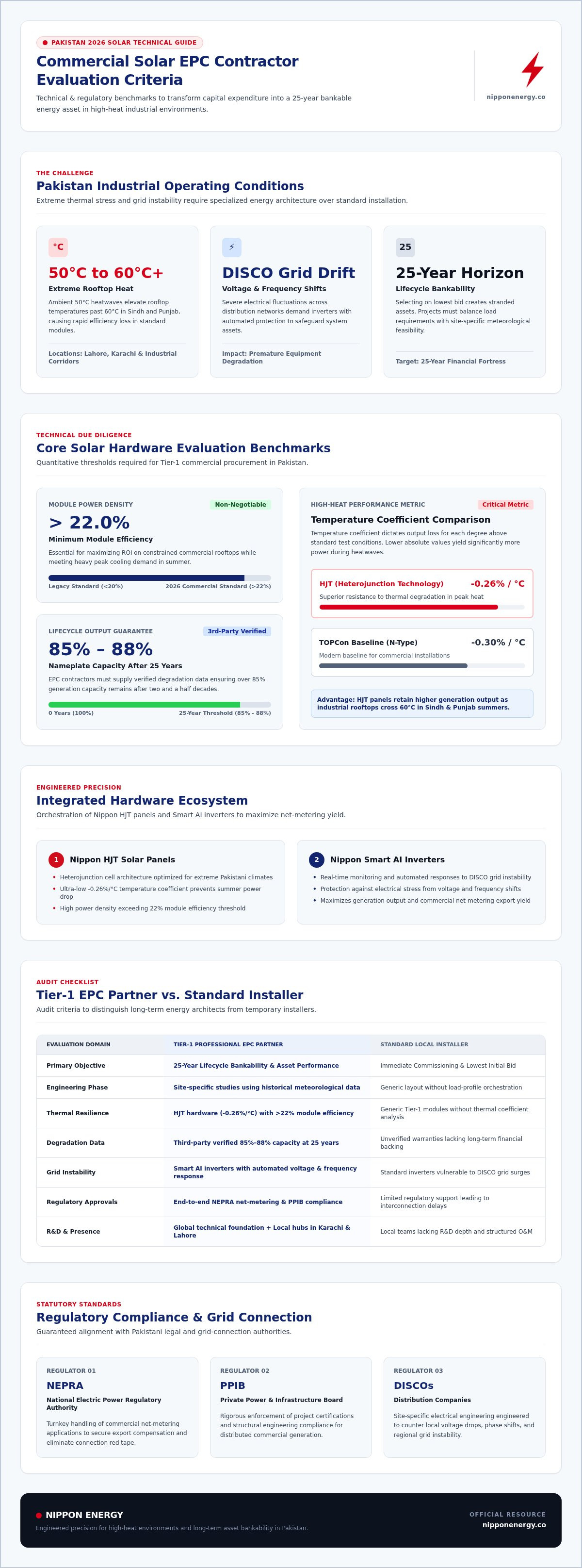
Distinguishing between a standard installer and a professional EPC firm is the first step in your solar epc contractor evaluation criteria pakistan. While installers focus on immediate commissioning, a Tier-1 partner prioritizes the system's performance over a 25-year horizon. This requires a global technical foundation combined with a physical presence in hubs like Karachi and Lahore to handle rapid operations and maintenance. Local installers often lack the R&D depth to manage complex energy architecture, whereas a global partner brings engineered precision to every project phase.
The Strategic Importance of Engineering Precision
Engineering is the most critical phase for long-term ROI. A system that isn't precisely engineered for its specific site will suffer from thermal degradation and reduced yield. Professional solar epc services involve rigorous site-specific feasibility studies. These studies use historical meteorological data to predict actual generation, ensuring that the orchestration of Nippon HJT Solar Panels and Smart AI Inverters is optimized for the facility's unique load profile. This level of precision prevents system downtime during peak summer months when cooling demands are at their highest and energy costs are most volatile.
Pakistan's Unique Climate and Grid Challenges
The "Heat Island" effect in urban centers like Lahore and Karachi presents a significant technical hurdle. Temperatures on industrial rooftops can far exceed ambient readings, causing standard modules to lose efficiency. A competent EPC must select hardware with superior temperature coefficients to maintain output. Additionally, grid stability remains a variable factor across different DISCOs. A professional contractor designs systems that account for voltage fluctuations and frequency shifts common in local grids. By integrating Nippon Smart AI Inverters, an EPC provides real-time monitoring and automated responses to grid instability. This protects the asset from electrical stress while maximizing net-metering exports and ensuring long-term bankability.
Core Technical Evaluation Criteria for Solar Hardware
Technical due diligence defines the boundary between a high-yield energy asset and a depreciating liability. In 2026, the primary solar epc contractor evaluation criteria pakistan must prioritize hardware resilience against the country's specific environmental stressors. Selecting an EPC that offers generic Tier-1 modules without analyzing the temperature coefficient or annual degradation rates is a strategic oversight. High-performance systems require hardware that maintains efficiency even when rooftop temperatures exceed 60°C during the peak summer months in Sindh and Punjab.
Efficiency benchmarks have shifted significantly. Modern standards for commercial and industrial projects now demand module efficiency exceeding 22%. This high power density is essential for maximizing the ROI of limited rooftop space. Beyond initial efficiency, the 25-year performance guarantee is a critical metric. Tier-1 hardware must demonstrate a degradation rate that ensures at least 85% to 88% of the original nameplate capacity remains after two and a half decades of operation. If an EPC cannot provide third-party verified degradation data, the long-term bankability of the project is at risk.
Panel Technology: HJT vs. TOPCon for High-Heat Yield
While topcon solar panels have become the modern baseline for commercial projects due to their N-type cell architecture, HJT (Heterojunction Technology) offers a distinct advantage in Pakistan's extreme heat. HJT panels typically feature a temperature coefficient as low as -0.26%/°C, compared to -0.30%/°C for TOPCon. A lower temperature coefficient ensures that energy harvest in Punjab remains stable even as rooftop temperatures soar during the summer peak. This technical nuance can result in a 3% to 5% higher annual energy yield in high-heat zones like Multan or Sukkur. To ensure these technical standards are met, always verify that your partner is among the PPIB and AEDB certified installers capable of handling advanced N-type deployments.
Inverter Orchestration and AI Integration
The inverter is the intelligence hub of the solar ecosystem. Evaluation must extend to smart ai solar inverter capabilities, which go beyond simple DC-to-AC conversion. These intelligent systems use machine learning to manage grid-tied fluctuations and optimize self-consumption. Real-time monitoring is no longer optional; it is a requirement for predictive maintenance. AI-driven diagnostics can identify string-level issues before they lead to system-wide downtime. For industrial stakeholders, local server data security for these monitoring platforms is a vital evaluation point to protect operational intelligence. You can consult with our technical team to review how these AI integrations stabilize energy output across volatile grid conditions.
Assessing EPC Bankability and Financial Security
Financial solvency is the bedrock of long-term energy security. When establishing solar epc contractor evaluation criteria pakistan, a rigorous audit of the firm's balance sheet is mandatory. An EPC partner must possess the fiscal strength to honor service agreements and performance guarantees for the next quarter-century. This bankability ensures that if a technical failure occurs in year fifteen, the entity responsible for the remedy still exists. For large-scale industrial projects, the inclusion of performance bonds and comprehensive insurance coverage acts as a critical safeguard against capital loss.
Supply chain resilience is another pillar of financial security. In a market where import regulations and currency fluctuations can stall project timelines, a Tier-1 EPC must demonstrate robust procurement channels. Evaluating their ability to secure Tier-1 components consistently ensures that your project isn't compromised by substandard substitutions or indefinite delays. Global firms with local inventory are better positioned to insulate your project from the volatility of the Pakistani PKR or sudden changes in customs duties.
The ROI of High-Efficiency Energy Architecture
Upfront PKR per watt is a misleading metric that often hides the true cost of ownership. Accurate ROI is calculated through the Levelized Cost of Energy (LCOE) over the system's life. Integrating the nipponhev system provides a streamlined, integrated architecture that reduces balance-of-system costs and improves payback periods. The strategic addition of lithium ion battery storage also allows for peak-shaving. This significantly enhances financial returns by avoiding high-tariff periods during grid peak hours, turning your solar installation into a dynamic financial asset rather than a static hardware setup.
Warranty Management and After-Sales Support
Differentiating between a manufacturer's hardware warranty and an EPC’s service guarantee is vital. A manufacturer's warranty is often difficult to claim without a local intermediary. A professional EPC contract must include comprehensive solar system maintenance and real-time monitoring. With a direct presence in Lahore and Karachi, Nippon Energy ensures that technical support is localized; this reduces response times from weeks to hours. This local execution capability is a non-negotiable criterion. It ensures your asset remains a high-performing financial engine rather than a maintenance burden that drains your operational budget over time.
Regulatory Compliance and Local Execution Standards
Integrating a solar asset into the national grid requires more than technical compatibility; it demands strict adherence to the legal frameworks established by NEPRA and the PPIB. A critical component of solar epc contractor evaluation criteria pakistan is the firm’s ability to navigate the specific requirements of regional DISCOs like LESCO or K-Electric. Contractors must prove a consistent track record of securing approvals without the administrative bottlenecks that often derail commercial timelines. Legal authorization through PPIB/AEDB certifications ensures the EPC is qualified to manage large-scale industrial loads while maintaining grid integrity.
Beyond paperwork, structural integrity and Health, Safety, and Environment (HSE) protocols define the physical lifespan of the project. Industrial rooftops require specialized mounting structures that meet local wind load standards, particularly in coastal zones where wind speeds fluctuate significantly. Evaluating an EPC's HSE framework is equally vital to mitigate risk during high-rise installations. These protocols protect your facility and the personnel involved, ensuring that the project meets global safety benchmarks while adhering to Pakistani labor and industrial safety laws.
Navigating the Net-Metering Application Process
The EPC manages the entire lifecycle of the net-metering application, from the initial technical drawings to the final commissioning of the green meter. Common pitfalls, such as inconsistent documentation or non-compliant single-line diagrams, can delay a project by several months. In 2026, NEPRA standards for grid-tied commercial systems require bi-directional metering that is fully compatible with advanced telemetry for real-time data exchange. A Tier-1 partner ensures these technical requirements are met before the first panel is installed. You can request a regulatory consultation to audit your facility’s readiness for high-capacity net-metering.
Local Engineering Standards and Durability
Pakistan’s climate necessitates specific engineering standards for hardware longevity. Mounting structures must utilize high-grade hot-dip galvanization to resist corrosion, especially in high-salinity coastal regions like Karachi or humid inland areas. Protection against the monsoon season and heavy dust accumulation is achieved through high Ingress Protection (IP) ratings across the system architecture. Evaluating the IP66 or IP67 ratings of inverters and junction boxes ensures that the delicate electronics remain shielded from the particulate matter and moisture levels typical of the South Asian climate. These standards prevent premature component failure and ensure the system operates at peak efficiency regardless of environmental stress.
Why Nippon Energy is Pakistan's Benchmark for Solar EPC
Nippon Energy represents the apex of the solar epc contractor evaluation criteria pakistan demands for high-stakes industrial projects. We merge Japanese-engineered precision with an granular understanding of South Asian climate dynamics to deliver systems that outperform standard market offerings. By utilizing proprietary Nippon HJT Solar Panels and Nippon Smart AI Inverters, we eliminate the technical performance gaps that often plague generic installations. Our methodology focuses on building bankable energy assets designed for a 25-year operational lifecycle, ensuring that your capital expenditure translates into permanent energy security.
Our full-cycle project management architecture oversees every detail from the initial feasibility study to 24/7 remote monitoring. We take total responsibility for the energy orchestration of your facility. This vertical integration means that every component, from the cell technology to the AI-driven diagnostics, is optimized for peak efficiency. This level of technical oversight provides a degree of reliability that fragmented third-party installers simply cannot match. We don't just install panels; we architect high-performance power plants.
Proven Industrial Expertise in Lahore and Karachi
Maintaining a direct presence in Lahore and Karachi allows our engineering teams to provide rapid operations and maintenance support. We've enabled numerous manufacturing units to achieve energy independence by deploying systems specifically hardened against the extreme thermal stress of Punjab and Sindh. Because we provide direct access to our proprietary hardware, including Nippon TOPCon Solar Panels, our clients are insulated from third-party supply chain risks. This direct-to-manufacturer relationship protects your investment from the volatility of international procurement and ensures consistent component quality across the entire system.
Partnering for a Sustainable Energy Future
Rising electricity tariffs and grid instability have made energy security a strategic necessity for Pakistani businesses. Nippon Energy future-proofs your operations by delivering high-efficiency systems that provide predictable, low-cost power for decades. Our engineering teams in Lahore and Karachi are equipped to conduct comprehensive, site-specific feasibility studies to determine your facility's optimal energy configuration. We prioritize structural integrity and technical excellence to ensure your transition to renewable energy is both seamless and permanent. It's time to secure your industrial future with a partner that values precision as much as you do.
Evaluate your project with Nippon Energy's EPC experts
Secure Your Energy Architecture for 2026 and Beyond
Selecting the right solar partner is no longer about simple procurement; it's about the long-term precision of your energy architecture. By applying rigorous solar epc contractor evaluation criteria pakistan, industrial leaders can bypass the risks of premature equipment failure and regulatory delays. You've learned that 2026 standards demand hardware capable of withstanding extreme thermal stress and a partner with the financial depth to support a 25-year lifecycle.
Nippon Energy bridges this gap through Japanese engineering precision and proprietary HJT high-heat technology. Our local support teams in Lahore and Karachi ensure your system remains a high-performing asset regardless of grid or climate conditions. Transitioning to a sustainable energy model requires a partner who treats your technical security as a structural priority. It's time to transform your facility into a bankable power plant that drives permanent ROI.
Schedule a Technical Consultation for Your Industrial Solar Project
We look forward to powering your long-term industrial growth with excellence.
Frequently Asked Questions
What are the most important certifications for a solar EPC in Pakistan?
PPIB and AEDB certifications are the primary legal requirements for executing large-scale projects in the local market. These certifications, categorized from C-1 to C-3, determine the maximum capacity an EPC can legally install. You must also ensure the firm adheres to NEPRA's technical standards for grid-tied systems. Verifying these credentials is a baseline for any solar epc contractor evaluation criteria pakistan to ensure the legality and safety of your industrial energy infrastructure.
How do I verify the bankability of a solar EPC contractor?
To verify bankability, you must audit the contractor’s financial solvency and their ability to honor 25-year performance guarantees. Look for firms that provide performance bonds and comprehensive project insurance. A bankable EPC partner demonstrates a stable balance sheet and direct relationships with tier-1 manufacturers. This financial strength ensures that your energy asset remains supported and operational throughout its entire lifecycle without the risk of the provider becoming insolvent.
What is the difference between an installer and an EPC company in the local market?
A standard installer focuses on the physical mounting of panels, while an EPC company provides a comprehensive "Engineering, Procurement, and Construction" framework. This includes site-specific feasibility studies, procurement of proprietary hardware like Nippon HJT panels, and adherence to global HSE standards. EPC firms act as energy architects who manage the entire project lifecycle. They prioritize long-term energy orchestration and system bankability rather than just immediate commissioning or low-cost hardware assembly.
Can a solar EPC help with the NEPRA net-metering application?
A professional solar EPC manages the entire NEPRA net-metering application process from technical drawings to final green-meter installation. They handle the complex documentation required by local DISCOs such as LESCO or K-Electric. This end-to-end service prevents common regulatory pitfalls and administrative delays. By managing the bi-directional metering requirements and grid-connection studies, the EPC ensures your system begins exporting excess energy to the national grid as quickly as possible.
Why should I prioritize HJT panels for industrial solar projects in Pakistan?
Industrial projects in Pakistan should prioritize Nippon HJT Solar Panels because of their superior temperature coefficient of -0.26%/°C. Standard panels lose significant efficiency when ambient temperatures exceed 40°C in regions like Sindh and Punjab. HJT technology maintains higher output during peak summer months and offers better bifaciality. This results in a higher annual energy yield and a faster ROI compared to traditional P-type or basic N-type module architectures.
How much does the engineering phase affect the long-term ROI of a solar farm?
The engineering phase is the most influential factor in determining long-term ROI. Precise site-specific design prevents thermal degradation and minimizes system downtime caused by grid instability. Engineering precision involves analyzing historical meteorological data and electrical load profiles to optimize the placement of Nippon TOPCon Solar Panels. A well-engineered system reduces the Levelized Cost of Energy (LCOE) by ensuring the hardware operates at its maximum theoretical efficiency for 25 years.
What should be included in a Tier-1 solar EPC warranty agreement?
A Tier-1 warranty agreement must distinguish between the 25-year hardware performance guarantee and the EPC’s workmanship warranty. It should include clear service-level agreements (SLAs) for maintenance and repair response times. Ensure the contract covers the replacement of Smart AI Inverters and provides string-level monitoring data. Reliable agreements are backed by local support teams who can execute on-site repairs without the delays associated with international hardware claims or third-party intermediaries.
How does Nippon Energy handle O&M for projects in Karachi and Lahore?
Nippon Energy maintains a direct technical presence in Lahore and Karachi to provide rapid operations and maintenance (O&M). We utilize Nippon Smart AI Inverters for 24/7 remote monitoring, which allows our engineering teams to detect and diagnose performance anomalies in real time. This proactive approach minimizes downtime and ensures your solar asset remains at peak performance. Our local teams are equipped to handle on-site technical support, ensuring rapid resolution of any hardware or grid-related issues.


