

In 2026, the volume of solar hardware your facility hosts is less important than the intelligence of the system managing it. For industrial leaders, the commercial solar net metering policy pakistan has evolved into a precision instrument that rewards efficiency over raw capacity. You've likely recognized that traditional energy models no longer provide the stability required for long-term operational planning, especially as buy-back rates and NEPRA licensing requirements become increasingly technical. It's a complex environment where regulatory shifts can either erode your margins or solidify your energy independence.
We'll provide the roadmap to navigate these 2026 regulations, focusing on maximizing your industrial energy ROI through advanced engineering. You'll learn how high-efficiency HJT modules and Smart AI inverters mitigate grid instability while ensuring compliance with the latest export protocols. This guide breaks down the transition from basic installation to a sophisticated energy architecture, offering a clear path toward lower operational expenses and permanent technical resilience in a volatile market. By aligning your infrastructure with the new regulatory standards, you can transform energy from a variable cost into a strategic asset.
Key Takeaways
- Analyze the structural shifts in the commercial solar net metering policy pakistan to align your industrial energy architecture with 2026 NEPRA and PPIB mandates.
- Identify the technical eligibility criteria, including sanctioned load and three-phase connection specifications, required to navigate the DISCO licensing process efficiently.
- Evaluate the ROI advantages of high-efficiency HJT technology in Pakistan's high-heat zones, where superior thermal coefficients drive faster capital recovery.
- Implement a methodical 5-step framework for dossier preparation and feasibility studies to ensure seamless regulatory approval and grid-tie optimization.
- Future-proof your operations by integrating lithium-ion battery storage and hybrid configurations to mitigate the risks of evolving net billing frameworks.
The 2026 Landscape of Commercial Net Metering in Pakistan
The commercial solar net metering policy pakistan operates as a technical framework established by the National Electric Power Regulatory Authority (NEPRA). It enables industrial and commercial consumers to offset their energy consumption by exporting surplus solar generation back to the national grid. By 2026, this policy has transitioned from a simple billing arrangement into a sophisticated mechanism for grid management. The Private Power & Infrastructure Board (PPIB) now plays a more centralized role, acting as the primary facilitator for large-scale distributed generation projects to ensure they align with national energy security goals.
The primary objective of the current framework is the mitigation of industrial 'Circular Debt', which has historically hampered Pakistan's energy sector. Unlike the initial 2015 regulations or the 2021 amendments, the 2026 landscape demands higher technical standards for export. It prioritizes system reliability over mere capacity expansion. This evolution means that businesses can't rely on substandard hardware; instead, success requires high-performance components that meet stringent grid-tie requirements.
The Role of NEPRA and Distribution Companies (DISCOs)
NEPRA serves as the supreme regulatory body, issuing the Distributed Generation License that forms the legal foundation for every net metering installation. While NEPRA sets the national standards, the actual execution and grid connection are managed by local Distribution Companies (DISCOs) such as LESCO, K-Electric, or FESCO. This relationship is critical. The DISCO evaluates the local transformer capacity and grid stability before granting technical approval. In 2026, these entities have implemented more rigorous testing protocols to ensure that commercial exports don't destabilize the local distribution network, making professional EPC partnership essential for licensing success.
Current Policy Drivers for Industrial Solar Adoption
The acceleration of solar adoption is driven by a steady increase in grid tariffs, which has fundamentally altered the payback period for industrial investments. The Alternative and Renewable Energy (ARE) Policy 2019 continues to influence the 2026 market by setting ambitious targets for renewable integration. Government initiatives now focus on 'Clean & Green Energy' to reduce reliance on imported fossil fuels. For a commercial entity, shifting to solar isn't just an environmental choice; it's a defensive strategy against rising operational costs. High-efficiency systems, particularly those utilizing HJT technology, are becoming the standard for businesses looking to maximize their energy ROI under these evolving regulations.
Technical Eligibility and Commercial Licensing Requirements
To qualify under the commercial solar net metering policy pakistan, a facility must first meet specific infrastructure benchmarks. The primary prerequisite is a valid three-phase connection. Most commercial and industrial entities already possess this, but the sanctioned load on the existing electricity bill determines the maximum allowable solar capacity. Generally, NEPRA regulations dictate that your solar installation cannot exceed 100% of your sanctioned load. This cap ensures that the local distribution transformer maintains stability during peak export periods without risking thermal overload.
Hardware standards are equally rigorous. Regulatory bodies now mandate Tier 1 hardware for all commercial export projects. This isn't merely a quality preference; it's a safety requirement. Systems must demonstrate high resilience against voltage fluctuations and maintain a power factor within the 0.9 lagging to 0.9 leading range. If your equipment fails to meet these technical specifications, the local DISCO will likely reject the net meter installation during the final inspection phase.
NEPRA Licensing: The Distributed Generation Permit
Securing a Distributed Generation License from NEPRA is the legal cornerstone of your project. These licenses typically carry a legal lifespan of 7 years, after which they require renewal based on the prevailing regulations at that time. The application process involves the submission of a comprehensive technical dossier. This package must include detailed site maps, single-line electrical wiring diagrams, and equipment certifications. Because the bureaucracy involves multiple stakeholders, leveraging professional solar EPC services is essential to ensure that documentation aligns with current engineering standards. Consulting with a specialist in industrial energy architecture can clarify your specific capacity limits before you commit to hardware procurement.
Hardware Compliance: Inverters and Protection Devices
Grid synchronization requires specialized protection mechanisms to prevent "islanding," a dangerous scenario where a solar system continues to feed power into a dead grid. Modern regulations require inverters to have built-in anti-islanding protection that disconnects the system within milliseconds of a grid failure. Smart AI Solar Inverters are increasingly favored in 2026 because they manage these transitions autonomously while minimizing total harmonic distortion (THD). Keeping THD below 3% is vital for maintaining the longevity of both your internal machinery and the utility's infrastructure. These intelligent systems also allow for remote monitoring, which is often a requirement for large-scale commercial licenses to ensure transparent energy accounting.
Maximizing ROI: Efficiency as the Primary Value Driver
The profitability of a solar investment under the commercial solar net metering policy pakistan is no longer a matter of simple installation; it's a calculation of technical yield over time. As 2026 buy-back rates emphasize the value of every exported kilowatt-hour, industrial operators must prioritize hardware that maintains peak performance under stress. Standard panels often suffer from significant efficiency drops as ambient temperatures rise, directly extending the capital recovery period. High-efficiency panels lower the Levelized Cost of Energy (LCOE) by maximizing total kilowatt-hour yield over the system's operational lifespan relative to the initial capital expenditure.
Degradation rates represent a silent threat to long-term revenue. While conventional P-type modules may lose efficiency rapidly, N-type architectures provide superior stability. This durability ensures that the units exported in year ten remain consistent with year one projections, protecting the financial integrity of the net metering agreement against inflationary pressures. Choosing hardware with a low annual degradation rate is a prerequisite for any business aiming for a sub-four-year payback period in the current regulatory environment.
Nippon HJT vs. TOPCon: Selecting the Right Architecture
Choosing between HJT and TOPCon requires an analysis of your facility's specific environmental conditions. Nippon HJT solar panels feature a superior thermal coefficient, making them the optimal choice for the extreme summers of Sindh and Punjab where panel temperatures frequently exceed 65°C. This architecture ensures minimal power loss during peak midday production hours. Conversely, TOPCon Solar Panels offer an excellent cost-performance balance for regions with more moderate temperature profiles. Both technologies utilize bifacial gain, capturing reflected light from industrial rooftops to increase total energy harvest by up to 25% depending on the surface albedo.
Smart AI Management and Export Optimization
Modern energy architecture relies on intelligent orchestration to maximize fiscal returns. Nippon Smart AI Inverters analyze real-time grid conditions to time exports during periods of maximum production efficiency. This automation ensures that your system doesn't just generate power but manages it as a strategic commodity. Monitoring performance through AI-driven analytics allows for the early detection of string-level anomalies. Under a commercial net metering agreement, even 48 hours of system downtime can result in a measurable loss of export credits, making proactive maintenance and real-time monitoring a fundamental requirement for ROI protection. Reliability is the bridge between technical capability and financial success.
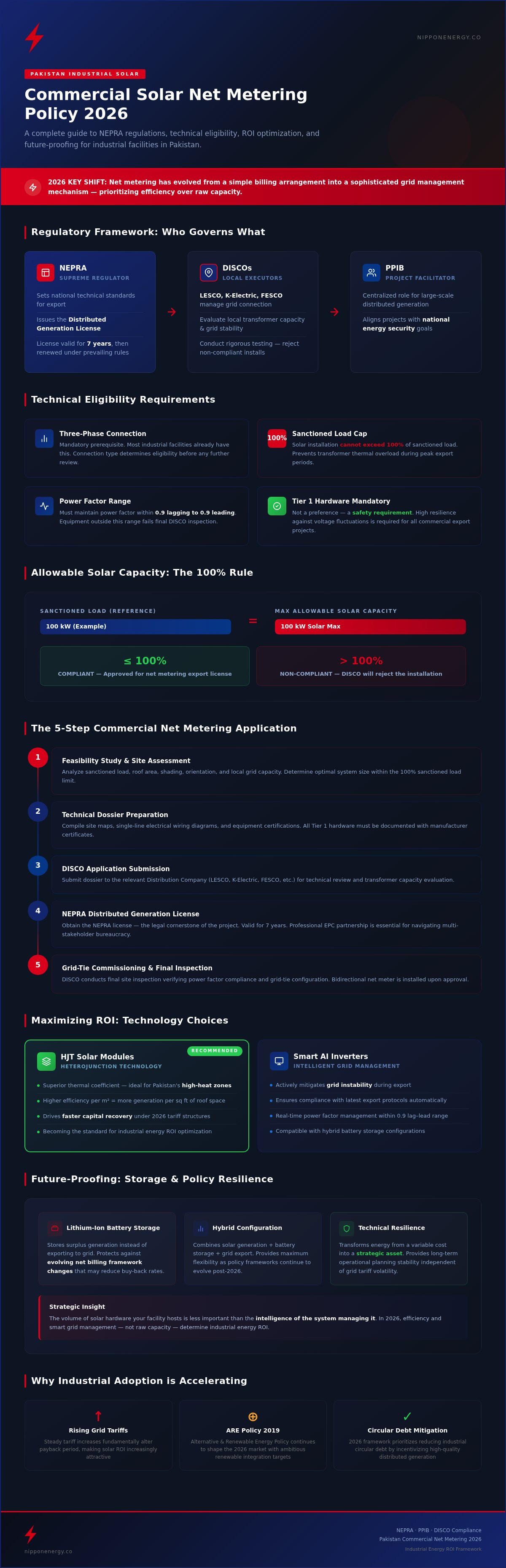
The 5-Step Commercial Net Metering Application Process
Adhering to the commercial solar net metering policy pakistan requires a disciplined approach to documentation and engineering. The application journey is a methodical sequence designed to ensure that your industrial power plant integrates safely with the national grid. This process typically spans several weeks, moving from initial technical audits to the final activation of the bi-directional billing system. Success depends on the precision of your engineering dossier and the responsiveness of the local utility provider.
The standard workflow for commercial entities follows these five critical stages:
- Preparation: Development of the technical dossier and a comprehensive feasibility study.
- Submission: Filing the application with the relevant DISCO (such as LESCO, K-Electric, or MEPCO).
- Inspection: Technical verification of hardware safety and 'Green Meter' installation.
- Licensing: Issuance of the Distributed Generation License by NEPRA and signing the formal agreement.
- Commissioning: Final system testing and activation of the net export functionality.
Phase 1: Feasibility and Technical Design
The technical dossier serves as the foundational document for your permit. Engineers conduct a detailed load analysis of the commercial facility to ensure the proposed solar capacity aligns with the existing sanctioned load and physical rooftop constraints. This phase concludes with obtaining the 'No Objection Certificate' (NOC) from the DISCO. This certificate confirms that the local distribution infrastructure can handle the projected energy export without compromising grid stability. To accelerate your project timeline, partner with a team that understands the nuances of commercial solar project development.
Phase 2: Inspection and Interconnection
Once the system is installed, the DISCO inspection team visits the site to verify hardware safety and compliance with NEPRA standards. They focus specifically on the functionality of anti-islanding protection and the quality of the earthing system. Following a successful audit, the utility installs the bi-directional 'Green Meter', which tracks both imported and exported energy units. During this phase, inspectors also verify that solar system maintenance protocols are in place to ensure long-term grid synchronization. The final step is the formal commissioning, where the system begins offsetting operational costs by feeding surplus energy back to the national grid.
Future-Proofing: Storage and Policy Resilience
In 2026, the industrial energy sector in Pakistan is witnessing a fundamental shift toward 'Hybrid' commercial systems. While the commercial solar net metering policy pakistan remains a powerful tool for credit accumulation, forward-thinking enterprises are now prioritizing self-consumption through advanced storage. This strategy serves as a critical hedge against potential regulatory transitions from net metering to net billing frameworks. By integrating Lithium-Ion Battery Storage, businesses can capture surplus daytime generation to power heavy night-time industrial loads, effectively decoupling their operations from volatile grid tariffs.
Total energy orchestration is now achievable through the NipponHev System. This integrated architecture synchronizes solar generation, battery reserves, and grid interaction into a single, intelligent stream. It's no longer enough to just export power; you must manage the flow to ensure the highest possible financial yield. This level of technical sophistication transforms a standard solar installation into a resilient power plant capable of navigating any policy environment that NEPRA or the PPIB might implement in the coming decade.
Transitioning from Net Metering to Energy Independence
Storage integration allows industrial facilities to bypass high peak-hour grid charges by discharging stored energy when utility rates are at their maximum. There is a profound technical synergy between Nippon HJT panels and lithium-ion storage; the high-yield consistency of HJT ensures that batteries are fully charged even during hazy or overcast conditions. This setup doesn't just improve ROI; it ensures business continuity. During grid outages or scheduled load shedding, a hybrid system maintains critical machinery operations, preventing the massive financial losses associated with production downtime. It's a shift from being a grid-dependent exporter to becoming an energy-independent entity.
Strategic Partnership with Nippon Energy
Establishing a high-performance energy infrastructure requires a partner that understands both the bureaucracy and the technology. Nippon Energy provides end-to-end EPC services, managing everything from the initial NEPRA licensing application to the final commissioning of the system. Our performance architecture is designed for the long term, incorporating continuous monitoring to ensure your industrial assets operate at peak efficiency. We handle the technical complexities so you can focus on your core business operations. The first step toward securing your facility's energy future is a comprehensive technical audit. Requesting a commercial solar feasibility study allows our engineers to design a system that maximizes your specific sanctioned load and rooftop potential.
Architecting Your Industrial Energy Independence
The commercial solar net metering policy pakistan has evolved into a rigorous technical standard that demands engineering precision and strategic foresight. Success in this landscape requires more than basic hardware; it necessitates a calculated alignment with NEPRA licensing protocols and the deployment of resilient, high-performance systems. By prioritizing HJT and TOPCon technology, you don't just offset utility costs. You secure a predictable energy ROI that remains stable despite the region's extreme thermal challenges.
Integrating lithium-ion storage and hybrid architectures provides the ultimate hedge against future regulatory shifts. It's the strategic difference between a grid-dependent facility and a future-proofed industrial power plant. Our team combines Japanese engineering excellence with comprehensive NEPRA licensing support to ensure your transition is both seamless and technically superior. Establishing a robust energy foundation today protects your margins for the next decade.
Secure Your Commercial Solar Future with Nippon Energy's EPC Services and leverage specialized HJT and TOPCon high-efficiency hardware to transform your operational efficiency. It's time to take command of your facility's energy destiny.
Frequently Asked Questions
What is the maximum solar capacity allowed for a commercial net metering license in Pakistan?
The maximum solar capacity for a commercial license is strictly capped at 100% of the facility's sanctioned load. This regulation ensures that the energy fed back into the grid doesn't exceed the infrastructure's design limits. For instance, if your industrial sanctioned load is 200kW, your solar installation cannot exceed this threshold. This alignment is critical for maintaining transformer stability and ensuring compliance with the commercial solar net metering policy pakistan.
How long does the NEPRA net metering application process take for businesses?
The NEPRA application process typically spans between 4 to 8 weeks. This timeline includes the initial feasibility study, the issuance of a 'No Objection Certificate' (NOC) by the local DISCO, and the final technical inspection. Delays often occur if documentation is incomplete or if the hardware doesn't meet safety standards. Professional EPC management significantly accelerates this journey by ensuring all technical dossiers are architecturally sound from the first submission.
Can I export more electricity than my sanctioned load under the 2026 policy?
You cannot export more electricity than your sanctioned load under the 2026 framework. The system is designed to synchronize with the existing utility connection; exceeding the sanctioned load would require a formal load enhancement application. This technical constraint prevents grid destabilization. If your production potential exceeds your sanctioned load, integrating lithium-ion storage allows you to capture that excess energy rather than losing it to grid-tie limitations.
What happens to my net metering credits if the buy-back rate changes?
Net metering credits are settled according to the buy-back rates notified by NEPRA at the time of the billing cycle. If the regulator adjusts the distributed generation tariff, the value of your exported units will reflect those changes in subsequent bills. These rates are subject to periodic review based on national energy requirements. High-efficiency systems maximize the volume of exported units to maintain ROI despite rate fluctuations and policy shifts.
Is it mandatory to use Tier 1 solar panels for net metering approval?
Utilizing Tier 1 solar panels is a non-negotiable requirement for obtaining net metering approval from any DISCO in Pakistan. Regulatory bodies mandate hardware that carries specific international certifications, such as IEC 61215, to ensure long-term grid safety. Substandard equipment poses a risk of electrical feedback and grid instability. Using high-efficiency HJT or TOPCon modules ensures your system meets these rigorous technical benchmarks while providing superior performance in high-heat industrial zones.
How does the 'Green Meter' differ from a standard commercial electricity meter?
A 'Green Meter' is a bi-directional device that records two distinct streams of data: energy imported from the grid and surplus energy exported to the grid. In contrast, standard commercial meters only track consumption. The net difference between these two readings determines your final monthly bill. This specialized hardware is installed by the DISCO only after your solar system passes a final safety inspection and the NEPRA license is officially issued.
Can I integrate battery storage with an existing net metering system?
You can integrate battery storage with an existing net metering system by utilizing a hybrid energy architecture. This setup requires a hybrid-compatible inverter, such as a Smart AI Inverter, to manage the flow between the panels, batteries, and the utility grid. Adding lithium-ion storage allows you to discharge energy during peak hours when grid rates are highest. This integration is a key component of the commercial solar net metering policy pakistan strategy for energy independence.
Which DISCOs in Pakistan currently support commercial net metering?
All major Distribution Companies (DISCOs) in Pakistan support commercial net metering, including LESCO in Lahore, K-Electric in Karachi, IESCO in Islamabad, and MEPCO in Multan. Each entity follows the centralized NEPRA framework but may have localized procedures for technical inspections and meter installations. Regardless of the provider, the facility must have a valid three-phase connection and meet all equipment standards to qualify for a distributed generation license.


