

In 2026, a solar inverter is no longer a simple converter; it's a grid-stabilizing asset that dictates the bankability of your entire energy infrastructure. For commercial operators in Pakistan, the era of passive energy generation has ended. You've likely experienced the frustration of system trips during frequency fluctuations or the complexity of integrating a solar inverter with grid management features into a volatile local network. These challenges aren't just technical hurdles. They're direct threats to your operational uptime and long-term ROI.
This guide provides the technical blueprint you need to master energy orchestration for utility-scale stability and project longevity. We'll examine how to achieve full compliance with IEEE 1547 and UL 1741 standards while significantly reducing operational downtime. You'll learn how intelligent grid support services can transform your system from a cost center into a revenue-generating asset through Virtual Power Plant integration and ancillary service participation. By the end of this analysis, you'll understand the architecture required to future-proof your assets against a rapidly evolving energy landscape.
Key Takeaways
- Discover how the shift from passive energy injection to active grid orchestration prevents system curtailment and ensures compliance with 2026 utility standards.
- Identify the critical technical specifications of a solar inverter with grid management features, focusing on active and reactive power control to stabilize volatile local networks.
- Analyze the performance gap between active and passive inverters to eliminate unnecessary system trips and protect your commercial ROI.
- Master the implementation of smart inverters by aligning communication protocols with SCADA systems to enable participation in Virtual Power Plants.
- Explore how AI-driven real-time balancing reduces grid stress and future-proofs utility-scale projects against evolving regulatory requirements in Pakistan.
The Evolution of Grid Stability: Why Management Features Matter in 2026
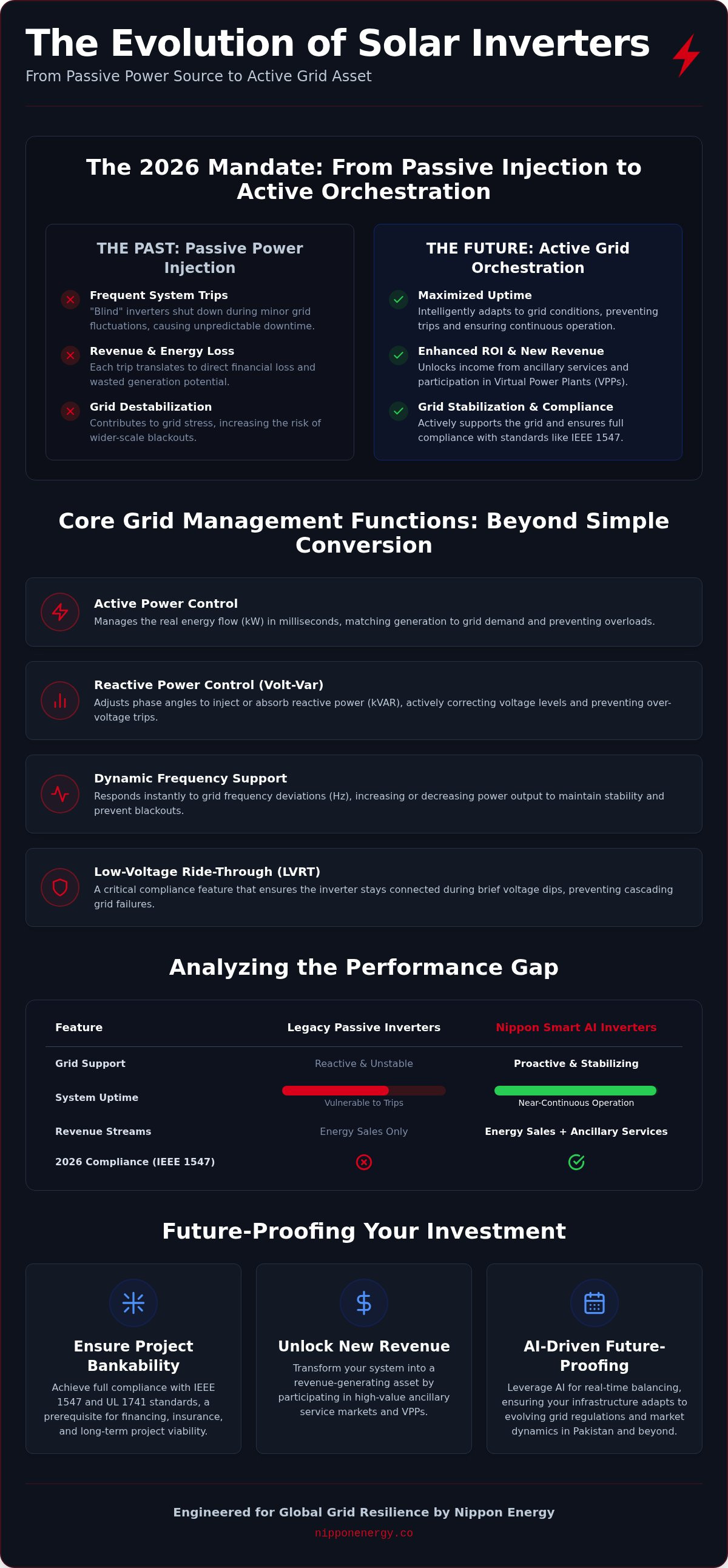
The global energy transition has reached a critical inflection point. In 2026, the sheer volume of decentralized energy resources (DERs) means the grid can no longer treat solar systems as simple, passive power injectors. Modern utility-scale projects in Pakistan face a volatile electrical environment where traditional infrastructure often struggles to maintain equilibrium. This shift necessitates a move from passive energy injection to active grid participation. A solar inverter with grid management features is now the primary tool for maintaining this balance, providing the intelligence required to modulate voltage, frequency, and power flow in real-time.
The economic cost of utilizing "blind" inverters has become unsustainable. Without the ability to sense and respond to grid stress, basic units often trip offline during minor fluctuations, leading to significant revenue loss and system curtailment. In modern volatile energy markets, inverters must behave like traditional spinning reserves, offering the same level of inertia and stability as large-scale thermal plants.
From Conversion to Orchestration
A decade ago, a standard grid-tie inverter functioned as a simple unidirectional bridge. It converted DC to AC and pushed it out until the grid failed. Today, that's insufficient. Modern systems require orchestration. As DERs proliferate across Pakistan's industrial sectors, the inverter must serve as the system's digital brain. It manages the complex interaction between onsite generation, Nippon Lithium-ion Battery Storage Systems, and the utility provider. This intelligence at the edge prevents unnecessary shutdowns by making granular adjustments to power output before a fault occurs.
Regulatory Drivers for Intelligent Hardware
Compliance is the foundation of project bankability in 2026. Global standards, specifically the updated IEEE 1547 and revised local grid codes, mandate that a solar inverter with grid management features must include Low-Voltage Ride-Through (LVRT) capabilities. This technical requirement ensures the system stays connected during brief voltage dips, preventing a localized fault from cascading into a regional blackout. Securing these capabilities directly impacts the financial viability of a project, as they're now essential for obtaining insurance and ensuring the long-term structural integrity of the national energy supply.
Core Grid Management Functions: Beyond Simple Conversion
A solar inverter with grid management features acts as a dynamic stabilizer within the local distribution network. Unlike legacy units that merely push energy, these systems utilize active and reactive power control to maintain equilibrium on the feeder. Active power modulation manages the real energy flow, while reactive power control, often referred to as Volt-Var control, adjusts phase angles to correct voltage levels. This dual-layered approach is critical in Pakistan, where grid impedance varies wildly and over-voltage trips frequently disrupt commercial production.
Modern hardware provides frequency support by adjusting power output in milliseconds. When grid frequency drops due to high demand, the inverter increases its contribution; when it rises, the system throttles back. This rapid adjustment mitigates fluctuations that would otherwise lead to localized blackouts. These innovations in grid planning allow solar assets to function as reliable, predictable components of the national infrastructure. Dynamic grid support ensures the system responds to transient events in milliseconds, protecting both the onsite equipment and the wider utility network.
Ancillary Services and Revenue Generation
Beyond energy production, intelligent inverters unlock secondary income through ancillary services. These services include frequency regulation and voltage support, which utilities increasingly compensate to maintain stability. Ancillary services are the secondary revenue stream for modern solar plants. By participating in frequency response markets, operators can enhance their commercial ROI beyond standard energy arbitrage. Integrating Nippon Smart AI Inverters ensures your hardware possesses the sub-second response times required for these high-value contracts.
Grid-Forming vs. Grid-Following Technology
The technical distinction between these two modes defines the resilience of your energy architecture. Most standard inverters are grid-following; they require an existing voltage reference from the utility to synchronize their output. If the grid fails, they shut down. In contrast, grid-forming technology allows the inverter to create its own voltage and frequency reference. This creates a stable internal network that doesn't rely on the utility for synchronization.
Grid-forming capabilities are essential for microgrids and remote industrial sites in Pakistan where utility signals are weak or non-existent. Nippon Energy prioritizes black-start capabilities, allowing systems to restart independently after a total outage. This architectural choice ensures that critical operations remain powered even when the primary utility is compromised, providing a level of autonomy that grid-following systems cannot match.
Active vs. Passive Inverters: Analyzing the Performance Gap
The structural integrity of a utility-scale power plant depends on its ability to withstand external volatility without collapsing into a state of inactivity. Passive inverters represent a legacy risk in the 2026 energy market. These units operate on binary logic; they either inject maximum power or disconnect entirely when grid parameters shift. This lack of nuance leads to massive system curtailment, where energy potential is wasted because the hardware cannot adapt to localized congestion. A solar inverter with grid management features eliminates this binary failure point by utilizing intelligence at the edge to modulate output rather than shutting down.
Data granularity is the primary differentiator between these two classes of hardware. While passive systems often rely on 5-minute average sampling, active inverters utilize 1-second high-resolution sampling. This precision allows the system to identify transient faults before they trigger a full system trip. These smart inverter grid support functions allow for precise voltage regulation and frequency modulation, ensuring the asset remains a contributing part of the infrastructure even during periods of high grid stress.
Curtailment Mitigation Strategies
In Pakistan, zero-export requirements and grid saturation are becoming standard operational hurdles. Passive systems struggle with these constraints, often over-correcting and losing significant yield. Smart inverters solve this through AI-driven predictive balancing. By analyzing real-time data, they predict saturation points and throttle production just enough to stay within limits. This approach significantly reduces the Levelized Cost of Energy (LCOE) by minimizing downtime and avoiding the financial penalties associated with grid-code violations.
Hardware Resilience in Extreme Environments
Thermal management is the silent killer of power electronics in Pakistan's high-temperature zones. When ambient temperatures exceed 45°C, standard air-cooled inverters often derate their power output to protect internal components. This leads to a direct loss in ROI during peak sun hours. Nippon Smart AI Inverters utilize advanced cooling architectures, such as liquid cooling or high-velocity advanced air systems, to maintain full grid support capabilities without thermal throttling. This resilience ensures that the solar inverter with grid management features continues to provide active balancing when the grid is most vulnerable, typically during the hottest part of the day. Reduced electrical stress through active balancing also extends the operational lifespan of the capacitors and IGBTs, securing the asset's performance for decades.
Implementation Strategy: Integrating Smart Inverters into Utility-Scale Projects
Successful deployment of high-capacity solar assets begins with a comprehensive site analysis. You must assess the Short Circuit Ratio (SCR) and grid impedance at the point of common coupling before procurement. A solar inverter with grid management features requires robust communication links to function as an active asset rather than a passive component. If the local grid is weak, as is common in Pakistan's developing industrial corridors, the inverter's control loops must be precisely tuned to prevent harmonic resonance and maintain system stability.
Modern energy orchestration relies on seamless data flow between the power electronics and the Energy Management System (EMS). This integration is essential for future-proofing your assets for Virtual Power Plant (VPP) participation. By pairing these intelligent units with lithium ion battery storage, you create a "firm" capacity asset capable of energy arbitrage and sub-second frequency response. This synergy transforms a standard solar plant into a sophisticated energy hub capable of meeting the stringent requirements of the 2026 energy market.
SCADA and AI Orchestration
Inverter data must be fully transparent and accessible. Integrating high-resolution telemetry into solar system maintenance protocols ensures that thermal anomalies or control loop deviations are identified before hardware failure occurs. Cybersecurity has become a non-negotiable requirement for grid-connected devices. With the 2026 focus on supply chain integrity and supply chain audits, inverters must utilize encrypted communication protocols to protect the national infrastructure from unauthorized access. AI-driven fleet management further enhances this by autonomously adjusting parameters across multiple sites to optimize global performance.
Designing for Multi-Regional Compliance
Hardware selection must account for the specific regulatory demands of the target geography. A system optimized for European grid codes often requires significant parameter re-configuration to meet the frequency response and high-temperature mandates of the Middle East or South Asia. This technical complexity is why solar epc services are vital during the hardware selection phase. They ensure the solar inverter with grid management features is pre-certified for local standards, such as Pakistan's 2026 utility updates. In South Asian markets, where grid volatility remains a challenge, these smart systems provide the sub-millisecond response times needed to stabilize the local network and ensure commercial project bankability.
To ensure your next utility-scale project meets these rigorous standards, consult with the engineering experts at Nippon Energy for a comprehensive technical assessment.
Nippon Smart AI Inverters: Engineering Global Grid Resilience
The "High-Tech Architect" philosophy of Nippon Energy treats power electronics as the structural foundation of a resilient energy network. In 2026, the solar inverter with grid management features must do more than convert current; it must act as a predictive stabilizer for the national utility. Our proprietary AI-driven balancing technology reduces grid stress by 30% through autonomous phase adjustment and harmonic filtration. This level of precision is engineered to meet the stringent Tokyo-engineered standards that Nippon applies to every project across Japan, the UAE, and Pakistan.
Operational excellence is achieved through the technical synergy between our Smart AI Inverters and high-efficiency Nippon HJT and TOPCon solar panels. While the panels maximize energy harvest, the inverter ensures that this yield is delivered with the stability required for utility-scale bankability. This integrated approach prevents the technical bottlenecks that often occur when mixing disparate hardware brands, ensuring that every kilowatt generated contributes to a stable, compliant energy flow.
Predictive Intelligence at the Core
Nippon's AI architecture anticipates grid voltage spikes before they occur by analyzing high-frequency telemetry data in real-time. The Nippon AI Orchestrator serves as a centralized intelligence hub for multi-megawatt sites, synchronizing thousands of data points to maintain sub-second grid equilibrium. This predictive capability allows the system to adjust reactive power injection milliseconds before a fluctuation reaches critical thresholds. By identifying these anomalies early, the system significantly reduces O&M costs through predictive hardware health monitoring, preventing the electrical stress that leads to premature component aging and unscheduled downtime.
The NipponHev Advantage
The nipponhev system represents the peak of integrated grid management, combining power conversion, storage, and AI control into a single, cohesive architecture. Utilizing a single-manufacturer ecosystem ensures total grid compliance, as all components are pre-configured to communicate via native, encrypted protocols. This eliminates the interoperability risks that plague multi-vendor systems in volatile grid environments. For industrial operators in Karachi or Lahore, this means a simplified path to regulatory approval and a more resilient asset. You can contact our global offices in Tokyo, Dubai, or Karachi for a technical consultation to assess the specific requirements of your utility-scale or commercial project.
Securing Project Bankability through Intelligent Orchestration
The transition toward high-penetration renewable energy has fundamentally redefined the role of power electronics in 2026. A legacy passive approach to energy injection is no longer viable for utility-scale projects. Success now depends on deploying a solar inverter with grid management features that can autonomously stabilize voltage and frequency. By moving beyond simple conversion to active orchestration, commercial operators can eliminate the risk of system curtailment and ensure full compliance with evolving regulatory standards in Pakistan. This technical agility is the primary driver of long-term ROI in modern volatile markets.
Integrating intelligence at the edge transforms your energy infrastructure into a dynamic asset capable of generating revenue through grid support services. You can design your grid-resilient solar infrastructure with Nippon Energy to leverage our Tokyo-engineered Smart AI technology and global EPC expertise across five regions. Our ancillary service ready hardware provides the structural integrity needed to navigate complex grid codes while maximizing operational uptime. It's time to future-proof your energy architecture with systems built for the next decade of grid evolution.
Frequently Asked Questions
What are the primary grid management features in a solar inverter?
Primary features include active and reactive power control, frequency response, and low-voltage ride-through (LVRT) capabilities. These functions allow the system to modulate its output based on real-time grid conditions. A solar inverter with grid management features acts as a stabilizing asset by balancing voltage levels and mitigating frequency deviations. This architectural intelligence ensures the system remains connected during transient events, preventing localized faults from escalating into wider outages.
How do smart inverters help with grid stabilization?
Smart inverters stabilize the grid by providing sub-second responses to frequency and voltage shifts. Unlike legacy units that disconnect during fluctuations, smart hardware adjusts its power injection to counteract the imbalance. This active participation mimics the inertia of traditional spinning reserves. By utilizing high-resolution telemetry, these systems provide the dynamic support required to maintain equilibrium in volatile networks, which is essential for the reliability of Pakistan's industrial energy infrastructure.
Is grid-forming technology necessary for commercial solar projects?
Grid-forming technology is essential for commercial projects operating in microgrids or areas with high grid impedance. While grid-following inverters require an external voltage reference to synchronize, grid-forming units can create their own reference signal. This capability allows for black-start operations and provides stability to weak grids. For industrial sites in Pakistan where utility signals are often unreliable, grid-forming hardware ensures operational continuity regardless of the primary grid status.
How does an AI-enhanced solar inverter improve ROI?
AI-enhanced systems improve ROI by minimizing curtailment and reducing operational downtime through predictive maintenance. By analyzing real-time data, the AI anticipates grid saturation and adjusts output to stay within regulatory limits without tripping the system. This precision increases total energy yield. These systems also unlock new revenue streams through participation in ancillary service markets, where operators are compensated for providing frequency and voltage support to the utility.
What is the difference between active and reactive power control in inverters?
Active power control manages the actual energy flow, measured in Watts, that powers electrical loads. Reactive power control manages the phase relationship between voltage and current, which is critical for maintaining stable voltage levels on the distribution feeder. A solar inverter with grid management features uses reactive power to adjust voltage back to nominal levels. Balancing both allows commercial operators to optimize their power factor and avoid utility penalties.
Can smart inverters reduce the need for battery storage?
Smart inverters optimize grid interaction but they don't eliminate the requirement for battery storage in high-resilience architectures. While they can manage peak loads and stabilize frequency, they cannot shift energy production from day to night. Integrating Smart AI Inverters with Nippon Lithium-ion Battery Storage Systems provides the most robust solution. This combination allows for both sub-second grid stabilization and long-duration energy arbitrage, maximizing the project's overall commercial viability.
What grid codes must inverters comply with in 2026?
In 2026, inverters must comply with the updated IEEE 1547 and UL 1741 standards for grid interconnection. In Pakistan, projects must also adhere to the latest 2026 grid code updates mandated by national utility regulators. These codes require specific capabilities like Low-Voltage Ride-Through (LVRT) and encrypted communication for cybersecurity. Ensuring your hardware meets these rigorous standards is a prerequisite for project insurance and long-term bankability in the global energy market.
How does Nippon Energy support grid integration for large-scale projects?
Nippon Energy provides end-to-end support through Tokyo-engineered Smart AI Inverters and comprehensive EPC services. We assess local grid strength and tune control loops to prevent harmonic resonance in volatile environments. Our global footprint across five regions, including Karachi and Lahore, allows us to deliver localized expertise for large-scale integration. By deploying the NipponHev system, we ensure that every component is pre-configured for total grid compliance and maximum operational performance.


