

A single hour of unexplained downtime in a megawatt-scale commercial array is more than a technical glitch. It represents a direct erosion of your projected Levelized Cost of Energy (LCOE) and a disruption of your corporate sustainability targets. You likely transitioned to renewable infrastructure to secure predictable overheads, yet unexplained yield drops and cryptic inverter error codes often transform a high-performance asset into a source of financial friction. Troubleshooting commercial solar system issues requires more than a basic repair checklist; it demands a structured, engineering-led diagnostic approach.
We understand that the high cost of emergency technician call-outs in Pakistan can jeopardize your operational margins. This 2026 diagnostic guide provides the systematic framework needed to identify faults rapidly, allowing you to restore system efficiency and safeguard your long-term energy ROI. We'll explore the diagnostic advantages of Nippon Smart AI Inverters, examine the impact of the latest 2026 NEC updates on grounding, and provide an actionable preventive maintenance plan tailored for high-efficiency HJT and TOPCon architectures. By the end of this analysis, you'll possess the technical clarity to move from reactive repairs to predictive performance management.
Key Takeaways
- Implement a structured, multi-tier diagnostic framework to transition from reactive repairs to a comprehensive performance audit of your commercial solar assets.
- Utilize Nippon Smart AI Inverters as a central diagnostic engine for troubleshooting commercial solar system issues, enabling precise identification of ground and isolation faults.
- Identify specific failure modes in high-efficiency HJT and TOPCon solar panels, including the early detection of Potential Induced Degradation to protect your yield.
- Resolve data link disruptions and communication errors within Nippon Lithium-ion Battery Storage Systems to ensure continuous energy availability and battery health.
- Adopt a predictive maintenance strategy by integrating the NipponHev system, moving toward real-time energy orchestration and reduced long-term operational costs.
The Systematic Diagnostic Framework for Commercial Solar
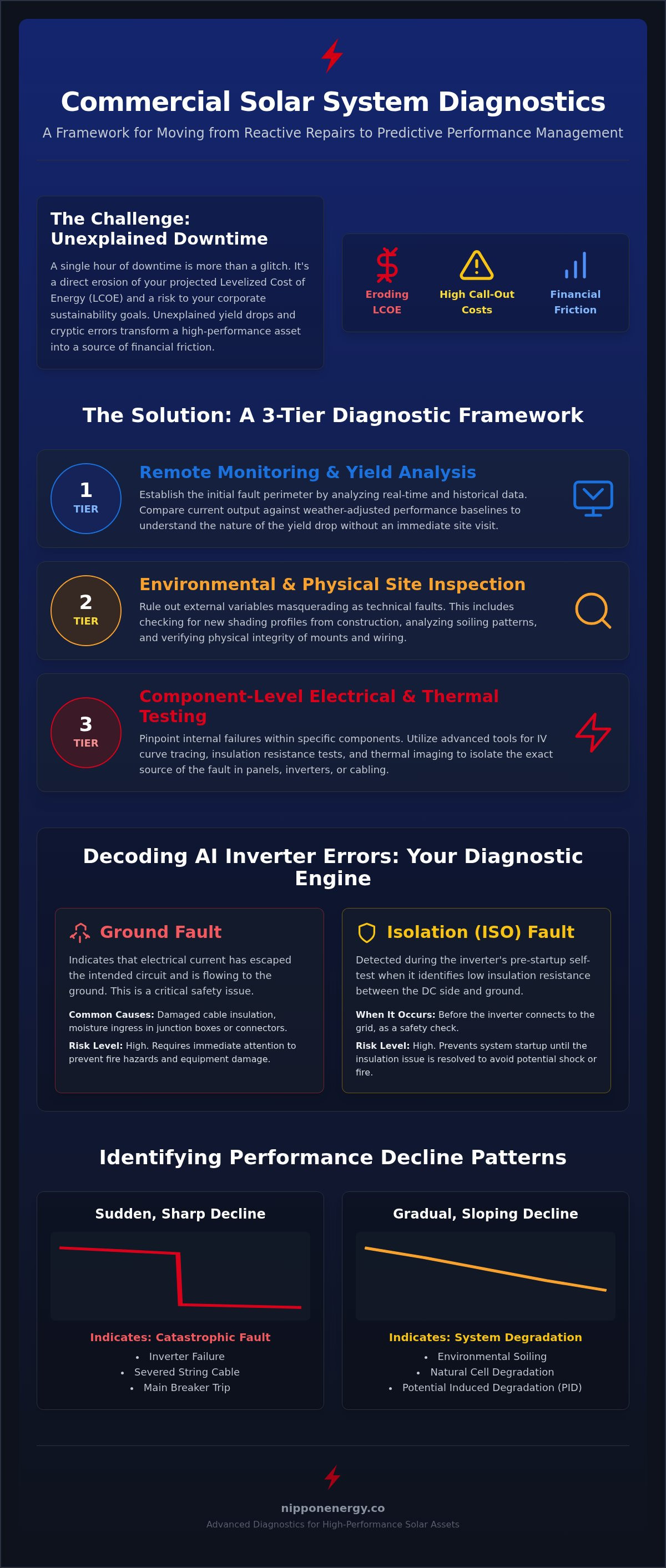
Commercial solar troubleshooting is not a trial-and-error process. It is a rigorous, multi-tier performance audit designed to protect the structural integrity of your energy architecture. By adopting a hierarchical diagnostic approach, operations and maintenance teams can isolate failures without incurring the high costs of unnecessary component replacements. This systematic methodology moves from macro-level data analysis to micro-level electrical verification. It's the only way to ensure that troubleshooting commercial solar system issues remains efficient and data-driven.
The framework consists of three distinct phases. Tier 1 involves remote monitoring and yield analysis to establish the initial fault perimeter. Tier 2 focuses on environmental and physical site inspections to rule out external interference. Finally, Tier 3 employs component-level electrical and thermal testing to pinpoint internal failures within specific photovoltaic system components. This structured progression prevents technicians from overlooking simple fixes while chasing complex electrical ghosts.
Establishing a Performance Baseline
Precision in diagnostics begins with a clear reference point. You must compare current output against historical, weather-adjusted data to determine the nature of the yield drop. A sudden, sharp decline typically indicates a catastrophic fault, such as an inverter failure or a severed string. Conversely, a gradual slope often points toward environmental soiling or natural cell degradation. Utilizing established solar system maintenance protocols allows you to benchmark performance against the original commissioning reports. This baseline is essential for identifying subtle deviations before they escalate into systemic failures that threaten your ROI.
Identifying External Environmental Factors
External variables often masquerade as internal technical faults. In rapidly developing urban centers like Lahore or Dubai, new construction projects frequently introduce unexpected shading profiles that bypass initial site surveys. You should also analyze soiling patterns; the fine particulate matter in these regions can reduce module transparency by several percentage points within weeks. The 2026 climate data reveals significant temperature anomalies that test the thermal limits of standard arrays. If your system lacks advanced temperature resilience, these heat spikes can trigger automatic derating in the inverter to prevent hardware damage. Identifying these external factors first prevents the misdiagnosis of high-performance hardware and ensures your troubleshooting efforts remain focused on actionable technical issues.
Decoding AI Inverter Errors and Grid Synchronization
The smart ai solar inverter serves as the central nervous system of your energy architecture. It's no longer a passive component; it's a diagnostic engine that provides real-time visibility into the health of your entire array. When troubleshooting commercial solar system issues, the inverter's error log is the first place an engineer should look. Modern systems utilize sophisticated algorithms to distinguish between minor transient events and critical hardware failures, ensuring that maintenance resources are deployed with surgical precision.
Interpreting error codes correctly is vital for site safety. A "Ground Fault" indicates that current has escaped the intended circuit and is flowing through the equipment grounding conductor, often due to damaged cable insulation or moisture ingress. In contrast, an "Isolation Fault" (ISO) is detected during the inverter's pre-startup self-test when it identifies low insulation resistance between the DC side and the ground. These faults require immediate attention to prevent fire hazards. Adhering to a rigorous plan for preventive operation and maintenance helps mitigate these risks before they trigger a system-wide shutdown.
AI-Driven Fault Isolation
Integrated AI analytics allow for granular, string-level monitoring that traditional inverters cannot match. By analyzing voltage and current curves, the system can pinpoint a single underperforming string among hundreds. This capability allows you to distinguish between a hardware failure, such as a blown fuse, and a software configuration error. If the system experiences frequent "nuisance trips," a firmware verification is necessary. Ensuring your software is updated to the latest 2026 specifications can often resolve communication lags and improve the accuracy of predictive failure alerts. For complex installations, you can consult with our technical architects to optimize your inverter's diagnostic parameters.
Grid Interaction and Stability Issues
In Pakistan, grid-side instability remains a primary cause of commercial solar downtime. Overvoltage and frequency fluctuations often trigger the inverter's "anti-islanding" protection, causing the system to disconnect to protect utility workers. Troubleshooting these issues requires analyzing the AC-side telemetry to see if the grid voltage exceeds the inverter's programmed limits. Adjusting these parameters within 2026 utility compliance standards can improve uptime without compromising safety. Seamless communication between the inverter and your energy management software is critical to ensure that grid-side events are logged and analyzed as part of your broader energy orchestration strategy.
Panel-Level Issues: HJT and TOPCon Performance Audits
High-efficiency N-type modules have redefined energy density, yet they introduce specialized failure modes that require advanced diagnostic protocols. While topcon solar panels offer superior resistance to Light Induced Degradation (LID) compared to legacy PERC technology, they remain susceptible to Potential Induced Degradation (PID) in high-voltage commercial strings. Troubleshooting commercial solar system issues at the module level demands an understanding of how these advanced cell architectures respond to environmental stressors. Identifying PID early is critical; it often manifests as a significant power loss in modules closest to the negative pole of the string, where high potential differences drive ion migration.
Thermal imaging has become a non-negotiable tool for auditing commercial arrays. By deploying high-resolution thermography, technicians can detect 'hot spots' that indicate internal cell shunting or bypass diode failures. These thermal anomalies often hide micro-cracks caused by improper handling during installation or extreme wind loads. Identifying these defects before they escalate into localized fires is a cornerstone of professional energy architecture management. In 2026, drone-based thermography is the industry standard for rapid, large-scale panel audits.
Diagnostic Techniques for N-Type Cells
HJT panels possess a distinct thermal profile compared to standard monocrystalline modules. Their symmetrical cell structure and low temperature coefficient mean that thermal signatures must be interpreted with tighter tolerances. When troubleshooting commercial solar system issues, measuring the Open Circuit Voltage (VOC) and Short Circuit Current (ISC) of individual strings is the most reliable way to isolate a faulty module. Engineers must also account for bifacial gain variances. With 2026 bifaciality thresholds reaching 85% for HJT modules, a drop in rear-side albedo due to dust accumulation or surface weathering can be misdiagnosed as a cell-level failure if not properly audited against the system's design parameters.
Physical Integrity and Connection Audits
The reliability of a commercial array depends on the integrity of its physical connections. MC4 connectors are frequent points of failure; corrosion or thermal damage from poor crimping can lead to high-resistance joints and eventual arc faults. Technicians should verify that cable management systems prevent conductors from resting on sharp racking edges, which avoids the insulation resistance faults discussed in previous sections. Structural shifting in mounting systems, often caused by soil settling in regions like Sindh, can stress module frames and lead to glass breakage. Regular audits of racking torque and alignment ensure the system remains aerodynamically stable and electrically sound.
Troubleshooting Storage: Lithium-Ion Battery Systems
Integrating lithium ion battery storage into a commercial array requires a shift from purely electrical diagnostics to electrochemical analysis. While PV panels are static assets, storage systems are dynamic components that respond to charge cycles, temperature fluctuations, and software logic. Troubleshooting commercial solar system issues often reveals that storage underperformance isn't a hardware failure but an orchestration error. Capacity fade, the gradual loss of usable energy, must be audited against the manufacturer's cycle-life guarantee. If the fade exceeds the standard 2026 degradation rates, it suggests improper Depth-of-Discharge (DoD) settings or persistent thermal stress.
Thermal management is the most critical factor for storage longevity in Pakistan. If the ambient temperature of the facility exceeds 30°C (86°F), the Battery Management System (BMS) will initiate thermal throttling to protect the cell chemistry. This results in reduced discharge rates and lower system responsiveness. Additionally, inconsistency in the State of Charge (SoC) reporting across battery clusters can lead to unbalanced loading, where one rack reaches its cut-off voltage prematurely, causing the entire system to trip. Resolving these discrepancies requires a methodical data-link audit to ensure the BMS communication remains uninterrupted.
BMS and Software Diagnostics
The BMS acts as the primary diagnostic interface for Nippon Lithium-ion Battery Storage Systems. SoC drifting occurs when the battery isn't allowed to complete a full synchronization cycle, causing the software to lose its reference points. Calibrating the BMS involves a controlled full charge and discharge to reset these parameters. Engineers should also verify that the battery firmware is updated to 2026 standards, which include optimized algorithms for high-frequency grid stabilization. Cell imbalance can be identified through diagnostic software ports; if individual cell voltages deviate significantly, it indicates a failing cell that could compromise the entire module's safety.
Physical and Environmental Storage Safety
Safety is a structural requirement, not an afterthought. In accordance with NFPA 855 standards, commercial storage facilities must undergo Hazard Mitigation Analysis (HMA) to ensure fire suppression sensors are correctly positioned. Technicians should inspect terminals for oxidation, especially in high-humidity regions, as loose power connections create high-resistance points that generate localized heat. Verifying the ambient temperature range is essential; maintaining the facility at the industry-optimal 15°C (59°F) can significantly extend the operational life of the cells. For a comprehensive safety audit of your storage infrastructure, you can request a technical site evaluation from our EPC team.
Advanced O&M: Transitioning to Predictive Maintenance
The final evolution of troubleshooting commercial solar system issues is the transition from reactive restoration to predictive energy orchestration. In 2026, the global solar farm predictive maintenance monitoring market is projected to reach $965.1 million, reflecting a systemic shift toward data-driven operations. Rather than waiting for a component to fail, modern energy architects utilize real-time telemetry to anticipate degradation. This proactive methodology ensures that your energy infrastructure remains a high-yielding financial asset rather than a liability. By integrating the nipponhev system, you create a unified diagnostic layer that synchronizes inverter data, storage health, and panel performance into a single, manageable stream.
Developing a 2026 preventive maintenance schedule requires adherence to the latest regulatory updates, including the NEC 2026 standards for grounding and medium-voltage bonding. While basic troubleshooting commercial solar system issues can be handled by on-site teams, certain faults demand specialized intervention. Escalation to professional solar epc services is necessary when diagnostics reveal structural integrity failures, medium-voltage transformer issues, or systemic Potential Induced Degradation (PID) that requires string-level remediation. This clear escalation path protects your personnel and your hardware warranties.
Digital Twin and Simulation Diagnostics
Digital twins represent the pinnacle of modern O&M by creating a virtual replica of your physical installation. These simulations allow engineers to run 'what-if' repair scenarios, determining the exact impact of a component replacement before a technician arrives on site. AI monitoring platforms now automate maintenance tickets, prioritizing faults based on their direct effect on LCOE. This capability facilitates a precise cost-benefit analysis, helping you decide if a repair is sufficient or if a full upgrade to high-efficiency N-type modules is the more bankable decision for your 2026 energy strategy.
Partnering for Long-Term Reliability
Maintaining the bankability of a commercial solar project requires more than technical skill; it requires a world-class partnership. Professional O&M services provide the structural stability needed for large-scale success, especially when navigating complex grid requirements in Pakistan. Establishing a robust Service Level Agreement (SLA) for critical faults ensures that downtime is minimized through defined response windows. By leveraging Nippon Energy's global technical support network, which spans Karachi, Tokyo, and Dubai, you gain access to a disciplined, methodical team focused on excellence. This partnership transforms troubleshooting from a burden into a strategic advantage, securing your energy future through technical prowess and visionary engineering.
Future-Proofing Your Commercial Energy Architecture
Transitioning from reactive repair to a structured diagnostic framework is essential for maintaining a high-performance array. By leveraging AI-driven telemetry and understanding the specific failure modes of N-type cells, you transform troubleshooting commercial solar system issues from a financial burden into a strategic performance audit. This methodical approach ensures that every component, from the smart inverter to the storage cluster, operates at its engineered limit. It's a calculated shift that prioritizes structural integrity and long-term yield over temporary fixes.
Realizing the full potential of your 2026 energy infrastructure requires a partner with specialized technical depth. Our team of certified engineers in Karachi, Dubai, and Riyadh provides proprietary HJT and TOPCon diagnostic expertise to safeguard your investment. With 24/7 AI-driven system monitoring, we identify subtle performance deviations before they impact your LCOE. Secure your commercial energy assets with Nippon O&M services to ensure your architecture remains resilient and efficient. Your path to sustained energy independence is built on technical precision and visionary engineering.
Frequently Asked Questions
What is the most common cause of commercial solar system failure?
Inverter malfunctions and grid-side synchronization errors represent the most frequent causes of systemic failure. Because the inverter is the most complex active component, it's susceptible to thermal stress and electrical transients. In Pakistan, local grid instability often triggers protective shutdowns that are misdiagnosed as hardware failures. Troubleshooting commercial solar system issues starts with distinguishing between these external grid events and internal component degradation to prevent unnecessary downtime.
How do I know if my solar inverter needs a firmware update or a hardware repair?
You can distinguish between the two by analyzing the specific error codes generated by the Nippon Smart AI Inverters. Software issues typically manifest as communication timeouts or grid-sync lags, which are often rectified via a firmware update. Hardware failures usually produce persistent physical fault codes, such as isolation errors or internal temperature warnings. If a system reboot doesn't clear the alert, a hardware inspection by a certified engineer is required.
Can dirty solar panels cause a permanent drop in system efficiency?
While surface soiling is generally reversible through professional cleaning, it can lead to permanent cell damage if left unaddressed. Heavy, uneven soiling creates localized hot spots where cells are forced to dissipate energy as heat rather than conducting electricity. This thermal stress can cause micro-cracks or bypass diode failures, resulting in a permanent reduction in the module's power output. Regular maintenance is essential to prevent these irreversible efficiency losses.
What should I do if my commercial solar monitoring system shows a zero-yield alert?
A zero-yield alert requires an immediate systematic check of the main AC disconnect and the inverter's operational status. You should first verify if a local grid outage has triggered the system's anti-islanding protection. If the grid is active, inspect the inverter display for critical fault codes. Troubleshooting commercial solar system issues during a zero-yield event often reveals a tripped breaker or a communication failure between the monitoring hardware and the site's energy orchestration layer.
Is it safe to perform an electrical reset on a commercial AI inverter?
Performing an electrical reset on a commercial AI inverter is safe provided you strictly adhere to the documented DC and AC isolation sequence. You must first disconnect the AC side before the DC side to prevent hazardous arcing within the system components. Once the system has fully de-energized, waiting five minutes allows the internal capacitors to discharge completely. This process often clears transient software glitches and restores normal grid-synchronization parameters.
How often should a commercial solar array undergo a professional thermal inspection?
We recommend that commercial solar arrays in high-temperature environments, such as Karachi or Dubai, undergo a professional thermal inspection at least once per year. These audits use high-resolution thermography to detect anomalies that are invisible to the naked eye. In 2026, bi-annual inspections are becoming the standard for megawatt-scale assets to ensure that micro-cracks or loose connections don't escalate into catastrophic failures or localized fires.
What are the signs of Potential Induced Degradation (PID) in high-efficiency panels?
Potential Induced Degradation (PID) typically manifests as an unexplained, non-linear power loss across specific strings, particularly those operating at high negative potential relative to the ground. You may notice that modules located closer to the negative pole show significantly lower VOC readings. In high-efficiency TOPCon or HJT panels, PID can be identified through electroluminescence imaging, which reveals darkened cells that are no longer contributing to the total energy yield.
How does ambient temperature affect commercial battery storage performance?
High ambient temperatures directly impact the operational efficiency and longevity of Nippon Lithium-ion Battery Storage Systems. When temperatures exceed 30°C (86°F), the internal Battery Management System initiates thermal throttling to prevent chemical degradation. This results in reduced charge and discharge rates to manage heat. Maintaining an optimal storage environment of 15°C to 25°C is critical for preserving cycle life and ensuring the system can meet peak demand requirements.


