

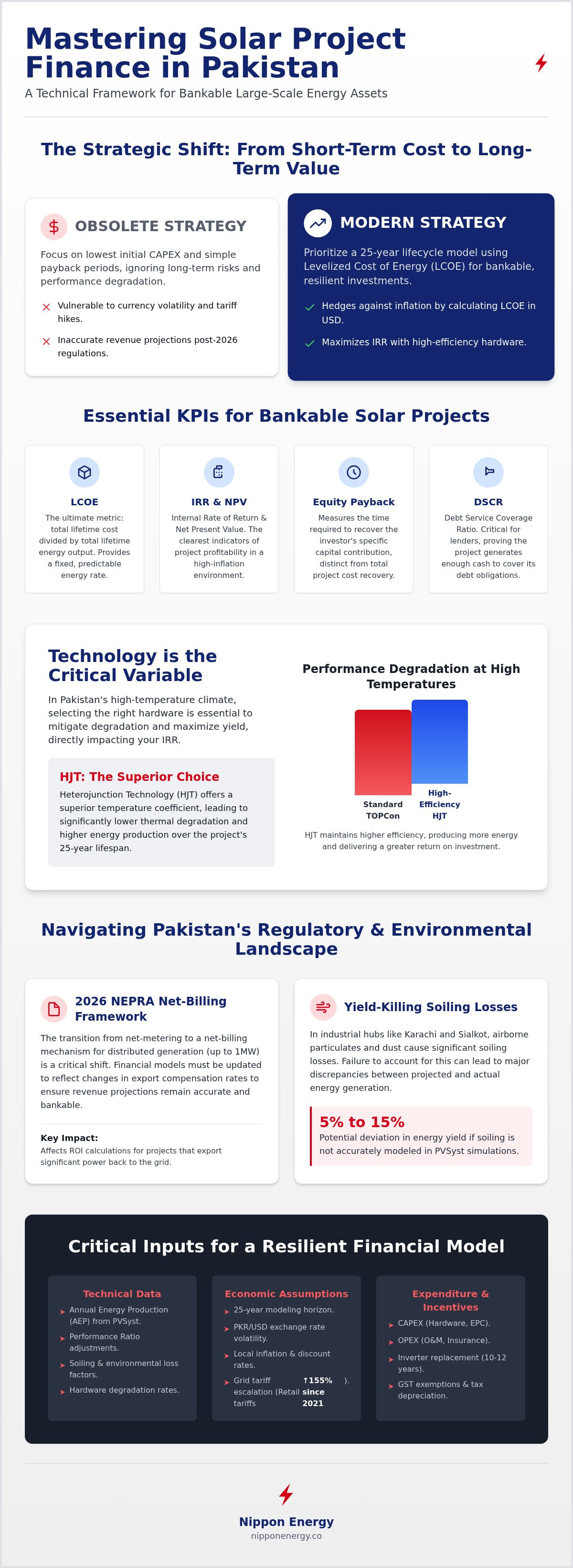
The viability of a large-scale energy asset in Pakistan no longer hinges on the lowest initial CAPEX, but on the precision of its 25-year yield projections. As NEPRA transitions to a net-billing mechanism for distributed generation up to 1 MW, the traditional investment strategy has become obsolete. You likely recognize that currency volatility and the 155% increase in retail tariffs since 2021 have made a robust commercial solar project financial model in Pakistan essential for any bankable enterprise. This guide provides the technical framework required to master these complexities, specifically focusing on ROI, LCOE, and the impact of the 2026 regulatory shift.
We'll analyze how calculating LCOE in USD provides a necessary hedge against local inflation while ensuring long-term project bankability. We also examine why selecting high-efficiency HJT hardware is the critical variable in mitigating high-temperature degradation to maximize your internal rate of return. This systematic breakdown moves from macro-economic variables to granular technical specifications, ensuring your 2026 solar transition is both resilient and highly profitable. By aligning engineering precision with financial foresight, we can secure the future of industrial power.
Key Takeaways
- Transition from basic payback periods to a sophisticated commercial solar project financial model pakistan that prioritizes Levelized Cost of Energy (LCOE) over 25 years.
- Analyze the 2026 NEPRA net-billing framework and its impact on export compensation to ensure your revenue projections remain accurate.
- Determine how HJT technology and its superior temperature coefficient directly increase internal rates of return by reducing thermal degradation in local climates.
- Account for the latest BESS mandates and GST exemptions to optimize your capital expenditure and meet new grid stability requirements.
- Evaluate the role of EPC execution and smart monitoring in maintaining the structural integrity and financial bankability of your energy investment.
Fundamentals of Commercial Solar Financial Modeling in Pakistan
Establishing a robust commercial solar project financial model pakistan requires a departure from short-term metrics. While many businesses historically focused on simple payback periods, the current economic climate in Pakistan demands a lifecycle approach. A 25-year modeling standard ensures that industrial projects remain bankable and resilient against shifting tariffs. This transition to Levelized Cost of Energy (LCOE) allows investors to treat solar as a long-term utility hedge rather than a one-time equipment purchase.
Capital expenditure (CAPEX) encompasses high-efficiency hardware, EPC services, and permitting. However, the operational expenditure (OPEX), including specialized O&M and insurance, determines the project's actual yield. Given the history of Solar Power in Pakistan, volatility in the PKR/USD exchange rate remains a primary risk factor for initial valuations. Since most high-tier hardware is priced in USD, modeling must account for currency fluctuations to protect the initial equity investment.
Key Performance Indicators (KPIs) for Solar Investors
In a high-inflation environment, the Internal Rate of Return (IRR) and Net Present Value (NPV) provide the clearest picture of project health. Investors must distinguish between Project Payback, which measures the system's ability to recover total costs, and Equity Payback, which tracks the return on the investor's specific capital contribution. For those seeking external financing, the Debt Service Coverage Ratio (DSCR) is the most critical metric. It proves to lenders that the project generates sufficient cash flow to cover debt obligations reliably over the term of the loan.
LCOE: The Ultimate Metric for Industrial Power
LCOE calculates the total cost of energy by dividing the lifetime costs of the system by its total energy output. High-efficiency hardware directly lowers this figure by increasing the denominator; the total kWh produced over the system's life. When compared against volatile industrial tariffs from providers like K-Electric or LESCO, solar LCOE offers a fixed, predictable rate. This comparison highlights the financial advantage of decentralized generation, where the cost per unit remains stable regardless of grid-wide price hikes or fuel adjustment charges.
Step-by-Step Construction of the Financial Model
Constructing a robust commercial solar project financial model pakistan requires a granular approach to technical and economic data integration. The process begins by establishing a baseline for Annual Energy Production (AEP), which serves as the foundation for all subsequent revenue projections. This figure isn't a static estimate; it's a dynamic calculation based on historical irradiance and localized environmental stressors. By structuring a clear cash flow waterfall, developers can visualize the movement of capital from gross savings to net cash flow, ensuring that debt service obligations are met before equity distributions occur.
Inputting financial assumptions necessitates a deep understanding of the local economic climate. High inflation rates and fluctuating discount rates must be modeled over a 25-year horizon to reflect the true cost of capital. Additionally, integrating tax depreciation benefits and planned maintenance cycles, such as inverter replacements every 10 to 12 years, prevents unforeseen shocks to the project's liquidity. This methodical construction transforms a simple spreadsheet into a powerful predictive tool for long-term energy security.
Technical Inputs and Yield Estimation
The revenue side of any financial model relies on high-fidelity simulation data, typically sourced from PVSyst. In Pakistan's industrial hubs, such as Karachi or Sialkot, modeling must account for significant soiling losses caused by airborne particulate matter and industrial dust. Failure to adjust for these factors can lead to a 5% to 15% discrepancy in actual versus projected generation. The Performance Ratio represents the measured gap between the system's theoretical capacity and its actual energy yield after accounting for environmental and hardware losses. Integrating these technical parameters ensures the model reflects the harsh reality of the local operating environment.
Revenue Streams and Savings Analysis
Revenue modeling has evolved significantly with the 2026 shift toward net-billing mechanisms. Investors must analyze the future of net-metered solar to understand how export compensation rates affect the internal rate of return. The primary value driver remains "Avoided Cost" savings, where the system offsets high-tier industrial tariffs. For large-scale projects, factoring in carbon credits or green financing incentives can further compress the payback period. These savings must be balanced against projected OPEX, including professional maintenance services that preserve the system's bankability over its lifecycle.
Pakistan Regulatory Variables and Tax Incentives 2026
In February 2026, NEPRA fundamentally altered the commercial solar project financial model pakistan by introducing a net-billing mechanism for distributed generation. This shift from traditional net-metering to a five-year contract structure requires investors to prioritize self-consumption over grid exports to maintain high returns. Under these new regulations, export compensation is reset periodically, making the "buy-back" rate a variable rather than a constant. For industrial entities, this means the financial feasibility now depends heavily on the precise synchronization of generation and load profiles.
Fiscal incentives remain a cornerstone of project bankability. The Pakistan Solar Panels & Allied Equipment Manufacturing Policy 2026-2035 provides critical GST exemptions and reduced customs duties for high-efficiency hardware. Industrial investors can also leverage Income Tax Credits under Section 65B for renewable energy investments. These credits provide a direct reduction in tax liability, which significantly improves the project's Net Present Value (NPV). When combined with the Production Linked Incentive (PLI) scheme, these policies reduce the initial capital burden for large-scale adopters.
Net Metering and Grid Interaction
The 2026 buy-back rates have shifted the optimal 'Export vs. Self-Consumption' ratio toward maximizing on-site usage. Modeling must also account for grid outages, which can interrupt generation unless the system is designed for islanding. To maintain compliance and optimize these interactions, the integration of Smart AI Inverters is essential. These intelligent systems manage grid-tie parameters and ensure the financial model accounts for real-world grid instability, protecting the projected internal rate of return from technical downtime.
Financing Options in the Local Market
Financing structures are diversifying beyond traditional commercial bank lending. While the State Bank of Pakistan (SBP) continues to offer specialized refinancing schemes for renewable energy, many large-scale developers are looking toward Corporate Power Purchase Agreements (PPAs). These agreements allow businesses to procure solar energy with zero upfront CAPEX. Insights from utility-scale initiatives like the Sindh Solar Energy Project show that structured financing is key to scaling distributed generation. For SMEs, leasing models provide a path to transition without straining balance sheets, allowing for a phased approach to energy independence through predictable monthly payments.
Sensitivity Analysis: HJT vs. TOPCon Financial Impact
The most critical variable in a commercial solar project financial model pakistan is the temperature coefficient. In industrial corridors like Karachi or Multan, where ambient temperatures frequently exceed 40°C, hardware efficiency drops as heat rises. Standard PERC or TOPCon modules often suffer from higher thermal losses compared to Nippon HJT Solar Panels. This "Heat Premium" justifies a higher initial CAPEX because Heterojunction (HJT) cells maintain superior performance at high temperatures, directly increasing the annual energy yield and improving the project’s Internal Rate of Return (IRR).
As of 2026, regulatory mandates increasingly require the integration of Lithium-Ion Battery Storage for new renewable capacity auctions. Modeling the ROI for these systems involves a complex peak-shaving analysis. By discharging stored energy during high-tariff periods, businesses avoid expensive grid power and stabilize their operational cash flow. When storage is paired with high-efficiency panels, the resulting synergy maximizes the Net Present Value (NPV) of the entire energy architecture by reducing reliance on a volatile grid.
Degradation and Long-Term Yield
Degradation rates are a silent determinant of long-term profitability. A system with a 0.25% annual degradation rate, typical of HJT, retains significantly more capacity after 25 years than standard modules with a 0.5% rate. This delta translates into thousands of additional kilowatt-hours produced in the final decade of the project's life. HJT technology represents the convergence of crystalline and thin-film benefits for maximum heat tolerance. Furthermore, the superior bifacial gain of HJT, often exceeding 90%, allows the model to capture additional reflected light, further lowering the Levelized Cost of Energy (LCOE).
Risk Assessment and Mitigation
A rigorous sensitivity analysis must account for PKR devaluation and potential import restrictions. Since hardware is globally priced in USD, modeling these fluctuations protects investors from capital shortfalls during the procurement phase. Operational risks are mitigated through proactive Solar System Maintenance, which ensures that technical downtime does not erode the financial model's assumptions. Finally, insurance costs for industrial assets should be factored in to protect against climate-related damages, ensuring the structural integrity of the investment remains intact throughout its lifecycle.
To secure the highest possible yield for your industrial facility, consult with our technical architects to refine your 25-year financial projections.
From Spreadsheet to Site: EPC and Execution
The bridge between a theoretical commercial solar project financial model pakistan and a high-yielding energy asset is physical execution. A model represents a set of assumptions that only materialize through precise engineering and disciplined construction. If the installation quality is compromised, the "bankability" of the project evaporates as technical losses exceed the modeled tolerances. Investors must treat the selection of a Solar EPC Partner as a primary financial decision rather than a procurement task. High-tier execution ensures that the structural integrity and electrical performance of the system align with the 25-year projections required for large-scale industrial success.
Nippon Energy approaches project development as a High-Tech Architect, focusing on future-proofing every component. By managing the entire lifecycle from feasibility to commissioning, we eliminate the friction between financial planning and site reality. This end-to-end integration protects the investor from the hidden costs of fragmented service providers. Our methodology prioritizes long-term ROI by using hardware that meets the exact specifications used in the initial model, ensuring that the projected savings are captured without technical leakage.
The EPC Financial Shield
Turnkey EPC solutions act as a financial shield against capital expenditure overruns. By utilizing a fixed-price contract, businesses lock in their investment costs and avoid the volatility of local material price hikes. Performance guarantees and comprehensive warranties provide a secondary layer of protection, as they shift the technical risk from the owner to the provider. In markets like Karachi and Lahore, local expertise is vital for navigating the complex DISCO approval processes. Securing timely net-billing permissions from K-Electric or LESCO is essential to prevent delays that could postpone the project's "Day One" revenue and disrupt the debt service schedule.
Nippon Energy: Your Partner in Solar ROI
Maximizing the financial performance of a solar asset requires a cohesive ecosystem of hardware and software. We integrate Nippon HJT panels with Smart AI inverters to create a system that self-optimizes for maximum yield. This intelligent orchestration ensures that the commercial solar project financial model pakistan remains a living document, supported by real-time performance data. Our professional monitoring services identify and rectify micro-deviations in output before they impact the bottom line. This proactive stance on maintenance guarantees that the initial assumptions of the model are not just met, but maintained over the system's entire lifecycle.
To ensure your energy transition is backed by rigorous technical and financial data, consult with Nippon Energy's engineers for a custom financial feasibility study.
Securing Energy Autonomy Through Financial Precision
The transition to decentralized power in Pakistan demands more than simple hardware procurement. It requires a sophisticated integration of regulatory foresight and engineering excellence. By prioritizing Levelized Cost of Energy (LCOE) over initial CAPEX, industrial leaders can protect their investments against the 2026 net-billing shifts and persistent currency volatility. Developing a bankable commercial solar project financial model pakistan is the first step toward ensuring that high-temperature degradation doesn't erode your long-term internal rate of return.
As an HJT technology specialist with Japanese-standard engineering, Nippon Energy provides the full EPC support necessary to transform these projections into high-performing physical assets. We ensure that every financial assumption is backed by resilient hardware and professional, real-time monitoring. Request a Professional Solar Project Financial Model for Your Business to begin your transition with technical certainty. The future of Pakistani industry belongs to those who build with precision today.
Frequently Asked Questions
What is the average payback period for commercial solar in Pakistan in 2026?
Payback periods for commercial installations have compressed to under three years as of September 2026. This acceleration is primarily driven by a 155% increase in retail electricity tariffs since 2021 and a significant drop in global hardware costs. When you integrate high-efficiency panels into your commercial solar project financial model pakistan, the rapid reduction in grid reliance ensures that initial capital is recovered through avoided utility costs within a very tight timeframe.
How does the NEPRA net metering policy change affect my ROI?
The transition from net-metering to a net-billing mechanism in February 2026 requires a shift toward maximizing self-consumption. Under the new Prosumer Regulations, export compensation for new participants is reset periodically within five-year agreement terms. This makes the timing of energy usage a critical variable. Systems that use smart orchestration to align generation with peak industrial loads will maintain a higher ROI than those relying heavily on grid exports for revenue.
Is it better to model solar projects in PKR or USD?
Financial modeling should ideally be conducted in USD to provide a stable benchmark against currency volatility. Since high-tier hardware like Nippon HJT panels and AI inverters are globally priced in USD, a dollar-based model prevents inflationary distortions from skewing your internal rate of return. This approach allows for a clearer comparison of LCOE against international standards and ensures that the project's bankability remains intact for potential foreign investors or green financing providers.
What is the typical LCOE for industrial solar projects in Lahore?
Industrial LCOE in Lahore typically remains significantly lower than the prevailing LESCO industrial tariffs, which have seen drastic hikes since 2021. While exact figures depend on the specific site's shading and soiling factors, high-efficiency systems consistently deliver a lower cost per unit over a 25-year lifecycle. By reducing the Levelized Cost of Energy, businesses can lock in a fixed power price that protects them from future fuel adjustment charges and grid-wide tariff increases.
Can I get green financing for solar from Pakistani banks?
Yes, several commercial banks in Pakistan offer specialized green financing products backed by the State Bank of Pakistan's (SBP) refinancing schemes for renewable energy. These loans typically offer lower interest rates and longer tenors compared to standard commercial credit. To qualify, your commercial solar project financial model pakistan must demonstrate a high Debt Service Coverage Ratio (DSCR) and utilize hardware that meets national grid stability and quality standards.
How much does O&M (Operations and Maintenance) typically cost in a financial model?
Operations and maintenance costs usually range between 1% and 2% of the total project CAPEX annually. This OPEX variable includes routine panel cleaning, inverter health checks, and professional performance monitoring. At Nippon Energy, we emphasize that these costs are an investment in yield protection. Proper O&M prevents technical leakage and ensures that the degradation rates used in your initial financial projections remain accurate over the system's 25-year lifespan.
Why is HJT technology preferred for commercial models in high-heat areas?
Heterojunction (HJT) technology is superior for the Pakistan market because of its exceptionally low temperature coefficient. In high-heat regions like Karachi or Multan, standard panels lose efficiency as ambient temperatures rise. Nippon HJT panels maintain higher yields during peak summer hours, which are often the most expensive tariff periods. This thermal resilience directly increases the annual energy production (AEP), making HJT a more profitable choice in long-term financial sensitivity analyses.
What tax credits are available for solar energy in Pakistan currently?
Under the Pakistan Solar Panels & Allied Equipment Manufacturing Policy 2026-2035, industrial investors benefit from significant GST exemptions and reduced customs duties on high-efficiency components. Additionally, Section 65B of the Income Tax Ordinance provides tax credits for industrial undertakings that invest in renewable energy for self-consumption. These incentives reduce the effective capital burden and improve the project's Net Present Value (NPV), making the transition to solar financially compelling for local manufacturers.


