
In 2026, the value of a solar asset is no longer defined by its peak nameplate capacity, but by its cognitive ability to defend itself against environmental degradation. You likely recognize that high-performance hardware alone cannot mitigate the persistent challenges of extreme heat or the mounting expenses of reactive maintenance. This reality demands a shift toward ai based solar performance optimization, where intelligence is embedded directly into the system architecture.
This guide explores how artificial intelligence transforms standard energy collectors into self-optimizing assets that actively maximize ROI and ensure long-term structural integrity. We'll analyze the synergy between Nippon Smart AI Inverters and HJT technology, demonstrating how real-time orchestration provides quantifiable efficiency gains. By the end of this article, you'll understand how automated fault detection and seamless storage integration are setting a new benchmark for utility-scale and commercial performance. This isn't just about capturing sunlight; it's about the precision of intelligent energy management.
Key Takeaways
- Understand the fundamental transition from passive monitoring to active, data-driven execution through ai based solar performance optimization.
- Learn how specialized AI protocols maximize bifacial gains for HJT and TOPCon architectures by calculating optimal tilt based on real-time ground albedo.
- Discover how to transform O&M from a reactive expense into a strategic asset using computer vision and automated predictive maintenance.
- Explore the configuration of Nippon Smart AI Inverters as edge-computing hubs for sophisticated grid-forming and grid-following orchestration.
- Identify the performance advantages of an integrated ecosystem like the NipponHev System, where Japanese engineering ensures hardware-software synergy.
What is AI Based Solar Performance Optimization?
At its core, What is Solar Performance Optimization? in the modern era is the transition from reactive data logging to proactive machine execution. It involves the deployment of machine learning algorithms that analyze multi-modal data streams, including real-time electrical telemetry and localized environmental variables, to maximize energy harvest. While traditional systems focused on passive monitoring, ai based solar performance optimization utilizes neural networks for irradiance forecasting and computer vision for thermal analysis. This shift ensures that every photon captured is converted with maximum efficiency. By 2026, this approach has become the industry standard as hardware efficiencies for TOPCon and HJT cells plateau, leaving intelligent orchestration as the primary lever for increasing specific yield.
The Evolution from SCADA to AI-Driven Orchestration
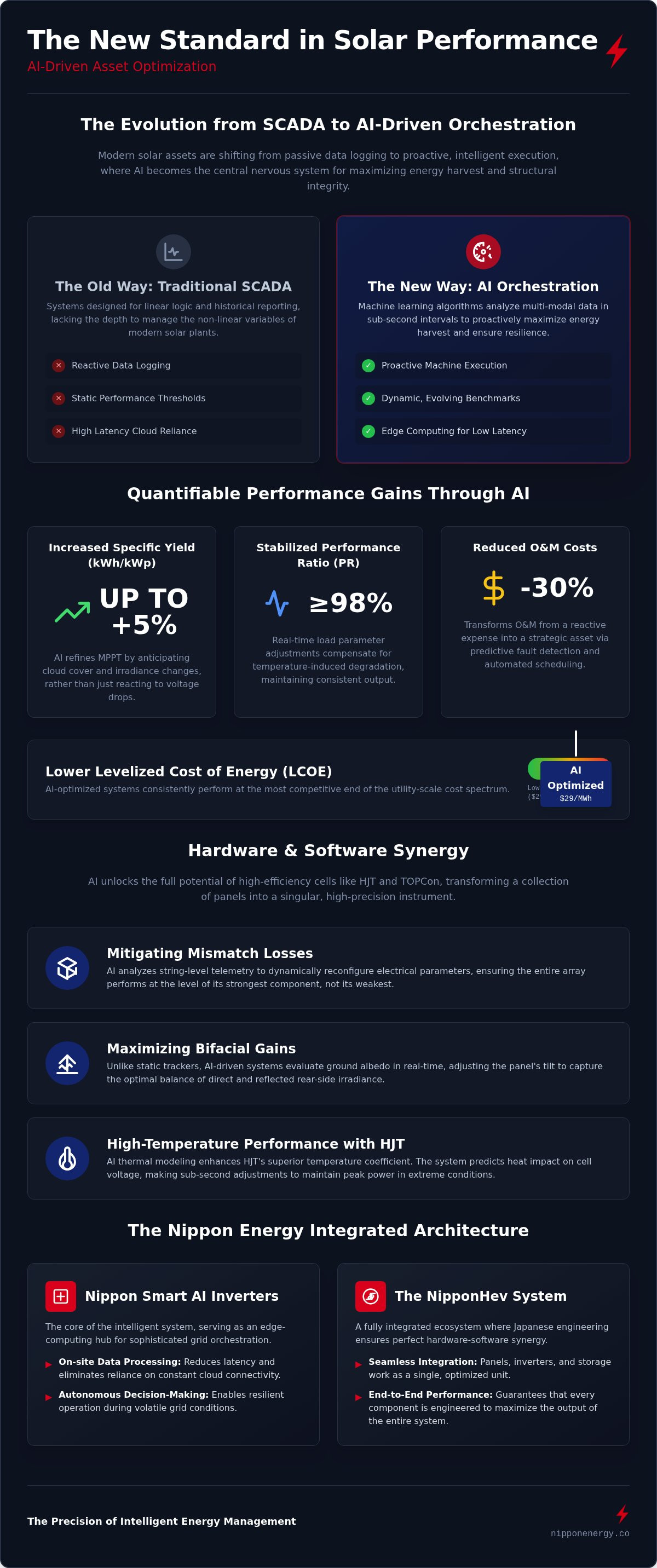
Traditional Supervisory Control and Data Acquisition (SCADA) systems were designed for linear logic and historical reporting. They lack the computational depth to manage the non-linear variables present in modern, high-capacity solar plants. AI-driven orchestration replaces these static thresholds with dynamic models that process data in sub-second intervals. This allows the system to establish a baseline performance benchmark that evolves as the hardware ages or as local climatic patterns shift. Edge computing, integrated within the Nippon Smart AI Inverters, processes this data at the source. This localized intelligence reduces latency and allows the system to maintain architectural integrity without relying on constant cloud connectivity. The result is a resilient infrastructure capable of autonomous decision-making in volatile grid conditions.
Key Metrics Influenced by AI Optimization
The success of an AI-integrated system is verified through concrete technical benchmarks. AI algorithms refine Maximum Power Point Tracking (MPPT) by anticipating cloud movement rather than reacting to voltage drops, which directly increases the Specific Yield (kWh/kWp). Performance Ratio (PR) stabilization is another critical outcome; AI compensates for temperature-induced degradation by adjusting load parameters in real-time. These technical gains translate into significant economic advantages. In 2026, the unsubsidized LCOE for utility-scale solar is estimated between $29/MWh and $92/MWh. Systems utilizing ai based solar performance optimization consistently sit at the lower end of this range. By automating O&M scheduling through predictive logic, operators eliminate the high costs of unnecessary field deployments and extend the operational lifespan of the entire asset.
Hardware Synergy: AI and High-Efficiency Cell Architectures
In 2026, the distinction between hardware capacity and software intelligence has vanished. High-efficiency cells like HJT and TOPCon provide the physical foundation, but ai based solar performance optimization serves as the central nervous system that dictates their actual output. This synergy is most evident in the mitigation of mismatch losses. In high-efficiency string configurations, even minor variances in module performance can lead to significant energy dissipation. AI algorithms analyze string-level telemetry to dynamically reconfigure electrical parameters, ensuring the entire array performs at the level of its strongest component rather than its weakest. This proactive orchestration transforms a collection of panels into a singular, high-precision instrument.
Bifacial gain maximization represents another frontier where AI and hardware converge. Traditional trackers follow a static solar path, but AI-driven systems use localized sensors to evaluate ground albedo in real-time. By calculating the reflective intensity of the surrounding environment, the AI adjusts the tracking angle to capture the optimal balance of direct frontal sunlight and reflected rear-side irradiance. This process typically results in measurable yield improvements that static systems simply cannot achieve. It's a methodical approach to energy harvest that prioritizes technical precision over simple installation volume.
Nippon HJT and AI: A High-Temperature Performance Duo
The technical marriage of AI with Nippon HJT Solar Panels is specifically engineered for resilience in high-demand environments. HJT technology is renowned for its superior temperature coefficient, but AI thermal modeling enhances this advantage. The system predicts how ambient heat will impact cell voltage, allowing for sub-second adjustments that maintain peak power output during the hottest hours of the day. The symmetrical structure of HJT cells allows for high bifaciality, which the AI manages through specialized algorithms designed to balance rear-side gain without compromising the structural stability of the trackers. This predictive logic doesn't just increase yield; it actively protects the asset's long-term value by benchmarking current degradation against historical environmental data. If you're designing for extreme climates, you can explore our high-temp HJT configurations to see these benefits in action.
Optimizing TOPCon Yield in Commercial Solar Farms
For commercial-scale deployments, TOPCon solar panels offer a robust efficiency profile that AI further refines through vigilant degradation monitoring. The system tracks Light Induced Degradation (LID) and Light and elevated Temperature Induced Degradation (LeTID) with surgical precision, identifying performance drifts that human operators might overlook. Dynamic load management ensures that large-scale TOPCon farms operate at their maximum efficiency regardless of grid fluctuations or cloud cover. AI identifies subtle electrical signatures indicative of micro-cracks through string-level telemetry analysis before they can escalate into performance-limiting failures. This level of granular oversight ensures that the architectural integrity of the solar farm remains uncompromised throughout its operational lifecycle.
Predictive Maintenance: Transforming O&M into an Asset Strategy
The transition from reactive maintenance to an intelligent asset strategy represents a fundamental evolution in solar operations. Historically, operators relied on a break-fix model that incurred significant revenue loss during downtime. By implementing ai based solar performance optimization, this model shifts toward a predictive framework where hardware health is monitored in real-time. Computer vision and drone-mounted thermal sensors allow for the automated detection of hotspots and localized soiling with surgical precision. This data integrates directly with established Solar System Maintenance protocols to ensure architectural integrity. By distinguishing between nuisance trips and critical hardware failures, AI reduces unnecessary site visits, ensuring that technical teams are only deployed when a measurable ROI is at stake.
Automated Fault Detection and Diagnosis (AFDD)
Advanced AI pattern recognition identifies anomalies at the string level that traditional monitoring often misses. The system analyzes electrical signatures to predict the failure of specific inverter components, such as cooling fans or capacitors, before they result in a system-wide shutdown. This transition to component-level forecasting allows for the pre-ordering of parts and scheduled intervention. Precise fault localization significantly reduces the Mean Time to Repair (MTTR). Technicians arrive on-site with the exact diagnostic data and hardware required for the fix, eliminating the diagnostic phase of traditional field work.
Soiling Loss Mitigation and Cleaning Optimization
In high-dust environments like Riyadh and Karachi, soiling can degrade energy output by significant margins within days. AI weather integration analyzes localized meteorological data to schedule cleaning cycles that maximize financial yield. The system performs a real-time cost-benefit analysis, weighing the expense of AI-triggered robotic cleaning or manual labor against the projected energy gain from a clean array. This data-driven approach ensures that cleaning only occurs when the performance gain exceeds the operational cost. It maintains the plant's LCOE within the optimal $29/MWh to $92/MWh range observed in 2026 by preventing wasted O&M expenditures on clean panels.
Smart Inverters and Grid Orchestration: Implementation Framework
The Smart AI Solar Inverter serves as the primary decision-maker in a modern energy ecosystem. It's no longer a simple power converter; it's a localized edge-computing hub. This architecture is essential for ai based solar performance optimization, as it facilitates the sub-second processing of electrical telemetry required for grid stability. Operators can configure AI parameters to toggle between grid-following modes for standard utility interaction and grid-forming modes for microgrid resilience. This flexibility ensures that the system maintains structural integrity during frequency fluctuations or voltage drops, protecting both the hardware and the connected load.
Effective energy management requires the precise orchestration of Lithium-ion Battery Storage. The AI logic analyzes historical consumption patterns and real-time grid pricing to execute peak shaving and time-of-use optimization. By predicting when grid demand will peak, the system autonomously discharges storage to offset high-cost energy periods. This results in a flattened demand curve and maximized financial returns for commercial and utility-scale assets. You can consult with our engineers on integrated inverter-storage configurations to optimize your facility's energy independence.
Edge Computing vs. Cloud-Based Solar AI
Sub-second latency is non-negotiable for modern grid orchestration. Processing data at the inverter level eliminates the delays inherent in cloud-based models, allowing the system to react to transient faults in real-time. This localized approach provides superior security for critical energy infrastructure by minimizing external data exposure and ensuring operation during network outages. Nippon Energy utilizes a hybrid model where localized execution handles immediate response while cloud-based training refines the long-term AI logic. This dual-layer strategy ensures that the system is both fast and increasingly intelligent over its lifecycle.
Thermal Management in High-Irradiance Regions
In high-irradiance regions like the Middle East and South Asia, thermal stress is the primary cause of inverter failure and energy loss. AI-driven cooling strategies monitor internal component temperatures and ambient conditions to adjust fan speeds and airflow dynamically. Predictive derating prevents total thermal shutdowns by subtly reducing output during peak heat events rather than allowing a complete system trip. AI-based thermal derating is the intelligent modulation of power output to maintain internal component temperatures within safe operational limits while preventing abrupt system disconnection. This methodical approach ensures that the plant continues to produce energy even in the most extreme climatic conditions.
The Nippon Energy Approach: Integrated Intelligent Solar Architecture
The NipponHev System represents the pinnacle of integrated energy design. It is a unified ecosystem where every component is engineered to support ai based solar performance optimization from the ground up. Unlike fragmented systems that layer software over aging hardware, NipponHev applies Japanese engineering precision to ensure that AI model accuracy is matched by hardware durability. This architectural approach allows the system to adapt to evolving machine learning algorithms through seamless firmware updates. This capability effectively future-proofs the asset against technological shifts, ensuring that a system installed today remains at the cutting edge of efficiency for decades.
Our global EPC expertise allows us to implement these intelligent architectures across diverse regulatory and climatic environments. By treating the solar plant as a single, cognitive organism, we eliminate the data silos that typically lead to energy loss. The result is a resilient, high-performance asset that delivers predictable yields even in the most volatile market conditions. We don't just build solar plants; we architect intelligent energy legacies that prioritize long-term structural integrity and quantifiable ROI.
End-to-end EPC and AI Integration
Professional Solar EPC Services are the foundation of this technological integration. We incorporate AI modeling during the initial feasibility study phase to establish realistic performance benchmarks based on localized data. Whether we're designing utility-scale solar farms or complex commercial rooftops, our engineers create custom AI profiles that account for specific shading, wind loads, and thermal patterns. This end-to-end oversight ensures that the system reliability is baked into the design, preventing the performance gaps that often occur during the handoff between construction and operations.
Global Support and Performance Monitoring
Operational excellence is maintained through our network of real-time monitoring centers located in Tokyo, Dubai, and Karachi. These hubs provide localized AI training using regional irradiance and weather data, which ensures that ai based solar performance optimization protocols are specifically tuned to the local climate. This global scale allows us to provide technical support that is both culturally relevant and technically superior. Our centers monitor thousands of data points per second to ensure every NipponHev installation meets our rigorous standards. You can contact Nippon Energy for a technical consultation on AI-optimized solar architecture to begin your transition toward intelligent energy orchestration.
Architecting the Future of Intelligent Energy Yield
The era of treating solar panels as passive energy collectors has ended. Success in 2026 depends on ai based solar performance optimization to transform hardware into a cognitive, self-defending asset. By synchronizing high-efficiency cell architectures with intelligent orchestration, you can effectively mitigate the risks of thermal degradation and unpredictable maintenance costs. This methodical approach ensures that every component performs at its peak theoretical capacity throughout its operational lifecycle.
Nippon Energy brings Japanese precision engineering to every project, supported by a robust global presence across the Middle East, Asia, and Europe. Our proprietary Smart AI Inverter technology provides the localized intelligence necessary to navigate complex grid requirements and extreme climates. We don't just provide equipment; we deliver a future-proof energy architecture designed for maximum longevity and quantifiable ROI. Take the first step toward a more resilient energy future today.
Request a Technical Consultation for Your AI-Optimized Solar Project
Your transition to an intelligent, high-yield energy ecosystem is the key to sustainable success in an evolving market.
Frequently Asked Questions
How much can AI based solar performance optimization increase my energy yield?
AI optimization typically yields measurable gains by refining MPPT and mitigating mismatch losses within the array. In 2026, systems utilizing HJT technology and intelligent orchestration see specific yield improvements compared to static, non-optimized installations. The exact increase depends on environmental variables like shading and ground albedo; however, the primary focus is on stabilizing the Performance Ratio across extreme climates to ensure consistent energy harvest throughout the year.
Is AI optimization compatible with older solar panel models?
AI optimization is primarily a function of the inverter and system architecture, which means it can be integrated with existing legacy arrays. By replacing traditional inverters with Nippon Smart AI Inverters, older assets gain access to advanced string-level monitoring and predictive maintenance logic. While older panels don't have the native bifaciality of HJT modules, the software still improves total harvest through more precise electrical load management and fault detection.
Does AI solar monitoring require a constant internet connection?
No, core optimization functions are performed at the edge within the inverter itself. Nippon Smart AI Inverters use localized edge computing to process telemetry and execute sub-second adjustments to thermal management and voltage control. An internet connection is only necessary for long-term cloud-based model training and remote reporting. This ensures that the system maintains its architectural integrity and peak performance even during network outages or in remote geographic locations.
How does AI improve the lifespan of solar battery storage systems?
AI improves battery longevity by managing charge-discharge cycles with surgical precision. By analyzing historical load data and temperature patterns, the system prevents deep discharge and excessive thermal stress on Nippon Lithium-ion Battery Storage Systems. This predictive orchestration ensures that the chemical integrity of the cells is preserved; it effectively extends the operational lifespan and maintains the asset's capacity over thousands of cycles without premature degradation.
What is the difference between standard monitoring and AI-based optimization?
Standard monitoring is a passive process that simply logs historical data for human review. In contrast, ai based solar performance optimization is an active orchestration layer that executes real-time adjustments based on predictive logic. While standard systems tell you what happened in the past, AI-driven systems anticipate environmental changes and modify inverter parameters to prevent energy loss before it occurs, shifting the paradigm to autonomous execution.
Can AI help with solar energy forecasting for grid participation?
Yes, AI is essential for the high-fidelity irradiance and energy forecasting required for grid-forming and grid-following modes. By integrating localized meteorological data with historical plant performance, the system generates accurate production estimates. This allows operators to participate in energy arbitrage and frequency regulation markets with high confidence. The result is a more resilient grid connection and improved financial returns through the precise dispatching of stored energy.
How secure is AI-driven solar hardware against cyber threats?
Security is a fundamental component of the NipponHev architecture. By utilizing edge computing, the system processes sensitive operational data locally rather than transmitting every telemetry point to the cloud. This localized execution significantly reduces the attack surface for external cyber threats. The system employs encrypted firmware updates and hardware-level security protocols to protect the integrity of the power conversion process and the overall energy infrastructure from unauthorized access.
What are the initial costs of implementing AI in a commercial solar project?
Implementing AI-driven architecture involves a strategic investment in smart hardware, such as Nippon Smart AI Inverters and high-efficiency modules. While the upfront hardware cost is higher than traditional systems, the investment is offset by lower O&M expenses and higher specific yields. In 2026, these costs are viewed as a calculated asset expenditure that reduces the long-term LCOE and maximizes the total ROI of the commercial solar project.


