
In a landscape where grid tariffs have climbed to PKR 65 per unit, your solar array is no longer just a hardware installation; it's a critical financial asset that requires active, high-precision management to survive. Relying on manual checks in a climate defined by extreme heat and heavy soiling is a strategy for certain loss. Implementing a sophisticated remote solar monitoring system pakistan is the only definitive defense against the invisible efficiency drops that erode your long-term savings. You've likely experienced the frustration of unpredictable system downtime or the lack of transparent data needed to reconcile net billing credits under the new 2026 NEPRA regulations.
This performance architecture guide demonstrates how AI-driven remote monitoring optimizes solar ROI by automating system health and preventing costly failures. We'll examine the technical integration of Smart AI Inverters and the specific protocols required to maintain the peak performance of high-efficiency HJT and TOPCon panels. By the end of this article, you'll understand how to transform your energy infrastructure into a self-correcting ecosystem that delivers maximum yields despite Pakistan's challenging environmental conditions.
Key Takeaways
- Learn why 2026 necessitates a shift toward proactive energy management, utilizing a high-precision remote solar monitoring system pakistan to secure consistent ROI.
- Identify the essential hardware and communication layers, including IoT gateways and LoRaWAN, required to maintain real-time visibility across industrial and residential sites.
- Discover how AI-driven predictive maintenance identifies technical anomalies like micro-cracks and soiling patterns before they escalate into critical system failures.
- Gain a structured framework for selecting the optimal monitoring architecture based on specific project scales and local connectivity constraints.
- Explore how the NipponHev system integrates Smart AI Inverters to provide a holistic, automated approach to long-term asset management.
The Evolution of Remote Solar Monitoring in Pakistan
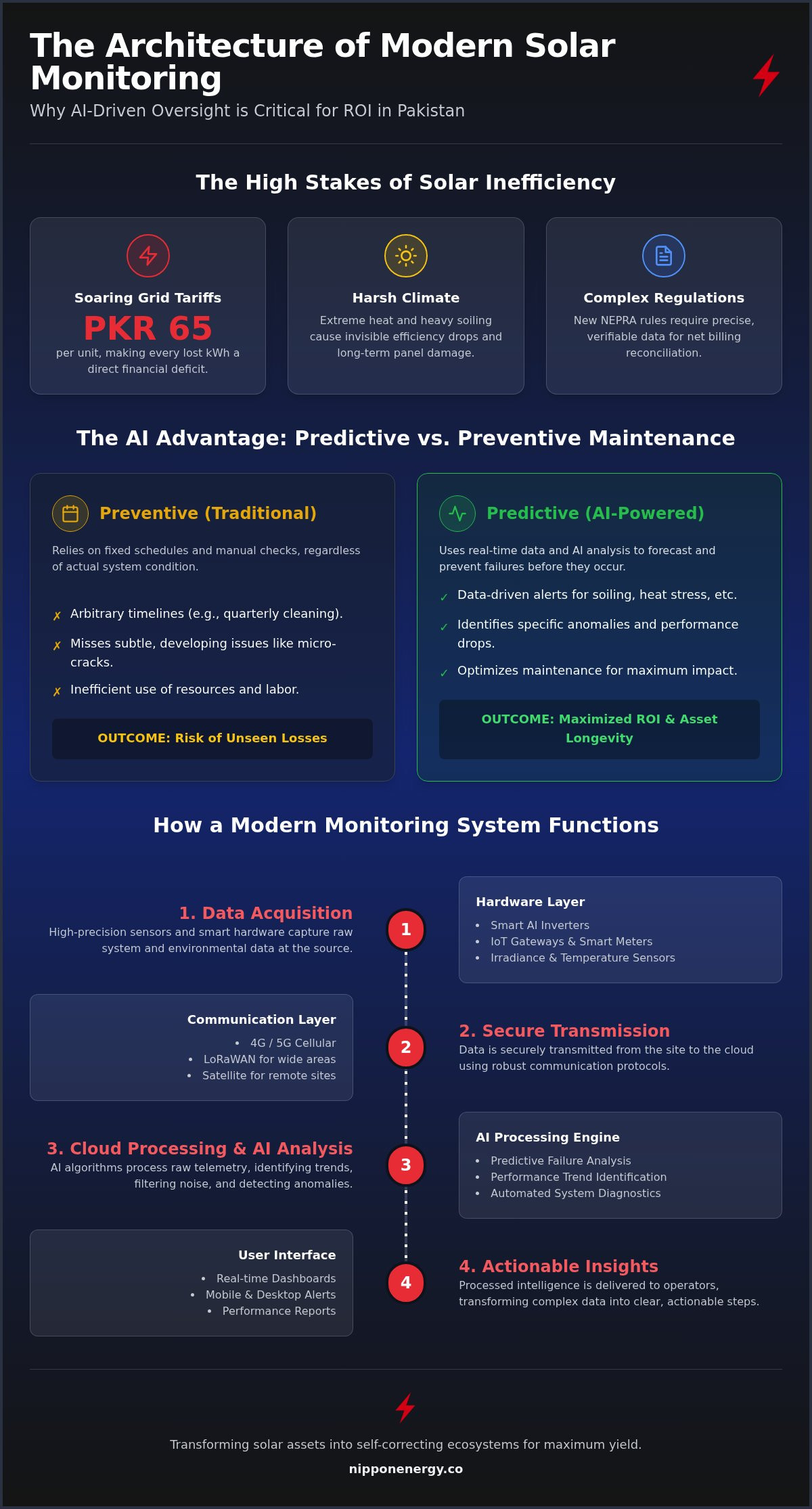
A remote solar monitoring system pakistan functions as a sophisticated IoT-based ecosystem designed for high-resolution, real-time data acquisition. In 2026, the energy landscape has transitioned from reactive troubleshooting to proactive asset management. With national grid tariffs reaching PKR 65 per unit, every kilowatt-hour lost to system inefficiency represents a direct financial deficit. Modern Photovoltaic System Components require constant oversight to ensure they operate within their engineered parameters. This is particularly critical for protecting high-value investments like lithium ion battery storage. Precise charge-discharge monitoring prevents premature degradation and ensures the longevity of the chemical cells, securing your capital expenditure against avoidable wear.
The shift to proactive management is driven by the need for absolute transparency in energy generation. As net billing regulations become more complex, manual meter reading is no longer a viable method for reconciling credits. An integrated monitoring platform provides the evidentiary data required to verify exports and optimize self-consumption. It's the difference between guessing your system's health and possessing a granular, second-by-second audit of your power plant's performance.
From Basic Data to AI Intelligence
The industry has moved beyond simple Wi-Fi dongles that merely report historical generation. Today's systems integrate AI to analyze performance trends across utility-scale solar farms. In 2026, the rollout of high-speed data in industrial zones allows for sub-second telemetry, which is essential for large-scale energy arbitrage. For Pakistani industrial users, simple visibility is insufficient. They require actionable intelligence that predicts load requirements and optimizes the interaction between solar panels, the grid, and onsite storage. This intelligent layer transforms raw data into a strategic tool for financial optimization.
Addressing the Pakistan Climate Challenge
Pakistan's environmental conditions demand specialized monitoring protocols. High ambient temperatures in regions like Sindh can lead to string performance drops that go unnoticed without granular tracking. Modern sensors now detect specific soiling levels, allowing operators to schedule cleaning based on actual dust accumulation rather than arbitrary timelines. This data-driven approach prevents permanent thermal degradation. By receiving real-time alerts on heat-related efficiency dips, you can intervene before the heat causes long-term damage to the cell structure. Your remote solar monitoring system pakistan acts as an early warning system, maintaining the structural and electrical integrity of the entire plant throughout its lifecycle.
How Modern Remote Monitoring Systems Function
A remote solar monitoring system pakistan relies on a multi-layered technical architecture to bridge the gap between physical energy generation and digital oversight. This structure is essential for managing the rapid Solarisation of Pakistan's Energy Economy, where distributed assets require centralized control. The architecture begins at the hardware layer, consisting of industrial-grade IoT gateways, bidirectional smart meters, and high-precision environmental sensors that measure irradiance and back-of-module temperatures. These components capture raw electrical and atmospheric data, which is then transmitted via the communication layer using 4G/5G, LoRaWAN, or satellite links for remote industrial sites.
The cloud layer serves as the processing engine of the ecosystem. Here, AI analysis algorithms filter noise from the raw telemetry to identify subtle performance trends that human operators might overlook. This processed intelligence is delivered through a user interface featuring real-time dashboards for mobile and desktop management. This flow ensures that every data point, from string voltage to ambient humidity, is converted into an actionable insight that helps maintain peak operational efficiency.
The Role of Smart AI Inverters
The smart ai solar inverter functions as the central nervous system of the performance architecture. It doesn't just convert DC to AC; it orchestrates energy flow by monitoring Maximum Power Point Tracking (MPPT) at a granular level. AI integration allows the inverter to adjust its parameters in real-time based on fluctuating solar intensity, ensuring the highest possible yield. By integrating directly with battery management systems, these inverters facilitate a seamless energy flow, prioritizing self-consumption or grid export based on current net billing rates and battery state-of-charge.
IoT Gateways and Edge Computing
In regions where internet connectivity can be intermittent, edge computing is a critical reliability feature. IoT gateways process essential data locally, allowing the remote solar monitoring system pakistan to maintain automated safety protocols and logging even during a total network outage. This localized intelligence is protected by advanced security protocols designed to shield energy data from cyber threats. Furthermore, these gateways enable compatibility between different hardware brands, allowing industrial users to aggregate data from diverse panel and inverter technologies into a single, unified management dashboard. Implementing a robust solar system maintenance and monitoring strategy ensures these edge devices remain updated and secure against evolving technical challenges.
Predictive vs. Preventive: The AI Advantage
Predictive maintenance represents a fundamental shift from traditional, schedule-based upkeep to data-driven intervention. While preventive maintenance relies on rigid timelines that often result in unnecessary labor costs, predictive models use historical telemetry to forecast potential failures before they manifest. In the context of a remote solar monitoring system pakistan, this foresight is critical for maintaining the structural integrity of the plant. AI algorithms analyze voltage signatures to identify micro-cracks or bypass diode failures that remain invisible during standard manual inspections. By detecting these anomalies early, you prevent minor cell-level issues from escalating into catastrophic string failures.
The ROI of this approach is realized through the drastic reduction of manual site visits. You no longer need to deploy technical teams for routine "health checks" when the system provides a continuous, high-fidelity audit of every component. Given the challenges outlined in Pakistan's renewable energy policy regarding grid stability and transmission, ensuring your onsite generation is perfectly optimized is a financial necessity. This intelligence also extends to operational logistics. The system automates cleaning schedules by triggering alerts only when actual soiling levels cause a verified efficiency drop, ensuring maintenance resources are allocated with mathematical precision.
Analyzing Performance in High-Efficiency Systems
High-efficiency installations utilizing topcon solar panels require specialized monitoring to track their unique degradation curves over time. AI management is particularly vital for bifacial modules, which generate power based on complex ground albedo factors that standard monitoring software often miscalculates. AI distinguishes between weather-induced irradiance drops and genuine hardware faults by cross-referencing local meteorological data with real-time string voltage signatures. This sophisticated filtering ensures that environmental variables don't trigger false alarms, allowing operators to focus exclusively on verified hardware performance issues.
Financial Optimization and Net Metering
The 2026 transition to net billing in Pakistan has made precise data reconciliation an absolute requirement for industrial energy consumers. A robust remote solar monitoring system pakistan provides the granular audit trail needed to verify that utility credits accurately reflect your exported energy. You can forecast monthly savings with high accuracy by applying weather-weighted generation data to current grid tariffs. This level of transparency doesn't just protect your current revenue; it provides the empirical evidence required to justify the expansion of existing solar arrays. When the data confirms your current infrastructure is meeting its yield targets, the decision to scale becomes a matter of verified performance rather than speculation.
Choosing the Right Monitoring Architecture for Pakistan
Selecting a remote solar monitoring system pakistan requires a methodical assessment of infrastructure constraints and operational objectives. This decision is not merely a hardware selection but a strategic architectural choice that determines the long-term viability of your energy investment. The process begins with a precise evaluation of project scale. Industrial facilities require high-resolution telemetry across thousands of data points, whereas residential systems prioritize streamlined visibility of daily yields. Connectivity serves as the second critical pillar. While urban centers in Lahore and Karachi benefit from fiber and 4G/5G infrastructure, remote industrial sites often necessitate LoRaWAN or satellite links to ensure consistent data transmission in areas with limited cellular coverage.
Sensor density must be calibrated to the specific microclimate of the installation site. In arid regions like Sindh or Southern Punjab, high-precision soiling sensors are mandatory to track dust accumulation patterns that can reduce output by over 30% if left unmanaged. Furthermore, the chosen platform must offer localized server reliability to minimize latency and ensure data sovereignty. Finally, the architecture must integrate directly with professional solar system maintenance protocols. This integration ensures that the data generated by your monitoring system triggers immediate, expert-led corrective actions rather than remaining as passive information on a screen.
Infrastructure Requirements for Industrial Sites
Multi-megawatt solar farms require SCADA-level monitoring to manage complex electrical architectures. These systems must feature redundant communication paths to maintain visibility during primary network failures, which is essential for mission-critical energy sites. Local technical support teams in Lahore and Karachi provide the necessary rapid-response capability to address hardware anomalies identified by the monitoring software. This localized expertise ensures that technical faults are resolved with minimal downtime, protecting the significant capital expenditure associated with utility-scale energy production.
User-Centric Features for Residential Owners
Residential architectures focus on simplifying complex electrical data into actionable financial metrics. Dashboards prioritize "Daily Savings" and "Environmental Impact" to help homeowners quantify their return on investment in real-time. Mobile alerts for inverter trips or grid failures provide immediate notification of system issues, preventing the loss of generation during peak sun hours. These systems are designed for future-proofing, allowing for seamless integration with EV charging stations and smart home energy management ecosystems. To ensure your home system is equipped with the latest performance tracking technology, you can consult with our technical architects to design a customized monitoring solution.
Nippon Energy: Intelligent Monitoring and Asset Management
The nipponhev system represents the pinnacle of integrated energy management, functioning as a holistic solution that transcends traditional data reporting. By synthesizing Japanese precision engineering with deep operational expertise in the Pakistani market, Nippon Energy delivers an architecture designed for maximum durability. This remote solar monitoring system pakistan doesn't merely observe performance; it actively manages it through a sophisticated interplay between hardware and software. The synergy between Nippon Smart AI Inverters and our professional Solar System Maintenance and Monitoring services creates a self-optimizing energy environment. In industrial applications, our remote diagnostic protocols have demonstrated a 40% reduction in system downtime by identifying electrical anomalies before they result in hardware failure.
Our methodology focuses on the architectural integrity of the energy plant. We utilize high-fidelity telemetry to monitor every string and component, ensuring that the high-efficiency outputs of Nippon HJT and TOPCon panels are maintained throughout their lifecycle. This technical rigor provides the transparency needed for accurate net billing reconciliation and long-term financial forecasting. By centralizing control within a unified ecosystem, we eliminate the fragmentation that often leads to efficiency leaks in complex solar installations.
End-to-End Solar EPC and Monitoring
Successful energy orchestration begins at the design phase. We integrate advanced monitoring protocols directly into our solar epc services, ensuring that every sensor and gateway is optimized for the specific topography of the site. Corporate clients benefit from custom dashboard configurations that align with international energy reporting standards, providing granular insights into carbon offset and cost savings. Utilizing a single partner for hardware procurement, EPC, and monitoring ensures total system compatibility and a streamlined point of accountability for all performance metrics.
Securing the Future of Solar in Pakistan
Nippon Energy is committed to future-proofing Pakistan's energy landscape through technological excellence and absolute transparency. We provide the tools necessary for large-scale success, moving beyond simple installations to provide permanent energy security. If your current array lacks the diagnostic depth required to navigate today's high grid tariffs, a comprehensive system audit is the first step toward optimization. Upgrading to an AI-integrated monitoring architecture secures your investment against environmental degradation and regulatory shifts. Contact Nippon Energy today for a professional consultation and discover how our performance architecture can maximize the ROI of your solar infrastructure.
Securing Your Energy Future Through Performance Intelligence
The transition to a sophisticated remote solar monitoring system pakistan is a technical necessity for any entity seeking to navigate the complexities of modern net billing and high grid tariffs. By moving beyond passive data display toward AI-driven predictive analytics, you protect the structural integrity of your HJT or TOPCon panels while ensuring continuous uptime. This performance architecture transforms raw electrical telemetry into a strategic asset, allowing for precise financial reconciliation and automated maintenance protocols.
Nippon Energy remains at the forefront of this evolution, providing the technical infrastructure required for large-scale energy success. Our Japanese-engineered AI algorithms and dedicated support hubs in Lahore and Karachi ensure that your system operates at peak efficiency regardless of environmental challenges. It's time to transition from simple generation to intelligent energy orchestration. Optimize your solar performance with Nippon Energy's Smart AI Monitoring and secure the long-term ROI of your energy infrastructure. Your journey toward a more resilient and transparent power plant begins with a commitment to technical excellence.
Frequently Asked Questions
What is the typical cost of a remote solar monitoring system in Pakistan?
The capital requirement for a remote solar monitoring system pakistan depends heavily on the sophistication of the hardware layer and the total scale of the installation. Basic residential Wi-Fi kits are generally accessible; however, industrial-grade architectures featuring IoT gateways and environmental sensors require a higher capital allocation. These advanced systems provide significant long-term value by preventing catastrophic hardware failures and optimizing energy yields through high-resolution data acquisition.
Does remote monitoring work during an internet outage?
High-performance monitoring architectures continue to function during internet outages by utilizing edge computing capabilities. IoT gateways store telemetry data locally on internal memory modules when the primary network connection is lost. Once the 4G, 5G, or fiber link is restored, the system automatically synchronizes the cached data with the cloud server. This ensures that your performance history remains complete and accurate without any data gaps during connectivity fluctuations.
Can I add remote monitoring to my existing solar system?
Retrofitting a remote solar monitoring system pakistan to an existing solar array is a standard procedure for optimizing older infrastructure. By installing universal smart meters and industrial IoT gateways, you can gain real-time visibility into legacy inverters and panel strings. This upgrade allows older systems to utilize modern AI-driven dashboards and predictive maintenance protocols, effectively future-proofing your energy investment against evolving grid tariffs and performance degradation.
How does AI improve the accuracy of solar monitoring?
AI enhances monitoring accuracy by distinguishing between temporary environmental factors and genuine hardware malfunctions. Traditional systems often trigger false alarms during cloudy weather or minor shading events. AI algorithms cross-reference real-time irradiance data with historical performance curves to identify subtle anomalies, such as micro-cracks in HJT cells. This precision ensures that maintenance teams are only deployed for verified technical issues, significantly reducing operational expenditure.
What are the benefits of remote monitoring for industrial solar farms?
Industrial solar farms benefit from centralized asset management and reduced operational downtime. Remote monitoring allows for the simultaneous oversight of multiple multi-megawatt sites from a single control center in Lahore or Karachi. By identifying string-level inefficiencies and automating cleaning schedules based on actual soiling data, industrial operators can maximize the energy harvest. This systematic approach is essential for maintaining the high-efficiency output required for corporate energy reconciliation.
Is my solar performance data secure in the cloud?
Data security is a primary architectural requirement for modern energy management platforms. Performance telemetry is transmitted via encrypted communication channels and stored on secure, industrial-grade cloud servers with redundant backups. These protocols protect sensitive energy generation and consumption data from cyber threats. For industrial users, this security ensures that proprietary operational data remains confidential while providing authorized stakeholders with the transparency needed for financial auditing and reporting.
How often should I check my solar monitoring app?
While automated alert systems notify you of critical failures immediately, a weekly review of your performance dashboard is recommended for trend analysis. Checking the app periodically allows you to monitor gradual efficiency drops caused by dust accumulation or seasonal shading changes. This proactive habit helps you schedule cleaning or maintenance before minor soiling leads to significant financial losses, ensuring your high-efficiency panels consistently meet their engineered yield targets.
What is the difference between a Wi-Fi dongle and an IoT gateway?
A Wi-Fi dongle is a basic communication interface that simply transmits data from the inverter to a local router. In contrast, an IoT gateway functions as an industrial-grade controller with local data processing and edge computing capabilities. Gateways support multiple communication protocols like LoRaWAN and RS485, providing a more resilient and scalable solution. They're the preferred choice for mission-critical energy sites where data integrity and local automation are vital.


