
In 2026, the most expensive solar component isn't the one with the highest procurement cost; it's the one that lacks the intelligence to survive a volatile grid. For industrial operators in Pakistan and the UAE, the gap between a standard unit and a high-performance system is no longer measured in simple hardware specs but in operational resilience. You've likely experienced the frustration of rising energy costs and the legitimate fear that today's hardware will become tomorrow's obsolete scrap. It's a valid concern that marketing claims about artificial intelligence often obscure the actual utility of the equipment.
This analysis provides a definitive breakdown of the three phase smart solar inverter price by examining the technical drivers and ROI frameworks currently shaping the $22.81 billion global market. We'll explore how high-power string inverters reaching 125kW are replacing central architectures to eliminate single points of failure. You'll discover the specific impact of 99.1% efficiency ratings on your long-term OPEX and learn to identify the AI-driven energy management features that ensure true energy independence. This guide establishes a structured roadmap for investing in energy infrastructure that remains relevant and profitable well into the next decade.
Key Takeaways
- Learn how three-phase smart inverters have evolved from passive converters into active, AI-managed nodes that orchestrate your entire energy infrastructure.
- Understand the technical drivers behind the three phase smart solar inverter price in 2026, including the shift toward Silicon Carbide (SiC) components and software-defined power electronics.
- Discover how to evaluate Tier 1 versus Tier 2 pricing models by focusing on the long-term Levelized Cost of Energy (LCOE) rather than initial capital expenditure.
- Master a two-step selection framework for matching inverter capacity to your operational load while ensuring your system remains future-proof through modular expansion.
- Explore the benefits of integrating Nippon Smart AI Inverters within the NipponHev system to achieve high-temperature resilience and industrial-grade stability.
The Evolution of Three-Phase Power: Why Smart Inverters Dominate 2026
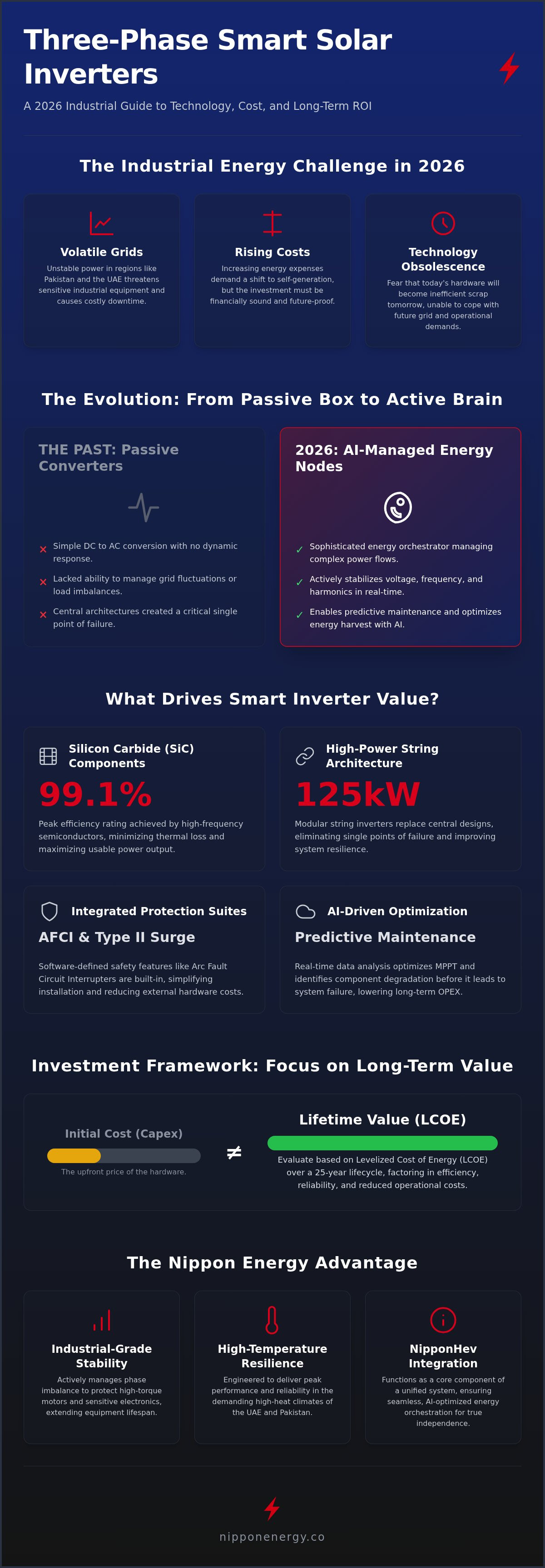
The transition from passive hardware to active energy nodes defines the current era of power management. In 2026, a Solar inverter is no longer a simple device that converts direct current to alternating current. It has become a sophisticated energy orchestrator. This evolution is driven by the necessity of grid stability in regions like Pakistan and the UAE, where traditional infrastructure faces increasing pressure. The three phase smart solar inverter price reflects this shift; you aren't just paying for copper and silicon but for the embedded intelligence that manages complex power flows in real time.
Passive string inverters of the past operated on a logic of simple conversion. They lacked the capability to respond to dynamic grid conditions or internal load fluctuations. Modern AI-managed nodes actively monitor voltage frequencies and harmonic distortions. They provide a stabilization layer that protects sensitive industrial electronics from the volatility often found in South Asian and Middle Eastern grids. By acting as a buffer between the panels and the facility, these units ensure that energy independence doesn't come at the cost of hardware safety.
Three-Phase vs. Single-Phase: The Industrial Standard
Industrial environments require the balanced power delivery that only a three-phase system provides. Single-phase systems often struggle with high-torque motor starts, leading to voltage dips and equipment wear. Smart three-phase inverters address this by managing phase imbalance automatically. If one phase experiences a higher load, the inverter redistributes power to maintain equilibrium. This precision engineering extends the lifespan of motor-heavy equipment and reduces the risk of phase-loss failures, which are common causes of industrial downtime.
The Role of AI in 2026 Energy Infrastructure
Artificial Intelligence is the core differentiator in modern energy architecture. High-speed processors allow for real-time data analysis, optimizing Maximum Power Point Tracking (MPPT) with millisecond precision. This ensures that energy harvest remains peaked even during rapid cloud cover or high-temperature fluctuations common in Dubai or Karachi. Integrating smart ai solar inverters into a facility's infrastructure enables predictive maintenance. The system identifies thermal anomalies or component degradation before they cause a shutdown. By preventing industrial downtime, the three phase smart solar inverter price justifies itself through significantly lowered operational expenditure over the system's 25-year lifecycle.
Decoding the Technical Architecture: What Drives Smart Inverter Costs?
The valuation of energy hardware in 2026 is determined by the complexity of its internal architecture rather than raw material weight. A primary driver of the three phase smart solar inverter price is the transition to Silicon Carbide (SiC) components. These high-frequency switching semiconductors allow for higher efficiency ratings of up to 99.1% while reducing the size of magnetic components. This technical shift minimizes thermal energy loss, which directly translates into more usable power for your facility. Understanding how these units manage inverters and grid services is essential for calculating the total value proposition of your energy investment.
Software-defined power electronics have made the code within the machine as valuable as the copper windings. Modern systems include integrated protection suites, such as Arc Fault Circuit Interrupters (AFCI) and Type II surge protection, which are now standard for industrial safety compliance. These features eliminate the need for external protection hardware, simplifying the installation process and reducing potential failure points. For those seeking to optimize their industrial footprint, consulting with an energy architect can reveal the precise ROI of these technical specifications.
Hardware Precision and Durability
Thermal management remains a critical factor in hardware longevity, especially in desert climates like Karachi or Riyadh. Premium inverters utilize sophisticated cooling systems to maintain optimal operating temperatures under heavy loads. While passive cooling reduces mechanical failure risks, active cooling systems are often necessary for sustained performance in 50°C+ environments. Selecting a unit with an IP66 rating ensures the internal circuitry is protected from fine dust and high-pressure water jets. This level of Japanese-engineered reliability ensures that the three phase smart solar inverter price you pay today results in a system that performs for decades without degradation.
Intelligent Energy Orchestration Features
Smart inverters provide the digital backbone for modern energy management through dynamic export limit control. This software functionality ensures compliance with local net-metering regulations by automatically adjusting power output based on real-time grid requirements. Furthermore, AI-driven charging algorithms optimize the lifecycle of lithium ion battery storage by managing discharge depths based on predictive weather patterns and peak-shaving needs. These units are also Virtual Power Plant (VPP) ready, allowing industrial operators to participate in grid-balancing markets and generate additional revenue streams from their idle energy capacity.
Investment Analysis: Three-Phase Smart Solar Inverter Price Tiers
In 2026, the global solar inverter market has reached a valuation of USD 22.81 billion, a figure driven by the urgent demand for sophisticated grid-support functions. The three phase smart solar inverter price has stabilized across major markets because manufacturing efficiencies have finally balanced the rising costs of raw semiconductors. Investors must now distinguish between the initial sticker price and the total cost of ownership (TCO). This distinction is critical when evaluating emerging technology for grid integration, where the ability to manage voltage and frequency adds significant value to the energy infrastructure.
Tier 1 manufacturers justify their premium positioning through extensive R&D and high bankability. For industrial projects in Pakistan or the UAE, Tier 1 hardware is often a non-negotiable requirement for project financing. Tier 2 units might offer lower upfront costs; however, they frequently lack the consistent firmware updates and high-temperature resilience necessary for long-term stability. Bulk procurement strategies for large-scale developers now focus on master supply agreements (MSAs) that lock in pricing for multi-phase rollouts, effectively protecting against minor supply chain fluctuations.
Residential vs. Commercial Pricing Models
Luxury residential projects typically utilize 10kW to 20kW three-phase units to manage high-consumption appliances and integrated EV charging stations. These units carry a higher price per kilowatt due to their compact form factors and advanced aesthetic designs. Conversely, commercial installations in the 50kW to 100kW range benefit from volume discounts and streamlined logistics. Strategic solar epc services optimize these costs by leveraging established global supply chains and engineering expertise to reduce the total procurement overhead for the end user.
Hidden Costs and Value Add-ons
Several secondary factors influence the final three phase smart solar inverter price beyond the base hardware. Monitoring platforms are a critical consideration. While some brands provide basic SaaS models at no cost, advanced AI-driven analytics that predict component failure may require a subscription. Extended warranties, which have become a 2026 standard with options reaching 25 years, represent a strategic CAPEX increase that mitigates future OPEX risks. Localized technical support in hubs like Lahore or Dubai remains the most undervalued price component, as the immediate availability of spare parts determines the difference between a 24-hour resolution and a costly, month-long system shutdown.
Selection Framework: Matching Inverter Capacity to Operational Load
Selecting the correct inverter capacity requires a methodical engineering approach that extends beyond simple wattage calculations. In high-load industrial environments, the selection process must account for the dynamic nature of three-phase power distribution. A mismatched system doesn't just lose efficiency; it risks hardware failure and operational downtime. The three phase smart solar inverter price should be viewed as a variable in a larger equation of load management and future scalability.
The framework for 2026 investment follows four critical steps. First, you must analyze peak load versus average consumption to ensure the inverter handles high-torque starts without tripping. Second, evaluate future expansion needs by opting for modular AI inverters that allow for incremental capacity increases. Third, assess grid stability in your specific region; areas with frequent fluctuations require hybrid capabilities to maintain a seamless power supply. Finally, calculate the specific ROI by mapping the inverter’s efficiency curve against local electricity tariffs in Pakistan or the UAE.
Industrial Load Analysis
Factories and processing plants often deal with inductive loads from large motors that generate significant surge currents during startup. Standard inverters may struggle with these spikes, leading to frequent system resets or component stress. Strategic oversizing of the inverter capacity, often by 20% to 30% above the peak load, provides a safety buffer that ensures long-term stability. This approach minimizes thermal stress on the internal semiconductors. Additionally, consistent solar system maintenance is essential to ensure that the cooling systems and sensors continue to operate at peak precision, protecting your initial investment.
ROI and Payback Periods
While the initial three phase smart solar inverter price for a premium unit is higher than a standard model, the Levelized Cost of Energy (LCOE) is significantly lower. AI optimization features, such as predictive load shedding and enhanced MPPT tracking, typically reduce the payback period by 15% to 20%. For instance, in a 100kW industrial setup in Lahore, the ability to mitigate grid instability through smart hybrid management prevents the indirect costs of production halts. These efficiency gains ensure that the system pays for itself faster than a cheaper, passive alternative. To begin architecting a system tailored to your facility's specific load profile, contact our technical engineering team for a comprehensive site assessment.
The Nippon Energy Advantage: AI-Optimized Three-Phase Infrastructure
Nippon Energy redefines the energy landscape by positioning the inverter as the central intelligence of the industrial site. The Nippon Smart AI Inverter is engineered with proprietary thermal management protocols to maintain peak performance in environments exceeding 50°C. This high-temperature resilience ensures that the three phase smart solar inverter price reflects a commitment to 25-year reliability rather than temporary cost savings. By integrating these units within the NipponHev system, industrial operators achieve a unified energy architecture where HJT panels, lithium storage, and AI nodes communicate with millisecond latency. This integrated approach minimizes energy conversion losses and provides a stable foundation for large-scale operations.
Our global support network bridges the gap between visionary Japanese engineering and local operational execution. From initial design phases in Tokyo to turnkey project delivery in Lahore, Karachi, and Dubai, we provide a seamless deployment experience. These systems aren't static hardware; they're dynamic assets that receive continuous AI firmware updates. These updates refine MPPT algorithms and grid-balancing logic over time, ensuring your infrastructure evolves alongside changing utility regulations and technological advancements. This commitment to future-proofing protects your capital investment from technical obsolescence, allowing your facility to remain competitive in a rapidly shifting energy market.
High-Tech Architecture and Precision
We adopt the role of a High-Tech Architect, prioritizing the structural integrity and longevity of your energy future. While many market participants engage in a race to the bottom on pricing, Nippon Energy focuses on the total lifecycle value of the installation. We don't design for the lowest bid; we engineer for the highest endurance and maximum uptime. Clients gain direct access to our specialized engineering teams, facilitating the development of custom industrial solutions that address specific voltage requirements or unique site constraints. This methodical focus on technical excellence transforms a standard equipment purchase into a world-class partnership based on reliability.
Next Steps for Your Energy Infrastructure
Advancing your facility's energy independence requires a disciplined, data-driven strategy. We offer comprehensive feasibility studies that analyze your current load profiles and project future energy needs with mathematical precision. By leveraging our end-to-end EPC expertise, we deliver turnkey excellence from the first blueprint to final grid synchronization. This structured approach eliminates the complexity of multi-vendor management and ensures every component is optimized for peak system performance. Request a specialized quote for your three-phase smart inverter system today to begin architecting a future-proofed energy asset that delivers sustained industrial power.
Architecting Your Industrial Energy Future
Investing in a three-phase system in 2026 is a strategic move toward energy orchestration rather than simple power conversion. You've seen how Silicon Carbide components and AI-driven firmware transform a standard unit into a resilient industrial asset. While the three phase smart solar inverter price is influenced by these advanced technical specifications, the resulting decrease in Levelized Cost of Energy ensures long-term profitability and operational stability.
Nippon Energy brings Japanese-standard engineering precision and proprietary AI energy orchestration to every project. Our successful EPC deployments across Pakistan, the UAE, and KSA demonstrate our capacity to deliver stable, future-proofed infrastructure in the most demanding climates. We don't just supply hardware; we build the foundations for industrial longevity through technical mastery.
If you're ready to secure your facility's resilience and eliminate the risks of grid instability, it's time to take the next step. Consult our engineers for a custom 2026 pricing proposal and discover how our technical prowess can optimize your infrastructure. Your path to energy independence begins with a system built for excellence.
Frequently Asked Questions
What is the average price range for a 10kW three-phase smart inverter in 2026?
The three phase smart solar inverter price depends on the integration of high-frequency Silicon Carbide (SiC) components and the level of embedded AI intelligence. While global market competition has stabilized costs, premium units reflect the research and development required for complex grid-support functions. Investors should evaluate the Levelized Cost of Energy (LCOE) rather than the initial capital outlay. High-efficiency models often justify their positioning through significantly reduced long-term operational expenditures.
How does an AI-enhanced inverter reduce my monthly electricity bill?
AI-enhanced inverters utilize predictive algorithms to optimize energy flows based on weather patterns and consumption history. By performing real-time Maximum Power Point Tracking (MPPT) with millisecond precision, the system maximizes energy harvest during variable cloud cover. These units also manage peak-shaving by discharging battery storage when utility tariffs are highest. This intelligent orchestration ensures you draw the minimum possible power from the grid, which directly lowers your monthly operational costs.
Are three-phase smart inverters compatible with older solar panel models?
Smart inverters are generally compatible with existing photovoltaic arrays, provided the voltage and current specifications align with the inverter's input range. However, integrating a modern AI-managed node with older panels might not yield the full efficiency benefits of a unified system. While the inverter will optimize the available power, the total system performance remains limited by the older panel's degradation. A technical site assessment is recommended to ensure hardware synchronization.
What is the typical warranty for a Nippon Smart AI Inverter?
The standard warranty for a Nippon Smart AI Inverter is 10 years, which aligns with 2026 commercial standards for high-performance string inverters. We also provide extended warranty options reaching up to 25 years to support the long-term structural integrity of your energy infrastructure. These warranties cover the internal power electronics and communication modules, ensuring that your industrial facility maintains stability without the risk of hardware obsolescence or unexpected replacement costs.
Can a smart inverter operate effectively during frequent grid outages in Pakistan?
Yes, smart inverters equipped with hybrid capabilities or integrated into the NipponHev system provide seamless power during grid instability. These units detect grid failure instantly and transition to island mode, drawing power from connected battery storage or real-time solar generation. This functionality is essential for industrial sites in Lahore or Karachi, where frequent outages can disrupt production lines. The system ensures that critical loads remain operational without any manual intervention.
Does the price of a smart inverter include the monitoring software license?
The initial three phase smart solar inverter price typically includes access to a basic monitoring platform for real-time performance tracking. Premium AI-driven analytics, which provide predictive maintenance alerts and advanced grid-balancing data, may require a separate SaaS subscription. These software updates are critical for maintaining system security and optimizing efficiency over a 25-year lifecycle. Most industrial operators find that the data-driven insights significantly outweigh the overhead of the monitoring license.
Is it possible to upgrade a standard three-phase system to a smart AI system later?
Upgrading a standard system usually requires replacing the existing inverter with an AI-managed node, as the intelligence is embedded in the hardware's processors. While panels and racking can often be reused, the communication protocols and energy management features of a smart system require specific internal circuitry. It's often more cost-effective to invest in a smart inverter during the initial installation to avoid redundant labor costs and ensure total system optimization from day one.
How do I calculate the ROI for a commercial-scale smart inverter installation?
Calculate ROI by comparing the total system cost against the cumulative energy savings and reduced maintenance expenditures over 10 to 15 years. You must factor in the efficiency gains provided by AI optimization and the avoidance of costly industrial downtime through predictive maintenance. Additionally, consider the value of grid-balancing revenue if your region supports Virtual Power Plant participation. This multi-layered approach provides a more accurate financial picture than simple payback period calculations.


