
In 2026, the hardware of a solar plant is secondary to the intelligence that governs it. If your facility treats power generation as a passive process, you're likely losing up to 20% of your potential energy to inefficient string management or environmental factors like dust and shading. Integrating a smart solar inverter for commercial use is no longer a luxury; it's a structural requirement for businesses facing high peak-hour costs and grid instability in regions like South Asia or the Middle East.
This guide demonstrates how AI-enhanced systems transform passive generators into high-yield assets that actively lower your Levelized Cost of Energy (LCOE). You'll learn how these intelligent architects facilitate seamless integration with battery storage and utilize automated fault detection to slash maintenance costs. We will preview the role of Nippon Smart AI Inverters within the NipponHev architecture, showing you how to secure long-term operational stability through advanced engineering and predictive monitoring. By shifting from reactive hardware to proactive intelligence, your enterprise can turn solar installations into reliable, 24/7 industrial power assets.
Key Takeaways
- Understand the evolution of commercial inverters from simple power converters into intelligent energy management hubs that dictate the financial viability of solar assets.
- Learn how predictive MPPT algorithms in a smart solar inverter for commercial use optimize industrial yield by counteracting environmental factors like shading and dust.
- Discover how AI-driven peak shaving and energy arbitrage strategies allow businesses to reduce demand charges and capitalize on fluctuating utility rates.
- Evaluate critical selection frameworks, including efficiency ratings and scalability models, to ensure your solar infrastructure supports long-term industrial expansion.
- Explore the integration of proprietary AI chipsets within the NipponHev system to achieve seamless synchronization between generation, storage, and grid interaction.
Defining the Smart Solar Inverter for Commercial Scale in 2026
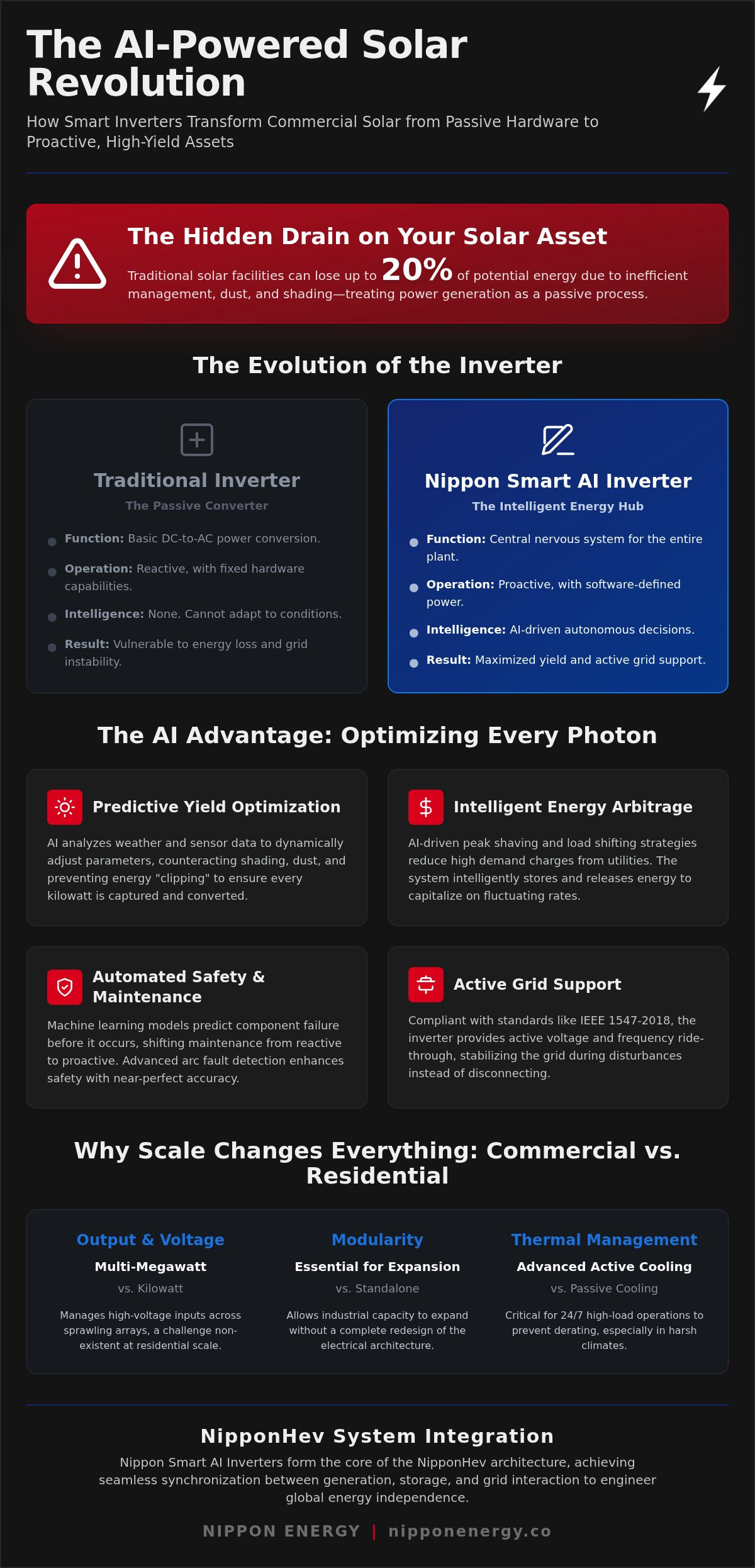
The modern Solar inverter has transitioned from a basic electrical component into a sophisticated energy management hub. Historically, inverters served the singular purpose of DC-to-AC conversion. In 2026, a smart solar inverter for commercial use functions as the central nervous system of an industrial power plant. It executes complex grid synchronization and real-time data analytics while maintaining the structural integrity of the energy stream. This evolution is driven by the necessity for edge computing, where the device makes autonomous decisions at the point of generation to stabilize the local grid. These units don't just report data; they interpret it to maximize the yield of every photon captured.
Meeting modern utility-scale grid codes requires more than simple connectivity. Standards such as IEEE 1547-2018 mandate that smart inverters provide active support through voltage and frequency ride-through capabilities. This means the inverter must remain connected and stabilize the network during minor disturbances rather than simply disconnecting. By utilizing autonomous decision-making, these systems ensure that commercial solar assets contribute to, rather than strain, the regional energy infrastructure. This level of intelligence is what transforms a passive generator into a resilient industrial asset.
The Shift from Hardware to Software-Defined Power
Traditional hardware relied on fixed physical capacities that degraded over time. Modern systems utilize software-defined power, where frequent firmware updates enhance hardware efficiency long after the initial installation. This capability allows for the integration of new grid protocols and performance optimizations without requiring physical site visits. Because these devices are interconnected, cybersecurity is now a critical pillar of commercial energy infrastructure. A smart inverter is a bidirectional data-and-power gateway that secures the flow of information as rigorously as the flow of electrons.
Commercial vs. Residential: Why Scale Changes Everything
Scaling solar infrastructure for industrial applications introduces engineering challenges that residential units don't encounter. Commercial systems must manage high-voltage inputs and multi-megawatt outputs across sprawling arrays. Modularity is essential; it allows for the expansion of industrial capacity without redesigning the entire electrical architecture. Thermal management is also a priority for 24/7 high-load operations. Unlike smaller units, a smart solar inverter for commercial use requires advanced active cooling systems to prevent derating during peak thermal stress. This ensures the system maintains peak performance even in the harsh environments of the Middle East or South Asia.
The AI Advantage: How Intelligent Inverters Optimize Industrial Yield
The integration of Artificial Intelligence represents the most significant advancement in solar technology since the development of high-efficiency cells. While a standard smart solar inverter for commercial use handles basic data reporting, AI-driven models actively intervene to optimize energy output. These systems use machine learning to analyze historical weather patterns and real-time sensor data, allowing for autonomous voltage regulation. This prevents "clipping," a common phenomenon where excess energy is lost because the inverter can't process the surge in power during peak production hours. By dynamically adjusting parameters, the system ensures that every kilowatt produced by the array is converted into usable energy.
Safety at the industrial scale is equally prioritized through AI-driven arc fault detection and rapid shutdown protocols. Traditional systems often struggle to distinguish between normal electrical noise and a dangerous arc, leading to nuisance trips. AI models are trained on thousands of arc signatures, allowing them to identify genuine threats with near-perfect accuracy. This level of precision is supported by guidelines from organizations like the Interstate Renewable Energy Council on Smart Inverters, which emphasize the role of advanced software in maintaining grid-support functions. Machine learning models further enhance this by predicting component failure before it occurs, shifting maintenance from a reactive to a proactive strategy.
AI-Driven MPPT and Predictive Shading
Predictive Maximum Power Point Tracking (MPPT) algorithms resolve the efficiency losses caused by partial shading or dust accumulation. In industrial parks, nearby structures or rooftop obstructions create complex shading patterns that shift throughout the day. AI identifies the optimal voltage curve in milliseconds, bypassing the "global scan" required by older technology. This rapid response prevents the system from getting stuck on local power peaks, which often leads to significant yield loss. Comparative analyses suggest that AI-optimized tracking can recover up to 6% of energy typically lost to environmental obstructions, providing a measurable impact on the overall Levelized Cost of Energy.
Smart Thermal Management for Harsh Climates
Engineering for high-temperature resilience is essential in regions like the UAE and Pakistan, where ambient temperatures often exceed 45°C. A smart solar inverter for commercial use must maintain full power output without derating, even when the thermometer hits 50°C+. Intelligent sensors manage active cooling systems, adjusting fan speeds based on internal component stress rather than just ambient air temperature. This predictive thermal management prevents premature component failure and ensures the longevity of the inverter's power electronics. For enterprises seeking this level of technical precision, exploring Nippon Energy's specialized commercial solutions provides a path toward sustained industrial performance.
Grid Stability and Energy Arbitrage in Commercial Operations
Commercial energy strategy in 2026 is defined by how effectively an asset interacts with the utility grid. A smart solar inverter for commercial use serves as a high-speed negotiator that times power delivery to maximize financial gain. It doesn't just produce electricity; it manages the sophisticated flow between the solar array, the regional grid, and lithium ion battery storage. This orchestration is essential for energy arbitrage, where the system charges batteries during low-tariff periods and discharges them when utility rates reach their daily peak. Recent U.S. Department of Energy solar technology research highlights how these grid-support functions are critical for maintaining regional frequency and voltage stability. By providing these services, commercial assets transition from simple consumers to active grid participants that stabilize the infrastructure they rely on.
The technical authority of a smart system is most visible in its millisecond response to grid fluctuations. When the regional grid experiences frequency drops, the inverter can instantly modulate its output to provide synthetic inertia. This capability is a core requirement for modern industrial facilities that cannot afford the micro-interruptions caused by grid instability. By utilizing AI to monitor these external variables, the inverter ensures that the internal power quality remains consistent, protecting sensitive industrial machinery from voltage sags or surges.
Peak Shaving and Demand Charge Management
Industrial operations often face demand charges that can account for up to 50% of a monthly utility bill. These charges are based on the single highest point of electricity consumption during a billing cycle. A smart inverter mitigates this through automated peak shaving. By analyzing the industrial load profile in real-time, the AI predicts upcoming spikes in consumption and sources power from on-site storage rather than the grid. This intelligent shedding of peak demand can lead to a 20% reduction in commercial energy costs. The result is a flattened load curve that protects the business from the volatility of time-of-use pricing and high-cost peak hours.
Grid Services and Virtual Power Plants (VPP)
The decentralized energy markets of 2026 treat commercial solar plants as Virtual Power Plants. These systems sell excess capacity back to the grid during periods of high demand, creating a recurring revenue stream for the asset owner. The inverter acts as the primary interface for automated demand response programs. It throttles or boosts output based on direct utility signals, ensuring the plant remains a flexible component of the broader energy architecture. This functionality future-proofs the installation against changing regulatory landscapes and allows businesses to capitalize on the increasing value of grid-flexible power assets.
Selection Framework: Evaluating Smart Inverters for Large-Scale Projects
Selecting a smart solar inverter for commercial use requires a shift from simple price-per-watt metrics toward a comprehensive Total Cost of Ownership (TCO) analysis. Efficiency ratings are the first point of technical scrutiny. While Euro-efficiency provides a weighted average based on European climate profiles, the CEC efficiency rating is often more relevant for projects in high-sunlight regions like the Middle East or South Asia. High-performance units in 2026 typically exceed 98.5% weighted efficiency. Beyond conversion rates, the integration of communication protocols like Modbus and SunSpec is mandatory for seamless IoT connectivity and remote asset management. These protocols ensure the inverter can communicate with third-party monitoring platforms and utility control centers without proprietary bottlenecks.
Warranty structures and long-term O&M support from the manufacturer are equally critical. A standard 10-year warranty is the baseline, but the ability to extend this to 20 or 25 years reflects the manufacturer's confidence in their power electronics. In a commercial context, the speed of service and the availability of local technical support can be the difference between a minor interruption and a multi-day revenue loss. Reliability is not just a specification; it's a financial safeguard.
String vs. Central Inverters: The 2026 Consensus
The industry has reached a clear consensus regarding the 1MW to 10MW segment: modular string inverters are now the standard. Unlike central inverters, which represent a single point of failure, a string-based architecture provides inherent redundancy. If one unit requires maintenance, only a small fraction of the array goes offline, avoiding total system downtime. This modularity also accelerates installation speed and reduces labor costs because smaller units don't require heavy cranes or specialized site preparation. For large-scale industrial expansion, the ability to add capacity in granular increments ensures that the energy infrastructure grows alongside the business requirements.
Technical Specifications to Scrutinize
Optimizing the DC/AC ratio is critical when pairing inverters with high-efficiency topcon solar panels. A higher ratio allows the system to reach peak AC output earlier in the day and maintain it longer, maximizing the energy harvest during shoulder hours. Engineers must also evaluate total harmonic distortion (THD) limits. Maintaining THD below 3% is essential for protecting sensitive industrial machinery from electrical noise and potential damage. In dust-heavy industrial zones or coastal regions, enclosure ratings must be a priority. Selecting hardware with IP66 protection ensures that internal electronics remain isolated from particulates and moisture, extending the operational life of the asset. To ensure your project utilizes the highest standards of Japanese engineering and technical precision, consult with Nippon Energy's technical architects to design your commercial energy system.
Nippon Smart AI Inverters: Engineering Global Energy Independence
Nippon Energy's approach to energy architecture moves beyond component-level performance. By utilizing proprietary AI chipsets, a Nippon smart solar inverter for commercial use is specifically engineered to maintain structural integrity in high-temperature industrial environments. These systems are not merely power converters; they function as the intelligent decision-makers for global commercial projects. With a robust engineering presence spanning from Tokyo to Riyadh and Lahore, Nippon Energy provides the global EPC and maintenance support necessary for large-scale energy independence. Real-time monitoring is facilitated through the Nippon Energy Cloud platform, which utilizes edge computing to offer granular visibility into every string of the industrial array, ensuring that performance deviations are corrected instantly.
The Brain of the NipponHev Integrated Architecture
The nipponhev system represents the definitive integration of solar generation and storage. Within this ecosystem, the smart inverter functions as the central processor, synchronizing Nippon HJT panels with lithium-ion storage to ensure 24/7 power availability for heavy industry. By consolidating these high-performance components into a unified architecture, businesses benefit from a single dashboard that manages the entire industrial power plant. This cohesion significantly reduces installation complexity. It eliminates the communication barriers often found when mixing hardware from disparate manufacturers. The result is a streamlined, future-proofed energy asset that operates with total architectural harmony, allowing for seamless scalability as industrial demands grow.
Professional Maintenance and Monitoring
Achieving 25-year reliability requires more than robust hardware; it demands an intelligent approach to long-term upkeep. By leveraging specialized solar system maintenance services, enterprises can ensure their assets remain at peak performance through every season. The Nippon Energy Cloud platform generates predictive alerts based on real-time data trends. These alerts identify potential thermal stress or component wear before they escalate into hardware failures. This proactive strategy minimizes unnecessary truck rolls and manual inspections, directly lowering the operational and maintenance (O&M) costs that typically drain commercial ROI. For organizations ready to transition to an intelligent energy model, we invite you to consult our engineers for a custom smart ai solar inverter solution tailored to your specific industrial load requirements.
Future-Proofing Industrial Energy with Intelligent Architecture
The transition to AI-driven power electronics is no longer optional for enterprises seeking global competitiveness. By deploying a smart solar inverter for commercial use, businesses move beyond simple generation into the realm of active energy orchestration. This shift ensures that your solar installation functions as a high-yield asset capable of autonomous decision-making and real-time grid support. These systems provide the technical foundation needed to manage complex industrial loads while capitalizing on energy arbitrage and peak shaving opportunities.
Nippon Energy bridges the gap between visionary ambition and grounded reliability. We combine Japanese engineering excellence with a global EPC and maintenance network, ensuring your energy assets are optimized for high-temperature climates and long-term stability. Our integrated approach through the NipponHev architecture simplifies the path to total energy independence. Explore Nippon Smart AI Inverters for Your Commercial Project to transform your facility into a resilient, self-sustaining power hub. The future of industrial energy is intelligent, and the tools for your success are ready for deployment today.
Frequently Asked Questions
What is the difference between a standard inverter and a smart AI inverter?
A standard inverter performs basic DC-to-AC conversion with limited data reporting. In contrast, a smart AI inverter acts as an intelligent energy management hub that utilizes edge computing to make autonomous decisions. These systems provide active grid support by riding through voltage fluctuations and optimizing yield in real-time. By integrating predictive algorithms, they transform a passive electrical component into a proactive asset that ensures the long-term structural integrity of your power plant.
Can smart inverters reduce my industrial electricity demand charges?
Yes, a smart solar inverter for commercial use significantly reduces demand charges through automated peak shaving. By analyzing your facility's load profile, the AI predicts consumption spikes and draws power from Nippon Lithium-ion Battery Storage Systems instead of the utility grid. This strategy flattens the load curve and protects your enterprise from high-cost peak hour tariffs. Many industrial users report a 20% reduction in energy-related operational expenses by implementing these intelligent shedding protocols.
How do AI inverters handle high-temperature environments in regions like the Middle East?
Nippon Smart AI Inverters are engineered with advanced thermal management systems specifically for regions like Dubai and Riyadh. Unlike standard hardware that derates as temperatures rise, our intelligent sensors manage active cooling to maintain full power output even at ambient temperatures exceeding 50°C. This resilience is achieved through a calculated blend of high-performance power electronics and predictive cooling algorithms that adjust fan speeds based on internal component stress rather than external air temperature.
Do Nippon Smart AI Inverters work with other brands of solar panels?
Nippon Smart AI Inverters are designed with open-architecture compatibility and work seamlessly with various high-quality solar panel brands. While they're technically optimized for the superior efficiency of Nippon HJT and TOPCon modules, they utilize standard MC4 connectors and industry-standard communication protocols. Integrating them into the broader NipponHev architecture ensures maximum synchronization, but they remain a versatile choice for any large-scale project requiring precision power conversion and intelligent energy management.
What communication protocols are supported for building management system (BMS) integration?
These systems support a wide range of industry-standard communication protocols to ensure seamless integration with Building Management Systems. Common standards include Modbus TCP/RTU and SunSpec, which allow for granular data exchange and remote control. Additionally, our hardware features IoT-ready APIs for integration with the Nippon Energy Cloud platform. This connectivity enables facility managers to orchestrate solar generation, battery storage, and HVAC loads from a single, unified dashboard for total facility efficiency.
Is a smart inverter necessary for a grid-tied commercial system without batteries?
A smart inverter is essential for grid-tied systems because it ensures compliance with modern utility grid codes like IEEE 1547-2018. Even without battery storage, the AI provides predictive MPPT tracking to mitigate losses from dust or partial shading. It also offers advanced safety features like arc fault detection and real-time performance analytics. Investing in a smart solar inverter for commercial use future-proofs your installation against evolving regulations and maximizes the yield of your rooftop or ground-mount array.
How does AI help in detecting solar panel faults or degradation?
Artificial Intelligence identifies faults by comparing real-time string data against historical performance models. The system can instantly distinguish between temporary environmental shading and permanent hardware degradation or Potential Induced Degradation (PID). By utilizing proprietary MPPT algorithms, it detects arc faults and ground leakage with high precision, triggering rapid shutdown protocols to protect industrial assets. This automated monitoring reduces the need for manual inspections and allows for predictive maintenance before a minor fault leads to system downtime.
What is the typical ROI for upgrading to an AI-driven inverter in a commercial setting?
The ROI for upgrading to AI-driven technology is realized through three primary channels: increased energy yield, reduced maintenance costs, and lower demand charges. AI-optimized tracking can recover up to 6% of energy typically lost to environmental obstructions like dust or shading. Furthermore, automated fault detection slashes maintenance expenses by identifying issues before they require expensive truck rolls. While we don't quote specific project costs, the reduction in the Levelized Cost of Energy ensures a faster payback period for industrial installations.


