

In the 45°C heat of a Pakistani summer, the difference between a high-yield power plant and a rapidly depreciating asset isn't just the hardware; it's the engineering integrity of your partner. Many investors prioritize the lowest upfront cost per watt, only to face systemic performance drops when grid-tie synchronization fails or thermal degradation accelerates. Understanding how to choose a solar epc company in pakistan requires moving beyond basic vendor quotes toward a rigorous evaluation of technical resilience and vertical integration. You need an architect, not just a contractor, to ensure your capital expenditure translates into decades of reliable energy.
We recognize that a solar transition is a twenty-five-year commitment. This guide provides the 2026 engineering benchmarks for selecting a Tier-1 EPC partner capable of delivering sub-1% annual degradation and seamless NEPRA net metering integration. We will analyze the critical protocols for hardware procurement, thermal management, and the sophisticated monitoring infrastructure necessary to protect your industrial or commercial investment. By mastering these technical and commercial criteria, you'll secure a system that maintains its efficiency despite the region's extreme climate challenges.
Key Takeaways
- Differentiate between high-level engineering firms and basic hardware vendors to avoid structural failures common in low-cost installations.
- Master the technical criteria for how to choose a solar epc company in pakistan by auditing their thermal modeling and simulation capabilities.
- Verify essential IEC and ISO certifications that guarantee component durability against extreme heat and grid synchronization issues.
- Analyze the Levelized Cost of Energy (LCOE) to determine the true financial viability of your solar investment beyond the initial quote.
- Discover the yield advantages of partnering with a vertically integrated manufacturer that controls both engineering standards and hardware quality.
Understanding the Solar EPC Landscape in Pakistan for 2026
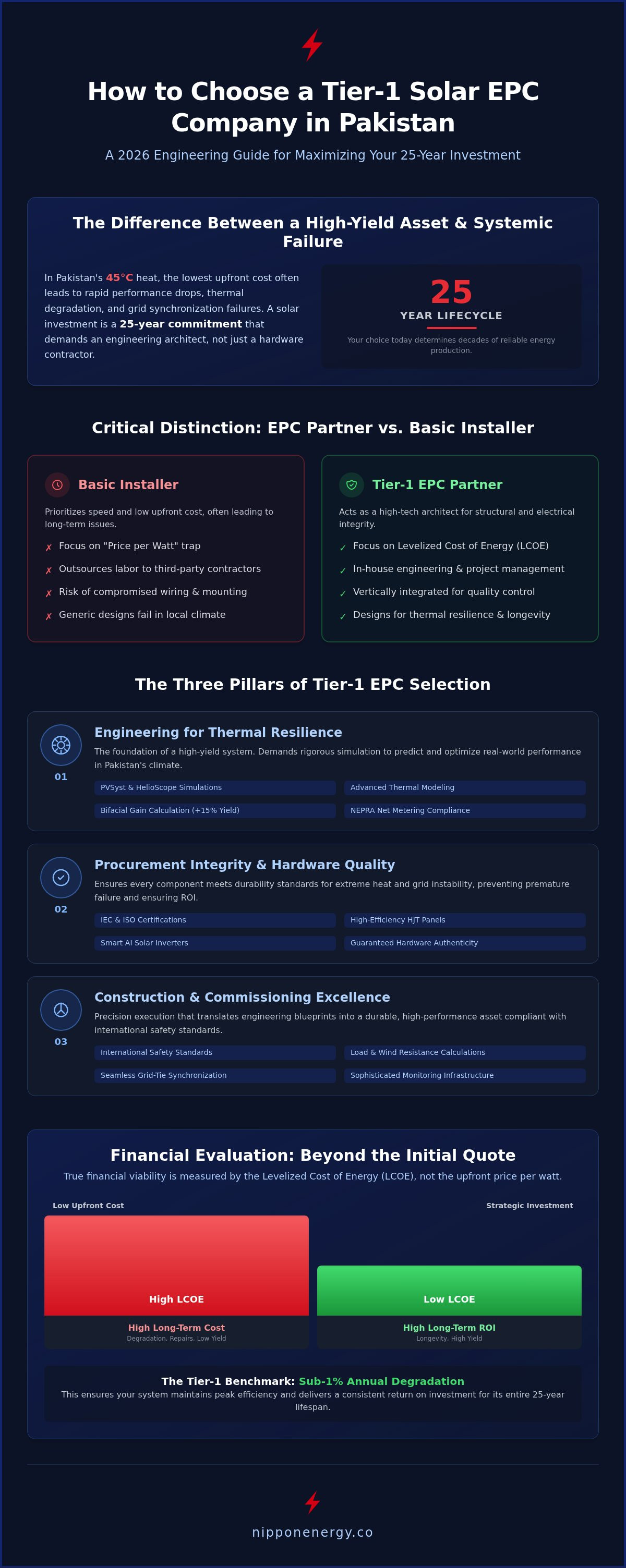
The 2026 energy market in Pakistan has evolved beyond simple hardware retail. An EPC company provides a vertically integrated lifecycle: Engineering, Procurement, and Construction. While a standard vendor might offer a basic installation, a professional EPC firm acts as a high-tech architect, ensuring every component functions as a cohesive unit. This distinction is vital when evaluating how to choose a solar epc company in pakistan, as the "Price per Watt" trap often leads to catastrophic system failure. Low-cost installers frequently ignore thermal coefficients. This leads to rapid efficiency drops in regions where ambient temperatures exceed 45°C.
Modern energy systems must also account for the technological shift from aging PERC modules to high-efficiency hjt solar panels. These modules offer superior temperature coefficients, which are essential for maintaining yield during the peak solar hours of a Pakistani summer. Additionally, EPC firms play a critical role in managing compliance with NEPRA's 2026 net metering regulations. They ensure your investment remains legally and technically synchronized with the national grid, protecting you from bureaucratic delays or synchronization issues.
Installer vs. EPC: Why the Distinction Matters
Speed is the priority for basic installers; long-term structural and electrical integrity is the priority for an EPC. Professional solar epc services involve in-house engineering teams that perform rigorous load calculations and string sizing. Outsourcing labor to third-party contractors often results in compromised wiring standards and poor mounting stability. A dedicated EPC manages the entire project lifecycle through specific phases:
- Engineering: Advanced thermal modeling and PVSyst simulations to predict real-world yield.
- Procurement: Direct relationships with manufacturers to ensure hardware authenticity.
- Construction: Precision execution that follows international safety and durability standards.
Pakistan's Specific Challenges: Heat, Dust, and Grid Instability
Generic system designs fail in cities like Multan, Sukkur, or Karachi because they don't account for local environmental stressors. High ambient temperatures accelerate the degradation of standard silicon cells, while heavy dust accumulation creates significant soiling losses. An expert EPC partner mitigates these issues through specialized site-specific design and advanced hardware selection. To combat the frequent voltage fluctuations and grid instability common in Pakistan, we utilize smart ai solar inverter technology. These systems provide intelligent energy orchestration. They protect your equipment while maximizing the export of surplus energy to the grid, ensuring your system remains an asset rather than a liability.
The Three Pillars of Selection: Engineering, Procurement, and Construction
Selecting the right partner is a strategic decision that determines the 25-year viability of your energy infrastructure. When researching how to choose a solar epc company in pakistan, you must evaluate their proficiency across three technical domains: engineering precision, procurement integrity, and construction durability. A failure in any single pillar compromises the entire asset's ROI. For a unified approach to energy management, the nipponhev system integrates these phases into a single, high-performance architecture.
Engineering for Thermal Resilience
Engineering begins with rigorous simulation using industry-standard software like PVSyst or HelioScope. These tools allow engineers to model specific Pakistani climate variables, such as the high ambient heat that causes standard modules to lose efficiency. HJT panels frequently outperform TOPCon in these environments due to their lower temperature coefficients. Additionally, engineers must calculate bifacial gain for concrete rooftops, where reflected light from the surface can increase energy yield by up to 15%. Whether your facility requires a "Zero-Export" configuration or a standard "Net Metering" setup, the design must align with local DISCO requirements to ensure grid stability.
Procurement Strategy: Tier-1 vs. Proprietary Hardware
Procurement is where many projects fail due to a lack of supply chain transparency. Many vendors claim "Tier-1" status, but without direct manufacturer relationships, there is a risk of receiving refurbished or lower-grade components. Utilizing high-efficiency topcon solar panels for commercial-scale projects ensures a faster ROI through superior power density. This procurement phase also involves verifying that your lithium ion battery storage is fully compatible with the inverter's communication protocols. Ensuring this technical handshake prevents premature battery degradation and system downtime.
Construction represents the final realization of the engineering vision. In coastal regions like Karachi, mounting structures must be rated for high wind load capacity to prevent mechanical failure during monsoon seasons. Similarly, the use of UV-stabilized DC cabling prevents insulation breakdown under Pakistan's intense solar radiation. If you are ready to secure your energy future, you can consult with our engineering team to audit your site's specific technical requirements.
Technical Standards and Certifications to Demand
Regulatory and technical certifications serve as the primary filter for institutional-grade quality. When evaluating how to choose a solar epc company in pakistan, you should ignore subjective marketing labels like "A-Grade" and demand documented compliance with international benchmarks. ISO 9001 for quality management, ISO 14001 for environmental standards, and ISO 45001 for occupational health and safety form the baseline for corporate EPC operations. These certifications ensure that the firm possesses the procedural maturity to handle large-scale deployments without compromising safety or structural integrity.
Beyond corporate standards, the hardware must meet specific durability criteria. IEC 61215 governs design qualification and type approval, while IEC 61730 focuses on safety requirements for photovoltaic modules. These protocols verify that the panels can withstand the mechanical stress and electrical loads typical of the Pakistani climate. Locally, a partner must hold valid Pakistan Engineering Council (PEC) registration in appropriate categories, ranging from C3 to CA, depending on the project's scale. For those seeking net metering, Alternative Energy Development Board (AEDB) certification is a legal prerequisite for DISCO approval.
Verifying Track Records in Pakistan
A firm's theoretical expertise must be validated by real-world performance data. You should request detailed "Generation Reports" from existing installations in industrial hubs like Karachi or Lahore. These reports compare actual energy yield against the original PVSyst simulations. A professional EPC will facilitate visits to their operational sites, allowing you to inspect the quality of the mounting structures and the organization of the DC combiner boxes. It's also vital to ensure the firm maintains dedicated service centers in major Pakistani hubs to provide rapid technical support when needed.
Safety Protocols and AI-Driven Protection
Electrical safety is paramount in monsoon-prone regions where lightning strikes and surges pose significant risks. Robust earthing and lightning protection systems are non-negotiable components of a resilient design. Modern systems require sophisticated DC/AC surge protection to safeguard sensitive semiconductor components in AI-driven inverters. IEC 62446 is the international standard for solar testing and commissioning that ensures your system is safe and fully operational from day one. By integrating AI-driven monitoring, a high-tech EPC can move from reactive repairs to predictive maintenance, identifying potential faults before they impact your energy harvest. This intelligent approach to operation and maintenance (O&M) is what distinguishes a future-proof energy asset from a standard installation.
Financial Evaluation: Beyond the Initial Quote
Evaluating capital expenditure (CAPEX) in isolation is a common strategic error. When determining how to choose a solar epc company in pakistan, the focus must shift to the Levelized Cost of Energy (LCOE). This metric accounts for the total cost of ownership divided by the total energy produced over the system's 25-year lifespan. A lower initial quote often masks hidden costs such as rapid panel degradation or premature inverter failure. High-quality EPC partners provide financial modeling that integrates these variables, ensuring the projected ROI is technically grounded.
Warranty structures also require granular analysis. You must distinguish between a product warranty, which covers manufacturing defects, and a linear performance warranty, which guarantees specific energy output over time. A bankable EPC partner maintains the financial stability to honor these commitments for decades. Partnering with a firm that lacks financial depth often leaves investors with "orphan systems" when the installer exits the market before the warranty period expires.
Calculating Long-Term ROI
The integration of HJT technology significantly alters the 10-year financial outlook. Because HJT modules exhibit a lower annual degradation rate compared to standard cells, the cumulative energy harvest is substantially higher. Investors must also factor in solar system maintenance costs to prevent soiling losses from eroding margins. Additionally, the prevailing net metering buy-back rates from local DISCOs dictate the exact payback period. Precise modeling of these rates allows for a realistic assessment of when the system will reach its break-even point.
Financing and PPA Options in Pakistan
Industrial clients often leverage the State Bank of Pakistan (SBP) Refinancing Scheme for Renewable Energy to secure low-interest capital. An authoritative EPC partner will facilitate this process by providing the necessary technical documentation required by major commercial banks. You should also evaluate the choice between CAPEX and OPEX (Power Purchase Agreement) models. While CAPEX offers maximum long-term savings, an OPEX model reduces upfront risk by allowing the EPC to own and maintain the asset while you pay for the generated power. To evaluate the financial architecture of your specific project, you can request a detailed LCOE analysis from our experts.
The Nippon Energy EPC Advantage: A Global-Local Hybrid
The complexity of the Pakistani energy market demands a partner that bridges the gap between international manufacturing standards and local operational realities. Nippon Energy operates as a global-local hybrid. We apply Japanese engineering precision to the specific environmental stressors of the region. When evaluating how to choose a solar epc company in pakistan, the ability to control the entire supply chain is a decisive factor. By acting as both the manufacturer and the EPC provider, we eliminate the technical disconnects that often occur between hardware vendors and site installers. This vertical integration ensures that every component is optimized for the unified energy architecture of the system.
Our infrastructure includes dedicated maintenance and monitoring teams stationed in Lahore and Karachi. These professionals provide rapid response capabilities that third-party contractors cannot match. This proximity ensures that your system benefits from real-time performance orchestration through our AI-integrated monitoring platforms. We don't just install hardware; we manage a high-performance energy asset throughout its entire lifecycle.
Why Vertical Integration Matters for Your Project
Vertical integration is the cornerstone of system longevity. Most EPC firms act as aggregators; they source panels from one vendor and inverters from another, creating a fragmented warranty landscape. We provide a unified warranty that covers both the hardware and the installation integrity. This model removes the "middleman risk" in procurement. For industrial clients in high-temperature zones like Korangi, Karachi, we perform custom engineering using our proprietary Nippon HJT and TOPCon modules. These panels are specifically designed to maintain high yields where standard PERC modules fail. This direct control over hardware quality allows us to guarantee performance levels that third-party installers simply cannot verify.
Securing Your 25-Year Energy Strategy
A solar asset is a multi-decade commitment that requires more than just an initial setup. Our methodology moves from rigorous feasibility studies to long-term predictive maintenance. We ensure your infrastructure remains future-proof through continuous AI updates that optimize inverter logic and storage discharge patterns. This proactive approach protects your capital from technological obsolescence. Every system we design is built with the structural integrity to survive Pakistan's extreme climate while delivering a superior return on investment. If you're ready to transition to a high-yield energy architecture, you should schedule a technical consultation with Nippon Energy's Pakistan team to audit your facility's potential.
Securing Your Energy Infrastructure for the Next Decade
Mastering how to choose a solar epc company in pakistan transforms a simple hardware purchase into a resilient financial asset. By prioritizing thermal modeling and vertical integration over the lowest initial quote, you protect your investment from the region's extreme climate. The shift toward high-efficiency HJT and TOPCon technology ensures your system maintains peak yield while standard installations suffer from rapid degradation. Evaluating a partner based on their technical certifications and bankability is the only way to ensure your facility remains operational for its entire lifecycle.
Our methodology combines Japanese engineering standards with a robust local presence in Karachi and Lahore to deliver end-to-end excellence. We provide the specialized hardware and AI-integrated orchestration necessary for long-term energy security and seamless grid synchronization. If you're ready to deploy a future-proof energy architecture that delivers measurable ROI, you can contact Nippon Energy for a turnkey EPC proposal in Pakistan. Building a sustainable power plant is a twenty-five-year commitment; we provide the precision and reliability to make it a monumental success.
Frequently Asked Questions
What is the difference between a solar installer and an EPC company?
A solar installer typically focuses on the physical assembly and wiring of components provided by third parties. An EPC company manages the entire lifecycle: engineering the system design, procuring high-grade hardware, and executing the construction. This comprehensive approach ensures that every component is optimized for a unified energy architecture. When researching how to choose a solar epc company in pakistan, prioritize firms that offer this end-to-end accountability for performance and structural integrity.
How do I check if a solar EPC company is registered with the AEDB in Pakistan?
You can verify a firm's status by accessing the official Alternative Energy Development Board website and reviewing their current list of certified service providers. This registration is a legal prerequisite for any system intended for net metering. A valid AEDB certification serves as a baseline indicator of technical competency and regulatory compliance. It ensures the partner possesses the authorization to handle synchronization with local power distribution companies (DISCOs).
Why is the temperature coefficient important for solar panels in Pakistan?
The temperature coefficient quantifies the reduction in power output for every degree the ambient temperature rises above 25°C. In Pakistan's extreme climate, where summer temperatures frequently exceed 45°C, a low temperature coefficient is vital for maintaining yield. Nippon HJT modules utilize advanced cell architecture to minimize these thermal losses. This technical feature ensures your energy harvest remains stable despite the intense heat common in industrial zones like Korangi or Multan.
Can a solar EPC company help with the net metering application process?
Professional EPC firms manage the entire net metering lifecycle, from the initial feasibility study to final grid synchronization. They handle the complex technical documentation and regulatory filings required by NEPRA and local DISCOs. This proactive management eliminates bureaucratic delays and ensures your system begins exporting surplus energy immediately after commissioning. Entrusting this process to an expert partner protects your investment from common administrative and technical bottlenecks.
What should be included in a standard solar EPC contract?
A transparent EPC contract must include a detailed Bill of Materials (BOM), a guaranteed performance ratio, and a specific project completion timeline. It should also define the warranty structures for both the hardware and the installation workmanship. A well-structured agreement outlines the frequency of system maintenance and the scope of long-term technical support. This clarity ensures that the investor and the provider are aligned on the system's 25-year operational expectations.
How does HJT technology improve the performance of an EPC project?
Heterojunction (HJT) technology combines crystalline silicon with thin-film layers to achieve superior efficiency and a lower annual degradation rate. This bifacial architecture allows for energy harvest from both sides of the panel, significantly increasing the total yield on reflective surfaces. In an EPC project, utilizing HJT hardware leads to a lower Levelized Cost of Energy (LCOE) and a faster return on investment. It's the ideal choice for high-performance industrial energy systems.
What are the common hidden costs in solar EPC quotes in Pakistan?
Hidden costs often arise from the use of substandard mounting structures, low-grade DC cabling, or the omission of essential surge protection devices. Some quotes also exclude the costs associated with net metering licensing or specialized logistics for remote sites. A thorough evaluation of how to choose a solar epc company in pakistan should focus on the total cost of ownership rather than just the initial price per watt. This perspective reveals the long-term value of high-quality engineering.
Is it better to choose an EPC company that manufactures its own solar panels?
Selecting a vertically integrated EPC partner like Nippon Energy eliminates the middleman risk and ensures perfect compatibility between the panels, inverters, and storage systems. This model provides a single point of accountability for the entire infrastructure's performance. It also grants the investor direct access to the latest technological innovations and manufacturer-backed warranties. Vertical integration simplifies the supply chain and guarantees that the hardware meets the highest Japanese engineering standards.


