
In 2026, a standalone solar array is no longer a complete energy strategy. It is a half-finished blueprint that leaves industrial operations vulnerable to the volatile architecture of the modern grid. You likely recognize that rising peak-hour tariffs and grid instability aren't just operational inconveniences; they're structural threats to your bottom line. Discover how integrated solar and lithium-ion storage systems provide commercial and industrial enterprises with a decisive financial and operational edge this year.
The benefits of solar plus storage for c&i have shifted from optional sustainability goals to mandatory financial requirements. By pairing high-efficiency panels with Nippon Lithium-ion Battery Storage Systems, firms can achieve the 85% round-trip efficiency standard while securing predictable long-term OPEX. This guide provides a granular analysis of the 2026 energy landscape. We'll examine how Nippon Smart AI Inverters optimize load profiles, the impact of the 3.0 REC multiplier for storage, and the technical pathways to achieving seamless backup power for critical industrial processes.
Key Takeaways
- Understand why shifting to a dual-asset energy architecture is essential to mitigate 2026 market volatility and ensure long-term cost predictability.
- Learn how the technical benefits of solar plus storage for c&i are amplified by high-density HJT panels that accelerate battery charging cycles and maximize limited roof space.
- Discover the mechanics of peak shaving and energy arbitrage to transform your facility from a passive consumer into an active participant in energy management.
- Evaluate the critical role of turnkey EPC services and Smart AI Inverters in orchestrating complex industrial energy flows for maximum efficiency.
- Gain insights into future-proofing industrial operations with integrated storage solutions engineered for resilience in extreme global climates.
The Strategic Shift: Why C&I Solar Plus Storage is Mandatory in 2026
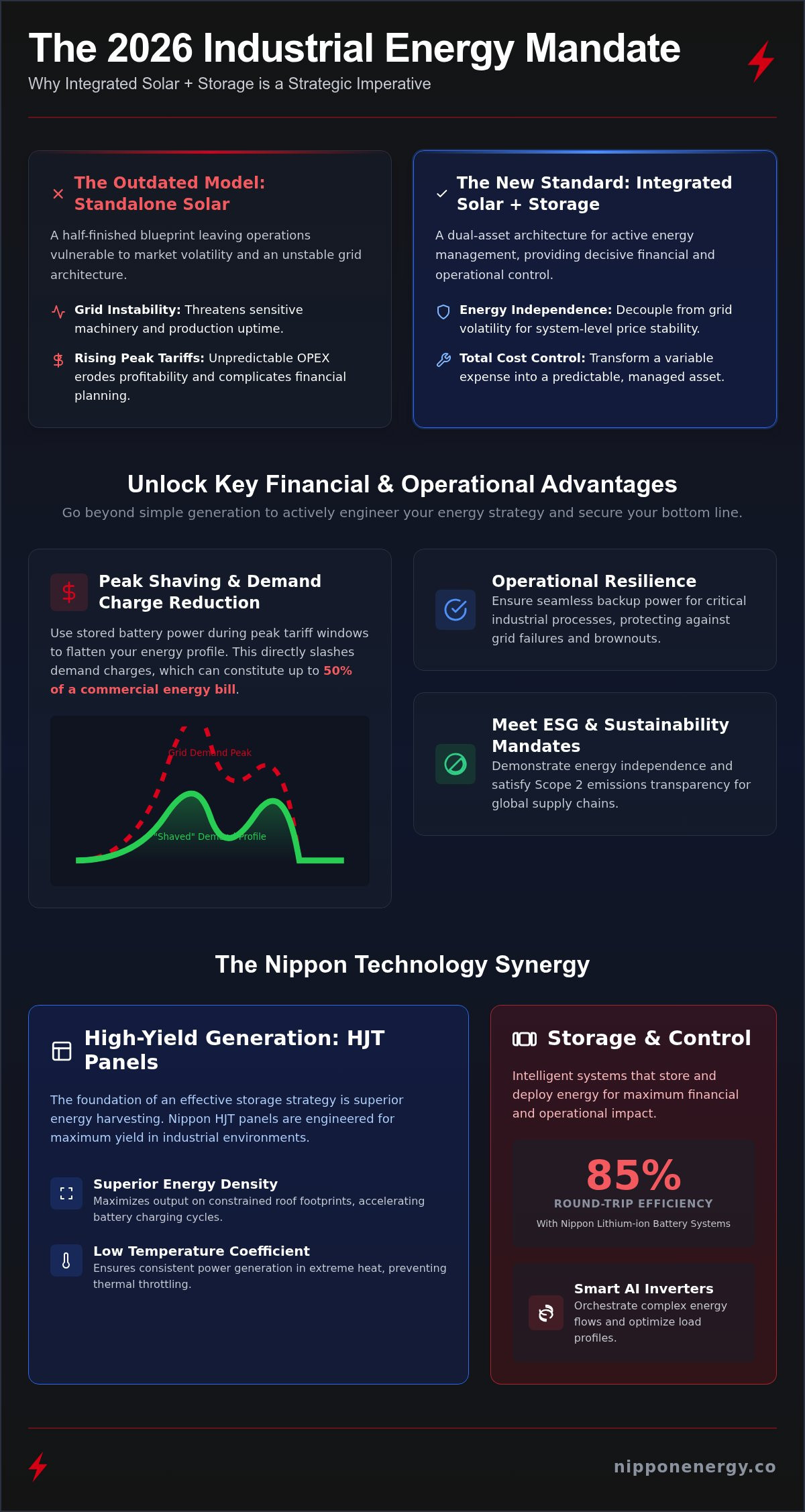
In the current industrial climate, energy is no longer a utility to be purchased; it's a strategic asset to be engineered. The transition to a dual-asset energy architecture, combining high-efficiency generation with a sophisticated Battery energy storage system, has become the baseline for modern facility management. This shift represents a move from passive generation, where firms simply harvest sunlight, to active energy management. By controlling the timing of power distribution, enterprises unlock the core benefits of solar plus storage for c&i, transforming power from a variable expense into a predictable operational component.
The global energy markets of 2026 are defined by extreme price swings and infrastructure strain. While standalone solar provides some relief during daylight hours, it doesn't protect against the high-tariff windows or grid instability that occur after sunset. A dual-asset system provides a localized buffer. It creates system-level price stability by decoupling industrial operations from the immediate volatility of the public grid. For manufacturers, this resilience is a decisive competitive advantage. It ensures that production lines remain active while competitors struggle with escalating costs or intermittent supply.
Mitigating Grid Volatility and Demand Charges
Demand charges often constitute up to 50% of a commercial energy bill. These fees are calculated based on the highest level of electricity drawn during a single short interval. By utilizing stored energy during peak tariff windows, a process known as peak shaving, businesses can effectively flatten their load profile. This reduces the peak used for billing calculations. Beyond cost, the technical stability of an integrated system protects sensitive industrial machinery from the micro-fluctuations and brownouts that characterize aging grid infrastructures.
Meeting 2026 Sustainability and ESG Mandates
The regulatory landscape has shifted toward Green Industrialization. Global supply chains now demand transparency regarding Scope 2 emissions, making one of the key benefits of solar plus storage for c&i its ability to maximize carbon-neutral energy usage. Investors and partners prioritize enterprises that demonstrate tangible energy independence. By integrating Nippon Lithium-ion Battery Storage Systems, firms don't just meet compliance targets; they build brand equity. Reliable, renewable energy becomes a hallmark of a future-proofed, responsible organization.
Technical Synergy: HJT Panels and Lithium-Ion Storage Performance
The efficiency of the generation source determines the operational ceiling of any storage system. Nippon HJT Solar Panels utilize a Heterojunction technology that achieves superior energy density, which is critical for industrial facilities with constrained roof footprints. Higher energy yields directly correlate with faster battery charging cycles. This technical relationship ensures that the storage system reaches full capacity earlier in the day, providing a larger buffer for evening peak shaving and maximizing the benefits of solar plus storage for c&i.
Thermal stability is a non-negotiable requirement for industrial zones in high-temperature regions like Pakistan and the Middle East. Standard panels often see a sharp decline in performance as ambient temperatures rise. In contrast, Nippon HJT technology maintains a low temperature coefficient; this ensures consistent output even in extreme heat. This stability prevents the generation gap that often plagues legacy systems during the hottest hours of the day, allowing for a steady flow of energy to the storage units without thermal throttling.
Maximizing Solar Harvest with HJT Efficiency
Nippon HJT panels are engineered for maximum bifacial gain. When installed on high-albedo surfaces, such as white TPO roofs, these panels capture reflected light from the underside to increase total system output. This precision engineering is a core pillar of modern energy architecture. For facilities where specific architectural constraints or budget requirements exist, Nippon TOPCon Solar Panels offer a high-performance alternative to ensure no energy potential is wasted. Both technologies prioritize high-yield generation to keep storage reserves at optimal levels.
The Superiority of Lithium-Ion Energy Density
The transition from legacy lead-acid to Nippon Lithium-ion Battery Storage Systems represents a significant leap in energy architecture. Lithium-ion systems offer a substantially smaller physical footprint, allowing for high-capacity installations in confined industrial spaces. Crucially, the Depth of Discharge (DoD) for lithium-ion typically reaches 90% or higher, whereas lead-acid systems are often limited to 50% to prevent permanent damage. This increased usable capacity supports the intensive duty cycles required by industrial machinery. For a granular breakdown of these specifications, consult the Definitive Guide to Lithium-Ion Battery Storage.
Durability is another key differentiator. While lead-acid batteries may require replacement every 3 to 5 years, Nippon Lithium-ion systems are designed for longevity, often exceeding 6,000 cycles at high DoD. This resilience ensures that the initial capital investment translates into a decade or more of reliable service. If you're ready to engineer a more resilient power structure, consult with our project development team to evaluate your site’s specific technical requirements.
Financial Architecture: Peak Shaving, Arbitrage, and ROI
The transition to a dual-asset energy model transforms power from a fixed operational cost into a dynamic financial instrument. Peak shaving serves as the primary mechanism for immediate expenditure reduction. By discharging stored energy during peak tariff windows, the system effectively flattens the facility's load profile. This action directly lowers demand charges, which can constitute up to 50% of an industrial utility bill. These benefits of solar plus storage for c&i provide a level of fiscal control that standalone solar cannot achieve, as it decouples production schedules from the utility's most expensive timeframes.
Energy arbitrage further enhances this financial architecture. The system logic allows for charging from the grid during off-peak hours when rates are lowest, then discharging that power when market prices escalate. While adding storage increases the initial levelized cost of energy (LCOE) on a per-unit basis, the total system value is significantly higher. In 2026, regulatory frameworks have introduced powerful incentives to support this shift. For instance, certain jurisdictions now offer a Renewable Energy Certificate (REC) multiplier of 3.0 for energy storage, alongside 12-year waivers on inter-state transmission charges for co-located projects. These provisions accelerate the path to capital recovery.
Calculating the Internal Rate of Return (IRR)
Analyzing the IRR requires a shift in perspective from simple energy savings to total risk mitigation. Standalone solar projects often face diminishing returns due to midday curtailment or low export rates. Integrating storage solves this by capturing every kilowatt produced. The break-even point for these systems often shifts forward when factoring in the avoided costs of industrial downtime. Utilizing the NipponHev System simplifies this financial modeling, as it provides a unified platform for tracking performance and predicting long-term capital yields with high precision.
Revenue Generation through Grid Services
Modern industrial energy systems are no longer isolated islands. Through Virtual Power Plants (VPPs), C&I entities can aggregate their stored capacity to provide frequency regulation and grid stability services. This creates a secondary revenue stream by selling excess power back to the grid during periods of high demand. Nippon Smart AI Inverters manage these complex transactions autonomously, ensuring that the facility's primary power needs are met before engaging in market services. This intelligent orchestration ensures that the benefits of solar plus storage for c&i extend beyond internal savings into active market participation.
Implementation Strategy: EPC and System Orchestration
Successful deployment of industrial energy systems requires a synchronized orchestration of generation, storage, and consumption. A turnkey approach ensures that the technical benefits of solar plus storage for c&i aren't lost through fragmented engineering. The integration process links high-efficiency arrays with battery banks and factory loads, creating a closed-loop system that responds in real-time to operational demands. Centrally, Smart AI Solar Inverters serve as the command center, managing power flows with millisecond precision to prevent industrial downtime.
Asset longevity depends heavily on rigorous Solar System Maintenance, particularly for the lithium-ion storage components. Regular monitoring of thermal profiles and cycle health prevents degradation, ensuring that the system delivers its promised ROI over a 15 to 20-year lifecycle. Without professional oversight, even the most advanced hardware can suffer from efficiency losses that undermine the financial architecture established in previous project phases.
AI-Driven Energy Management Systems (EMS)
Modern Energy Management Systems utilize machine learning to predict local weather patterns and facility load requirements. This predictive capability allows the system to preemptively charge batteries before forecasted cloud cover or high-tariff peak windows. By activating "Self-Consumption Mode," the EMS prioritizes internal power usage, minimizing grid reliance and maximizing the benefits of solar plus storage for c&i. For industrial enterprises, the security of this AI-orchestrated energy data is critical, requiring encrypted protocols to protect operational intelligence from external vulnerabilities.
The Role of an EPC Partner in C&I Success
High-voltage industrial systems demand specialized Solar EPC Services that go beyond standard rooftop installations. The feasibility study phase is particularly vital for battery sizing; an undersized system fails to provide sufficient backup, while an oversized one extends the payback period unnecessarily. A partner with a local engineering presence in Tokyo, Dubai, and Karachi understands the specific regulatory and climatic challenges of these regions. This technical proximity ensures that the system architecture is future-proofed against local grid evolutions and extreme environmental conditions. To begin your facility's transition, request a technical feasibility study from our engineering team.
The Nippon Advantage: Future-Proofing Industrial Energy
Choosing an energy partner is a decision that defines the structural longevity of an industrial operation. Nippon Energy has established itself as the global pioneer in integrated HJT and storage solutions, providing a cohesive architecture that hardware vendors cannot replicate. While a vendor sells components, a High-Tech Architect engineers a system for 25 years of operational integrity. The long-term benefits of solar plus storage for c&i depend on this holistic approach, where every technical feature is calibrated to the specific load requirements of the enterprise. By positioning ourselves as a world-class partner, we provide the tools for large-scale success across diverse industrial sectors.
Resilience in High-Temperature Environments
In regions like the Middle East and South Asia, ambient heat poses a significant risk to energy storage longevity and panel efficiency. Nippon HJT Solar Panels are engineered for high-temperature resilience, preventing the performance degradation typical of legacy modules. Our Nippon Lithium-ion Battery Storage Systems feature proprietary cooling and thermal management protocols within their cabinets to maintain internal stability. This advanced engineering ensures that cells operate within their optimal range regardless of external environmental stress. Nippon HJT technology stands as the industry benchmark for 2026 thermal efficiency, maintaining peak performance when conventional systems fluctuate.
Global Expertise, Local Execution
Strategic hubs in Riyadh and Lahore allow Nippon Energy to apply Japanese engineering standards to localized industrial challenges. This global presence ensures that the technical prowess of our international headquarters is matched by precise, on-the-ground execution. We prioritize a "Quiet Power" philosophy, where the complexity of energy orchestration is handled by invisible, intelligent systems that operate with methodical excellence. This discipline ensures that industrial projects move from inspiration to evidence through a predictable and steady pace of development.
The cumulative benefits of solar plus storage for c&i are only fully realized when the enterprise can focus on production, knowing their energy architecture is secure and future-proofed. Our end-to-end EPC services ensure that the structural integrity of your system remains a priority from initial design to long-term maintenance. This methodical focus on excellence creates a stable foundation for industrial growth in a volatile energy market. For a customized evaluation of your facility's potential and a granular breakdown of your projected ROI, contact Nippon Energy for a C&I energy feasibility audit.
Architecting Your Industrial Energy Independence
Industrial enterprises must evolve from passive utility consumers to active architects of their own energy future. The integration of high-density generation and lithium-ion storage represents the only viable pathway to long-term price stability and grid independence. This guide has detailed how technical synergy and financial orchestration converge to create a superior operational model. Each component, from the panel to the inverter, must serve a unified strategic purpose within your facility's infrastructure.
The benefits of solar plus storage for c&i are most effectively realized through a partnership with a global pioneer. Nippon Energy delivers Japanese-engineered HJT technology and proprietary AI-driven energy management to ensure your system performs at peak efficiency. Our turnkey EPC excellence across five continents provides the structural reliability needed for large-scale success. Take the decisive step toward a resilient and future-proofed energy profile today.
Consult with a Nippon Energy Architect for your C&I Solar Plus Storage project to secure your facility's competitive advantage in 2026 and beyond.
Frequently Asked Questions
What is the typical ROI for a C&I solar plus storage system in 2026?
ROI is influenced by local tariff structures and demand charge reductions. In 2026, integrated systems often see an Internal Rate of Return (IRR) increase from 13% to over 21% when compared to standalone solar. Factors like a 4.3-year payback period are achievable for facilities that effectively use storage for cost arbitrage. These benefits of solar plus storage for c&i ensure that the initial capital expenditure translates into millions in long-term operational savings.
Can solar plus storage provide full backup power for a manufacturing facility?
Full backup is achievable through precise system sizing and energy orchestration. A Nippon Lithium-ion Battery Storage System can be configured to support critical industrial loads during grid failures. During the EPC phase, engineers identify essential machinery to ensure that the battery capacity matches the required duration of the outage. This creates an islanded microgrid that prevents costly production downtime and protects sensitive equipment from micro-fluctuations in power.
How long do Nippon Lithium-ion Battery Storage Systems last in industrial use?
Nippon Lithium-ion Battery Storage Systems are engineered for durability in intensive industrial environments. These systems typically deliver over 6,000 cycles at a high depth of discharge, translating to a service life of 10 to 15 years. This longevity represents a significant improvement over legacy lead-acid solutions, which often require replacement every 3 years. Advanced thermal management within our cabinets ensures that the cells remain stable even in extreme climates.
What is peak shaving and how does it reduce industrial electricity bills?
Peak shaving is a strategy where stored energy is discharged during periods of highest demand to lower the facility's peak draw from the grid. Since demand charges can constitute up to 50% of a commercial energy bill, flattening this load profile leads to immediate savings. This mechanism is one of the primary benefits of solar plus storage for c&i, as it allows manufacturers to bypass the most expensive utility tariff windows.
Is HJT or TOPCon better for large-scale commercial rooftop solar?
The choice depends on specific site conditions and budget requirements. Nippon HJT Solar Panels are generally superior for high-temperature regions like Pakistan and the Middle East due to their lower temperature coefficient. This ensures higher yields during peak heat hours. Nippon TOPCon Solar Panels provide a highly efficient alternative for projects where maximizing energy density is the priority. Both technologies integrate seamlessly with our storage solutions to provide reliable industrial power.
How does an AI solar inverter improve battery life and performance?
Nippon Smart AI Inverters act as the brain of the energy architecture. They use machine learning to forecast weather patterns and facility consumption, which allows them to optimize charge and discharge timings. By preventing unnecessary cycling and managing thermal loads, the AI extends the operational lifespan of the battery cells. This intelligent orchestration ensures that the storage system always operates at its peak efficiency while minimizing the risk of degradation.
What maintenance is required for a commercial-scale battery storage system?
While lithium-ion systems are low-maintenance compared to mechanical generators, they require professional Solar System Maintenance and Monitoring. This includes annual inspections of thermal management hardware, cell balancing verification, and software updates for the AI management layer. Remote monitoring allows our engineers to detect and resolve micro-fluctuations before they impact production. Regular maintenance is essential to protect the 15 to 20-year design life of the industrial energy asset.
Are there specific incentives for C&I solar storage in the Middle East or Pakistan?
Regional governments have introduced several mechanisms to support industrial energy independence. In 2026, some jurisdictions offer a Renewable Energy Certificate (REC) multiplier of 3.0 for energy storage projects. There are also 12-year waivers on inter-state transmission charges for co-located storage commissioned by June 2028. In markets like Pakistan and the UAE, the widening gap between peak and off-peak tariffs provides a natural financial incentive for adopting storage-based cost arbitrage.


