

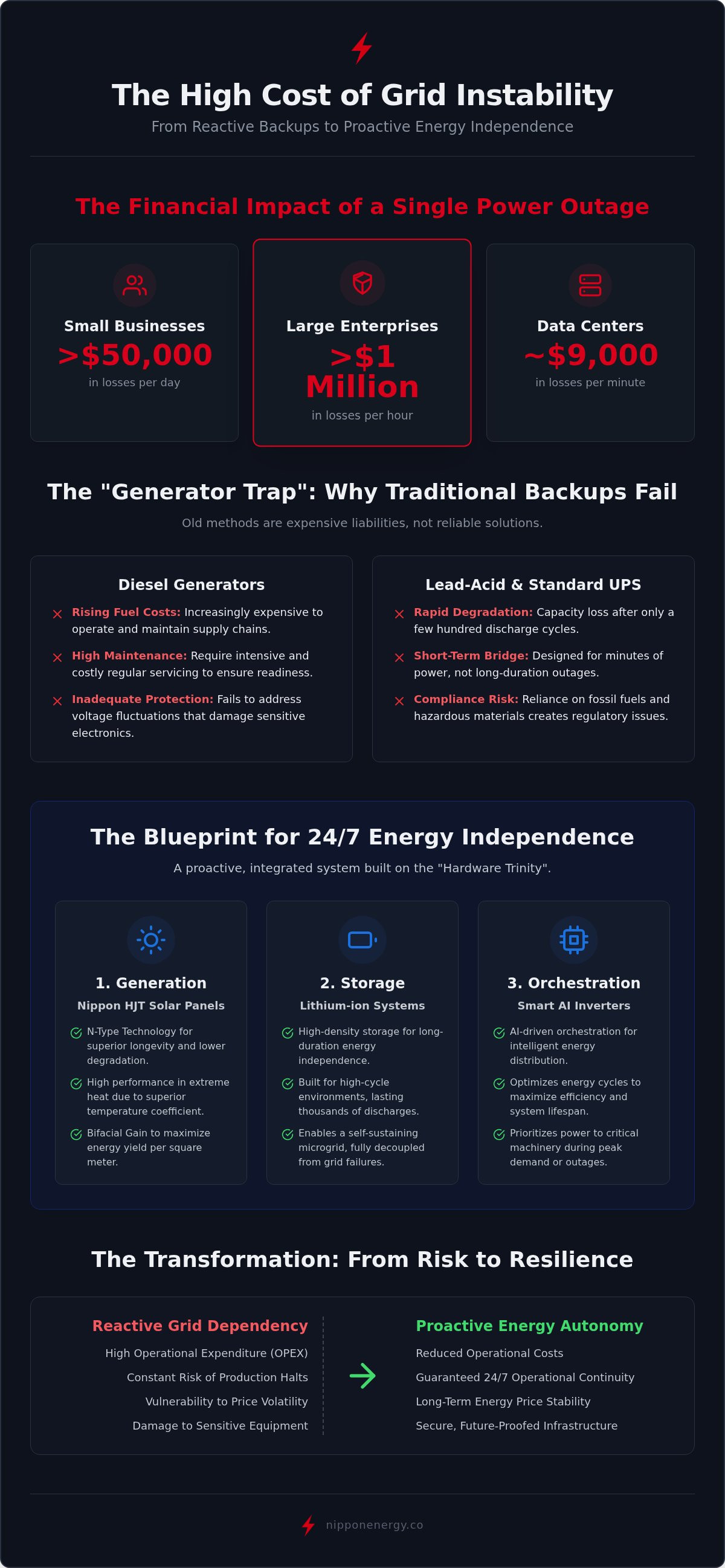
In 2026, a single day of power loss can cost a small business over $50,000, while large enterprises often face hourly losses exceeding $1 million. You likely recognize that relying on a fragile grid is no longer a viable strategy for growth. If you're searching for how to ensure 24/7 power for my business, you've realized that traditional diesel generators are becoming a liability due to rising fuel costs and high maintenance demands. It's time to move beyond temporary fixes toward permanent, structural energy security.
We understand the frustration of production halts during load shedding and the technical risks posed by voltage fluctuations. This guide provides a precise blueprint for architecting a resilient, AI-driven energy system that decouples your operations from grid instability. We'll explore the integration of Nippon HJT Solar Panels, lithium-ion storage, and Smart AI Inverters to create a self-sustaining microgrid. You will discover how to transition from reactive backup power to a proactive, future-proofed energy infrastructure that reduces operational expenditure and secures your long-term success through intelligent orchestration.
Key Takeaways
- Analyze the hidden economic impacts of grid instability and the strategic necessity of transitioning toward full energy resilience.
- Architect a robust power generation engine by integrating high-efficiency Nippon HJT Solar Panels with long-life lithium-ion storage systems.
- Discover how to ensure 24/7 power for my business through AI-driven orchestration that prioritizes critical machinery and optimizes energy cycles.
- Evaluate the importance of a professional EPC approach to ensure your infrastructure is engineered for site-specific environmental demands.
- Implement the scalable NipponHev system to achieve multi-megawatt energy independence through a unified and modular hardware architecture.
The Economic Imperative: Why Traditional Power Backups Fail Modern Businesses
Energy resilience is the structural capacity to maintain operational continuity during grid failure or extreme price volatility. It's a strategic asset, not a luxury. For many executives asking how to ensure 24/7 power for my business, the answer begins with a stark realization: the old methods of backup power are no longer sufficient. Modern operations rely on sensitive data, synchronized machinery, and precise climate control. A momentary lapse in current doesn't just turn off the lights; it triggers a cascade of technical and financial failures.
The hidden costs of downtime are often underestimated. Beyond immediate production spoilage, businesses face permanent data loss and significant labor idle time. In 2026, the U.S. Department of Energy estimates that power outages cost businesses approximately $150 billion annually. In regions like Pakistan and the Middle East, heat-induced grid failures are becoming the baseline rather than the exception. High ambient temperatures stress local infrastructure, leading to frequent load shedding that disrupts industrial output and commercial stability.
Many firms remain stuck in the "Generator Trap." While diesel generators were once the standard, they're now a liability. Rising fuel prices and intensive maintenance schedules make them expensive to operate. They also fail to address voltage fluctuations that can damage sophisticated electronic equipment. To achieve true independence, businesses must transition from reactive backup to proactive energy architecture.
The Limitations of Lead-Acid and Standard UPS
The traditional Uninterruptible Power Supply (UPS) often serves as a stopgap rather than a permanent solution. Lead-acid batteries degrade rapidly in high-cycle environments, losing capacity after only a few hundred discharges. These systems are designed for short-term bridge power, not long-duration energy independence. As regulatory pressure increases to reduce carbon footprints, the reliance on fossil-fuel-based backups creates a compliance risk alongside a technical one. Modern businesses require systems that can sustain loads for hours, not minutes.
Calculating the Real Cost of a Power Outage
To understand the investment required, you must first calculate your hourly downtime losses. This framework includes direct revenue loss, idle labor wages, and the cost of restarting complex machinery. When determining how to ensure 24/7 power for my business, identifying the financial tipping point is essential. According to recent data, over 90% of large and mid-size enterprises report that a single hour of power loss exceeds $300,000 in total losses. Data center downtime costs can average $9,000 per minute. There is a clear tipping point where the CAPEX for advanced solar and storage systems pays for itself by eliminating these recurring OPEX drains.
The Hardware Trinity: Architecting 24/7 Energy Independence
Transitioning from the economic risks of grid dependency requires a shift in technical philosophy. You don't just need a backup; you need a primary energy architecture. When investigating how to ensure 24/7 power for my business, the solution lies in the "Hardware Trinity": high-efficiency generation, high-density storage, and intelligent orchestration. This integrated approach ensures that energy is produced reliably, stored efficiently, and distributed with precision.
The generation engine starts with Nippon HJT Solar Panels. These modules utilize N-type technology, which offers superior longevity and significantly lower degradation rates compared to traditional P-type alternatives. By selecting N-type architecture, you ensure your infrastructure remains productive for decades, maintaining high performance even as the system ages. This long-term stability is the foundation of a truly resilient energy system.
Generation: Why HJT Panels are Critical for Business Continuity
HJT (Heterojunction Technology) panels are specifically engineered for high performance in demanding environments. Their temperature coefficient is superior to standard modules, allowing them to maintain high energy yields even in the extreme heat of desert or tropical climates. For industrial rooftop settings, the bifacial gain of these panels captures reflected light from the roof surface, maximizing the total kilowatt-hours produced per square meter. If your facility has specific spatial constraints, you might also consider TOPCon solar panels as a high-efficiency alternative for maximizing power density.
Storage: The Superiority of Lithium-Ion Over Lead-Acid
Energy generation is only half the equation. To bridge the gap between peak solar production and nighttime operations, a robust storage medium is mandatory. Nippon Lithium-ion Battery Storage Systems provide 6,000+ cycles, a monumental improvement over the 500 to 1,000 cycles typical of lead-acid batteries. This durability directly translates to a lower total cost of ownership and fewer hardware replacements over the system's lifecycle.
Beyond cycle life, lithium-ion technology allows for a much higher Depth of Discharge (DoD). You can safely utilize up to 90% or more of the stored energy without damaging the cells. For a deep dive into these technical specifications, consult our guide on lithium ion battery storage. The final component of this trinity is the Smart AI Solar Inverters. These units act as the system's brain, managing the flow between panels, batteries, and the load. As you Prepare for Utility Disruptions, having an intelligent inverter ensures that your critical systems stay online without manual intervention. You can view our full range of industrial energy hardware to begin architecting your solution.
Intelligent Energy Orchestration: The Role of AI in 24/7 Operations
Hardware alone is insufficient without a central intelligence layer to manage the complexities of modern energy demand. For executives determining how to ensure 24/7 power for my business, the focus must shift to AI-driven orchestration. Nippon Smart AI Inverters serve as the neural center of the microgrid, executing real-time load balancing that prioritizes critical industrial machinery over non-essential systems. By dynamically adjusting power distribution, the system ensures that high-value production lines remain operational even when total available energy is constrained. This logical prioritization prevents the total system shutdowns that often plague less sophisticated setups.
This intelligence extends to predictive analytics and economic optimization. The system ingests localized weather data to anticipate solar yield fluctuations, automatically adjusting battery charging cycles to maximize reserves before periods of low generation. The AI also enables "Peak Shaving" by discharging stored energy from Nippon Lithium-ion Battery Storage Systems during high-tariff grid windows. This specific feature-action-result sequence reduces utility costs while maintaining full operational capacity. Remote monitoring platforms provide a transparent view of these operations, allowing facility managers to track system health and performance metrics from any global location to ensure proactive maintenance.
Dynamic Load Management in Industrial Settings
Industrial environments present unique challenges, particularly regarding surge currents from heavy-duty motors. Standard backups often trip during these spikes, but AI-managed systems anticipate these loads to prevent system failure. This orchestration also facilitates the seamless integration of the NipponHev system, ensuring that electric vehicle charging infrastructure doesn't destabilize the primary energy loop. This level of coordination is a cornerstone of modern Business Continuity Planning. Automated switching between solar, battery, and grid occurs without millisecond delays, protecting sensitive electronics from the destructive effects of power sags and frequency variations.
Future-Proofing with AI-Driven Firmware Updates
A truly resilient system is one that evolves with the facility it supports. AI-driven firmware updates allow the microgrid to refine its efficiency as it learns the specific consumption patterns of your facility over time. These updates also deliver critical security patches, insulating the energy infrastructure from cyber threats that target industrial control systems. Beyond technical performance, the AI simplifies ESG compliance by generating automated, granular reports on energy usage and carbon reduction. This data-driven approach ensures your business meets regulatory standards while maintaining a competitive edge in a shifting energy landscape.
Engineering Reliability: The EPC Lifecycle and Maintenance
Achieving energy independence requires more than high-performance hardware; it demands a rigorous engineering framework. When evaluating how to ensure 24/7 power for my business, you must consider the entire lifecycle of the project. This is where Solar EPC services become critical. EPC, or Engineering, Procurement, and Construction, provides an end-to-end methodology that ensures every component is matched to the specific environmental and operational demands of your site. A feasibility study for a facility in Karachi requires a vastly different thermal and structural profile than one in Tokyo. Professional standards in the engineering phase prevent the long-term fire and electrical risks that often plague low-cost installations.
The EPC Roadmap for Business Power
- Step 1: Load profiling and structural engineering. We conduct a granular analysis of your power consumption patterns to design either rooftop or ground-mount systems that can withstand local wind loads and seismic requirements.
- Step 2: Procuring Tier-1 hardware. By utilizing Nippon HJT or TOPCon modules, we ensure the bankability and technical longevity of your system, securing your investment against premature degradation.
- Step 3: Precision construction and synchronization. Our teams execute the physical installation with a focus on cable management and grid-tie synchronization, ensuring the system operates at peak efficiency from day one.
Predictive vs. Reactive Maintenance
Waiting for a component failure is the most expensive way to manage an energy system. True 24/7 uptime relies on solar system maintenance strategies that prioritize predictive action. By using thermal imaging and string-level monitoring, technicians can identify potential hot spots or voltage drops before they lead to downtime. This is a fundamental part of how to ensure 24/7 power for my business without suffering from unexpected production halts.
Mission-critical industrial power requires structured Service Level Agreements (SLAs) that guarantee response times and performance benchmarks. This disciplined approach ensures that your initial capital investment continues to deliver high-yield results for decades. To secure your facility's operational future, consult with our EPC experts to design a custom energy architecture that meets your specific industrial requirements.
The NipponHev Solution: Integrated Architecture for 24/7 Power
The NipponHev system represents the peak of integrated energy architecture. It functions as a unified ecosystem where generation, storage, and AI management operate in perfect technical harmony. For decision-makers investigating how to ensure 24/7 power for my business, this system provides a definitive, scalable answer. The modular design is a core strength; it permits businesses to initiate operations with a 50kW configuration and expand to multi-MW systems without replacing existing infrastructure. This "Japanese Engineering, Global Execution" approach guarantees that the structural integrity and precision of the hardware are maintained, regardless of the geographic location of the project.
By centralizing all energy functions into a single, cohesive platform, the NipponHev solution eliminates the compatibility issues that often arise with piecemeal systems. The result is a monumental shift in how energy is consumed at the enterprise level. Businesses can effectively decouple from the grid, insulating themselves from price volatility and infrastructure failure while simultaneously achieving aggressive sustainability goals. This architecture doesn't just provide power; it provides a strategic competitive advantage through permanent energy security.
Case Study: 24/7 Power in High-Temperature Zones
In high-temperature zones like Karachi, the performance gap between standard solar and the NipponHev system is stark. A typical industrial facility relying solely on the grid or lead-acid backups faces significant thermal degradation and frequent outages. By deploying Nippon HJT panels, which maintain high efficiency in extreme heat, alongside Nippon Lithium-ion storage, the facility achieves total energy autonomy. Comparative data shows that while grid-only operations lose an average of 12% of their annual production capacity to instability, the Nippon-integrated architecture maintains consistent 24/7 uptime. Over a 25-year operational lifespan, the reduction in diesel fuel consumption and maintenance costs creates a compelling ROI, effectively decoupling the business from volatile energy markets.
Getting Started with Your Energy Audit
Implementation begins with a granular energy audit. This process involves a comprehensive load profiling exercise to determine your peak demand and baseline consumption patterns. Requesting a professional energy feasibility study from Nippon Energy allows our architects to design a system that fits your specific structural and financial requirements. We guide you through the consultation process for custom industrial microgrids, ensuring that every technical specification aligns with your long-term growth strategy. Secure your business future—Contact Nippon Energy for a custom EPC proposal to begin your transition to resilient energy independence.
Securing Your Operational Future Through Energy Independence
Transitioning to total energy autonomy is a strategic necessity in an era of increasing grid instability. You've explored the limitations of legacy backups and the technical superiority of the Hardware Trinity. Integrating proprietary HJT High-Efficiency Technology with AI-optimized energy management allows you to decouple your operations from external infrastructure failures. This shift from reactive backup to proactive orchestration represents the most reliable answer to how to ensure 24/7 power for my business.
Our global EPC presence across Tokyo, Dubai, Riyadh, and Lahore ensures that your infrastructure is engineered for specific environmental loads while maintaining world-class precision. The NipponHev system provides the modularity required to scale from local facilities to multi-megawatt industrial complexes. By prioritizing high-performance hardware and intelligent software, you eliminate the risks of downtime and secure a permanent competitive advantage. This architectural approach guarantees that your energy systems are as resilient as the business they support.
Consult with a Nippon Energy Architect to design your 24/7 power system. Take command of your energy lifecycle and build a resilient foundation for your organization's future growth.
Frequently Asked Questions
Can a solar system really power my business 24/7 without a grid?
A properly engineered solar microgrid can provide complete energy independence by combining high-efficiency generation with high-density storage. Achieving this requires a balanced ratio between your daily load and the capacity of your Nippon HJT Solar Panels. During daylight hours, the system powers operations while simultaneously charging Nippon Lithium-ion Battery Storage Systems. This stored energy sustains the facility overnight. When considering how to ensure 24/7 power for my business, this self-contained architecture is the most resilient solution.
How long do lithium-ion battery storage systems last in hot climates like Pakistan?
Nippon Lithium-ion Battery Storage Systems are engineered for 6,000+ cycles, which typically equates to over 15 years of daily use. In high-temperature regions like Karachi or Lahore, longevity depends on the thermal management protocols integrated into the system. Our Smart AI Inverters monitor cell temperatures in real-time to prevent overheating and accelerated degradation. Unlike lead-acid alternatives that fail rapidly in heat, these advanced lithium systems maintain structural integrity and capacity through thousands of deep discharge cycles.
What is the typical ROI for a commercial solar and storage system in 2026?
The return on investment for commercial systems in 2026 is driven by the elimination of downtime costs and high utility tariffs. With the federal Investment Tax Credit at 30%, the net cost of installation is significantly reduced. Most industrial facilities see a full capital recovery within four to six years. This timeline is accelerated by the reduction in OPEX from diesel fuel savings and the prevention of production losses, which can exceed $300,000 per hour for mid-size enterprises.
Do I still need a diesel generator if I have a Nippon Lithium-ion system?
A diesel generator is no longer required for daily energy cycles once a Nippon Lithium-ion system is commissioned. The battery storage handles the solar-to-night transition and grid outages seamlessly. Some businesses maintain a generator as a tertiary redundancy layer for extreme weather events that may limit solar generation for several consecutive days. However, for standard 24/7 operations, the combination of HJT panels and lithium storage provides sufficient reliability to eliminate primary reliance on fossil fuels.
How does AI improve the reliability of my business power supply?
AI improves reliability by acting as the system's central nervous system. It executes real-time load balancing, ensuring that critical machinery receives priority during energy constraints. By analyzing weather patterns and consumption trends, the AI optimizes charging cycles to maximize reserves before predicted grid instability. This intelligent orchestration is a core component of how to ensure 24/7 power for my business while minimizing operational interruptions. It manages the switching between sources without the millisecond delays that damage electronics.
What is the difference between HJT and TOPCon panels for 24/7 power?
Nippon HJT panels offer a superior temperature coefficient, making them more efficient in extreme heat than TOPCon modules. HJT technology also provides higher bifaciality, capturing more reflected light from industrial roof surfaces. While both are N-type technologies with low degradation, HJT is the preferred choice for maximizing yield in desert or tropical climates. TOPCon remains a highly effective, high-efficiency alternative for facilities with standard thermal profiles that require a lower initial capital investment for their generation engine.
How much space do I need for a commercial-grade battery storage system?
Space requirements depend on your total energy demand, but modern lithium-ion systems are highly compact compared to legacy lead-acid banks. A typical 100kWh commercial storage unit occupies approximately the footprint of a standard shipping pallet. Because Nippon Lithium-ion Battery Storage Systems are modular, they can be stacked vertically or housed in climate-controlled outdoor enclosures to save internal floor space. Our EPC team calculates the exact spatial requirements during the structural engineering phase of the project lifecycle.
What maintenance is required for a large-scale industrial solar plant?
Industrial solar plants require a structured maintenance regime focused on predictive health monitoring. This includes periodic cleaning of the Nippon HJT panels to maintain irradiance levels and thermal imaging of electrical connections to detect hotspots. Our Smart AI Inverters provide string-level data, allowing technicians to identify performance drops remotely. Professional maintenance ensures that the system continues to operate at peak efficiency, protecting the long-term structural integrity and financial yield of your energy infrastructure for its 25-year lifespan.


