

A single hour of peak demand can account for nearly 30% of a factory's monthly utility bill, effectively penalizing industrial growth during high-output cycles. In industrial hubs like Karachi and Lahore, where the grid remains volatile and summer temperatures frequently exceed 45°C, traditional energy management is failing the modern manufacturer. You recognize that the current tariff structure, including the September 2026 NEPRA adjustments, has made reducing peak demand charges for factories pakistan a critical priority for operational survival.
This guide provides a technical masterclass in leveraging Nippon Lithium-ion Battery Storage Systems to architect a resilient, cost-efficient energy profile. You'll master the strategic implementation of lithium-ion storage to eliminate demand charges, stabilize local grid connections, and protect your hardware from thermal degradation. We'll detail the specific engineering frameworks required to transform your facility into a self-sustaining power hub that secures a high-performance, ten-year infrastructure ROI.
Key Takeaways
- Understand why peak demand charges often comprise up to 50% of industrial energy bills in Pakistan and how this impact dictates your facility's long-term profitability.
- Discover how Nippon Lithium-ion Battery Storage Systems monitor real-time consumption to orchestrate precise peak shaving through advanced Power Conversion Systems.
- Evaluate the performance gap between lead-acid and lithium-ion technologies, specifically for reducing peak demand charges for factories pakistan where high cycle life is non-negotiable.
- Learn to size your energy architecture using C-rate calculations and load audits to ensure your infrastructure supports critical loads during extreme heat.
- Master the integration of Nippon HJT Solar Panels with Nippon Smart AI Inverters to eliminate DC-to-AC conversion losses and future-proof your energy ROI.
The Growing Crisis of Peak Demand in Pakistani Industrial Infrastructure
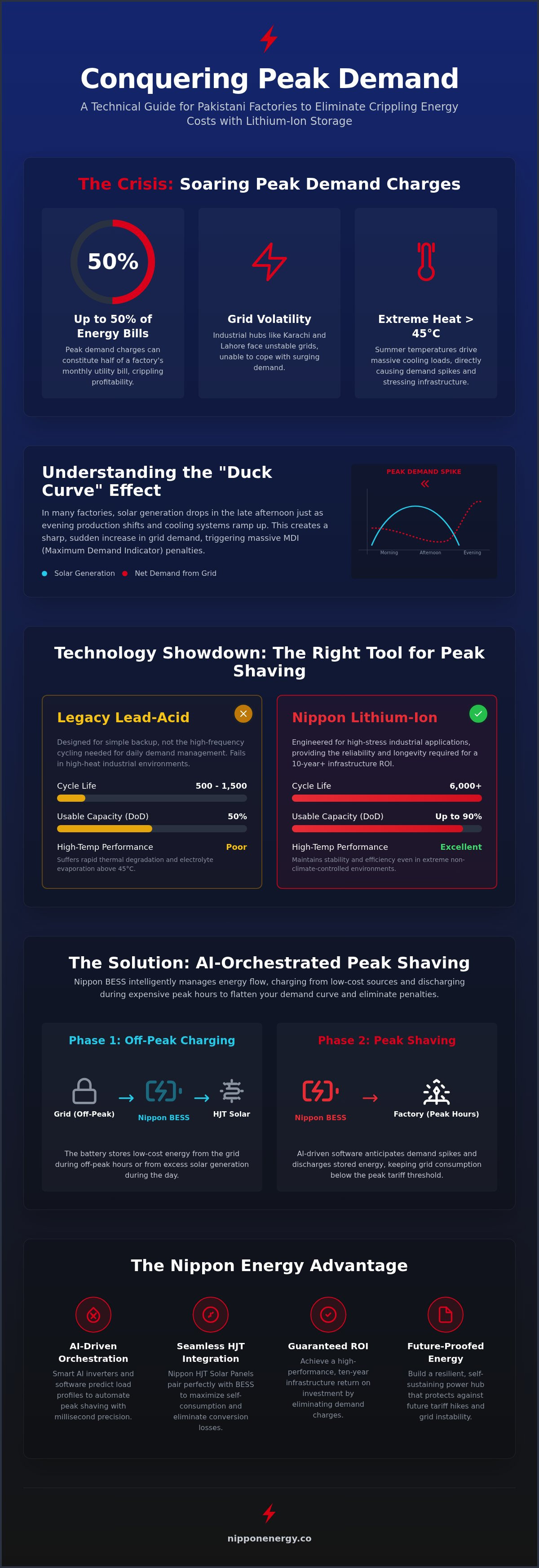
Peak demand represents the highest electrical power consumption measured over a set 15 to 30 minute interval. For Pakistani manufacturers, this short window often dictates the cost of the entire billing cycle. Demand charges can account for up to 50% of commercial energy bills in Pakistan's industrial sector, creating a massive financial burden that scales with production. As regional grid infrastructure in hubs like Karachi and Lahore struggles with surging cooling loads, the necessity for reducing peak demand charges for factories pakistan has transitioned from a financial preference to an architectural requirement.
The traditional approach to energy involves passive consumption, where factories remain at the mercy of grid volatility and frequent tariff adjustments. Modern industrial strategy requires a shift toward active demand orchestration. By utilizing a sophisticated Battery Energy Storage System (BESS), facilities can discharge stored energy during these expensive peak intervals, effectively "shaving" the demand spike seen by the utility provider. This technical intervention ensures the facility operates within a lower tariff bracket while maintaining full production capacity.
Understanding Industrial Demand Charges and Load Profiles
K-Electric and regional DISCOs utilize Maximum Demand Indicators (MDI) to calculate charges based on the highest point of consumption. Many textile and manufacturing plants suffer from the "Duck Curve" effect, where solar generation declines just as evening production shifts begin. This creates a sharp ramp in demand that stresses the grid and triggers high MDI penalties. Industrial cooling systems in South Asia work harder as ambient temperatures rise, creating a direct, measurable correlation between temperature spikes and peak demand volatility that legacy systems cannot manage.
The Failure of Legacy Lead-Acid Systems
Legacy lead-acid batteries were engineered for backup power during outages, not the high-frequency discharge cycles required for peak shaving. In non-climate-controlled Pakistani factory environments where temperatures frequently exceed 45°C, lead-acid units suffer from rapid thermal degradation and electrolyte evaporation. These systems typically offer only 500 to 1,500 cycles and a limited 50% Depth of Discharge (DoD), which is insufficient for daily demand management.
In contrast, Nippon Lithium-ion Battery Storage Systems provide 6,000+ cycles and up to 90% usable capacity. The hidden costs of lead-acid include frequent replacements and lower round-trip efficiency, which negate any initial savings. High-density lithium-ion storage remains the only viable path for factories seeking a resilient, 10-year infrastructure that can withstand the thermal and electrical stresses of the Pakistani industrial landscape.
The Mechanics of Peak Shaving: How Lithium-Ion BESS Orchestrates Load
The technical architecture of a modern factory must evolve beyond simple grid dependence to survive escalating tariff structures. Nippon Lithium-ion Battery Storage Systems function as the primary energy orchestrator for this transition. These systems monitor real-time load consumption with millisecond precision, identifying the exact moment when heavy machinery pushes the facility toward a new peak demand threshold. By utilizing a high-performance Power Conversion System (PCS), the architecture manages bidirectional energy flow. This allows the battery to absorb excess solar or off-peak grid power and discharge it instantly when production requirements intensify.
This intelligent orchestration is the most reliable method for reducing peak demand charges for factories pakistan. Data from global state energy storage programs confirms that automated, software-driven discharge is significantly more effective than manual grid management. AI-driven forecasting anticipates demand spikes before they breach the grid limit, ensuring the system is prepared to intervene. During grid micro-outages, the system maintains industrial process continuity through sub-cycle transitions. This prevents the costly restarts and hardware damage associated with voltage instability in Karachi or Lahore.
Anatomy of a High-Performance BESS
The Battery Management System (BMS) serves as the technical brain, regulating cell-level safety and maximizing discharge efficiency. In the extreme climates of Sindh and Punjab, thermal management remains the most critical engineering hurdle. Nippon systems utilize active cooling to maintain cells at an optimal 25°C even when external temperatures exceed 45°C. This prevents the thermal runaway and capacity degradation seen in legacy storage. Integration with Nippon Smart AI Inverters facilitates DC-coupled efficiency, which eliminates redundant conversion steps and increases total system performance.
Software-Defined Energy and AI Orchestration
Machine learning algorithms identify a factory's unique load signature by analyzing historical consumption patterns. This enables automated peak shaving, where the system executes a precise discharge the moment grid consumption crosses a pre-set threshold. Reducing peak demand charges for factories pakistan requires this level of granular control to ensure consistent savings across multiple billing cycles. Cloud-based monitoring further empowers multi-site industrial energy management, synchronizing power assets across various geographic locations. If you're looking to stabilize your operational costs, consulting with an expert on integrated storage solutions will help future-proof your energy architecture.
Lithium-Ion vs. Lead-Acid: Comparative Performance in High-Stress Scenarios
Selecting the appropriate storage chemistry is a fundamental engineering decision that determines the longevity of your energy infrastructure. Lead-acid batteries, while presenting a lower initial CAPEX, fail to meet the rigorous cycling demands of modern industrial peak shaving. A technical cycle life analysis reveals a stark disparity: standard lead-acid units provide approximately 500 to 1,500 cycles, whereas Nippon Lithium-ion Battery Storage Systems deliver 6,000+ cycles. This 12-fold increase in durability ensures that your investment remains operational for over a decade, rather than requiring replacement every three years.
Energy utilization is further optimized through superior Depth of Discharge (DoD) capabilities. Lead-acid systems are restricted to a 50% DoD to avoid permanent plate damage, effectively doubling the required physical footprint for the same usable energy. Lithium-ion technology permits a 90% usable capacity, which is critical for reducing peak demand charges for factories pakistan where floor space in dense industrial zones like Karachi is at a premium. Additionally, lithium-ion maintains a round-trip efficiency exceeding 95%, while lead-acid loses 15-20% of energy during the charge-discharge process, directly inflating operational overhead.
Thermal Resilience and Longevity
Ambient heat is the primary catalyst for battery chemistry degradation. In the Sindh and Punjab regions, where factory floor temperatures often exceed 45°C, lead-acid batteries suffer from electrolyte evaporation and internal corrosion. Lithium-ion chemistry is engineered for stability in high temperature solar environments, especially when paired with active thermal management. This resilience eliminates the high-upkeep requirements of legacy systems, such as water topping and terminal cleaning, allowing for a zero-maintenance operational profile.
Financial Architecture: ROI and LCOE
Evaluating the Levelized Cost of Storage (LCOS) provides a more accurate financial picture than initial purchase price alone. While lead-acid appears cheaper upfront, its 10-year Total Cost of Ownership (TCO) is significantly higher due to three to four replacement cycles and lower efficiency. Investing in high-density storage accelerates the ROI of topcon solar panels by capturing every kilowatt of excess generation for use during expensive peak windows. This strategic alignment of high-efficiency generation and durable storage creates a permanent hedge against volatile utility tariffs.
Strategic Implementation: Sizing and Deploying Storage for Maximum Demand Reduction
Strategic deployment of a Battery Energy Storage System (BESS) begins with a rigorous load audit. Engineers must analyze 15-minute interval data to distinguish between critical operational loads and non-essential peak contributors. This granular visibility allows for the precise configuration of assets, ensuring that stored energy is reserved for the highest-cost windows. For manufacturers, reducing peak demand charges for factories pakistan hinges on identifying "peak-within-peak" events where simultaneous motor starts or cooling surges trigger Maximum Demand Indicator (MDI) penalties.
Sizing the C-rate is the next technical milestone. The C-rate defines how fast a battery can discharge its total capacity; a 1C rating means the system can fully discharge in one hour. If your facility experiences short, intense power spikes, a higher C-rate is required to provide the necessary current without overstressing the cells. Thermal management and fire suppression protocols are equally vital. Large-scale BESS installations require integrated aerosol or clean-agent fire suppression systems and blast-resistant containment to meet international safety standards and local grid interconnection codes.
The Load Audit and Feasibility Framework
Mapping energy consumption patterns requires more than a simple review of monthly utility bills. Technical teams use power quality analyzers to capture transient surges that traditional meters might miss. This data identifies the exact threshold where battery intervention becomes profitable. Professional solar epc services provide the necessary diagnostic tools to conduct these site assessments, ensuring the resulting energy architecture is perfectly aligned with the factory's load signature.
Optimizing the Discharge Strategy
Success in demand management requires a dual-focus strategy: Time-of-Use (TOU) arbitrage and peak shaving. TOU arbitrage involves charging the Nippon Lithium-ion Battery Storage Systems during off-peak hours when tariffs are lowest and discharging during expensive peak periods. The system must maintain a specific state-of-charge (SoC) to balance peak shaving duties with emergency backup requirements. Modular BESS designs offer the scalability needed to expand storage capacity as industrial output grows, protecting the initial infrastructure investment. To begin optimizing your facility's energy profile, request a technical load audit from our engineering team today.
The Nippon Energy Advantage: AI-Orchestrated Storage and HJT Integration
The transition to a high-performance energy architecture requires more than just high-capacity batteries; it demands a synchronized ecosystem where generation and storage operate in technical harmony. Nippon Energy achieves this through the deliberate synergy of Nippon HJT Solar Panels and Nippon Lithium-ion Battery Storage Systems. Heterojunction (HJT) technology is uniquely suited for the Pakistani climate because it maintains higher efficiency at elevated temperatures compared to standard monocrystalline cells. When this superior generation is paired with intelligent storage, the result is a robust framework for reducing peak demand charges for factories pakistan, ensuring that every kilowatt generated is utilized with maximum financial impact.
Efficiency is further maximized through the deployment of Nippon Smart AI Inverters. Traditional AC-coupled systems often suffer from multiple conversion losses as energy moves between DC and AC states. Nippon’s architecture utilizes DC-coupling to eliminate these redundancies, preserving a higher percentage of generated power for industrial use. This turnkey EPC approach allows Nippon Energy to design bespoke systems for industrial parks and high-rise manufacturing units, providing a single point of accountability from initial load audit to long-term solar system maintenance.
NipponHev: The Integrated Energy Ecosystem
The nipponhev system represents the pinnacle of fail-proof energy architecture. It's engineered specifically for extreme environments like Karachi and Riyadh, where grid instability and high ambient heat converge. By integrating high-efficiency generation with high-density storage, factories can achieve up to 90% grid independence. This system doesn't just provide backup; it actively manages the facility's energy profile to prioritize self-consumption and eliminate the most expensive tariff brackets.
Future-Proofing with Predictive AI
Modern energy management must be proactive rather than reactive. Nippon’s AI-driven platform utilizes predictive maintenance to monitor cell health at a granular level, identifying potential issues before they cause a drop in performance. Over-the-air (OTA) updates ensure that your energy management algorithms remain optimized as utility regulations and tariff structures evolve in Pakistan. This commitment to technical excellence ensures that your 10-year infrastructure remains a high-yielding asset. Contact Nippon Energy today for a comprehensive technical peak demand analysis of your facility to begin your transition toward energy autonomy.
Architecting Industrial Energy Autonomy for the Next Decade
The volatility of the Pakistani grid and the rising cost of peak demand require a fundamental shift from passive consumption to active orchestration. High-performance lithium-ion storage is no longer a luxury; it's a structural requirement for reducing peak demand charges for factories pakistan. By integrating Tier 1 Nippon HJT Solar Panels with an AI-Integrated Storage Architecture, manufacturers can secure a resilient energy profile that withstands both thermal stress and tariff fluctuations. This synergy ensures that your facility operates at peak efficiency while insulating your bottom line from unpredictable utility adjustments.
Nippon Energy’s expert EPC presence in Tokyo, Dubai, Riyadh, and Lahore ensures that your facility benefits from global engineering standards localized for regional challenges. It's time to transform your energy overhead into a predictable, high-performance asset. Request a Technical Peak Demand Analysis from Nippon Energy to begin your transition toward a future-proofed industrial infrastructure. Your path to energy independence starts with technical precision and visionary engineering.
Frequently Asked Questions
What is the difference between peak shaving and load shifting?
Peak shaving reduces the absolute highest point of consumption to lower demand charges. Load shifting moves consumption from high-tariff periods to low-tariff periods, such as charging at night to use during the day. While related, peak shaving is a surgical intervention to prevent breaching a specific utility threshold. Both strategies are essential for reducing peak demand charges for factories pakistan, as they address different components of the industrial electricity bill.
How much can I save on my commercial energy bill with battery storage in Pakistan?
Industrial users in Pakistan typically see a reduction of 20% to 50% in their total energy bill by addressing the demand charge component. Because demand charges often constitute half of the total commercial bill, effectively lowering the Maximum Demand Indicator (MDI) provides immediate financial relief. Actual savings depend on your specific load profile, the current NEPRA tariff adjustments, and the efficiency of the storage architecture deployed at your facility.
Is lithium-ion battery storage safe for high-temperature climates like Karachi?
Lithium-ion technology is highly stable in extreme heat when integrated with active thermal management. Nippon systems utilize liquid or forced-air cooling to maintain cell temperatures at 25°C, even when ambient Karachi temperatures exceed 45°C. This prevents thermal runaway and capacity loss. Unlike legacy lead-acid systems, these advanced units are housed in climate-controlled enclosures, ensuring operational safety and long-term chemical stability in the harshest South Asian climates.
How long do Nippon Lithium-ion Battery Storage Systems typically last?
Nippon Lithium-ion Battery Storage Systems are engineered for a 10 to 15 year operational life. They typically provide 6,000+ cycles at a 90% Depth of Discharge before reaching 80% of their original capacity. This longevity is supported by an advanced Battery Management System (BMS) that regulates voltage and temperature at the cell level. Regular maintenance and over-the-air software updates further extend the system’s utility compared to traditional storage technologies.
Can I add battery storage to my existing factory solar panel system?
Yes, battery storage can be integrated into existing solar infrastructures through AC-coupling or DC-coupling methods. While DC-coupling is more efficient for new installations, AC-coupling allows for a seamless retrofit of storage into your current factory setup without replacing existing inverters. This modular approach enables you to enhance your energy independence and begin reducing peak demand charges for factories pakistan without a complete system overhaul or significant operational downtime.
What is a demand charge and why is it so high for industrial users?
A demand charge is a fee based on the highest amount of power your facility draws during a specific interval, usually 15 to 30 minutes. Utilities like K-Electric use this to cover the cost of maintaining the infrastructure required to meet your peak needs. For industrial users, these charges are high because heavy machinery creates massive, sudden draws on the grid, requiring the utility to reserve significant capacity specifically for your site.
Do I need a Nippon Smart AI Inverter to manage peak demand with batteries?
While storage can function with standard hardware, the Nippon Smart AI Inverter is essential for achieving the highest levels of efficiency and automation. It serves as the central nervous system, using machine learning to predict load spikes and orchestrate discharge with millisecond precision. Without this AI integration, the system cannot respond fast enough to transient surges, which may result in missed peak-shaving opportunities and higher MDI penalties on your monthly bill.
How do I calculate the correct battery size for my industrial facility?
Calculating the correct size requires a detailed analysis of your 15-minute interval data and your facility's C-rate requirements. You must identify the "peak-within-peak" events and determine the kilowatt-hour (kWh) capacity needed to cover the duration of those spikes. Our engineers assess your Maximum Demand Indicator (MDI) targets and your essential load requirements to architect a system that balances initial investment with maximum demand reduction and long-term energy ROI.


