

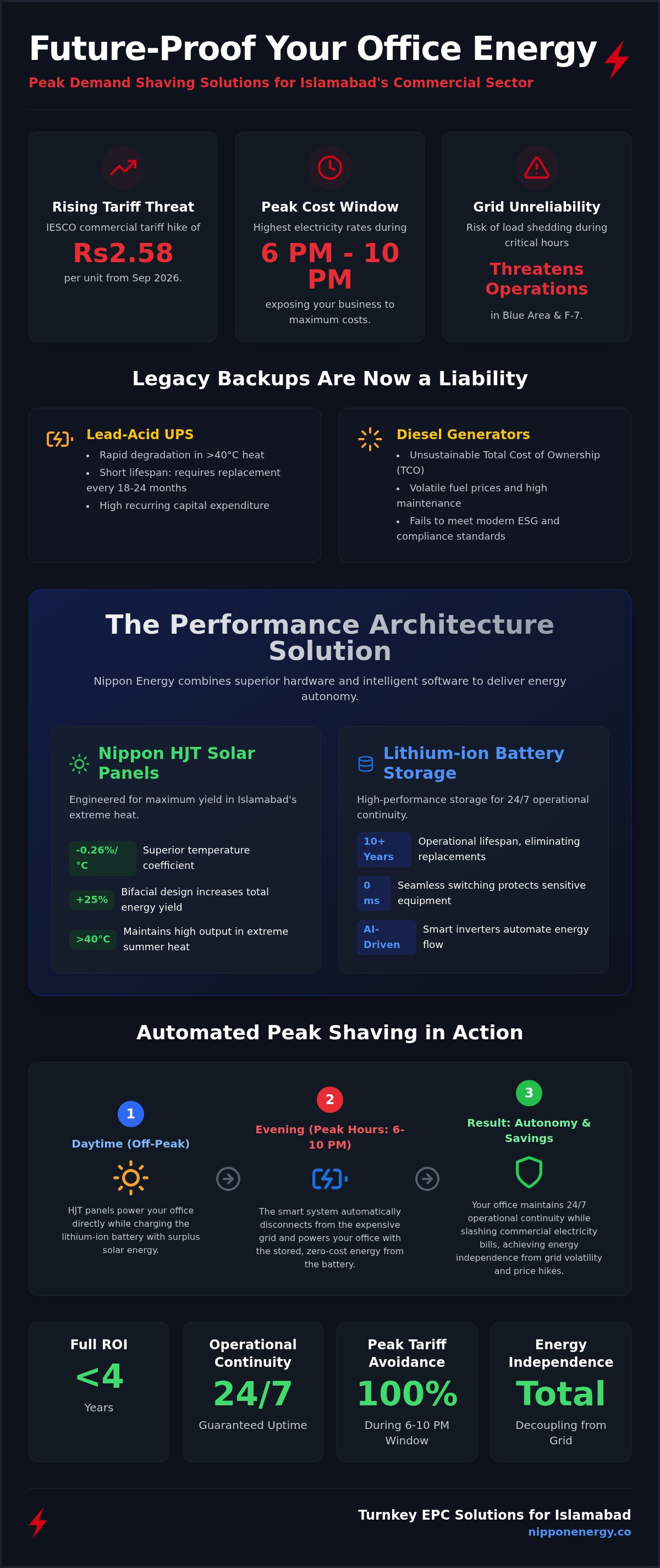
Every kilowatt-hour drawn from the IESCO grid during the 6:00 PM to 10:00 PM peak window is no longer just a utility cost; it's a direct tax on your office's operational scalability. Commercial entities in Blue Area and F-7 face a volatile energy landscape where September 2026 tariff hikes of Rs2.58 per unit are only the beginning. You've likely realized that traditional lead-acid backups and legacy net-metering are no longer sufficient to protect your bottom line. Implementing sophisticated peak demand shaving solutions for offices islamabad is the only way to decouple your growth from rising energy prices. This article demonstrates how to secure 24/7 operational continuity and slash commercial bills by leveraging Nippon Energy’s HJT technology and AI-driven lithium storage. We will analyze the transition to net billing, the technical superiority of Nippon Lithium-ion Battery Storage Systems, and the path to achieving a full return on investment in under four years through the NipponHev integrated platform. By shifting to a performance-based energy architecture, your facility can transition from grid dependence to a state of permanent energy autonomy.
Key Takeaways
- Analyze the 2026 IESCO commercial tariff structure to understand why traditional UPS and diesel generators have become fiscally unsustainable for modern corporate operations.
- Evaluate the technical advantages of Nippon HJT technology, which provides superior temperature coefficients for maximum energy yield during Islamabad’s extreme summer heat.
- Deploy peak demand shaving solutions for offices islamabad by utilizing Nippon Smart AI Inverters to orchestrate automated battery discharge during high-cost peak windows.
- Optimize operational continuity by sizing Nippon Lithium-ion Battery Storage Systems based on granular load profiling of critical infrastructure such as server rooms and HVAC systems.
- Streamline the transition to energy independence through Nippon Energy’s turnkey EPC services, ensuring seamless IESCO integration and professional long-term system monitoring.
The 2026 Energy Landscape for Islamabad Offices
The energy infrastructure in Pakistan has transitioned into a new era of fiscal complexity. For commercial entities operating in Islamabad, electricity is no longer a fixed utility cost but a variable that requires active management. The National Electric Power Regulatory Authority (NEPRA) implemented a tariff increase of Rs2.58 per unit in September 2026. This adjustment reflects a combination of fuel cost adjustments and quarterly revisions that directly impact the operational margins of offices in the Blue Area and F-7. As the grid moves toward a net billing model, the delta between what you pay for grid power and what you receive for exported energy has widened significantly. This shift makes peak demand shaving solutions for offices islamabad a technical necessity rather than a luxury.
IESCO Commercial Tariffs and Peak Hour Management
Managing energy costs requires a granular understanding of the IESCO peak window, which currently runs from 6:00 PM to 10:00 PM during the autumn season. During these hours, commercial tariffs reach their maximum threshold. Relying on the grid during this period exposes your business to the highest possible rates while simultaneously facing the risk of load shedding. Effective energy management begins with understanding your office's load profile to identify exactly when your consumption spikes. Peak shaving is the strategic reduction of grid draw during high-tariff windows. By deploying Nippon Lithium-ion Battery Storage Systems, offices can store excess solar energy generated during the day and discharge it during the 6:00 PM to 10:00 PM window. This architectural approach ensures that your most energy-intensive operations are powered by stored, zero-cost energy rather than expensive grid units.
The Failure of Legacy Backup Alternatives
Traditional backup systems like diesel generators and lead-acid UPS units are increasingly incompatible with modern corporate requirements. The Total Cost of Ownership (TCO) for diesel generators has become unsustainable due to rising fuel prices and high maintenance cycles. Furthermore, these systems fail to address ESG goals and environmental compliance standards now expected of Islamabad's leading corporations. Lead-acid batteries suffer from rapid degradation in the high-temperature environments typical of North Pakistan summers, often requiring replacement every 18 to 24 months. In contrast, Nippon Lithium-ion Battery Storage Systems offer a 10 plus year lifespan and maintain performance stability even when temperatures exceed 40°C. Peak demand shaving solutions for offices islamabad built on Nippon technology eliminate the recurring capital expenditure of battery replacements. Our systems provide a seamless transition with zero millisecond latency, protecting sensitive server rooms and high-end office equipment from the physical stress of frequent power switching.
Performance Architecture: Nippon HJT Panels and Lithium-Ion Storage
High-performance engineering is the foundational requirement for any resilient energy system. In Islamabad, where summer temperatures frequently exceed 40°C, standard photovoltaic modules experience significant efficiency drops. Standard PERC panels suffer from high temperature coefficients, leading to reduced energy harvest exactly when the grid is most stressed. Nippon Energy addresses this thermal challenge through HJT (Heterojunction) technology. This architecture combines the best attributes of crystalline silicon with thin-film silicon, creating a module that thrives in the extreme heat of North Pakistan.
Nippon HJT Technology: High Temperature Resilience
Nippon HJT panels utilize a symmetrical cell structure that results in a superior temperature coefficient, typically around -0.26%/°C. This allows the system to maintain high power output while standard modules falter under the sun. As documented in Pakistan's Solar Surge, the rapid adoption of solar in the region requires hardware that can withstand specific local conditions to remain viable. These panels are bifacial, capturing reflected light from concrete commercial rooftops to increase total yield by up to 25%. You can explore detailed efficiency data on Nippon HJT Solar Panels to understand how they maximize limited rooftop real estate in urban centers.
Commercial Lithium-ion Storage Systems
The efficacy of peak demand shaving solutions for offices islamabad depends entirely on the reliability of the storage medium. Nippon Lithium-ion Battery Storage Systems utilize Lithium Iron Phosphate (LiFePO4) chemistry, which is the global benchmark for safety in dense office environments. Unlike legacy lead-acid batteries, these systems support a 90% Depth of Discharge (DoD) and provide over 6,000 cycles at 80% capacity. This longevity ensures a 10 plus year lifespan, making them a cornerstone of long-term fiscal planning. Our modular architecture allows for seamless scalability, enabling enterprises to build battery banks ranging from 50kWh to 1MWh as their energy requirements evolve. For a technical deep dive into system sizing and integration, refer to The Definitive Guide to Lithium-Ion Battery Storage. If you're ready to future-proof your facility, you can consult with our engineering team for a customized site assessment.
Smart AI Integration: Automated Peak Shaving for ROI
The efficacy of modern peak demand shaving solutions for offices islamabad relies on the intelligent orchestration of power flows. While panels generate and batteries store, the Nippon Smart AI Inverter acts as the central processing unit of the entire commercial ecosystem. This hardware does not simply convert current; it executes complex algorithms to ensure fiscal and operational optimization. By integrating real-time data with historical consumption patterns, the system makes autonomous decisions on when to charge from the grid and when to discharge stored energy. This level of automation is essential for navigating the volatile energy market of 2026.
One of the most critical functions of this AI-driven architecture is managing load shedding transitions. In high-density commercial zones like Blue Area, power interruptions can disrupt sensitive IT infrastructure and server operations. The Nippon Smart AI Inverter manages these transitions with zero millisecond latency, ensuring that hardware remains online without the reboot cycles associated with standard backup systems. Beyond simple continuity, the system uses predictive analytics to incorporate weather forecasting into its harvesting logic. If the AI predicts a low-yield overcast day tomorrow, it prioritizes grid charging during low-tariff off-peak hours tonight to ensure the facility remains autonomous during the expensive peak window.
Nippon Smart AI Inverters and Energy Orchestration
Centralized energy management is vital for multi-floor office complexes where load requirements vary by department. Our inverters provide real-time monitoring and automated fault detection, allowing facility managers to identify inefficiencies before they impact the bottom line. These systems are designed for high-level integration, connecting seamlessly with existing Building Management Systems (BMS) to synchronize lighting, HVAC, and elevator loads. For a comprehensive technical breakdown of these capabilities, you can consult Smart AI Solar Inverters to understand the full scope of intelligent energy orchestration.
Optimizing Net Billing in Islamabad
The 2026 transition to a net billing model has fundamentally changed the economics of solar in Pakistan. With grid buyback rates reduced to approximately Rs8 to Rs13 per kWh, exporting surplus energy is no longer the primary path to ROI. Instead, the AI focuses on maximizing self-consumption, ensuring that every watt generated by your Nippon HJT panels is used internally during high-cost periods. AI inverters mitigate billing discrepancies through precise meter synchronization, ensuring that IESCO billing reflects actual consumption data. This precision is mandatory for compliance with the NEPRA (Prosumer) Regulations 2026, which prioritize grid stability through controlled energy injection. By utilizing peak demand shaving solutions for offices islamabad, your corporation can bypass the most expensive tariff hours and achieve energy independence.
Engineering Your Office Solar Backup System
Engineering a commercial energy system requires a methodical four-step protocol. Generic packages often fail because they don't account for the specific thermal and operational profiles of Islamabad's commercial sectors. Implementing peak demand shaving solutions for offices islamabad starts with precise load profiling. This phase involves a granular analysis of HVAC cycles, server room uptime requirements, and lighting density. We differentiate between critical loads, which require zero-millisecond failover, and non-critical loads that can be shed during extended grid outages to preserve battery life.
Structural integrity is the next priority. Islamabad office buildings, particularly in the Blue Area, have varied roof architectures that must withstand seasonal wind gusts and high thermal expansion. Our engineers conduct site-specific assessments to ensure Nippon HJT arrays are mounted for maximum wind resistance and optimal solar orientation. Finally, we develop financial models that calculate the Levelized Cost of Energy (LCOE). By factoring in the September 2026 tariff increases and the reduced buyback rates of the new net billing policy, we demonstrate how these systems achieve a full return on investment in under four years. This data-driven approach transforms energy from a volatile overhead into a predictable asset.
Commercial Load Assessment and Battery Sizing
Server rooms are the heartbeat of modern enterprises and require dedicated lithium-ion discharge stability to prevent data corruption. When sizing the battery bank, we help facility managers decide between 4-hour and 8-hour autonomy based on historical IESCO downtime data and peak window durations. For example, a mid-sized corporate office with a 100kW solar capacity typically requires a 200kWh Nippon Lithium-ion Battery Storage System to effectively manage peak shaving and provide critical backup. This configuration ensures that high-consumption HVAC systems don't drain the reserves needed for essential IT infrastructure during the expensive evening peak hours.
Integrated Architecture with NipponHev
Fragmented systems from multiple vendors often lead to maintenance bottlenecks and warranty disputes. The NipponHev System solves this by providing a unified, single-vendor architecture where every component is engineered to work in synergy. This integrated approach simplifies the EPC process for facility managers, as they deal with one point of contact from feasibility to IESCO commissioning. It's the most efficient way to deploy peak demand shaving solutions for offices islamabad while ensuring Japanese-standard engineering excellence. To begin your transition to energy autonomy, you can request a comprehensive load profile analysis from our technical team today.
Nippon Energy: Turnkey EPC Solutions for Islamabad
Nippon Energy provides a comprehensive Engineering, Procurement, and Construction (EPC) framework designed specifically for the Pakistani commercial sector. Our approach moves beyond simple installation, focusing on the deployment of peak demand shaving solutions for offices islamabad that adhere to rigorous Japanese engineering standards. We manage every technical and administrative layer of the project to ensure that your energy transition is seamless and financially secure. By centralizing all project phases under one entity, we eliminate the risks associated with third-party contractors and unverified hardware.
The EPC Lifecycle: Feasibility to Commissioning
The journey to energy autonomy begins with a detailed feasibility study that aligns your office's load requirements with local regulatory frameworks. Navigating Islamabad’s regulatory approvals involves complex interactions with the Alternative Energy Development Board (AEDB), NEPRA, and IESCO. Our team handles all documentation for net billing connections and grid synchronization, ensuring that your system is compliant with the latest NEPRA (Prosumer) Regulations 2026. Quality control is paramount during procurement; we guarantee the delivery of genuine Nippon HJT panels and Smart AI Inverters. For a deeper look at our project methodology, you can read more about our Solar EPC Services.
Operations and Maintenance (O&M) for Office Solar
Commercial systems in urban environments like Islamabad face specific challenges, primarily high levels of particulate matter and heat-induced stress. Professional maintenance is not merely a cleaning service; it's a technical requirement for maintaining peak demand shaving solutions for offices islamabad at peak efficiency. We utilize thermal imaging to detect micro-cracks or hot spots before they lead to system failure. Our O&M packages include 24/7 remote monitoring via proprietary AI software, allowing facility managers to oversee energy flows and battery health from any location. Consistent Solar System Maintenance ensures that your Nippon Lithium-ion Battery Storage Systems continue to provide reliable discharge stability for over a decade.
We secure your investment through long-term performance guarantees and comprehensive warranties that reflect the durability of our hardware. Our presence in Pakistan ensures that technical support is always accessible, providing the reassurance of a global pioneer with local expertise. This combination of Japanese-standard precision and dedicated local service makes Nippon Energy the definitive partner for Islamabad's corporate energy transition.
Architecting Permanent Energy Autonomy in Islamabad
Navigating the 2026 energy landscape requires a shift from reactive backup systems to a proactive performance architecture. By integrating Japanese-engineered Nippon HJT and TOPCon technology, your office can maintain maximum yields even during extreme thermal peaks. The transition to net billing has made peak demand shaving solutions for offices islamabad the most viable path to securing long-term fiscal stability. These systems use AI-driven energy management to ensure 24/7 uptime while bypassing the most expensive IESCO tariff windows.
Success depends on a unified approach that combines structural engineering with intelligent orchestration. Nippon Energy provides full EPC and O&M support across Pakistan; this ensures that every component of your NipponHev system operates at peak efficiency. Integrated lifecycle management protects your capital investment and delivers a predictable return in under four years. It's time to transform your facility into a self-sustaining power asset that thrives independently of grid volatility.
Ready to optimize your operational overhead? Request a Commercial Solar Feasibility Study for Your Islamabad Office and secure your energy future today.
Frequently Asked Questions
How much battery backup does a typical 50-person office in Islamabad need?
A 50-person office typically requires a system sized between 50kWh and 150kWh depending on HVAC and server density. Accurate sizing depends on the specific load profile of the facility. For a mid-sized office, a 100kWh Nippon Lithium-ion Battery Storage System often provides 4 to 6 hours of autonomy for critical loads. This capacity ensures continuity during IESCO load shedding while enabling effective peak demand shaving solutions for offices islamabad by discharging stored energy during expensive windows.
Can a solar battery backup system completely replace a diesel generator for an office?
A properly engineered NipponHev system can eliminate the need for diesel generators by providing zero-millisecond failover and extended autonomy. While generators rely on volatile fuel prices and high maintenance, lithium-ion storage offers a stable, 10 plus year lifespan. Strategic sizing of the battery bank allows the office to maintain HVAC and IT operations indefinitely. This is possible if the solar array is scaled to recharge the system during daylight hours even under partial cloud cover conditions.
What is the expected ROI for a commercial lithium-ion solar system in Islamabad?
Most commercial installations in Islamabad achieve a full return on investment in under four years. This accelerated ROI is driven by the September 2026 tariff increases and the implementation of peak shaving strategies that bypass expensive IESCO peak hour rates. By reducing reliance on the grid during high-tariff windows and eliminating diesel fuel costs, the system transforms energy from an operational overhead into a predictable financial asset. The longevity of Nippon hardware ensures continued savings long after the initial payback period.
How do Nippon HJT panels perform compared to standard panels in Islamabad summers?
Nippon HJT panels outperform standard PERC modules by maintaining higher efficiency when ambient temperatures exceed 40 degrees Celsius. Standard panels experience significant voltage drops in Islamabad’s extreme heat, whereas HJT technology features a superior temperature coefficient of -0.26 percent per degree Celsius. This allows for consistent energy harvest during the hottest months. Additionally, the bifacial design captures reflected light from concrete rooftops, further increasing total energy yield compared to traditional monofacial alternatives used in legacy installations.
Is net-metering still beneficial for offices in Islamabad in 2026?
Net-metering remains beneficial but has transitioned to a net billing model under 2026 NEPRA regulations. While buyback rates for exported energy have decreased to approximately Rs8 to Rs13 per kWh, the primary value now lies in self-consumption. Using Nippon Smart AI Inverters to prioritize internal use of solar energy during peak hours maximizes savings. The grid acts as a secondary buffer rather than a primary revenue source for commercial prosumers in the current regulatory environment.
How long does the installation and IESCO approval process take for commercial solar?
The end-to-end EPC lifecycle typically spans 8 to 12 weeks from the initial feasibility study to final IESCO commissioning. This timeline includes structural assessments, hardware procurement, and navigating regulatory approvals with AEDB and NEPRA. Nippon Energy manages the entire administrative process to ensure compliance with Islamabad’s specific grid requirements. Our turnkey approach minimizes delays, allowing offices to activate their peak demand shaving solutions for offices islamabad within a standardized professional window without disrupting daily business operations.
What maintenance is required for a commercial solar battery backup system?
Commercial systems require professional cleaning and technical inspections twice per quarter to mitigate the impact of urban dust and particulate matter. Nippon Energy provides specialized O&M services including thermal imaging to identify potential hot spots and micro-cracks in the HJT modules. The Nippon Smart AI Inverter handles most routine health checks autonomously. Remote monitoring software allows facility managers to track performance metrics and battery discharge stability in real-time from any location across Pakistan.
Can the Nippon Smart AI Inverter manage multiple office floors separately?
The Nippon Smart AI Inverter is designed to integrate with sophisticated Building Management Systems to orchestrate loads across multiple floors. It can prioritize critical circuits, such as server rooms, while managing non-essential lighting on other levels. This granular control allows for precise energy distribution and automated fault detection. The AI software optimizes discharge patterns for each zone, ensuring that energy is utilized where it provides the highest operational value during high-tariff periods.


