
Can your production line afford to lose substantial revenue every time the grid fluctuates for just three seconds? In 2026, many industrial operators in Pakistan still view the diesel generator as an unavoidable necessity, even as high-speed diesel prices climb to Rs378.05 per litre. You've likely felt the frustration of production restarts and the constant risk of equipment damage from voltage dips during grid switching. Choosing between a solar battery vs generator for industrial use pakistan is no longer just a backup decision; it's a core financial strategy to protect your margins from a volatile energy market.
This guide provides a technical roadmap to break the cycle of diesel dependence by transitioning to intelligent HJT solar and lithium-ion storage. We'll show you how to achieve 24/7 uninterrupted production while stabilizing your energy costs against unpredictable tariff hikes. You'll discover how Nippon Energy's high-tech architecture, including the NipponHev system, secures your operational future. We'll examine the shift from standby power to intelligent energy orchestration, ensuring your facility meets the stringent 'Green Factory' standards required for international export markets.
Key Takeaways
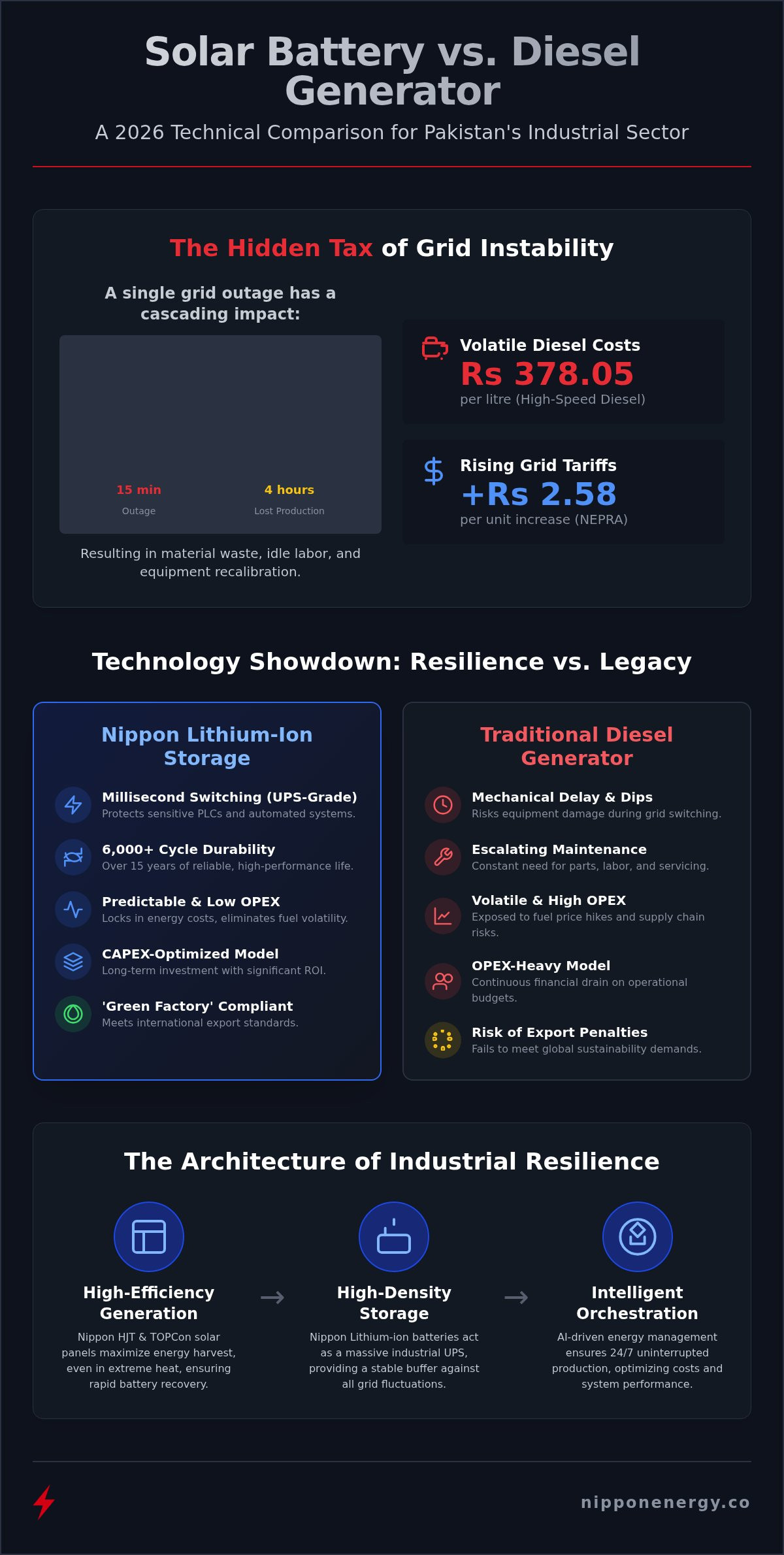
- Quantify the true impact of grid instability, where a 15-minute outage often results in four hours of lost production and significant material waste.
- Compare the 6,000-cycle durability of Nippon Lithium-ion storage against the escalating maintenance cycles and fuel volatility of traditional diesel engines.
- Learn how Nippon HJT solar panels maintain high-efficiency generation in Pakistan's climate to ensure rapid battery recovery during peak load shedding periods.
- Evaluate the strategic advantages of a solar battery vs generator for industrial use pakistan to eliminate diesel logistics and stabilize long-term operational budgets.
- Implement a future-proof energy architecture by conducting a precise load profile analysis to transition your facility toward international 'Green Factory' export standards.
The Industrial Impact of Load Shedding: Beyond Simple Power Cuts
Industrial stability in Pakistan has reached a critical juncture in 2026. While grid load shedding is a known variable, the true cost of power instability lies in the cascading failures within the production line. With NEPRA increasing electricity tariffs by Rs2.58 per unit in September 2026, the financial pressure on manufacturing margins is intense. A mere 15-minute interruption frequently results in a four-hour recovery period as machines require recalibration and material waste accumulates. When evaluating a solar battery vs generator for industrial use pakistan, manufacturers must look beyond the initial purchase price and calculate the total cost of production lost during these transition gaps.
Operational Disruptions in Modern Manufacturing
Modern production lines rely on sensitive Programmable Logic Controllers (PLCs) that can't tolerate even minor voltage dips. Sudden grid failures cause immediate material spoilage, particularly in the textile, plastics, and pharmaceutical sectors. Labor costs continue to accrue while workers remain idle during equipment restarts. To mitigate these risks, factories are shifting toward high-density lithium-ion storage that functions similarly to an Uninterruptible Power Supply (UPS) but at a massive industrial scale. This technology provides millisecond switching. It ensures that automated systems remain online without the mechanical delay inherent in starting a diesel generator.
The Financial Drain of Diesel Dependence
The "Hidden Tax" of diesel has become unsustainable. With the ex-depot price of high-speed diesel reaching Rs378.05 per litre in September 2026, the Levelized Cost of Energy (LCOE) for traditional generation is prohibitive. Unlike the predictable nature of solar-plus-storage, diesel dependence forces factories into a cycle of high operational expenditure (OPEX). This includes fuel logistics, storage safety risks, and escalating spare part costs. Transitioning to a CAPEX-optimized model using Nippon HJT solar panels and lithium-ion storage allows firms to lock in energy costs for over 25 years. When analyzing the long-term ROI of a solar battery vs generator for industrial use pakistan, the elimination of fuel volatility is the most significant factor. Diesel-heavy facilities also face increasing export penalties as international buyers demand compliance with 'Green Factory' standards. This makes the switch to intelligent storage a requirement for global competitiveness.
Designing a High-Performance Industrial Backup Architecture
Industrial backup is no longer a simple standby solution; it's a precisely engineered ecosystem. For a 500kW+ facility, a basic battery and inverter configuration cannot handle the complexities of heavy manufacturing. Success requires an integrated architecture of high-efficiency generation, high-density storage, and AI-driven orchestration. When debating a solar battery vs generator for industrial use pakistan, the speed of recovery and system intelligence are the decisive metrics for maintaining operational continuity.
According to the Pakistan's energy sector overview, the shift toward decentralized renewables is accelerating as the national grid struggles with thermal fuel costs. For large-scale manufacturers, this transition represents a move from passive consumption to active energy management. High-performance storage is the new backbone of industrial resilience. It provides a stable buffer against the grid fluctuations that frequently cripple automated production lines.
High-Efficiency Generation: HJT and TOPCon
Industrial facilities in Pakistan's high-temperature zones require panels that don't degrade under extreme thermal stress. Nippon HJT solar panels utilize heterojunction technology to maintain peak performance when traditional modules falter. Similarly, Topcon solar panels offer superior bifaciality, maximizing energy harvest from factory rooftops and carports alike. This high yield is essential for rapid battery recharging. During the short daylight windows between scheduled load shedding events, these panels ensure the lithium ion battery storage is fully recovered and ready for the next cycle.
Intelligent Orchestration with Smart AI Inverters
The brain of this architecture is the smart ai solar inverter. Industrial loads often involve heavy motor start-up currents that can trip standard backup systems. AI orchestration is the millisecond-level management of power sources to ensure zero-flicker production. These inverters prioritize critical production lines through automated load shedding protocols. This prevents a total system collapse if the instantaneous load exceeds available storage capacity. It's a level of precision that traditional diesel generators simply can't match. If you're ready to future-proof your facility, consulting with a solar project development expert can help define your specific load profile requirements.
Nippon Lithium-Ion Storage vs. Diesel Generators: The 2026 Comparison
Evaluating a solar battery vs generator for industrial use pakistan requires a shift from short-term procurement thinking to long-term architectural planning. Traditional diesel generators rely on mechanical combustion, which introduces inherent lag and high failure rates. In contrast, Nippon Lithium-ion Storage utilizes solid-state power electronics to achieve millisecond response times. While a generator requires several seconds to reach operational RPM, lithium storage provides instantaneous protection against voltage dips. This difference is critical in the context of Pakistan's major energy crisis, where grid instability is often as damaging to sensitive electronics as total blackouts.
- Cycle Life: Nippon Lithium cells are rated for 6,000+ cycles at high depth of discharge, which far exceeds the limited operating hours of a diesel engine before a major overhaul is required.
- Operational Costs: Solar storage leverages zero-cost fuel from the sun, whereas diesel engines consume fuel at an ex-depot price of Rs378.05 per litre as of September 2026.
- Response Time: Solid-state switching happens in under 20 milliseconds, ensuring that PLCs and CNC machines don't reboot during grid fluctuations.
- Maintenance Requirements: Modern storage systems utilize remote AI monitoring to predict cell health, eliminating the need for physical oil changes, filter replacements, and the logistics of fuel transport.
The ROI of Energy Independence
Industrial operators in Karachi and Lahore are seeing significantly shortened payback periods for solar-plus-storage due to rising grid tariffs and fuel volatility. The nipponhev system optimizes this ROI by integrating generation and storage into a single, high-efficiency architecture. This doesn't just lower monthly bills; it increases the overall factory valuation. As global supply chains tighten, having 'Green Factory' certification becomes a prerequisite for high-value export contracts. Factories that rely on diesel are increasingly seen as high-risk partners due to their carbon intensity and vulnerability to local fuel shortages.
Environmental and Noise Factors
Urban industrial zones like Korangi or Sundar Industrial Estate face increasing pressure to reduce noise and air pollution. Transitioning from diesel to lithium storage eliminates the acoustic footprint of heavy machinery, improving the working environment. Additionally, the 2026 Carbon Border Adjustment Mechanism (CBAM) imposes heavy penalties on carbon-intensive exports entering European markets. Switching to solar storage isn't just an energy decision; it's a strategic compliance move to protect export margins. Safety remains paramount, which is why Nippon utilizes LiFePO4 (Lithium Iron Phosphate) chemistry. It's the industrial standard for high-temperature stability, ensuring resilience in Pakistan's harshest climates without the fire risks associated with older chemistries.
Implementing Factory-Scale Backup: A Strategic Roadmap
Transitioning to a factory-scale energy ecosystem requires a departure from the simplistic kVA matching used for diesel generators. While traditional providers suggest matching generator capacity to peak load, an intelligent solar-plus-storage architecture involves calculating precise DC/AC ratios and battery depth-of-discharge (DoD) to ensure long-term stability. When comparing a solar battery vs generator for industrial use pakistan, the implementation phase determines whether the system delivers the promised ROI or becomes a bottleneck for production. Success depends on moving from a standby power mindset to a comprehensive energy orchestration strategy.
Phase 1: Load Profiling and Feasibility
Phase 1 begins with a granular load profile analysis. Engineers must distinguish between essential loads, such as PLC systems and critical cooling, and non-essential loads that can be shed during prolonged outages. This distinction allows for precise battery sizing, preventing over-investment while maintaining 24/7 uptime. We assess roof structural integrity to support high-wattage Nippon TOPCon arrays, ensuring the physical infrastructure can handle the weight and wind-load requirements of a 500kW+ installation. Feasibility studies also account for the 2026 net-billing regulations, where the export rate of Rs. 8-11 per unit is significantly lower than the retail rate. This makes self-consumption via storage the primary financial driver for modern manufacturing.
Step 2 involves sizing the solar array specifically to ensure full battery recovery during peak load shedding months. In Pakistan, winter months offer shorter daylight hours, meaning the DC-to-AC ratio must be optimized to charge the lithium-ion banks even under suboptimal conditions. This ensures that the system is not just a backup, but a primary energy source that effectively replaces the solar battery vs generator for industrial use pakistan debate with a clear preference for storage.
Phase 2: EPC Execution and Maintenance
Phase 2 focuses on execution through professional solar epc services. For a functioning factory, minimizing installation downtime is a technical requirement. Turnkey project management ensures that integration with existing grid infrastructure and switchgear happens during planned maintenance windows. Compliance with NEPRA standards is mandatory to ensure safety and system longevity. Once operational, a rigorous solar system maintenance schedule preserves the 25-year health of the architecture. This includes AI-driven monitoring to detect cell imbalances before they lead to voltage dips. If your facility requires a transition from diesel dependence, you can request a technical load audit to begin the architectural planning process.
Why Nippon Energy is the Architect of Industrial Resilience
Choosing between a solar battery vs generator for industrial use pakistan involves more than a simple comparison of fuel costs. It requires a partner capable of designing the structural integrity of your facility's energy future. Nippon Energy operates as a high-tech architect, utilizing Japanese engineering standards to solve the unique challenges of Pakistan's industrial landscape. We don't just provide hardware; we engineer comprehensive resilience. Our systems are optimized for the extreme thermal loads found in Pakistan's manufacturing hubs, ensuring that high-density storage maintains performance when traditional backup solutions falter.
Our track record includes high-capacity, MW-scale industrial EPC projects that demand rigorous technical precision. From the industrial parks of Karachi to the logistics hubs in Dubai and Riyadh, Nippon Energy delivers custom-engineered solutions that prioritize longevity. We focus on the precision of energy orchestration, moving beyond the "standby power" mindset to create an intelligent, self-sustaining ecosystem for large-scale manufacturing.
Global Innovation, Local Expertise
We leverage Tokyo-born technology to empower industrial parks in Lahore and Karachi. This global reach ensures that Pakistani manufacturers have access to the same tier-one advancements found in the world's most efficient factories. Reliability is reinforced through 24/7 technical support and real-time AI performance monitoring. Our Smart AI Inverters and lithium-ion systems provide a level of data-driven security that diesel generators cannot replicate. By partnering with Nippon Energy, industrial leaders secure a stable energy supply that protects sensitive PLC systems and eliminates the logistical risks of diesel dependence.
Next Steps: Securing Your Factory's Future
The transition from diesel-heavy operations to a modern solar-plus-storage architecture begins with a granular understanding of your facility's energy footprint. Nippon Energy provides professional industrial energy audits to identify peak demand patterns and essential load requirements. We specialize in customizing the NipponHev system to meet specific manufacturing requirements, ensuring that your investment aligns with both local operational needs and international 'Green Factory' export standards. This methodical approach guarantees that your facility remains competitive in a market defined by rising tariffs and carbon border adjustments. To begin your transition toward 24/7 uninterrupted production, you should Consult with Nippon Energy's Industrial Team for a technical evaluation of your current infrastructure.
Architecting Your Industrial Energy Independence
The era of passive energy consumption is over. By 2026, the strategic shift from diesel-heavy standby power to intelligent energy orchestration has become a necessity for Pakistani manufacturers. Transitioning to a system centered on high-efficiency HJT hardware and lithium-ion storage protects your facility from grid instability and the escalating costs of fuel logistics. This architecture doesn't just eliminate downtime; it ensures your production remains compliant with international green export standards like CBAM.
Resolving the choice of solar battery vs generator for industrial use pakistan allows you to reclaim control over your operational expenditure. Leveraging Japanese engineering excellence and a dedicated industrial EPC division, Nippon Energy provides the technical precision required for megawatt-scale resilience. You can Secure your factory's energy future with Nippon Energy's industrial solutions and benefit from Tier 1 TOPCon hardware and comprehensive maintenance protocols. Your path to 24/7 uninterrupted production starts with a technical load audit today. It's time to build a foundation that supports your long-term growth and global competitiveness.
Frequently Asked Questions
Can a solar battery system really run heavy industrial machinery during load shedding?
Industrial-scale battery systems are engineered specifically to handle heavy inductive loads and motor start-up surges. By integrating Nippon Smart AI Inverters, the architecture manages the high-power demands of CNC machines and production lines without the voltage dips common in grid switching. The key lies in precise load profiling to ensure the instantaneous discharge rate meets the peak demand of your specific machinery during load shedding intervals.
What is the typical ROI for a factory-scale lithium-ion backup system in 2026?
The ROI for a factory-scale system has shortened significantly in 2026 due to rising grid tariffs and diesel volatility. With high-speed diesel priced at Rs378.05 per litre, calculating a solar battery vs generator for industrial use pakistan comparison usually reveals a payback period within 3 to 5 years. This accounts for the elimination of fuel logistics and the 6,000-cycle lifespan of lithium-ion cells. The long-term financial stability provided by storage far outweighs escalating diesel expenses.
How long does it take for a Nippon Lithium-ion system to switch on during a power cut?
Nippon Lithium-ion systems utilize advanced solid-state power electronics to achieve millisecond switching times. Unlike diesel generators that require several seconds to reach operational RPM, our Smart AI Inverters detect grid failure and transition to battery power in under 20 milliseconds. This near-instantaneous response ensures that sensitive Programmable Logic Controllers (PLCs) and automated production lines remain online without the reboot cycles that often lead to material waste and labor idle time.
Do I need to replace my existing diesel generators completely when going solar?
You don't need to decommission your existing diesel assets immediately. Many industrial facilities retain generators as a tertiary backup for extreme, multi-day weather events where solar recovery might be limited. However, the goal of a modern energy architecture is to relegate the generator to a standby-only role. This shift minimizes fuel consumption and maintenance cycles, effectively ending the solar battery vs generator for industrial use pakistan debate by making intelligent lithium-ion storage the primary resilience tool.
How many hours of backup can a 500kWh Nippon Lithium-ion system provide for a typical factory?
The backup duration of a 500kWh system depends entirely on your factory's base load versus peak demand. For a facility with a continuous 100kW essential load, this system provides approximately five hours of 100% depth-of-discharge backup. During the audit phase, Nippon Energy's engineers identify critical versus non-essential circuits to extend this duration. This ensures that your most vital production lines remain operational throughout the standard load shedding windows experienced across Pakistan's industrial zones.
Are HJT solar panels better than TOPCon for factory roofs in hot Pakistani climates?
Nippon HJT solar panels are specifically engineered for high-temperature resilience, making them ideal for the intense heat of Sindh and Punjab. While TOPCon technology offers excellent efficiency, HJT modules maintain a superior temperature coefficient, which results in higher energy yields during the hottest hours of the day. For factory roofs where thermal stress is a constant factor, HJT panels ensure more consistent power generation to keep industrial-scale battery systems fully charged and ready.
What maintenance is required for an industrial-scale solar backup system?
Industrial solar systems require significantly less physical intervention than mechanical generators. Maintenance primarily involves periodic cleaning of panel surfaces to prevent soiling losses and routine inspections of electrical connections. Nippon Energy provides professional solar system maintenance and monitoring, utilizing AI-driven diagnostics to track cell health and inverter performance in real-time. This proactive approach identifies potential issues before they cause system failure, ensuring the 25-year structural integrity of your factory's energy infrastructure.
Is net metering available for industrial solar installations in Pakistan in 2026?
As of February 2026, Pakistan's traditional net metering policy has been replaced by a "net billing" system. Under these new regulations, the buyback rate for exported electricity is estimated between Rs. 8-11 per unit. This policy change makes self-consumption via lithium-ion storage the most viable strategy for industrial users. By storing excess generation rather than exporting it at a lower rate, factories can maximize their savings and protect themselves against high peak-hour grid tariffs.


