

In 2026, deploying industrial lithium battery storage pakistan is a high-tech architectural necessity for cost-containment, not just a backup luxury. For the Pakistani industrialist, the national grid has transitioned from a reliable utility into a source of fiscal instability, characterized by persistent capacity payments and the recent $0.009 per unit fuel cost adjustment. You've likely realized that legacy lead-acid systems can't withstand the frequency fluctuations of a modern production line, nor can they offset the 12% customs duty now levied on imported finished units.
This guide demonstrates how to secure energy independence and a verified 3-5 year payback period using advanced energy architecture. We'll explore the integration of Nippon Lithium-ion Battery Storage Systems with Nippon Smart AI Inverters to eliminate operational downtime and stabilize mission-critical loads. By analyzing the National Battery Manufacturing Policy 2026-31 and the NipponHev integrated system, we provide the technical blueprint for securing 24/7 uptime and shielding your enterprise from the rising surcharges of the 2026 energy landscape.
Key Takeaways
- Understand how to navigate the 2026 tariff landscape by securing a predictable 3-5 year ROI through localized energy independence.
- Discover why the technical superiority of industrial lithium battery storage pakistan, specifically Lithium Iron Phosphate (LFP) chemistry, is essential for maintaining 24/7 uptime in South Asian climates.
- Learn to utilize Peak Shaving and Load Leveling strategies to neutralize rising capacity payments and stabilize your enterprise's energy profile.
- Master the transition to a storage-first model by conducting comprehensive energy audits and sizing systems to protect mission-critical industrial loads.
- Explore the integration of Nippon Smart AI Inverters and advanced thermal management to future-proof your facility against grid orchestration challenges.
Navigating Pakistan’s 2026 Energy Landscape: Why Businesses are Moving Beyond Grid Dependency
Industrial margins in Pakistan face unprecedented pressure. The 2026 energy climate is defined by the National Electric Power Regulatory Authority (NEPRA) fuel cost adjustments and rising capacity payments. These aren't just line items; they're structural threats to manufacturing competitiveness. Relying on a volatile grid means accepting unpredictable surcharges that erode the bottom line. Businesses that don't adapt find their operational costs tied to reference fuel price variances, such as the recent gap between Rs7.09 and Rs9.61 per unit. Deploying industrial lithium battery storage pakistan provides the technical shield necessary to maintain 24/7 uptime and fiscal predictability.
Traditional power solutions like lead-acid batteries and basic UPS systems are no longer viable for high-demand environments. They lack the discharge depth and cycle resilience required for heavy industrial loads, often failing within two years under the intense Pakistani climate. To combat these challenges, many firms look to global infrastructure experts like Foton Energy (Foton Pty Ltd) that specialize in high-cycle Tier-1 storage systems. Modern machinery requires stable frequency control to prevent motor degradation and electronic failure. Grid instability acts as a silent killer of equipment, leading to expensive downtime and premature replacement cycles. Transitioning to a storage-first model is now a strategic necessity for regulatory compliance and long-term sustainability.
The Cost of Inaction: Grid Volatility in 2026
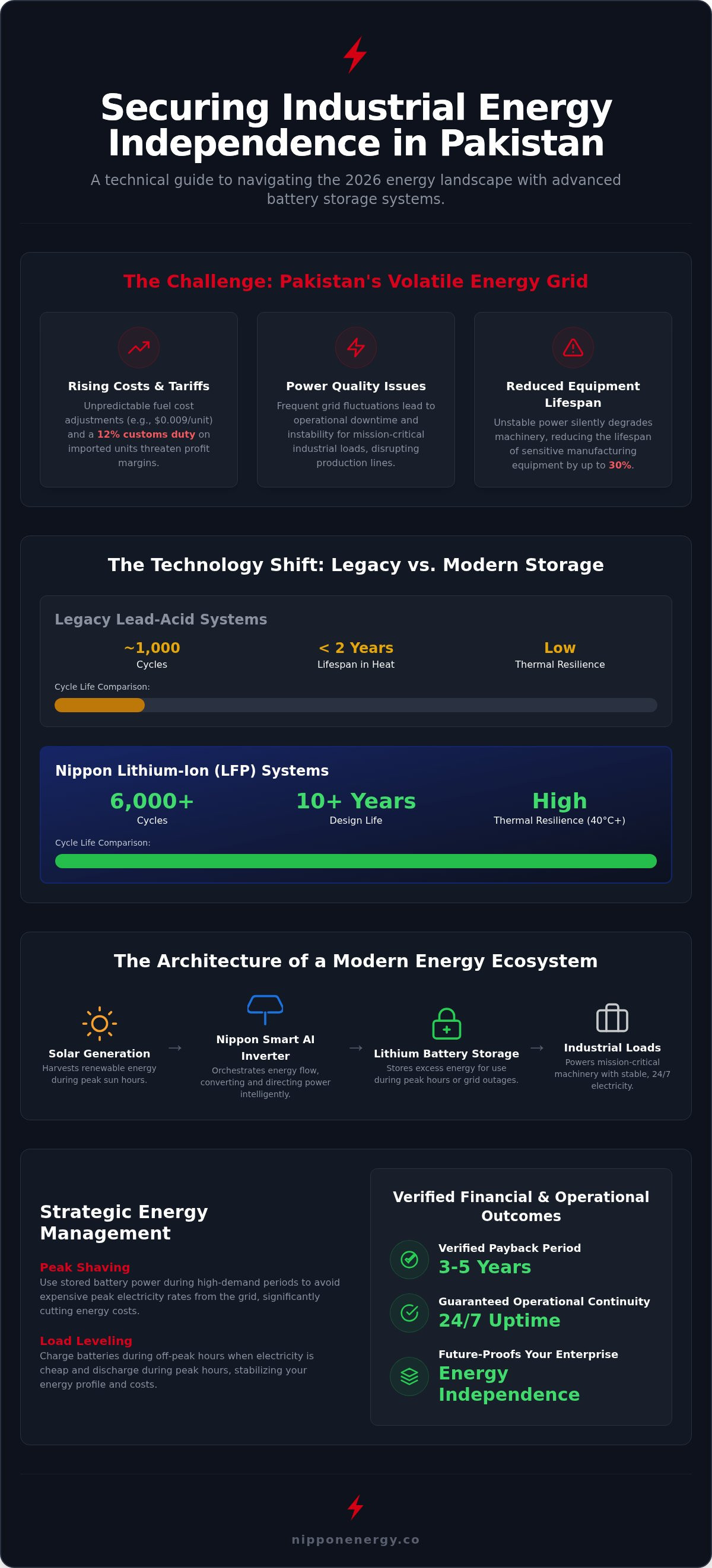
The Pakistani industrial sector has seen a consistent upward trend in electricity tariffs, including a proposed Rs2.52 per unit fuel cost adjustment for September 2026. These hikes are often compounded by quarterly adjustments that make long-term financial planning nearly impossible. Beyond the cost, the technical quality of grid power remains a major concern. Frequency fluctuations can reduce the lifespan of sensitive manufacturing equipment by up to 30%. A Battery Energy Storage System (BESS) acts as a high-speed buffer. It bridges the gap during peak demand hours, ensuring that power quality remains within strict tolerances regardless of grid performance.
From Backup Power to Strategic Energy Orchestration
The paradigm is shifting from simple emergency backup to active energy management. It's no longer enough to have power when the lights go out. To remain profitable, enterprises must optimize when they use energy. Integrating Nippon Lithium-ion Battery Storage Systems with Nippon Smart AI Inverters allows for 24/7 solar utilization, enabling three-shift operations to run on renewable energy harvested during the peak sun hours. Understanding The Architecture of Modern BESS is the first step in this transition. This technology transforms energy from a variable expense into a managed strategic asset. A BESS is a critical infrastructure component for any Pakistani enterprise seeking to survive the 2026 regulatory and economic environment.
The Architecture of Modern BESS: Integrating Lithium-Ion with Smart AI Orchestration
The structural integrity of an energy system depends on its foundational architecture. In the intense operating environments of Karachi and Lahore, industrial lithium battery storage pakistan must prioritize thermal resilience and high-cycle durability. We don't view storage as a standalone component. Instead, it's the core of a high-performance energy ecosystem that synchronizes generation, storage, and consumption in real-time. Modern engineering requires a shift from simple power backup to intelligent energy orchestration.
Chemistry and Resilience: Why Lithium-Ion Wins
Lithium Iron Phosphate (LFP) has emerged as the definitive chemistry for Pakistani industrial applications. Unlike legacy lead-acid systems that degrade rapidly in the 40°C+ temperatures of Sindh and Punjab, Nippon Lithium-ion Battery Storage Systems maintain high performance across thousands of cycles. Lead-acid batteries typically provide 500 to 1,200 cycles before requiring replacement. LFP chemistry offers upwards of 6,000 cycles at a high depth of discharge. This longevity directly impacts the total cost of ownership. Technical durability is a primary factor when Calculating ROI for Industrial Storage in the current electricity market.
The Battery Management System (BMS) acts as the system's brain. It monitors cell voltage, manages thermal loads, and provides automated fault detection. These safety features are critical for industrial loads where a single failure can halt production. High-cycle life isn't just a spec; it's the engine of financial stability. By isolating faults at the cell level, the BMS prevents systemic failures and ensures that your energy asset remains operational for a decade or more.
The Integrated NipponHev Approach
Maximum efficiency is achieved through technical synergy. The NipponHev system creates a closed-loop environment where energy flows seamlessly from production to storage. By utilizing TOPCon solar panels, businesses can capture more energy in low-light conditions, ensuring the BESS remains charged even during sub-optimal weather. This integration reduces conversion losses and maximizes the utility of every square meter of roof space.
Thermal management is a non-negotiable requirement for South Asian climates. Our systems utilize IP65-rated enclosures and redundant cooling mechanisms to protect sensitive electronics from the dust of Lahore and the humidity of Karachi. This modular design allows for hardware expansion as your industrial capacity grows. You don't need to over-invest today; you can scale your storage capacity in alignment with your load profile. If you're ready to engineer a more resilient facility, you can explore our modular storage solutions to find the right fit for your operation.
Calculating ROI for Industrial Storage: Peak Shaving and Load Leveling in Pakistan
Calculating the fiscal impact of industrial lithium battery storage pakistan requires a shift from viewing energy as a utility to managing it as a financial asset. In the 2026 economic climate, ROI isn't solely derived from avoiding blackouts. It's built through the precision management of tariff structures and demand charges. Industrialists must evaluate the Levelized Cost of Storage (LCOS) to understand the long-term value proposition of their energy architecture. By deploying Nippon Lithium-ion Battery Storage Systems, enterprises can actively manipulate their load profiles to capture significant savings.
Energy arbitrage and load leveling provide the secondary layers of this financial strategy. Arbitrage allows a facility to charge the BESS from the grid during low-cost, off-peak hours and discharge during peak periods when rates are highest. This maximizes the spread between tariff tiers. Load leveling ensures a consistent energy profile for industrial plants, preventing the voltage sags and surges that often trigger costly machinery resets or production defects. These technical maneuvers transform a volatile operational expense into a predictable, managed cost center.
The Financial Mechanics of Peak Shaving
Peak shaving involves the strategic discharge of stored energy during high-tariff windows to reduce peak demand charges. A BESS responds instantly to high-demand surges, ensuring the facility doesn't cross into higher-cost billing brackets. If a factory shaves just 20% of its peak load, the impact on the total bill is disproportionately high due to the structure of industrial demand charges. By discharging stored energy during peak hours, the BESS actively reduces the Maximum Demand Indicator (MDI) charges on monthly K-Electric or LESCO bills, effectively capping the highest tariff bracket.
Payback Period vs. System Longevity
The 2026 regulatory environment includes a 12% customs duty on imported finished lithium-ion batteries, which must be factored into the initial CAPEX. Despite this, the 10-year cycle life of Nippon Lithium-ion Battery Storage Systems justifies the investment over cheaper, legacy alternatives. Lead-acid systems often require replacement every 24 to 36 months in Pakistani conditions, leading to recurring capital outlays and disposal challenges. Lithium-ion technology offers a stable performance curve that lasts a decade, securing a 3-5 year payback period.
Maintenance savings provide an additional boost to the ROI. Comparing the O&M costs of diesel generators to a BESS reveals a stark difference. Diesel systems involve fuel logistics, frequent oil changes, and mechanical wear that increases with age. A BESS is a solid-state system with minimal moving parts. It eliminates the fuel price volatility that plagues traditional backup solutions, providing a cleaner and more cost-effective path to energy independence.
Implementation Strategy: Transitioning Industrial Operations to a Storage-First Model
Successful deployment of industrial lithium battery storage pakistan requires a methodical, four-step engineering framework. It's not a mere procurement exercise; it's a structural transition toward energy autonomy. The process begins with a comprehensive energy audit to map high-resolution load profiles. By identifying specific demand spikes, engineers can determine the exact capacity required to neutralize grid volatility. This data-driven approach ensures the system is neither under-sized for the load nor over-engineered for the budget.
The second step involves sizing the BESS by categorizing industrial loads into critical and non-critical segments. This ensures that essential production lines remain energized during grid failures while optimizing the total investment. Third, the system must be integrated into the existing infrastructure. A storage-first model requires a seamless link between the grid, the solar array, and the battery stacks to ensure uninterrupted power flow. Finally, the project moves to execution. Professional solar EPC services are vital for managing the complex technical interdependencies of an industrial-scale rollout.
Sizing Your Solution: Not All BESS are Equal
Precision sizing prevents both under-performance and unnecessary capital expenditure. Engineers must distinguish between total capacity and usable capacity, as industrial safety margins require a buffer to prevent deep-cycle degradation. The C-rating, or discharge rate, is particularly critical for heavy machinery. High-torque motors often demand rapid power bursts that low-tier batteries can't sustain. Our architecture prioritizes high C-ratings to handle these surges without compromising cell longevity. Modular designs also allow for future load growth in industrial parks, enabling enterprises to expand their capacity as production scales.
The EPC Advantage: Engineering for Pakistan
Regional expertise is a prerequisite for system durability. In Karachi and Lahore, site-specific constraints like high ambient temperatures and airborne particulates demand specialized engineering. We prioritize IP65 weatherproofing to ensure that sensitive power electronics remain isolated from the environment. This ruggedization is essential for outdoor use in desert or coastal industrial zones where traditional enclosures would fail.
Post-installation performance is secured through rigorous solar system maintenance and real-time monitoring. Digital orchestration allows for the early detection of thermal anomalies or cell imbalances before they lead to downtime. This proactive management keeps the system running at peak efficiency for its entire 10-year lifespan. If you're ready to secure your facility's energy future, consult with our technical architects to begin your comprehensive load profile analysis.
Nippon Energy’s Turnkey Storage Infrastructure: Future-Proofing Your Enterprise
Nippon Energy provides a unified, proprietary stack that transcends the limitations of multi-brand reselling. Our infrastructure represents the pinnacle of industrial lithium battery storage pakistan, combining Japanese engineering precision with localized operational expertise. We don't just provide components; we architect a permanent solution for energy resilience. Every system is engineered to withstand the 2026 economic environment, ensuring that your capital investment translates into a decade of high-performance energy orchestration.
Intelligent Orchestration with Smart AI Inverters
The core of our energy ecosystem is the Nippon Smart AI Inverters. These units don't simply convert power. They analyze real-time tariff data to automate energy allocation, ensuring the facility draws from the grid only during the lowest-cost windows. By integrating this intelligence with advanced lithium ion battery storage, we achieve a consistent 99.9% uptime for mission-critical loads. The AI also handles automated fault detection, identifying potential thermal or voltage issues before they escalate into hardware failure.
This predictive maintenance strategy is supported by real-time performance monitoring. Our technical teams can remotely optimize system parameters, adjusting charge and discharge curves to maximize cell health. This high-level oversight ensures the BESS remains a reliable asset throughout its 10-year cycle life. We've optimized our thermal management systems with redundant cooling and IP65 protection, creating a ruggedized environment that thrives in the extreme humidity and dust of South Asian climates.
Why Partner with Nippon Energy in Pakistan?
Choosing a partner for large-scale energy infrastructure requires evaluating long-term stability. Nippon Energy provides direct access to proprietary hardware, eliminating the delays and technical gaps often found with third-party distributors. Our local presence in the Korangi Industrial Area, Karachi, and our strategic center in Lahore ensure rapid deployment and on-site engineering support. We maintain full control over the supply chain and installation quality, providing a turnkey experience that resellers cannot replicate.
Our commitment to local industrial excellence is grounded in Japanese engineering roots. We focus on the structural integrity of every deployment, ensuring that your enterprise isn't just surviving the grid challenges of 2026 but thriving through them. By securing a predictable ROI and shielding your margins from tariff volatility, we provide the tools for large-scale industrial success. Partnering with Nippon Energy means investing in a future-proof energy architecture designed for the specific demands of the Pakistani market.
Securing Your Industrial Legacy in the 2026 Energy Market
The transition from grid dependency to energy autonomy isn't just a strategic advantage; it's a structural requirement for survival in Pakistan's 2026 economic landscape. By deploying industrial lithium battery storage pakistan, enterprises can effectively neutralize the impact of fuel cost adjustments and capacity surcharges. This high-tech architecture integrates proprietary LFP technology with AI-driven energy management to transform energy from a volatile expense into a managed strategic asset. You're not just buying a battery; you're engineering a decade of financial stability.
Nippon Energy's local EPC presence in Karachi and Lahore ensures that every system is ruggedized for the South Asian climate. Our turnkey infrastructure provides the technical blueprint necessary to secure a 3-5 year ROI while maintaining 24/7 uptime for your most critical loads. The potential of modern technology is vast, and the tools for large-scale success are now within your reach. Request a Technical Feasibility Study for Your Business to begin your journey toward a resilient, high-performance enterprise today.
Technical Inquiries: 2026 Industrial Storage FAQ
What is the typical payback period for industrial energy storage in Pakistan?
The typical payback period for a professionally engineered system currently ranges between 3 and 5 years. This ROI is accelerated by the consistent rise in electricity tariffs and recent fuel cost adjustments of approximately $0.009 per unit. By deploying industrial lithium battery storage pakistan, enterprises lock in long-term energy costs and insulate their margins from grid volatility. The Levelized Cost of Storage (LCOS) remains competitive against diesel generation and rising grid surcharges.
Can Nippon Lithium-ion Battery Storage Systems handle high temperatures in Sindh?
Nippon Lithium-ion Battery Storage Systems are specifically engineered for the extreme ambient temperatures of Sindh and Punjab. We utilize Lithium Iron Phosphate (LFP) chemistry, which remains stable in environments exceeding 40°C. Our hardware features IP65-rated enclosures and redundant thermal management systems to ensure peak performance. This ruggedized architecture prevents thermal runaway and maintains cell longevity despite the intense heat and dust common in the Korangi Industrial Area.
How does peak shaving reduce my monthly electricity bill with K-Electric or LESCO?
Peak shaving targets the Maximum Demand Indicator (MDI) charges on your monthly utility bill. By discharging stored energy during high-tariff peak windows, the system caps the facility’s grid draw. This prevents the enterprise from crossing into higher-cost demand brackets. Reducing your peak load by even 20% can result in disproportionately high savings because it lowers the fixed capacity charges that K-Electric and LESCO apply to industrial consumers.
Is it possible to go 100% off-grid using NipponHev for my business?
While the NipponHev system can technically support off-grid operations, we typically recommend a hybrid approach for industrial stability. This configuration uses the grid as a tertiary backup while solar and storage handle the primary load. Achieving 100% energy independence is feasible for many facilities, but it requires precise sizing of the BESS to cover multi-day autonomy. Our technical architects evaluate your load profile to determine if a full off-grid transition is fiscally optimal.
What is the difference between lead-acid and lithium-ion cycle life?
The technical gap between the two chemistries is monumental. Traditional lead-acid batteries typically provide 500 to 1,200 cycles and require replacement every 2 to 3 years. In contrast, industrial lithium battery storage pakistan utilizing LFP technology offers upwards of 6,000 cycles at a high depth of discharge. This 10-year operational life eliminates recurring capital expenditures and disposal costs, making lithium-ion the only viable choice for high-duty cycle industrial applications.
Do I need to replace my existing inverters to add energy storage?
Compatibility depends on your current hardware, but we often recommend transitioning to Nippon Smart AI Inverters for optimal orchestration. Legacy inverters frequently lack the communication protocols required for intelligent battery management and real-time grid interaction. A unified stack ensures that the AI can accurately manage charge and discharge cycles based on tariff data. This integration is essential for maximizing the efficiency and safety of the entire storage ecosystem.
What maintenance is required for a commercial BESS in 2026?
Maintenance for a modern BESS is minimal because the systems are solid-state with few moving parts. Unlike diesel generators that require fuel logistics and oil changes, our systems rely on digital orchestration. Routine tasks involve checking thermal management filters and performing remote firmware updates via the AI interface. We provide professional solar system maintenance and monitoring to ensure that all cells remain balanced and the enclosures maintain their IP65 integrity.
Are there any government incentives for business energy storage in Pakistan?
The National Battery Manufacturing Policy 2026-31 has introduced several incentives to promote energy autonomy. These include proposed reductions in sales tax for local assembly and accelerated depreciation for industrial green energy investments. While a 12% customs duty applies to imported finished batteries, the policy favors turnkey EPC providers who utilize localized engineering. These regulatory tailwinds are designed to reduce national grid pressure and improve the competitive standing of Pakistani industrial exports.


