

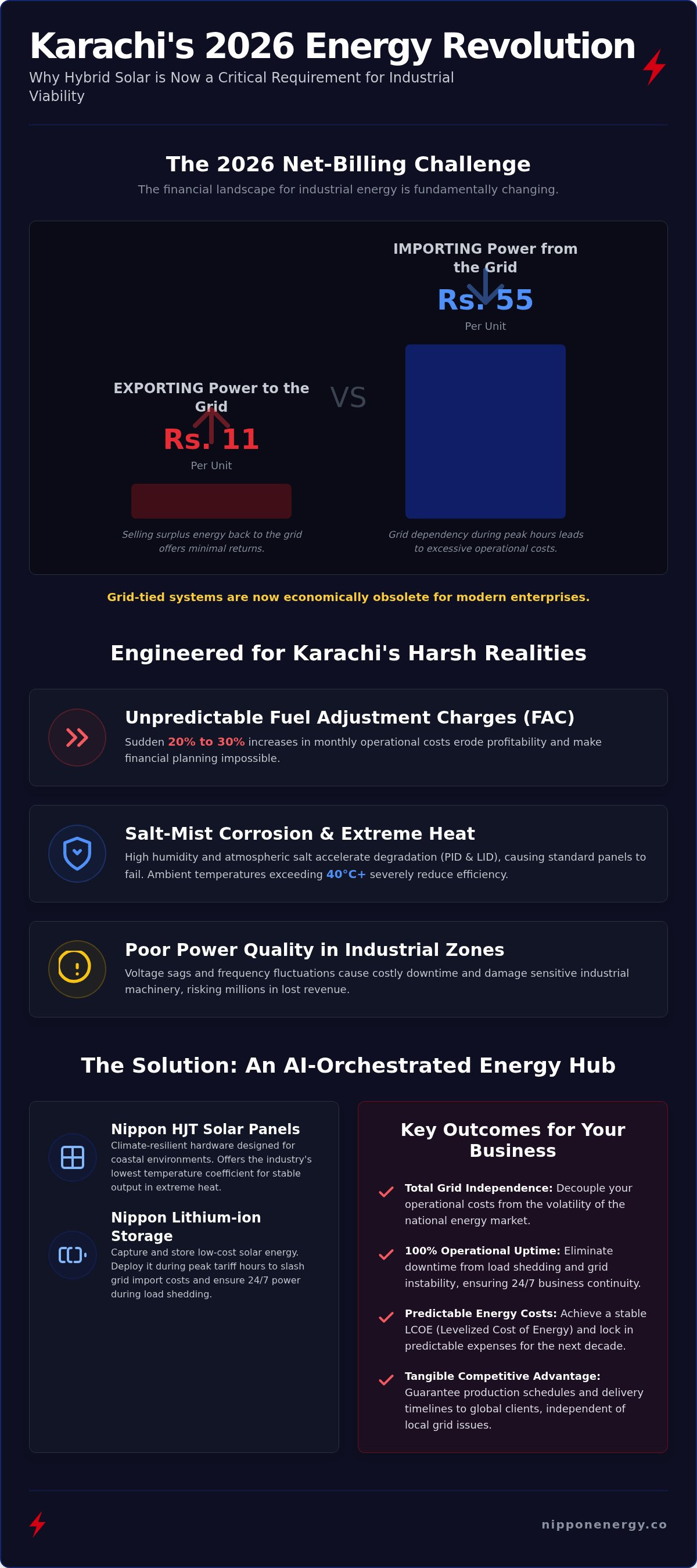
The 2026 transition from net-metering to net-billing has fundamentally altered the ROI equation for industrial energy in Pakistan. Exporting power at approximately Rs. 11 per unit while importing it at rates as high as Rs. 55 per unit makes traditional grid-tied setups obsolete for the modern enterprise. To maintain operational viability, implementing a high-performance hybrid solar system for commercial use karachi is no longer a luxury; it is a critical engineering requirement. You likely recognize that K-Electric's aggressive fuel adjustment charges and the relentless salt-mist corrosion of the coastal climate are eroding your bottom line.
This guide provides a comprehensive technical framework to help your business achieve total grid independence through advanced HJT and lithium-ion architecture. We will detail how to bypass tariff hikes and eliminate downtime during peak summer load shedding by utilizing hardware designed for 40°C+ environments. You will gain a clear understanding of the 2026 engineering standards required to build a resilient, AI-orchestrated energy asset that ensures 24/7 business continuity. We examine the integration of high-durability components that survive Karachi's humidity while delivering predictable energy costs for the next decade.
Key Takeaways
- Analyze how the 2026 net-billing transition and K-Electric fuel adjustment charges redefine the financial feasibility of industrial solar projects.
- Identify the specific engineering standards for a hybrid solar system for commercial use karachi to prevent salt-mist degradation in coastal industrial zones.
- Understand the role of Nippon Lithium-ion Battery Storage Systems in maintaining 24/7 operations during Karachi's scheduled load shedding.
- Navigate the full EPC lifecycle, focusing on urban-specific challenges like structural roof integrity and shading analysis in dense business districts.
- Discover how integrated architectures like NipponHev provide a future-proof solution for Karachi's unique grid instability and high-temperature environment.
Navigating Karachi’s 2026 Commercial Energy Landscape
The 2026 energy paradigm for Karachi enterprises is defined by a transition from passive consumption to active energy orchestration. A modern hybrid solar system for commercial use karachi is no longer just a set of photovoltaic modules; it's a sophisticated multi-source hub that synchronizes solar generation, lithium-ion storage, and the grid. This evolution is driven by the "K-Electric Factor," where unpredictable Fuel Adjustment Charges (FAC) can inflate monthly operational costs by 20% to 30% without warning. For businesses in the SITE area, even a single hour of downtime during peak production can result in millions of rupees in lost revenue and wasted raw materials.
While earlier installations relied on Mono-PERC technology, 2026 marks the decisive shift toward N-type architectures, specifically HJT and TOPCon. These technologies offer superior bifaciality and lower degradation rates, which are essential in the high-irradiance but harsh atmosphere of Sindh. The broader context of Solar power in Pakistan shows that distributed solar capacity has reached significant levels, forcing a move toward systems that prioritize self-consumption over simple grid export. This shift ensures that the energy produced is used to offset the highest tariff tiers rather than being sold back at a lower net-billing rate.
The Economic Case for Grid Independence in Sindh
The Levelized Cost of Energy (LCOE) for grid-reliant businesses has climbed steeply as subsidies are removed and infrastructure costs are passed directly to the commercial consumer. Under the 2026 NEPRA net-billing regulations, exporting power is significantly less lucrative than storing it for internal use. Integrating a hybrid solar system for commercial use karachi allows firms to capture solar energy during the day and deploy it when grid tariffs are at their peak. The Hybrid Advantage is the technical ability to decouple a business's operational costs from the volatility of the national energy market while ensuring 100% uptime through intelligent storage management.
Operational Resilience in Industrial Zones
Industrial clusters like Port Qasim and Korangi face unique power quality challenges, including voltage sags and frequency fluctuations that can damage sensitive CNC machinery or textile looms. Hybrid systems serve as a critical buffer, providing active voltage stabilization and harmonic filtration through intelligent AI inverters. By achieving strategic energy autonomy, Karachi's exporters can guarantee delivery timelines to global clients regardless of local grid instability. This reliability becomes a tangible competitive advantage in international trade, where energy security is synonymous with fiscal discipline and manufacturing precision.
Climate-Resilient Hardware: Selecting Panels for Coastal Karachi
Karachi’s geographical position presents a unique set of engineering challenges that standard solar components aren't equipped to handle. In coastal districts like DHA and Clifton, atmospheric salt concentration accelerates galvanic corrosion, often leading to the failure of standard modules within five years. A hybrid solar system for commercial use karachi requires hardware that treats the coastline as a high-stress laboratory. The combination of high humidity and salt-mist causes Potential Induced Degradation (PID) and Light Induced Degradation (LID) in traditional p-type panels, resulting in a rapid decline in ROI for industrial investors.
To combat these environmental stressors, Nippon HJT Solar Panels have emerged as the technical benchmark. While topcon solar panels represent a significant upgrade over older technologies, HJT offers the lowest temperature coefficient in the industry. This is critical when Karachi’s ambient temperatures exceed 45°C during summer heatwaves. While standard panels see a sharp drop in efficiency as heat rises, HJT modules maintain a stable output, ensuring that your energy hub remains productive during the most demanding peak hours.
Nippon HJT Technology: The Coastal Standard
Nippon HJT modules utilize a bifacial architecture that is particularly effective on Karachi’s industrial rooftops. Many commercial buildings in the SITE and Korangi areas use light-colored, reflective roofing materials. These panels capture reflected irradiance from the rear side, potentially increasing energy yield by up to 25% compared to monofacial setups. Beyond efficiency, the structural integrity of these panels is designed for the Sindh monsoon season. They feature reinforced frames and high wind-load ratings that prevent micro-cracking during extreme weather events. Choosing this N-type technology secures a 30-year performance lifecycle, with annual degradation rates significantly lower than industry averages.
Corrosion Resistance and Durability Metrics
Engineering a resilient system requires strict adherence to international durability metrics. Procurement teams should prioritize IEC 61701 Level 6 certification, which verifies resistance to severe salt-mist corrosion. Nippon Energy utilizes advanced encapsulation technology to hermetically seal solar cells, protecting them from the high particulate matter found near the Northern Bypass and industrial corridors. These panels also feature anti-soiling glass surfaces that simplify maintenance in dusty environments. For a truly durable hybrid solar system for commercial use karachi, these modules must be paired with hot-dip galvanized mounting structures that meet ASTM A123 standards to ensure the entire physical asset survives the coastal air.
Intelligent Energy Storage: AI Inverters and Lithium-ion Integration
The 2026 commercial energy landscape demands more than just energy generation; it requires intelligent management of every kilowatt-hour. For a hybrid solar system for commercial use karachi, the integration of lithium ion battery storage is now a technical necessity rather than an optional upgrade. This shift is driven by the need for peak shaving, a strategy where AI-driven systems discharge stored energy during K-Electric's highest tariff hours to protect the business from exorbitant peak-rate billing. Nippon Smart AI Inverters act as the central nervous system of this architecture, making millisecond-level decisions to optimize ROI while ensuring the facility remains operational during grid failures.
Sizing these storage systems involves a precise engineering balance between operational autonomy and initial CAPEX. While industrial users in the SITE area may desire 24/7 independence, the most efficient systems are often sized to cover critical loads and peak tariff windows. This targeted approach ensures that the investment pays for itself through avoided grid costs without over-burdening the project's financial structure with excess capacity that isn't fully utilized.
The Shift from Lead-Acid to Lithium-Ion
The technical superiority of Nippon Lithium-ion Battery Storage Systems is evident when analyzing cycle life and thermal resilience. Traditional lead-acid batteries typically fail after 1,500 cycles, whereas Nippon's lithium solutions offer 6,000+ cycles, representing a significantly lower total cost of ownership over a 10-year period. Furthermore, lithium systems support a Depth of Discharge (DoD) of 90% or higher, compared to the 50% limit of lead-acid. In Karachi's extreme heat, where ambient temperatures regularly exceed 40°C, lithium's stable chemistry prevents the rapid degradation common in older technologies. The compact footprint of these systems is also vital for urban Karachi commercial plots where warehouse and rooftop space is at a premium.
AI-Driven Energy Orchestration
Modern smart ai solar inverter technology utilizes machine learning to predict load patterns based on historical usage and weather forecasts. These inverters provide automatic grid-isolation during brownouts, instantly switching to battery power to protect sensitive commercial machinery from voltage spikes. For facility managers in industrial zones, real-time monitoring allows for the management of the entire energy footprint via a mobile app. This level of transparency ensures that energy consumption remains within optimized parameters, allowing Karachi businesses to maintain high-precision manufacturing standards even when the local grid is unstable.
EPC Framework: Engineering Your Solar Investment in Karachi
Deploying a hybrid solar system for commercial use karachi requires a rigorous engineering methodology that treats the installation as a long-term industrial asset. The transition from a conceptual design to an operational powerhouse involves a complex solar epc services lifecycle. This process ensures that every component is synchronized for maximum efficiency and safety. In Karachi's dense industrial corridors, engineering teams must address unique structural and electrical constraints that are often overlooked in residential setups. Professional EPC management guarantees that your investment complies with 2026 technical standards while providing a seamless integration with existing power infrastructure.
Feasibility and Structural Analysis
Precision begins with a detailed feasibility study that evaluates the structural integrity of the facility's roof. In high-density commercial areas like I.I. Chundrigar Road, shadow analysis is vital to account for neighboring high-rise structures that can significantly impact daily yield. Engineering calculations must also account for Karachi’s coastal wind profile; solar arrays must be designed to withstand 150km/h gusts that occur during cyclonic weather events. Professional mounting structures utilizing hot-dip galvanized steel are essential to prevent structural failure and maintain the integrity of the solar modules over their 30-year lifespan. This analytical approach prevents costly mid-project corrections and ensures the physical safety of the building and its occupants.
Net Metering and Regulatory Compliance
Navigating the 2026 regulatory landscape requires a deep understanding of the latest NEPRA and K-Electric (KE) net-billing protocols. The EPC team manages the entire application process, ensuring that the hybrid solar system for commercial use karachi meets all anti-islanding and rapid shutdown requirements. These safety protocols are non-negotiable for protecting KE line workers during grid maintenance. Furthermore, the electrical integration phase must ensure safe synchronization with existing diesel generators. AI-driven controllers manage this transition, preventing back-feeding and ensuring that the solar-plus-storage hub operates in harmony with all available power sources. To begin your transition to a future-proof energy hub, you can consult with our engineering team for a site-specific technical evaluation.
Commissioning concludes with a comprehensive handover where your technical staff is trained on the AI management tools. This ensures that the facility manager can monitor real-time performance and adjust load-shifting parameters as energy prices fluctuate. By adhering to a structured EPC framework, Karachi businesses can secure a reliable energy future that is both technically sound and financially optimized.
Nippon Energy: Your Partner for Industrial Solar Excellence
Nippon Energy operates as the high-tech architect for Karachi's evolving industrial landscape. Our engineering team, based in the Korangi Industrial Area, possesses an intimate understanding of the specific grid irregularities and climatic stressors unique to Sindh. To streamline the transition to renewables, we provide the nipponhev system, a pre-engineered commercial architecture designed for rapid deployment and maximum energy density. This solution mitigates the risks associated with fragmented component sourcing by offering a fully integrated, factory-tested energy hub.
Performance longevity in Karachi is directly tied to environmental management. Given the high particulate matter and dust levels found in Northern Bypass and SITE areas, rigorous solar system maintenance is a core component of our service level agreements. Regular cleaning protocols and thermal imaging inspections ensure that your hybrid solar system for commercial use karachi maintains its projected yield throughout its multi-decadal lifecycle. We don't just install hardware; we manage a long-term industrial asset that secures your fiscal predictability.
Integrated Performance Architecture
Our ecosystem synchronizes Nippon HJT panels with Nippon Lithium-ion Battery Storage Systems and AI-driven inverters to create a single, optimized energy hub. This technical synergy allows for millisecond-level response times during grid fluctuations. Our local Network Operations Center (NOC) in Karachi tracks your system's performance 24/7, identifying potential anomalies before they impact your production line. This architecture is inherently scalable; businesses can expand their storage capacity or solar array as their industrial footprint grows within Sindh. This modular approach ensures that your initial investment remains relevant as your energy requirements evolve.
The Path to Net Zero for Karachi Exporters
Karachi’s textile and manufacturing exporters face increasing pressure to meet international green compliance standards and carbon border adjustment mechanisms. By utilizing AI-optimized solar harvesting, firms can significantly reduce their carbon footprint and secure their position in the global supply chain. This transition isn't merely a cost-saving measure; it's a strategic alignment with the future of global trade. Our commitment to the South Asia region and Karachi’s industrial growth drives our pursuit of engineering excellence. Consult with our Karachi engineering team today to finalize your 2026 energy strategy and achieve true grid independence.
Architecting a Resilient Energy Future for Karachi
The 2026 transition from simple generation to intelligent energy orchestration marks a turning point for Sindh’s industrial sector. To remain competitive, businesses must move beyond generic hardware and adopt climate-resilient architectures that address the specific challenges of salt-mist corrosion and extreme thermal loads. Implementing a hybrid solar system for commercial use karachi is the most effective technical strategy for achieving absolute grid independence and neutralizing the impact of unpredictable fuel adjustment charges. By combining Tier-1 N-Type HJT Technology with intelligent lithium-ion storage, your facility can maintain 24/7 continuity regardless of grid instability.
Our commitment to Japanese engineering standards and local support from the Korangi Industrial Area ensures that your system is designed for longevity and peak performance. Securing your energy future requires a methodical approach to feasibility and structural integrity. We invite you to Request a Commercial Solar Feasibility Study for Your Karachi Business and discover how our AI-driven solutions can stabilize your operational overhead. Your transition to a sustainable, self-sufficient energy hub starts with precise engineering and a partner who understands the local landscape. We look forward to powering your growth.
Frequently Asked Questions
Is a hybrid solar system better than an on-grid system for Karachi businesses?
A hybrid solar system for commercial use karachi is superior because it ensures operational continuity during the frequent load shedding cycles common in Sindh. Unlike on-grid systems that shut down during grid failures, hybrid architectures utilize Nippon Lithium-ion Battery Storage Systems to maintain power. This setup also allows for peak shaving, where stored energy is discharged during K-Electric's highest tariff hours, significantly improving the project's financial return compared to a standard grid-tied installation.
How much space is required for a 100kW hybrid solar system in Karachi?
A 100kW installation typically requires between 6,000 and 7,500 square feet of unobstructed rooftop space. The exact footprint depends on the efficiency of the modules; using Nippon HJT Solar Panels reduces the required area due to their higher power density. Engineering teams must also conduct a thorough shadow analysis to account for neighboring industrial structures. This ensures that the array achieves maximum irradiance throughout the day without significant clipping or energy loss.
Can a hybrid solar system run heavy industrial machinery during load shedding?
High-performance hybrid systems are capable of supporting heavy industrial loads, provided the inverter and battery bank are engineered for high-surge currents. Nippon Smart AI Inverters manage the transition between solar, battery, and grid power in milliseconds to prevent equipment tripping. By integrating a hybrid solar system for commercial use karachi, factories can run sensitive CNC machinery or textile looms during grid outages. This prevents the costly raw material waste associated with sudden power interruptions.
What is the expected lifespan of Nippon HJT panels in Karachi's coastal climate?
Nippon HJT panels are engineered for a 30-year operational lifecycle, even in the aggressive salt-mist environments of DHA and Clifton. These N-type modules feature a superior temperature coefficient that maintains performance when Karachi temperatures exceed 40°C. Their advanced encapsulation technology provides a hermetic seal against humidity and particulate matter. This durability ensures that the power output remains above 80% of its original capacity after three decades of continuous exposure.
How long does the K-Electric net metering approval process take in 2026?
In 2026, the net-billing approval process with K-Electric and NEPRA generally spans four to eight weeks from the initial application. Our EPC team manages the entire regulatory lifecycle, including the technical inspection and the installation of the bidirectional meter. Adhering to strict safety protocols, such as anti-islanding and rapid shutdown requirements, is essential for a successful approval. Professional management of this process minimizes administrative delays and ensures the system is commissioned on schedule.
Does a hybrid solar system work with existing diesel generators?
Modern hybrid architectures are designed to synchronize seamlessly with existing diesel generators. The AI-driven controller treats the generator as a secondary backup source, only activating it when solar and battery reserves are depleted. This integration significantly reduces diesel consumption and engine wear by utilizing solar energy as the primary power source. Such a multi-source energy hub provides the highest level of energy security for industrial facilities in unstable grid zones. For industrial operators in other territories looking for similar specialized power equipment, Champion Baltics offers a wide range of reliable solutions.
Industrial zones like SITE and Korangi require a rigorous maintenance schedule due to high levels of airborne dust and particulate matter. We recommend bi-weekly module cleaning and quarterly electrical inspections to ensure optimal energy harvesting. Our Solar System Maintenance and Monitoring services include thermal imaging to detect hotspots and AI-driven performance tracking. These proactive measures prevent minor issues from escalating into significant energy losses, protecting the long-term integrity of the solar asset.
What is the ROI for a commercial hybrid solar system in Karachi?
The typical Return on Investment (ROI) for a commercial hybrid project in Karachi currently ranges between three and five years. This rapid payback period is primarily driven by maximizing self-consumption of solar energy to avoid K-Electric's escalating commercial tariffs. By utilizing Nippon Lithium-ion Battery Storage Systems to offset peak-hour rates, businesses can achieve substantial monthly savings. The combination of reduced energy bills and improved operational uptime creates a compelling financial case for industrial investment.


