

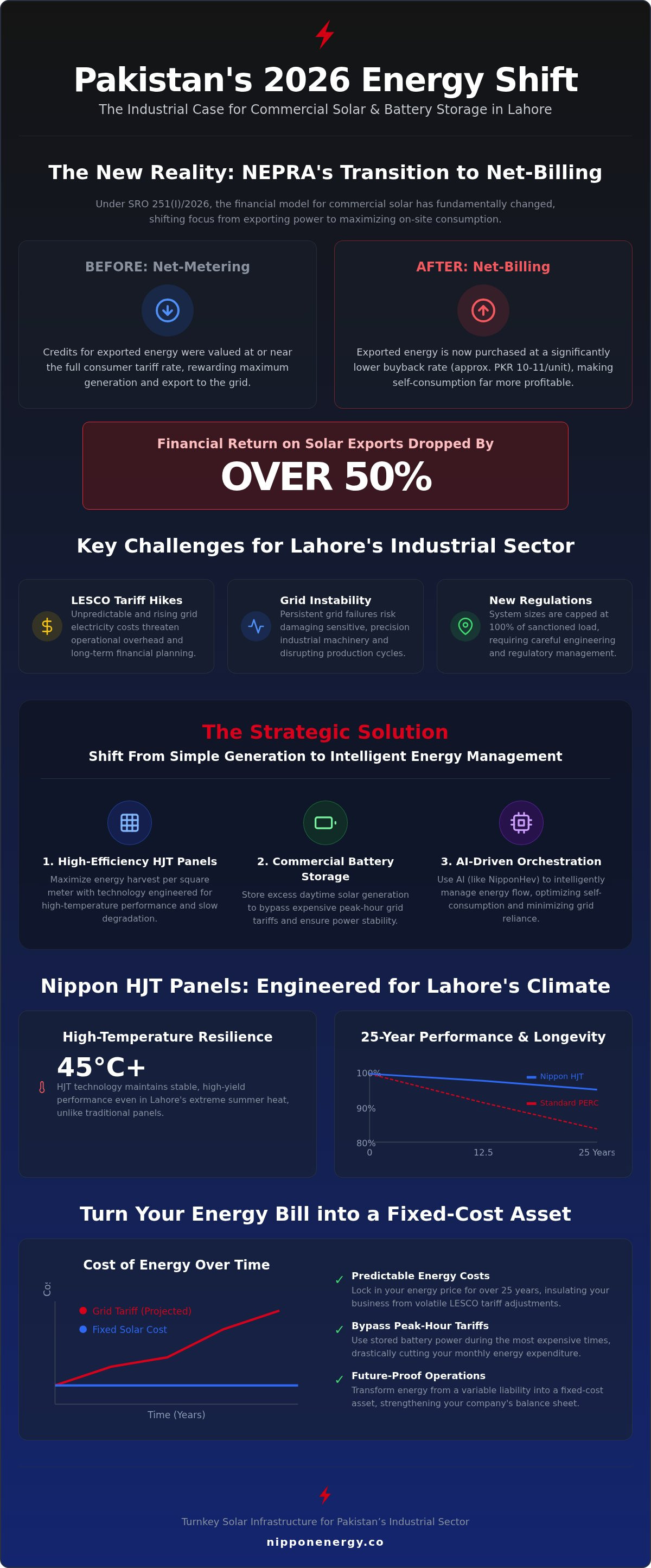
Does your current energy strategy account for the fact that the financial return on standard solar exports in Pakistan dropped by over 50% following the February 2026 NEPRA policy shift? For industrial facilities across Punjab, the transition from net-metering to net-billing makes high-capacity commercial solar battery storage in Lahore a technical necessity rather than a luxury. You've likely realized that unpredictable LESCO tariff hikes and persistent grid instability now threaten the precision of your machinery and the long-term predictability of your operational overhead. This environment demands a shift from simple power generation to sophisticated energy management.
Nippon Energy provides the engineering blueprint to secure maximum commercial ROI by integrating Japanese-engineered HJT technology with AI-driven grid orchestration. By prioritizing self-consumption, you can effectively neutralize the impact of the latest SRO 251(I)/2026 regulations and stabilize your energy costs for decades. This guide examines the technical requirements for commercial solar battery storage systems that exceed a 25-year operational lifespan, the precise mechanics of the new net-billing framework, and how a professional EPC partner manages the complex regulatory paperwork required for approval. We will provide the clarity needed to transform your facility into a self-sustaining power hub that thrives under Pakistan's new energy landscape.
Key Takeaways
- Analyze how the 2026 net-billing framework shifts the commercial advantage from energy exports to on-site self-consumption under new NEPRA regulations.
- Identify why Nippon HJT panels offer the thermal resilience needed to maintain high yields during Lahore’s extreme summer temperatures.
- Evaluate the role of commercial solar battery storage lahore in stabilizing precision industrial machinery and bypassing LESCO’s peak-hour tariff spikes.
- Understand the essential EPC standards for managing NEPRA’s 2026 licensing requirements and the 100% sanctioned load capacity caps.
- Discover how the NipponHev system uses AI-driven grid orchestration to optimize the Levelized Cost of Energy for large-scale industrial units.
The Economic Case for On-Grid Solar in Lahore’s 2026 Business Landscape
The solar energy landscape in Pakistan reached a decisive structural shift on February 9, 2026, when NEPRA transitioned from a traditional net-metering model to a net-billing framework under SRO 251(I)/2026. This regulatory evolution fundamentally redefined the profitability metrics for industrial power. An on-grid solar system is a grid-tied architecture that synchronizes with the LESCO network, allowing your facility to export surplus energy during high-irradiance periods. While the new regulations have reduced export buyback rates to approximately PKR 10-11 per unit, the accelerating cost of grid power has made solar the most effective hedge for commercial operations.
2026 serves as a financial tipping point for Lahore's industrial sector. With the National Electric Power Regulatory Authority (NEPRA) capping system sizes at 100% of the sanctioned load and introducing new licensing fees, the focus has shifted from maximizing exports to maximizing self-consumption. Integrating commercial solar battery storage lahore allows businesses to capture and store daytime generation for use during expensive peak hours. This engineering strategy provides immediate relief from high operational expenditures and strengthens corporate sustainability profiles. It's no longer just about generating power; it's about orchestrating that power to survive a volatile economic climate.
Understanding Net Metering for Lahore Businesses
Within LESCO’s jurisdiction, the technical efficiency of an on-grid system relies on the bi-directional meter. This hardware tracks the energy flow in real-time, recording the precise volume of electricity your system contributes to the grid. Industrial units accumulate credits during peak sunlight hours, which are then reconciled against their nighttime consumption. For urban Lahore commercial zones, on-grid systems are preferred over off-grid alternatives because they provide seamless grid support without the massive capital expenditure required for total grid independence. This configuration ensures that your machinery remains powered even during heavy cloud cover, maintaining the structural integrity of your production cycles.
Hedging Against LESCO Commercial Tariff Hikes
Energy inflation has become a primary threat to Lahore’s manufacturing and retail sectors. Solar infrastructure effectively transforms your energy supply from a variable monthly expense into a fixed-cost asset. While grid costs are projected to rise through 2030, a solar installation provides a predictable energy price for over 25 years. This stability is vital for precision industrial machinery that requires constant, reliable power. By future-proofing your facility today, you insulate your profit margins from the unpredictable nature of LESCO tariff adjustments. It's a strategic move that moves energy from the "liability" column to the "asset" column on your balance sheet.
High-Efficiency Hardware: Why HJT and TOPCon Lead the 2026 Market
The 2026 commercial solar market has moved decisively away from legacy P-type PERC modules. This transition toward N-type technologies, specifically Heterojunction (HJT) and TOPCon, is driven by the need for superior power density and slower degradation rates. Standard modules often lose significant efficiency after the first decade; however, HJT modules maintain a much flatter 25-year degradation curve. This ensures your initial capital investment continues to yield high returns well into the 2050s. Integrating commercial solar battery storage lahore with these N-type modules creates a synchronized system capable of handling the most demanding industrial loads. Nippon Energy prioritizes these high-efficiency hardware solutions to maximize the energy harvest per square meter of industrial roof space.
Nippon HJT Solar Panels: The High-Temperature Standard
Nippon HJT Solar Panels represent the pinnacle of industrial yield. The cell structure combines crystalline silicon with amorphous silicon layers, creating a hybrid that excels in Lahore's extreme 45°C+ summers. While traditional panels suffer from high temperature coefficients, HJT remains stable. This ensures your production lines stay powered during the hottest hours of the day. This technology is the logical progression from Topcon Solar Panels, which already set a high baseline for N-type efficiency. By minimizing thermal energy loss, HJT panels convert more sunlight into usable electricity when the grid is most stressed. You can evaluate your specific load requirements by consulting with the technical team at Nippon Energy.
Bifacial Gains in Lahore’s Industrial Zones
In the dense industrial corridors of Lahore, space is often at a premium. Bifacial TOPCon panels address this by utilizing light reflected from concrete roofs and surrounding structures. This "albedo effect" can generate an additional 10-20% yield compared to monofacial modules. The structural integrity of these glass-on-glass modules is particularly suited for dusty environments, as they offer better protection against micro-cracks and moisture ingress. This durability is essential for maintaining long-term performance without frequent manual interventions.
The current Net metering reforms and grid challenges in Pakistan emphasize the importance of hardware reliability. If your system cannot perform at peak efficiency during high-temperature months, your ROI calculations will fail. To mitigate these risks, many businesses are now pairing high-efficiency panels with commercial solar battery storage lahore to ensure they capture every available kilowatt-hour. This combination creates a resilient energy ecosystem that operates independently of grid volatility and maximizes self-consumption during the most expensive billing cycles.
Engineering the Grid Connection: Net Metering and EPC Excellence
For industrial facilities in Lahore, the transition to solar isn't merely a hardware purchase; it's a complex engineering undertaking. Achieving a seamless grid connection requires a professional Engineering, Procurement, and Construction (EPC) partner to navigate the technical and regulatory hurdles of the 2026 landscape. Under current NEPRA regulations, precision in system sizing is mandatory, as new installations are capped at 100% of the consumer's sanctioned load. A minor error in load calculation or electrical design can result in delayed approvals or suboptimal energy yields. Professional EPC ensures that your commercial solar battery storage lahore is integrated with the structural and electrical integrity required for a 25-year lifecycle.
Compliance with Punjab’s electrical safety standards is non-negotiable for industrial reliability. This involves rigorous testing of earthing systems, lightning protection, and DC/AC isolation protocols. A well-engineered system doesn't just generate power; it protects your expensive industrial machinery from grid fluctuations. By adhering to global Japanese engineering standards, you ensure that your facility remains a stable node within the LESCO network, avoiding the penalties or safety risks associated with substandard installations.
The EPC Lifecycle: From Feasibility to LESCO Commissioning
A successful industrial solar project follows a structured five-step progression. It begins with a comprehensive site audit and 3D shadow analysis to optimize panel placement on factory roofs. Following this, the regulatory phase involves managing the NEPRA licensing paperwork and LESCO application process, which has become more stringent since the February 2026 policy shift. Once approved, we move to the procurement of Tier-1 Nippon hardware, followed by precision installation. The final stage is commissioning, where the bi-directional meter is installed and the system is synchronized with the grid. For a deeper look at this turnkey process, consult our guide on Solar EPC Services.
Nippon Smart AI Inverters: The Brain of the System
The efficiency of your grid connection depends heavily on the sophistication of your power conversion hardware. Smart AI Solar Inverters act as the central nervous system, managing real-time energy flow between your panels, the LESCO grid, and your commercial solar battery storage lahore. These units use machine learning algorithms to detect faults and optimize export efficiency based on daytime generation patterns. Beyond simple conversion, they provide AI-driven surge protection and grid-balancing features that are essential for maintaining stability during LESCO's frequent frequency shifts. This intelligent orchestration ensures that your facility maximizes self-consumption and maintains peak performance without manual intervention.
Strategic ROI: Calculating Payback Periods for Lahore Commercial Units
The financial viability of a solar investment in 2026 is determined by the Levelized Cost of Energy (LCOE). This metric represents the total cost of the system over its lifetime divided by the total kilowatt-hours produced. While LESCO grid tariffs continue to follow an upward trajectory, the LCOE of a Nippon HJT system remains fixed once the hardware is commissioned. Current market analysis indicates that commercial solar systems in Lahore typically achieve a full payback within 3 to 4 years. For installations ranging from 50kW to 500kW, the primary driver of this rapid return is the high rate of self-consumption. By integrating commercial solar battery storage lahore, businesses can capture excess daytime generation and deploy it during expensive peak hours, effectively accelerating the amortization of the asset.
Pakistan’s fiscal landscape offers additional mechanisms to enhance this ROI. Commercial entities can utilize accelerated depreciation to write off a significant portion of the system’s value against taxable income in the first year. Furthermore, the State Bank of Pakistan (SBP) continues to support renewable energy through concessional financing schemes, with indicative interest rates often ranging between 5% and 9% per annum. These incentives, coupled with the reduction in monthly operational expenditures, transform solar from a utility cost into a high-yield financial asset. You can begin your transition to energy independence by requesting a customized financial feasibility study from Nippon Energy.
Industrial Case Study: Textile and Manufacturing Units
Textile mills and manufacturing plants in Lahore’s industrial clusters benefit most from solar due to their consistent daytime load profiles. These facilities often operate heavy machinery that aligns perfectly with peak solar irradiance. By utilizing on-site generation, these units bypass the most expensive LESCO commercial tiers. A typical facility can expect substantial savings over a 10-year horizon, providing a competitive edge in a market where energy costs are a primary driver of product pricing. The strategic use of commercial solar battery storage lahore ensures that even during temporary grid instability, critical production cycles remain uninterrupted.
Maintenance and Monitoring: Ensuring 25-Year Performance
The longevity of your ROI depends on the structural and technical health of the hardware. In Lahore, environmental factors like high particulate matter and extreme thermal stress can significantly impact yields if left unmanaged. Protecting your investment requires a disciplined Solar System Maintenance strategy. Nippon Energy employs remote monitoring and predictive maintenance to detect performance dips in real-time. This proactive approach ensures that every component, from the HJT panels to the smart inverters, operates at peak efficiency. Professional O&M services are essential for safeguarding the asset value and ensuring the system exceeds its 25-year design life.
Nippon Energy: Turnkey Solar Infrastructure for Lahore’s Industrial Sector
Nippon Energy operates at the intersection of Japanese precision and local operational expertise. We provide a comprehensive framework for energy independence through the NipponHev System, an integrated solar architecture designed to meet the rigorous demands of 2026 industrial environments. By deploying commercial solar battery storage lahore, we enable facilities to bypass the inefficiencies of aging grid infrastructure and secure a stable, high-performance power supply. Our commitment to technological leadership is evidenced by our exclusive focus on N-type architectures, ensuring that every kilowatt-hour generated is optimized for maximum density and resilience. This methodical approach to power generation focuses on long-term impact rather than temporary savings.
Why Partner with a Global Japanese Brand?
Partnering with a firm rooted in Japanese engineering principles guarantees a level of structural integrity that exceeds standard local market expectations. We maintain stringent ethical standards in hardware sourcing, ensuring that every Nippon HJT and TOPCon panel meets global quality benchmarks. For those who appreciate this culture of precision and are planning a visit to Japan, Naar Tokyo provides expert guidance for a stress-free trip, and you can learn more about their planning resources. Our expertise in solar project development and EPC execution allows us to manage large-scale industrial infrastructure with methodical precision. This disciplined approach minimizes downtime during installation and ensures that the system’s performance remains consistent over its multi-decade lifespan. While many providers focus on short-term costs, we prioritize the long-term reliability required for monumental industrial success. We don't just install panels; we architect future-proof energy ecosystems.The journey toward a zero-rated electricity bill begins with a granular energy audit of your Lahore facility. Our engineering team conducts a detailed analysis of your load profiles and roof structural capacity to determine the most viable configuration. Choosing between Nippon HJT and Nippon TOPCon panels depends on specific site factors such as ambient temperature peaks and available roof area. Integrating these panels with commercial solar battery storage lahore provides the final layer of grid independence, allowing your business to thrive despite shifting NEPRA regulations. This process includes a thorough review of your LESCO connection and a projection of your 25-year ROI. To initiate your transition, consult with Nippon Energy’s Lahore Engineering Team for a customized commercial feasibility study.
Securing Your Industrial Energy Future
The transition from net-metering to net-billing in February 2026 has fundamentally altered the financial landscape for Lahore's industrial sector. Success now depends on precise engineering and high-efficiency hardware that can withstand extreme thermal stress. By integrating commercial solar battery storage lahore, your facility can bypass grid volatility and capture the full value of every generated kilowatt-hour. We've established that Tier-1 Nippon HJT and TOPCon technologies provide the durability needed for a 25-year lifecycle, while professional EPC execution ensures compliance with evolving NEPRA regulations.
Leveraging Japanese Engineering Standards and a dedicated Lahore EPC support team ensures your system remains a high-performance asset for decades. It's time to move beyond the unpredictability of grid-dependent power and establish a stable, fixed-cost energy foundation. Request a Commercial Solar Feasibility Study for Your Lahore Business to begin your transition toward total energy independence. Establishing a self-sustaining power model isn't just a cost-saving measure; it's a strategic move toward monumental industrial resilience.
Frequently Asked Questions
What is the average cost of a 100kW on-grid solar system for a business in Lahore?
The total investment for a 100kW system depends on the hardware selection, such as choosing between HJT or TOPCon panels, and the complexity of your industrial roof structure. While global silicon prices influence industry averages, your costs include high-performance hardware and professional EPC services. To get an accurate valuation that aligns with 2026 NEPRA regulations and your specific sanctioned load, we recommend a custom feasibility study rather than relying on generic market estimates.
How long does the LESCO net metering process take for commercial clients in 2026?
The LESCO net-billing application typically spans 4 to 8 weeks from the initial filing to the final commissioning. This timeline includes the technical feasibility study conducted by LESCO and the installation of the bi-directional meter. Working with an experienced EPC partner ensures that all NEPRA licensing requirements and safety certifications are filed correctly. This proactive management prevents the administrative delays that often occur when businesses attempt to navigate the regulatory framework without professional assistance.
What is the difference between HJT and TOPCon panels for Lahore's climate?
Nippon HJT panels utilize a bifacial cell structure that excels in Lahore's 45°C summer peaks due to a superior temperature coefficient. While Nippon TOPCon panels offer a high-efficiency baseline for industrial projects, HJT modules provide lower degradation rates over a 25-year period. HJT technology is particularly effective for facilities where roof space is limited but power density requirements are high. Both options represent a significant upgrade over legacy PERC modules in terms of thermal resilience.
Does an on-grid solar system work during a LESCO power outage?
Standard on-grid systems automatically shut down during a LESCO power outage to prevent "islanding," which is a critical safety requirement for grid maintenance teams. However, integrating commercial solar battery storage lahore allows your facility to operate in a hybrid capacity. This configuration enables the system to disconnect from the grid and continue powering critical industrial loads using stored energy. It's an essential strategy for maintaining production continuity during frequent load-shedding cycles in Punjab.
What are the tax benefits for businesses installing solar in Pakistan?
Commercial entities can utilize accelerated depreciation to write off up to 100% of the solar equipment cost against taxable income within the first year. Additionally, businesses can access the State Bank of Pakistan's concessional financing schemes, which offer indicative interest rates between 5% and 9%. These fiscal incentives significantly reduce the effective payback period. They transform solar infrastructure into a high-yield financial asset for the manufacturing and retail sectors by lowering monthly operational expenditures.
How much roof space is required for a commercial solar installation?
A 100kW commercial installation typically requires approximately 8,000 to 10,000 square feet of unobstructed roof space. The exact footprint depends on the efficiency of the panels; for instance, high-density Nippon HJT modules require less area than standard alternatives to achieve the same output. Our engineering team conducts 3D shadow analysis to optimize panel placement. This ensures that HVAC units and other structural obstructions don't compromise the system's total energy yield or structural integrity.
Can I upgrade my on-grid system to include Lithium-Ion Battery Storage later?
Yes, you can upgrade an existing on-grid system by adding Lithium-Ion Battery Storage through an AC-coupled configuration. This setup allows you to store excess daytime generation without replacing your existing solar inverters. Integrating commercial solar battery storage lahore at a later stage is a strategic way to manage 2026 net-billing reforms. It shifts your focus from exporting cheap energy to the grid toward utilizing it during expensive peak hours.
What kind of maintenance is required for commercial solar systems in Lahore?
Commercial systems in Lahore require regular cleaning cycles to mitigate the impact of high particulate matter and dust. We recommend a monthly cleaning schedule and a semi-annual technical audit of the Nippon Smart AI Inverters and electrical connections. Professional maintenance ensures the system maintains its 25-year design life and prevents efficiency drops caused by thermal stress. Remote monitoring services allow for predictive maintenance, identifying potential faults before they affect your industrial production cycles.


