

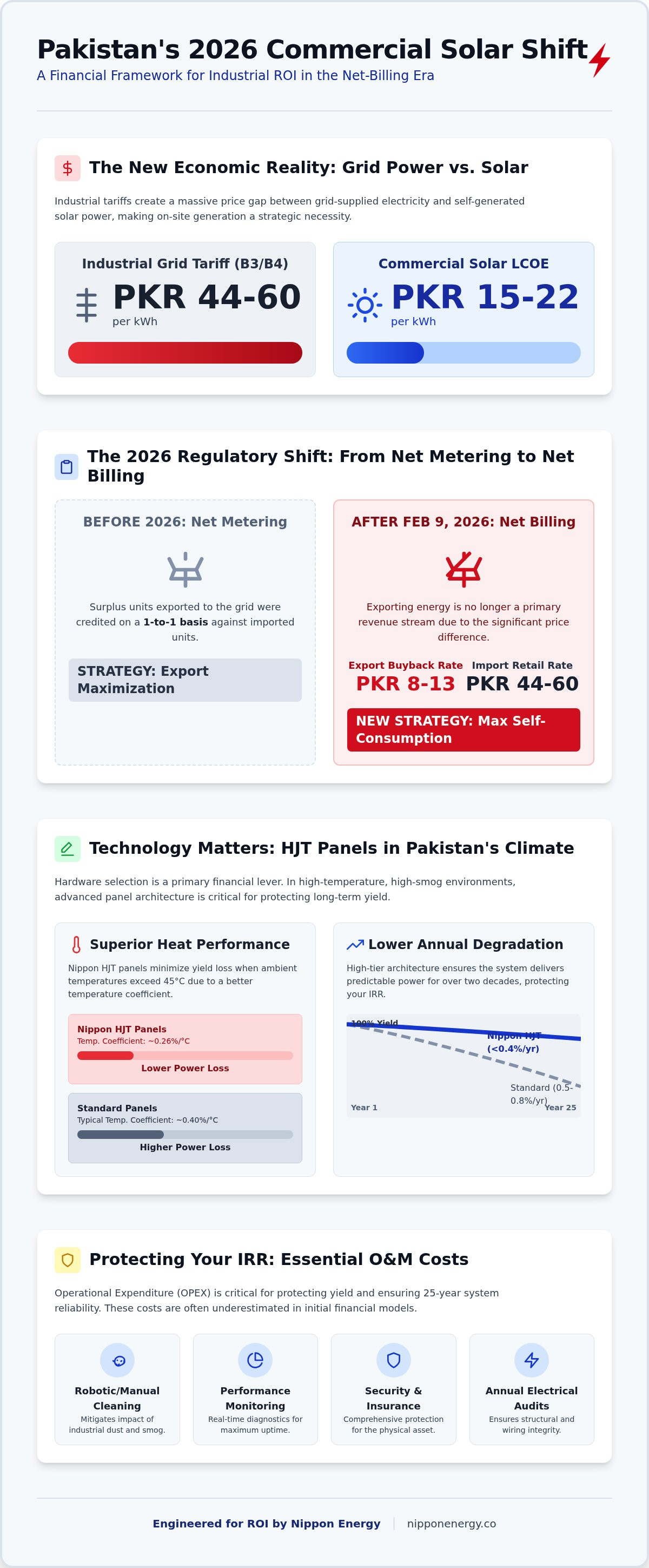
The 2026 transition to a net-billing framework has fundamentally altered the industrial energy landscape in Pakistan. With buyback rates for surplus electricity now set between PKR 8 and PKR 13 per kWh, the financial viability of a project no longer rests on grid exports but on the precision of self-consumption. Understanding commercial solar o&m costs pakistan is now a prerequisite for any firm seeking to insulate itself from industrial tariffs that fluctuate between PKR 44 and PKR 60 per kWh.
You recognize that escalating NEPRA rates make solar adoption a strategic necessity, yet the volatility of the current regulatory shift creates a need for a rigorous, data-driven approach. This guide provides the technical framework required to master your system's financial architecture. We promise to deliver a defensible brief for board approval, focusing on the Levelized Cost of Energy and the impact of local environmental factors like heat and smog on your 25-year yield.
We'll examine how Nippon HJT panels and Smart AI Inverters mitigate degradation and optimize grid interaction. You'll gain a clear understanding of 2026 OPEX projections, the shift toward zero-export architectures, and the hardware selections necessary to secure a sustainable return on investment in the current market.
Key Takeaways
- Analyze the 2026 shift from net metering to net billing to align your energy strategy with new export-to-import regulations.
- Master the calculation of commercial solar o&m costs pakistan to ensure your financial projections remain accurate against rising industrial tariffs.
- Evaluate the performance advantages of HJT architecture over TOPCon in Pakistan’s high-temperature and high-smog industrial corridors.
- Utilize a 5-step ROI framework incorporating city-specific P50/P90 simulations to develop a bankable technical feasibility report.
- Discover how professional EPC services and unified monitoring systems eliminate performance gaps and secure 25-year system reliability.
The 2026 Commercial Solar Landscape in Pakistan
The 2026 industrial energy sector in Pakistan is no longer defined by simple capacity addition; it is defined by the strategic management of electrons. As the solar power landscape in Pakistan matures, the focus has shifted from subsidized grid exports to sophisticated self-consumption models. For a Chief Financial Officer, the primary concern is no longer the upfront cost-per-watt, which often masks the true expense of low-quality components. Instead, the focus is on the Levelized Cost of Energy (LCOE) and the long-term commercial solar o&m costs pakistan required to maintain peak performance over a 25-year lifecycle. Energy security has become a pillar of corporate risk management, as reliance on a volatile grid exposes industrial margins to unpredictable NEPRA adjustments.
Industrial Tariffs and Peak/Off-Peak Dynamics
Industrial electricity tariffs for B3 and B4 consumers currently fluctuate between PKR 44 and PKR 60 per kWh. This creates a massive price delta between grid-supplied energy and solar-generated power. High-efficiency systems offset the most expensive energy buckets first, specifically targeting peak hours where tariffs are highest. However, the 2026 landscape includes significant fixed charges based on Sanctioned Load. Solar installations don't always eliminate these fixed costs, making it vital to size the system based on the base load rather than just peak capacity. By integrating Nippon Smart AI Inverters, factories can intelligently manage when they draw from the grid, maximizing the value of every solar-generated unit.
Regulatory Shifts: NEPRA and the Net Billing Era
The transition from net metering to net billing, effective February 9, 2026, has fundamentally changed the ROI equation. Under the old system, units were traded on a one-to-one basis. Now, surplus energy exported to DISCOs like LESCO or K-Electric is bought back at wholesale rates, typically between PKR 8 and PKR 13 per kWh. Meanwhile, businesses continue to buy at retail prices of PKR 44 plus. This 4x to 5x difference means that exporting energy is no longer a primary revenue stream. The objective in 2026 is "Zero Export" or maximum self-consumption. Successful industrial projects now prioritize high-efficiency HJT modules and lithium-ion storage to keep energy behind the meter. This shift emphasizes why commercial solar o&m costs pakistan must be factored into the initial feasibility study, as maintaining the system's ability to meet immediate internal demand is now the only way to protect the long-term yield of the investment.
Quantifying Commercial Solar O&M Costs and ROI Variables
Financial modeling for industrial solar requires moving beyond simple payback periods to a comprehensive analysis of the Levelized Cost of Energy (LCOE). Capital Expenditure (CAPEX) typically encompasses the procurement of high-efficiency modules, EPC services, and regulatory permitting fees. However, the long-term profitability is anchored in the commercial solar o&m costs pakistan businesses must account for over a 25-year lifecycle. According to IRENA, global solar generation costs have reached levels that make solar the most competitive source of new power; in Pakistan, commercial LCOE typically ranges from PKR 15 to PKR 22 per kWh when professional maintenance protocols are followed.
Operational Expenditure (OPEX) is often underestimated but remains critical for protecting the Internal Rate of Return (IRR). These costs include:
- Robotic or manual cleaning cycles to mitigate the impact of industrial dust and smog.
- Real-time performance monitoring and predictive diagnostics.
- Physical security and comprehensive system insurance.
- Annual electrical audits to ensure structural and wiring integrity.
Invisible variables, such as annual panel degradation, can erode yields if not managed. While standard modules may degrade at 0.5% to 0.8% annually, high-tier architectures significantly reduce this loss, ensuring the "R" in ROI remains defensible over two decades.
Hardware Selection as a Financial Lever
Hardware selection acts as a primary financial lever in the Pakistan market. Nippon HJT panels utilize advanced temperature coefficients (typically 0.26%/°C) to minimize yield loss when ambient temperatures exceed 45°C. Integrating Smart AI Inverters ensures maximum uptime through automated fault detection and grid-export optimization. For industries facing high peak-hour tariffs, lithium-ion storage systems provide a path to peak-shaving, allowing factories to bypass the most expensive energy buckets and directly improving the project's net present value.
The Impact of System Lifecycle and Warranty
A robust ROI model must factor in the entire system lifecycle rather than just the first five years. Professional solar system maintenance is an essential insurance policy for your investment. While performance warranties may span 25 years, businesses should model physical O&M costs as 1% to 2% of the initial CAPEX annually. You should also account for inverter replacement cycles around year 12 to 15 to maintain system efficiency. To see how these variables apply to your specific facility, you can explore our solar project development and EPC services for a detailed technical audit.
HJT vs. TOPCon: Which Architecture Wins the ROI Race?
The selection of cell architecture is a decisive factor in the long-term profitability of an industrial plant. While many developers treat modules as commodities, the delta in energy yield between Heterojunction (HJT) and Tunnel Oxide Passivated Contact (TOPCon) technologies can represent significant revenue differences over 25 years. In Pakistan’s industrial hubs, where ambient temperatures frequently exceed 40°C, thermal stability and degradation rates become the primary drivers of the Levelized Cost of Energy (LCOE). Engineering a system for the local climate requires a move away from generic hardware toward high-performance architectures that maintain efficiency under stress.
Nippon HJT Solar Panels: The High-Temperature Advantage
Nippon HJT panels represent the pinnacle of thermal resilience. Conventional modules suffer significant efficiency drops as temperatures rise, but HJT’s superior temperature coefficient ensures that energy harvest remains stable even during peak summer months in regions like Multan or Sukkur. This technical precision translates directly into financial performance through several key metrics:
- Annual Degradation: HJT offers a linear degradation rate of approximately 0.25% per year, compared to the industry standard of 0.5% or higher.
- 25-Year Yield: Over a quarter-century, this lower degradation ensures that an HJT system produces significantly more kWh per kWp than PERC or standard alternatives.
- Bifaciality: With bifaciality factors often exceeding 90%, these panels maximize ROI on industrial rooftops with reflective surfaces or in elevated carport structures.
By reducing the total number of panels required to meet a specific energy target, HJT also helps optimize commercial solar o&m costs pakistan by reducing the physical footprint that requires cleaning and inspection. This architectural efficiency ensures that every square meter of your roof works harder for your bottom line.
Nippon TOPCon Solar Panels: Balancing CAPEX and Yield
For projects where the initial Capital Expenditure (CAPEX) is the primary constraint, TOPCon solar panels offer a compelling middle ground. This technology provides a substantial efficiency boost over legacy systems while maintaining a price point that facilitates a faster initial payback period. In 1MW+ industrial installations, TOPCon modules deliver efficiency benchmarks that exceed 22.5%, making them an excellent choice for massive rooftop arrays where space is abundant.
While their degradation curve is slightly steeper than HJT, their high power density ensures a robust Internal Rate of Return (IRR). Choosing between these architectures requires a calculated assessment of your site's specific thermal profile and load requirements. Balancing these technical variables is essential to ensuring that your commercial solar o&m costs pakistan remain proportional to the energy generated, securing the structural integrity of your 25-year financial model.
5 Steps to Calculate Industrial Solar ROI in Pakistan
Developing a bankable financial model for industrial solar requires a transition from basic estimates to rigorous engineering simulations. In the 2026 regulatory environment, the profitability of a system is no longer a factor of total generation alone but a factor of how that generation matches your operational load. To secure board approval, your ROI calculation must integrate commercial solar o&m costs pakistan alongside technical variables like degradation and net billing deltas. Follow this five-step framework to determine your project's true net present value.
- Step 1: Audit 12 Months of Electricity Bills: Conduct a granular load profile analysis to identify base loads and peak demand periods. This identifies the "energy signature" of your facility.
- Step 2: Simulate Yield with P50/P90 Data: Use city-specific meteorological data to simulate energy yield. P90 simulations provide a conservative, high-confidence generation figure that banks require for financing.
- Step 3: Apply the 2026 Net Billing Ratio: Factor in the buyback rate of approximately $0.03 to $0.05 per unit against the grid purchase price of $0.16 to $0.22. This delta dictates your self-consumption strategy.
- Step 4: Factor in Corporate Tax Benefits: Utilize Pakistan’s accelerated depreciation rules, which allow businesses to write off a significant portion of the project cost in the first year, directly reducing taxable income.
- Step 5: Calculate IRR, NPV, and Payback: Combine CAPEX, OPEX, and tax savings to determine the Internal Rate of Return and Net Present Value over a 25-year horizon.
Load Profiling and Self-Consumption Ratio
The "sweet spot" for industrial ROI in 2026 is a self-consumption ratio of 70% or higher. Because the export rate to DISCOs is significantly lower than the retail purchase price, every unit consumed behind the meter is worth four times more than a unit exported. Matching your production curve to factory shift timings is essential. For industries with heavy evening operations, integrating Nippon Lithium-ion battery storage allows you to capture daytime surplus and deploy it during peak tariff windows, effectively "shaving" the most expensive energy buckets from your bill.
Tax Incentives and Financial Engineering
Financial engineering is as critical as technical engineering for project success. Pakistan currently offers favorable accelerated depreciation allowances for renewable energy equipment, which can improve the project's IRR by several percentage points. Additionally, many industrial projects qualify for the State Bank of Pakistan (SBP) Green Finance schemes, which provide lower-interest capital compared to private commercial loans. When building your model, ensure you include commercial solar o&m costs pakistan as a recurring OPEX line item to maintain the system's eligibility for these financial instruments. For a comprehensive audit of your facility's solar potential, you can request a technical brief through our solar project development and EPC services.
Nippon Energy: Engineering ROI through Precision EPC
Precision in engineering is the bridge between a theoretical ROI and realized fiscal gains. Professional Solar EPC services ensure that the hardware specified in the design phase performs to its maximum potential in the field. By integrating the NipponHev system, we provide a unified energy management architecture that synchronizes generation, storage, and consumption. This prevents the performance gaps that often occur when disparate components are forced to interact without a centralized intelligence layer. It's about creating a cohesive ecosystem where every electron is accounted for and optimized.
Real-time monitoring is not a passive feature but a proactive yield protection mechanism. Our AI-driven platforms detect soiling patterns and electrical faults before they escalate into significant downtime. This level of technical oversight is a philosophy shared by managed service providers like JP Technical, who prioritize system reliability through constant monitoring. In the context of commercial solar o&m costs pakistan, this predictive approach reduces the need for reactive repairs and ensures that the Levelized Cost of Energy remains within the projected $0.05 to $0.08 per unit range. By identifying exactly when cleaning is required based on real-time loss data, we eliminate unnecessary O&M expenses while protecting your revenue stream.
A 500kW industrial installation in Karachi provides a clear benchmark for 2026 performance. By utilizing Nippon HJT panels and Smart AI Inverters, the facility achieved a 3.8-year payback period despite the new net billing adjustments. The project’s success was driven by a 78% self-consumption ratio, made possible through high-precision load profiling and automated demand response. This case study demonstrates that technical excellence is the most effective hedge against regulatory volatility.
Turnkey Solutions for Industrial Parks
We manage the entire project lifecycle, from initial technical feasibility studies to final NEPRA licensing and grid synchronization. In high wind-load zones across Sindh, we deploy custom-engineered mounting structures designed to withstand coastal gusts exceeding 150 km/h. Our long-term O&M contracts guarantee performance ratios, providing a stable foundation for your commercial solar o&m costs pakistan modeling. This turnkey approach eliminates the complexity of coordinating multiple vendors and ensures a single point of accountability for your 25-year yield.
Securing Your Investment for 2046 and Beyond
Industrial energy needs are not static. Our modular architecture allows for the seamless expansion of lithium-ion storage as your factory’s load grows or as grid tariffs continue to rise. Partnering with a firm of Japanese heritage provides the technical discipline and structural integrity required for 25-year infrastructure. We don't just build for current needs; we architect for the next two decades of energy evolution. To begin your transition, you can contact Nippon Energy for a customised ROI simulation.
Securing Industrial Energy Autonomy in 2026
The industrial energy transition in Pakistan is no longer a matter of simple procurement; it's a task of sophisticated architectural planning. Success in the 2026 net billing era depends on maximizing self-consumption through high-efficiency HJT technology and intelligent storage. By accurately quantifying commercial solar o&m costs pakistan, your organization can transform a volatile utility expense into a stable, high-yield asset. Protecting your 25-year Internal Rate of Return requires a partner who understands the specific thermal and regulatory challenges of the local market.
Nippon Energy combines Japanese-engineered HJT technology with deep regional expertise in Karachi and Lahore. Our proprietary AI energy management systems provide the technical precision needed to eliminate performance gaps and future-proof your facility against rising tariffs. The path to energy autonomy is built on data, resilience, and engineering excellence. It's time to move beyond generic solutions toward a system engineered for the next two decades of growth.
Request a Professional 2026 ROI Simulation for Your Facility
Take the first step toward securing your industrial future with a framework designed for 25-year reliability and peak financial performance.
Frequently Asked Questions
What is the average payback period for commercial solar in Pakistan in 2026?
The typical payback period for industrial and commercial solar installations in 2026 ranges from 3 to 5 years. This timeline is heavily influenced by high industrial grid tariffs, which currently fluctuate between PKR 44 and PKR 60 per kWh. By offsetting these expensive units with solar generation, businesses achieve rapid amortization of capital costs. High-efficiency modules and optimized self-consumption ratios further accelerate this return by maximizing the value of every generated unit.
How does net billing differ from net metering for industrial consumers?
Net billing, implemented in early 2026, replaces the previous 1:1 unit exchange of net metering with a monetary credit system. Under this framework, surplus energy exported to the grid is credited at wholesale rates, approximately PKR 8 to PKR 13 per unit. Meanwhile, energy imported from the grid is billed at retail industrial rates. This shift prioritizes self-consumption and battery storage over grid export to maintain high project profitability and shorter payback cycles.
Does HJT technology really provide a better ROI than TOPCon?
HJT technology often delivers a superior long-term ROI in Pakistan due to its lower annual degradation rate of 0.25% and an industry-leading temperature coefficient. In high-heat regions, HJT modules maintain higher energy yields compared to TOPCon alternatives. While the initial investment for HJT may be higher, the cumulative energy harvest over 25 years typically results in a lower Levelized Cost of Energy, especially in harsh industrial environments where thermal stability is critical.
What are the typical commercial solar O&M costs per year in Pakistan?
Commercial entities can leverage accelerated depreciation allowances, allowing for a significant write-off of the solar equipment's value within the first year of operation. This reduces taxable income and improves immediate cash flow for the business. Additionally, the 2026-27 budget has maintained exemptions on various import duties for renewable energy components. These fiscal incentives significantly lower the effective cost of the project and shorten the overall payback period for industrial investors across the country.
How does the temperature coefficient affect ROI in cities like Multan or Karachi?
The temperature coefficient measures the efficiency loss of a solar panel for every degree the temperature rises above 25°C. In cities like Multan or Karachi, where ambient temperatures often exceed 40°C, panels with a poor coefficient can lose over 15% of their rated output. Choosing modules with a low coefficient, such as Nippon HJT panels, minimizes these thermal losses. This ensures consistent generation during peak summer months, directly protecting the project's annual revenue and yield.
Is it better to finance commercial solar or use equity?
Financing through the State Bank of Pakistan (SBP) Green Finance scheme is often more advantageous than using 100% equity. These specialized renewable energy loans offer interest rates significantly lower than standard commercial market rates. By leveraging low-cost capital, businesses can preserve their internal cash reserves while benefiting from a project that pays for its own debt through energy savings. A thorough financial simulation can determine the optimal debt-to-equity ratio for your specific industrial facility.
What is the typical O&M cost for a 1MW solar plant in Pakistan?
For a 1MW industrial solar plant, commercial solar o&m costs pakistan are calculated based on the technical complexity and environmental conditions of the site. These costs include specialized labor for high-voltage maintenance, AI-driven monitoring subscriptions, and water management for cleaning cycles. While specific figures depend on the facility's location, modeling O&M as a fixed percentage of generation value is common. Professional EPC providers typically offer comprehensive service contracts that guarantee performance ratios to mitigate operational risk.


