

In 2026, a megawatt-scale solar installation isn't just a construction project. It's a high-precision engineering asset where a minor efficiency gap can result in substantial revenue loss over the system's lifecycle. Industrial leaders understand that rising energy costs are tightening manufacturing margins, yet the fear of high-degradation hardware often stalls critical transitions. Selecting the right solar epc company for industrial projects is the difference between a technical liability and a long-term competitive advantage.
We recognize that managing multiple vendors and complex technical specifications creates unnecessary risk for your operations. This guide reveals how a manufacturer-led EPC partner integrates advanced Nippon HJT hardware and engineering precision to maximize industrial energy ROI. You'll discover how to achieve a significant reduction in LCOE through a turnkey solution that offers a single point of accountability. We will analyze the transition to N-type technology, the role of AI-driven management in grid stabilization, and the structural requirements for future-proofed megawatt excellence.
Key Takeaways
- Understand how a turnkey approach consolidates engineering, procurement, and construction into a single point of accountability to streamline megawatt-scale deployments.
- Learn why selecting a specialized solar epc company for industrial projects that utilizes N-type technologies like Nippon HJT panels is essential for maintaining efficiency in high-temperature environments.
- Discover the performance advantages of hardware-integrated EPC services, which eliminate component mismatch and optimize the synergy between AI inverters and storage systems.
- Master the 2026 evaluation framework for assessing a partner's technical depth, focusing on their ability to orchestrate complex HJT and TOPCon architectures.
- Identify strategies to significantly reduce your Levelized Cost of Energy (LCOE) by leveraging Japanese engineering standards and future-proofed system designs.
What is a Solar EPC Company for Industrial Projects?
A solar epc company for industrial projects provides the technical orchestration required for high-stakes energy transitions. In 2026, the EPC model has evolved from a simple service into a rigorous engineering discipline. It covers the entire lifecycle of a project, from initial site assessment to the final grid connection. This turnkey structure removes the burden of vendor management from the manufacturer, allowing for a streamlined execution that prioritizes speed and precision. By centralizing engineering, procurement, and construction, industrial leaders can focus on their core operations while a specialized partner manages the technical complexities of a megawatt-scale installation.
The distinction between industrial EPC and residential solar is found in the scale and the sensitivity of the electrical infrastructure. Residential systems are often standardized, but industrial projects require custom high-voltage engineering to handle the power surges and load profiles of heavy machinery. These projects also demand a higher degree of ROI sensitivity; a 1% drop in efficiency across a 10-megawatt plant results in significant financial loss over two decades. Navigating local regulations, such as net metering frameworks in Pakistan or the evolving GCC standards in Dubai, requires an EPC partner with deep regional knowledge to ensure compliance without delaying the project timeline. To gain a clearer perspective on the commercial requirements, you can explore Project-based installation fees for renewable energy systems from experts like Empire Electrical Innovations.
The Three Pillars of Industrial Solar EPC
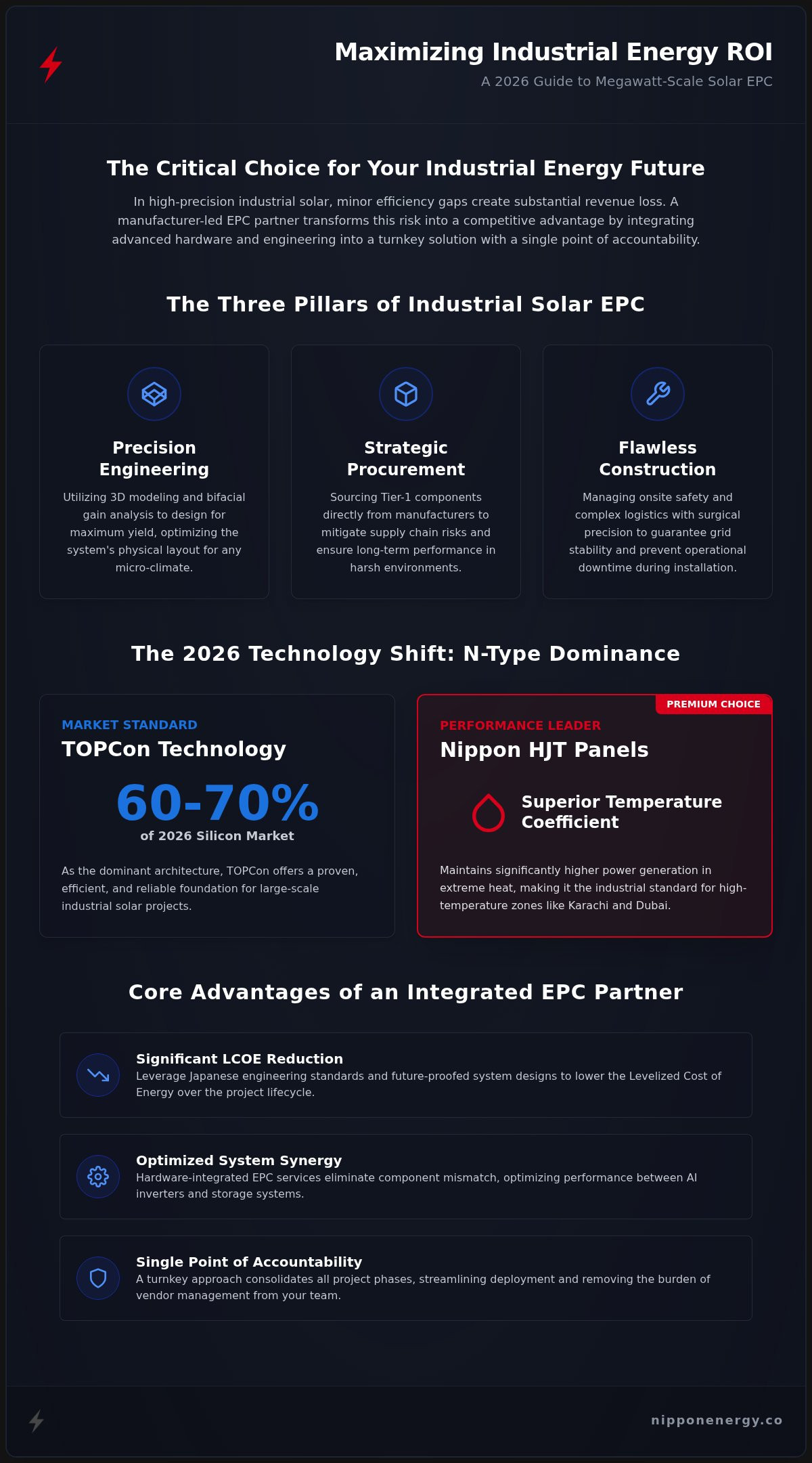
Success in large-scale solar depends on three integrated disciplines that must work in perfect synchronization:
- Engineering: Technical teams utilize advanced 3D modeling and bifacial gain analysis to design for maximum yield in specific micro-climates. This ensures that the system's physical layout optimizes every square meter of available space.
- Procurement: Sourcing Tier-1 components directly from manufacturers mitigates supply chain risks. This phase focuses on selecting the most resilient solar panel technology to ensure long-term performance in harsh environments.
- Construction: Managing onsite safety and large-scale logistical execution prevents operational downtime. Specialized crews install high-voltage equipment and monitoring systems with surgical precision to guarantee grid stability.
Why Industrial Scale Demands Specialized Partners
The "Megawatt Challenge" involves more than just installing hardware; it requires managing power quality for energy-intensive factories. Selecting a qualified solar epc company for industrial projects ensures that the system's electrical architecture can handle the rigorous demands of industrial loads without compromising the local grid. A specialized solar epc services partner provides the expertise needed to integrate AI-driven monitoring and smart inverters, which preserve long-term asset value. This level of technical depth is necessary to future-proof the investment against shifting energy prices and technological advancements. Industrial EPC is the architectural backbone of corporate decarbonization.
Engineering for Resilience: HJT and TOPCon in Industrial Design
The transition from P-type PERC to N-type architectures defines the 2026 industrial energy landscape. A specialized solar epc company for industrial projects must prioritize hardware resilience over upfront cost to ensure the structural integrity of the energy system. Industry analysts confirm that TOPCon technology has captured 60-70% of the silicon market this year. However, Heterojunction (HJT) remains the premium choice for high-performance requirements. Integrating these technologies into Solar for Industrial Processes ensures that manufacturing facilities can meet high thermal and electrical demands with maximum efficiency.
Nippon HJT panels have become the industrial standard in high-temperature zones like Karachi and Dubai. These regions experience extreme heat that causes standard modules to lose output rapidly. Because Nippon HJT panels possess a superior temperature coefficient, they maintain higher power generation during peak summer hours compared to traditional alternatives. This efficiency directly impacts land and roof space optimization; higher cell efficiency allows factories to generate more power from a smaller physical footprint. EPC partners leverage bifacial gains on flat-roof surfaces to capture reflected light, increasing the total energy harvest without expanding the installation area.
Heterojunction (HJT) vs. TOPCon: The Industrial Verdict
Choosing between these two N-type technologies requires a calculated look at degradation and environmental stressors. HJT offers superior 30-year performance due to its symmetrical structure and lower degradation rates, making it the ideal long-term asset. While Topcon solar panels provide an excellent cost-to-efficiency ratio for large-scale deployments, HJT's resilience in extreme climates offers a higher lifetime ROI. N-type cells eliminate Light Induced Degradation (LID) in industrial arrays, which prevents the initial power drop common in older P-type systems.
Future-Proofing Hardware for 2026 and Beyond
Resilient design extends beyond the panels to the intelligent management of the entire system. Nippon Smart AI Inverters play a critical role in managing industrial load fluctuations, ensuring that power quality remains consistent during heavy machinery startup. These inverters are designed for seamless compatibility with lithium ion battery storage, enabling 24/7 operations even during grid instability. By synchronizing high-efficiency hardware with AI orchestration, industrial leaders can secure total energy independence. If you are ready to evaluate the technical feasibility of your site, consider requesting a custom engineering analysis from our global team.
The Procurement Advantage: Hardware-Integrated EPC Services
Procurement in 2026 has evolved beyond simple equipment acquisition into a strategic effort to secure a unified energy ecosystem. Fragmented EPC models often suffer from "Component Mismatch," a condition where panels, inverters, and storage systems from different vendors fail to communicate at peak efficiency. This technical friction can lead to unexpected downtime or reduced energy yields. A specialized solar epc company for industrial projects eliminates these risks by serving as both the manufacturer and the system integrator. This alignment ensures that every technical specification, from voltage tolerances to AI communication protocols, is pre-validated before the equipment reaches the site.
Manufacturer-led EPC provides a distinct advantage in warranty management and long-term reliability. Instead of navigating a complex web of third-party suppliers, industrial clients benefit from a single point of technical accountability. This structure guarantees that the engineering standards applied during the manufacturing of Nippon HJT or TOPCon panels are maintained throughout the installation phase. It's a methodical approach that protects the structural integrity of the project while maximizing the synergy between high-performance hardware and industrial-grade software.
Streamlining the Industrial Supply Chain
Managing global supply chains for mega-projects in South Asia and the Middle East requires localized technical hubs. Nippon Energy utilizes Japanese-engineered production lines to ensure that every component meets rigorous performance benchmarks. By maintaining a direct presence in Karachi, Lahore, and Riyadh, we significantly reduce lead times for multi-megawatt deployments. This logistical efficiency is paired with a focus on "Bankability," ensuring that all components meet the stringent requirements of international financing institutions. Direct procurement minimizes the volatility of global shipping and provides a stable foundation for corporate decarbonization timelines.
Integrating the NipponHev Architecture
The nipponhev system represents the pinnacle of integrated solar architecture by providing a pre-engineered solution for industrial applications. This architecture simplifies the procurement process by consolidating panels, inverters, and storage into a single, cohesive unit. Integrated hardware naturally reduces Balance of System (BOS) costs because it eliminates the need for redundant wiring and custom interface adapters. It ensures seamless communication between Nippon Smart AI Inverters and lithium storage systems, allowing for real-time load balancing. By adopting a pre-validated system, industrial leaders can bypass the technical hurdles of fragmented procurement and move directly toward operational excellence.
Evaluating Your Solar EPC Partner: A 2026 Checklist
Identifying the right solar epc company for industrial projects is a high-stakes decision that dictates your energy overhead for the next three decades. It's a technical vetting process that goes beyond comparing quotes. You must first verify the partner's industrial track record, specifically looking for megawatt-scale deployments that mirror your facility's complexity. Assess their technical depth by questioning their proficiency in HJT cell structures and AI-driven load balancing. Financial stability is the third pillar; your project's bankability relies on the EPC's balance sheet and their standing with international lenders. Rigorous safety protocols and HSE certifications are non-negotiable for high-voltage industrial environments where risk management is paramount.
A specialized solar epc company for industrial projects provides more than just installation; they act as a long-term technical architect. This relationship is built on transparency and verifiable data. Before signing a contract, you should inspect their previous projects to ensure they can handle the specific electrical demands of heavy manufacturing. If an EPC cannot demonstrate a clear understanding of how to integrate lithium storage with high-voltage machinery, they aren't equipped for the megawatt challenge. Longevity matters because a solar plant is a 30-year asset that requires consistent professional oversight. For those interested in regional expertise and specialized installation services, you can discover Energy Saver to learn more about their approach to solar energy.
Regional engineering is the only way to combat local climate stressors. In Pakistan’s industrial hubs, system design must account for high ambient temperatures and heavy particulate matter that can cause thermal hotspots. Navigating the grid-tie requirements of local utilities requires a partner who understands the nuances of regional net metering laws. Reliability is further secured by choosing an EPC that maintains a solar system maintenance team within a 50km radius of your site. This localized presence ensures that technical support is immediate, preventing the cascading losses associated with factory downtime.
Financial and Performance Guarantees
Performance Ratio (PR) guarantees act as the financial insurance for your energy investment. These contractual obligations ensure the EPC is accountable for the actual energy yield, not just the theoretical capacity. Industrial leaders must evaluate the EPC's capability to provide real-time data monitoring through smart AI inverters, which offer granular visibility into every string's performance. A 25-year linear power warranty must be backed by a stable manufacturer to remain valid throughout the system's lifecycle. Fragmented installers often lack the longevity to support these claims, making a manufacturer-integrated partner the safer choice for corporate assets. To begin your technical evaluation, consult with our engineering team for a comprehensive site feasibility study.
Nippon Energy: The High-Tech Architect of Global Industry
Nippon Energy operates as the high-tech architect of the global energy transition, utilizing Japanese engineering precision to redefine industrial power standards. As a premier solar epc company for industrial projects, we maintain a strategic presence in key hubs including Tokyo, Dubai, Berlin, Lahore, and Karachi. This global reach allows us to apply international technical classifications to local regional challenges, ensuring that every megawatt-scale installation is optimized for its specific environment. By controlling both the manufacturing of high-efficiency hardware and the execution of the EPC phase, we eliminate the inefficiencies inherent in fragmented supply chains.
Our methodology centers on the technical synergy between Nippon HJT panels and smart ai solar inverter technology. This integration allows for real-time energy orchestration, where AI algorithms predict load fluctuations and adjust output to maintain grid stability. The result is a significantly lower Levelized Cost of Energy (LCOE), as the system is engineered to minimize degradation while maximizing instantaneous yield. We don't just install panels; we construct intelligent energy assets that provide a permanent competitive advantage for manufacturing facilities.
Industrial Case Studies and Capability
Industrial success requires designing for the future through megawatt-scale projects that thrive in diverse climates. Our engineering teams specialize in the seamless integration of Nippon Lithium-ion Battery Storage Systems, which are essential for industrial peak-shaving and 24/7 operational continuity. This capability ensures that factories can mitigate high-tariff periods by utilizing stored energy during peak demand. Beyond the construction phase, our commitment to long-term monitoring and asset management provides a sense of security that only a manufacturer-led solar epc company for industrial projects can offer. Every project is a testament to our focus on longevity and technical prowess.
Consult with a Nippon Energy Engineer
Transitioning to a megawatt-scale solar infrastructure begins with a rigorous feasibility study conducted by a Nippon Energy engineer. We analyze your specific energy load to customize the NipponHev system, ensuring that the electrical architecture matches your factory's unique operational profile. This methodical approach identifies potential technical bottlenecks before construction begins, protecting the structural integrity of your investment. Every detail, from the temperature coefficient of the HJT cells to the communication protocols of the AI inverters, is calibrated for excellence. Partner with Nippon Energy for your industrial transition to secure a future-proofed energy landscape.
Securing the Future of Industrial Energy Architecture
Achieving megawatt excellence requires moving beyond simple procurement toward a model of integrated engineering. We've analyzed how N-type technologies like Nippon HJT panels and AI-driven orchestration eliminate degradation risks while maximizing yield in extreme environments. Selecting a specialized solar epc company for industrial projects ensures that your infrastructure is built on a foundation of technical synergy rather than fragmented components. By centralizing accountability, you protect the structural integrity of your energy asset and secure a lower LCOE for decades to come.
Nippon Energy combines Japanese Engineering Precision with Tier-1 HJT & TOPCon hardware to deliver resilient power solutions. With a global presence in Tokyo, Dubai, and Karachi, our technical teams are equipped to handle the specific environmental stressors of your region. It's time to transition from energy dependence to architectural autonomy. We're ready to provide the tools for your large-scale success and long-term impact.
Request a Technical Feasibility Study for Your Industrial Project today to begin your site's transformation.
Frequently Asked Questions
What is the typical timeline for a megawatt-scale solar EPC project?
A megawatt-scale solar EPC project typically requires four to eight months from feasibility to grid connection. The engineering phase consumes the first two months, followed by procurement and logistical coordination. Construction and commissioning generally span three to five months. This timeline ensures that high-voltage electrical infrastructure and structural mounting systems meet rigorous Japanese engineering standards. Selecting an experienced solar epc company for industrial projects prevents delays caused by supply chain fragmentation or regulatory hurdles.
How do HJT solar panels improve the ROI of industrial projects in hot climates?
Nippon HJT panels provide a superior temperature coefficient that maintains power output in extreme heat. Standard panels lose efficiency rapidly when temperatures exceed 25°C; however, HJT cells are engineered for thermal resilience. In regions like Karachi or Dubai, this results in higher energy yields during peak summer hours. This increased generation directly accelerates the return on investment by maximizing the kilovolt-ampere output of the entire industrial array over its 30-year lifecycle.
What is the difference between a turnkey solar EPC and a solar contractor?
A turnkey EPC manages the entire project lifecycle, whereas a solar contractor typically provides only installation labor. The EPC model centralizes engineering, procurement, and construction under one entity to ensure component synergy. This single point of accountability reduces technical risk and simplifies warranty management. For complex megawatt-scale sites, a solar epc company for industrial projects is essential to maintain the structural integrity and electrical safety of the high-voltage system.
Can a solar EPC company help with net metering applications in Pakistan?
Specialized EPC partners provide comprehensive support for net metering applications through NEPRA and local distribution companies like K-Electric or LESCO. This process involves technical site audits, equipment certification, and rigorous coordination with utility providers. Nippon Energy utilizes its direct presence in Karachi and Lahore to navigate these regulatory requirements efficiently. We ensure that your system's electrical architecture complies with national grid codes to facilitate seamless energy export and billing credits.
How does AI-driven inverter technology impact industrial energy management?
Nippon Smart AI Inverters optimize energy management by utilizing real-time data for fault prediction and grid stabilization. These systems monitor string-level performance to identify efficiency gaps before they impact manufacturing margins. AI orchestration allows for intelligent load balancing, which is critical for factories with high-surge machinery. By integrating these smart systems, industrial leaders achieve a more stable power supply and reduced operational overhead through automated performance adjustments that preserve asset health.
What are the maintenance requirements for a large-scale industrial solar farm?
Maintenance for large-scale industrial farms involves automated panel cleaning, thermal imaging, and periodic electrical testing. Robotic cleaning systems mitigate the impact of dust and particulate matter in arid climates. Technical teams perform thermal scans to detect hotspots or micro-cracks that could compromise safety. Regular solar system maintenance and monitoring services preserve the system's performance ratio and ensure that the high-voltage components continue to operate within their designed technical classifications for maximum longevity.
How does Nippon Energy ensure the bankability of its solar projects?
Bankability is secured through the use of Tier-1 Nippon HJT and TOPCon hardware backed by Japanese engineering standards. International lenders prioritize projects that use pre-validated, high-efficiency components with long-term linear power warranties. Nippon Energy's role as a manufacturer-led EPC provides the financial stability and technical evidence required for project financing. This integrated approach demonstrates a lower risk profile to investors, ensuring that multi-megawatt transitions are economically viable and technically sound across global markets.
What is the role of lithium-ion storage in industrial solar EPC solutions?
Nippon Lithium-ion Battery Storage Systems enable industrial peak-shaving and provide a critical buffer against grid instability. These systems store excess solar energy during periods of low demand and discharge it during peak tariff hours to reduce manufacturing costs. Storage is the cornerstone of 24/7 energy independence for industrial facilities. It allows for load leveling, which protects sensitive machinery from voltage fluctuations and ensures that operations remain continuous during external power grid outages.


