

For commercial enterprises in Pakistan, the era of "bigger is better" in solar procurement ended with the 2026 prosumer regulations. You're likely facing grid tariffs near Rs. 45 per unit while seeing export rates drop to roughly Rs. 11 under the new net-billing regime. This shift makes every kilowatt-hour lost to Karachi's heat or Lahore's smog a direct hit to your bottom line. Mastering the process of calculating lcoe for commercial solar projects pakistan is no longer a technical luxury. It's a survival requirement for maintaining industrial competitiveness in an unstable energy market.
We understand the pressure to deliver energy autonomy while justifying CAPEX to stakeholders. This guide provides a precise framework to quantify your energy transition, moving beyond simple payback periods to a robust 25-year financial model. We will analyze how high-efficiency cell technology and smart AI integration stabilize your Levelized Cost of Energy against rising operational costs and thermal degradation. By the end of this guide, you'll possess a definitive LCOE figure to secure your ROI and future-proof your facility's energy infrastructure.
Key Takeaways
- Understand why traditional payback periods are insufficient under 2026 net-billing regulations and why LCOE provides the only accurate lifetime cost metric for industrial planning.
- Learn a localized framework for calculating lcoe for commercial solar projects pakistan that accounts for specific regional factors like high-temperature degradation and current export rates.
- Discover how N-type technologies like HJT and TOPCon lower long-term costs by maintaining higher performance in the extreme climates of Lahore and Karachi.
- Identify the critical variables in estimating 25-year operational expenses and the role of engineering-led EPC services in mitigating technical and financial risk.
- Explore how integrating Smart AI Inverters and the NipponHev system optimizes self-consumption ratios to maximize the total financial yield of your energy investment.
LCOE in Pakistan: The Definitive Metric for 2026 Commercial Solar
In the current Pakistani energy market, evaluating a solar investment based solely on the initial payback period is a strategic error. As grid tariffs fluctuate and regulatory frameworks evolve, sophisticated investors rely on the Levelized Cost of Electricity (LCOE). This metric represents the average net present cost of electricity generation for a system over its entire lifetime. It's the total cost of ownership divided by the total energy output. For industrial leaders in Lahore and Karachi, calculating lcoe for commercial solar projects pakistan provides a clear price-per-unit that can be compared directly against utility rates, offering a transparent view of long-term savings.
The transition from a CapEx-focused buying mindset to an OpEx-optimized engineering approach is essential. While the upfront price of a system is visible, the true value lies in the system's ability to produce energy reliably for 25 years. LCOE accounts for this longevity. It forces stakeholders to consider how performance will hold up against the intense heat of a Pakistani summer, ensuring that the chosen technology delivers the lowest possible cost per kilowatt-hour over its functional life.
The Shift from Export Credits to Self-Consumption
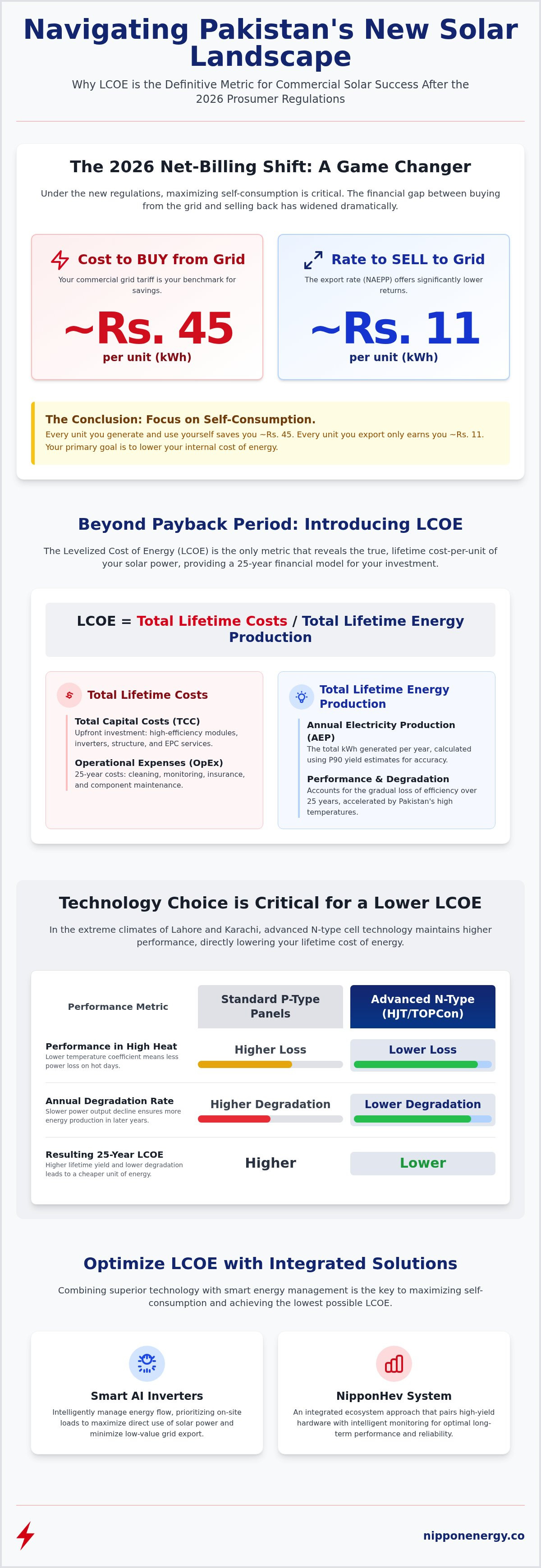
The enactment of SRO 251(I)/2026 officially transitioned the market from net metering to net billing. Under these 2026 prosumer regulations, the export rate for energy sent back to the grid is tied to the National Average Energy Purchase Price (NAEPP), currently approximately Rs. 11 per kWh. Contrast this with commercial grid tariffs that often reach or exceed Rs. 45 per unit. This disparity shifts the financial focus from maximizing exports to maximizing on-site self-consumption. LCOE becomes the primary KPI because it measures how efficiently a system generates the power your facility actually uses. When your LCOE is lower than the grid tariff, you've achieved grid parity, securing a competitive advantage that persists for decades.
Key Components of the LCOE Equation
Successfully calculating lcoe for commercial solar projects pakistan requires a granular look at three specific pillars:
- Total Capital Costs (TCC): This includes procurement of high-efficiency modules like Nippon HJT, EPC services following Japanese engineering standards, and permitting. It isn't just the sticker price; it's the cost of an engineered system designed for long-term stability.
- Annual Electricity Production (AEP): This is the total energy the system generates. In Pakistan, this variable is highly sensitive to thermal degradation and local irradiance levels. High-performance hardware is essential to prevent the AEP from dropping prematurely.
- Operational Expenses (OpEx): These are the hidden inflators, including cleaning, AI-driven monitoring, and component maintenance. Neglecting OpEx in your initial model will artificially deflate your LCOE, leading to unexpected financial strain in the project's second decade.
The LCOE Formula: Localizing Variables for the Pakistani Climate
The fundamental LCOE formula is the ratio of a system's total lifetime cost to its total lifetime energy production. While global benchmarks provide a baseline, the average LCOE for solar power in Pakistan is uniquely influenced by local environmental and economic stressors. When calculating lcoe for commercial solar projects pakistan, generic models fail because they don't account for the specific "thermal tax" imposed by regional climates or the volatility of local financing. A precise calculation requires adjusting both the numerator (costs) and the denominator (generation) to reflect the reality of operating in industrial hubs like Lahore or Karachi.
Calculating Lifetime Generation (The Denominator)
The denominator of your LCOE equation is the total energy harvest over 25 years. In Pakistan, this figure is highly sensitive to heat. Ambient temperatures exceeding 45°C cause standard modules to lose efficiency at a faster rate than in temperate zones. To remain financially conservative, engineers utilize P90 yield estimates, which represent a 90% probability of energy exceedance. You must also factor in annual degradation. While standard panels may lose 0.7% of their capacity each year, N-type technologies like TOPCon limit this to approximately 0.4%. This delta significantly preserves the denominator's value over the project's second decade.
Quantifying Lifetime Costs (The Numerator)
The numerator encompasses every rupee spent from procurement through decommissioning. For a 25-year commercial model, you must account for at least one inverter replacement cycle, typically occurring between years 10 and 12. Financing costs also play a dominant role. With commercial solar financing rates currently linked to KIBOR in the 14% to 18% range, the cost of capital can become the largest single line item in your numerator. Selecting a partner for Solar Project Development and EPC ensures these financial variables are integrated into a robust engineering framework.
Variable Operating Costs (VOC) are the final essential component. In Pakistan's industrial zones, high particulate matter necessitates frequent cleaning cycles to prevent soiling losses. Your model should include:
- Cleaning and Maintenance: Local labor and water procurement costs for bi-monthly cycles.
- Security and Insurance: Safeguarding high-value assets against site-specific risks.
- AI-Driven Monitoring: Real-time performance tracking to prevent minor faults from becoming major yield gaps.
By localizing these variables, your LCOE calculation shifts from a theoretical estimate to a reliable financial tool that justifies the energy transition to your stakeholders.
Technology Selection: How HJT and TOPCon Lower Commercial LCOE
The selection of photovoltaic technology is the most influential lever in calculating lcoe for commercial solar projects pakistan. While traditional P-type PERC modules offer lower initial procurement costs, they often result in a higher LCOE due to rapid thermal degradation and lower efficiency. A Duke University study on industrial solar highlights that optimized system designs in Pakistan can achieve remarkably low generation costs; however, this requires hardware capable of withstanding local stressors. N-type technologies, specifically Heterojunction (HJT) and Tunnel Oxide Passivated Contact (TOPCon), represent the modern standard for lowering lifetime energy costs by prioritizing yield over the entire 25-year lifecycle.
Thermal resilience is a critical variable in the Pakistani context. Standard panels experience significant voltage drops as ambient temperatures rise, yet HJT modules maintain a superior temperature coefficient. This allows them to produce more energy during peak sunlight hours when temperatures are highest. Additionally, bifacial gain allows industrial facilities with reflective or light-colored rooftops to capture reflected sunlight on the rear side of the panel. This increased energy density directly reduces the LCOE by expanding the denominator of the equation without a proportional increase in the numerator. Investing in higher-efficiency hardware often results in a lower LCOE because the incremental increase in CapEx is outweighed by the massive gains in lifetime energy production.
Nippon HJT Solar Panels: Engineering the Lowest LCOE
Nippon HJT modules provide a distinct advantage in desert-like climates by virtually eliminating Light Induced Degradation (LID). Traditional panels lose significant capacity in their first year of operation, but HJT's symmetrical cell structure ensures a flatter degradation curve over 25 years. Nippon HJT technology utilizes a low temperature coefficient to maintain high energy conversion rates even when ambient temperatures exceed 40°C. This long-term stability reduces technical risk and provides a more predictable ROI for stakeholders who value reliability in extreme environments.
TOPCon Technology for Commercial Scale
For large-scale industrial rooftops where space is a premium, TOPCon solar panels offer an exceptional balance-of-system (BOS) advantage. Higher power density means fewer panels are required to reach the target capacity, which reduces the cost of mounting structures, cabling, and labor. This efficiency is vital when calculating lcoe for commercial solar projects pakistan, as it lowers the initial capital expenditure while maintaining the high performance of N-type cells. TOPCon provides a sophisticated cost-to-performance ratio that makes it the preferred choice for massive industrial deployments requiring maximum area efficiency and lower installation complexity.
Step-by-Step Walkthrough: Calculating Your Project's LCOE
Transitioning from hardware selection to a financial model requires a methodical data-gathering phase. When calculating lcoe for commercial solar projects pakistan, you must harmonize immediate capital outlays with long-term operational realities. This process transforms technical specifications into a single, actionable per-unit cost that dictates your project's viability against a backdrop of rising utility tariffs and grid instability. A precise calculation allows stakeholders to move from speculative estimates to a data-driven investment strategy.
Step 1: Establishing the System Cost (CapEx)
The numerator of your LCOE calculation begins with the total installed cost. This figure extends far beyond the price of modules. Professional solar EPC services ensure engineering precision by covering structural mounting systems designed for local wind loads and balance-of-system (BOS) components including high-grade cabling and switchgear. You must also account for Nippon Smart AI Inverters for intelligent energy orchestration and storage readiness. These upfront investments determine the financial floor of your energy transition and must be quantified with absolute accuracy.
Step 2: Projecting Annual Performance
The denominator represents the total energy your system will generate over 25 years. This variable is highly sensitive to site-specific irradiance data in cities like Lahore, Karachi, and Islamabad. In dusty industrial zones, soiling losses can reduce output by 15% to 25% if left unmanaged. Implementing rigorous solar system maintenance is essential for yield preservation and LCOE optimization. Additionally, integrating lithium ion battery storage allows you to capture peak-shaving value, effectively increasing the financial utility of every kilowatt-hour produced by avoiding high-tariff peak periods.
Once costs and yields are established, you must apply a discount rate that reflects the local cost of capital, typically tied to 1-year KIBOR plus a project-specific risk premium. This calculation aligns future energy production with today’s currency value. The final LCOE figure should then be compared against projected grid tariffs, which currently exceed Rs. 45 per unit. If your LCOE is significantly lower, the project is a secure hedge against energy inflation. For a precise assessment of your facility's potential, contact our team for Solar Project Development and EPC consultation.
Optimizing LCOE with Nippon Energy's Integrated Solutions
The final stage in calculating lcoe for commercial solar projects pakistan involves moving beyond individual component selection to evaluate the system as a unified energy architecture. When disparate parts are combined without rigorous engineering, technical risks increase and the lifetime cost of energy often rises due to unforeseen incompatibilities. Nippon Energy addresses this by providing an integrated ecosystem where every hardware element is designed to complement the next. This holistic approach ensures that the theoretical efficiency of N-type cells translates into actual, long-term financial performance on your facility's roof.
Hardware synergies are best exemplified by the NipponHev system, which reduces technical risk through standardized engineering protocols. By utilizing smart ai solar inverters, businesses can intelligently manage self-consumption ratios in real time. Under the 2026 regulations, where the gap between the Rs. 11 export rate and the Rs. 45 grid tariff is substantial, AI-driven orchestration ensures you prioritize on-site utilization. This optimization directly lowers your LCOE by increasing the economic value of every generated kilowatt-hour.
The Value of Performance Architecture
A common pitfall in industrial procurement is selecting the "cheapest" panels based on initial CapEx. This strategy frequently results in the highest LCOE because low-quality modules suffer from higher failure rates and steeper degradation curves. Our EPC services follow Japanese engineering standards to mitigate these risks from the outset. By focusing on performance architecture, we ensure the denominator of your LCOE equation—the lifetime energy production—remains as high as possible. The Nippon Energy maintenance guarantee further protects this denominator by utilizing Smart AI monitoring to identify and resolve soiling or technical faults before they impact your ROI. In Karachi's industrial zones, this proactive approach has proven essential for maintaining yield in high-particulate environments.
Securing Your Energy ROI
Levelized Cost of Energy serves as the ultimate tool for securing energy independence in an era of rising utility costs and grid instability. By calculating lcoe for commercial solar projects pakistan with precision, you gain the clarity needed to justify large-scale energy transitions to boards and shareholders. Designing for 2030 and beyond requires a storage-ready architecture and high-efficiency HJT technology that can withstand the evolving climate and regulatory landscape of Pakistan. Your energy strategy should be a permanent asset, not a variable expense.
The transition to a low-LCOE solar solution begins with a granular analysis of your facility's specific load profile and environmental conditions. Our team provides the technical authority and global expertise required to model these variables accurately. Consult with Nippon Energy's engineers for your commercial LCOE model to receive a custom feasibility analysis and secure your facility's energy future.
Securing Long-Term Industrial Energy Autonomy
The 2026 regulatory landscape has fundamentally altered the economics of commercial solar. Success now depends on precision engineering that prioritizes self-consumption and thermal resilience over simple capacity. By calculating lcoe for commercial solar projects pakistan, you move beyond short-term payback periods to a definitive 25-year financial strategy. This framework ensures your facility remains competitive despite rising grid tariffs and extreme environmental stressors. It's no longer about the cost of the system; it's about the cost of the energy it produces over its entire functional life.
Nippon Energy specializes in this high-performance architecture. We combine high-efficiency HJT and TOPCon technologies with Japanese-standard EPC services to minimize technical risk and drive down lifetime costs. Our Smart AI Inverters and integrated energy management systems further safeguard your ROI by maximizing yield while ensuring system longevity. It's time to transition from being a passive consumer to an active energy architect with a resilient, future-proofed infrastructure. We're ready to help you navigate this transition with technical authority and engineering excellence.
Request a Professional LCOE Feasibility Study for Your Commercial Project to quantify your savings and lead your industry's energy transition. Your path to energy independence starts with a precise financial model.
Frequently Asked Questions
What is a good LCOE for commercial solar in Pakistan in 2026?
A competitive LCOE must be significantly lower than the prevailing commercial grid tariff of approximately Rs. 45 per unit. While exact figures depend on site-specific irradiance in Lahore or Karachi, industrial projects target a margin that justifies the initial capital outlay. Achieving this requires high-efficiency N-type hardware and EPC services following Japanese standards. These factors ensure the system maintains maximum energy output over a 25-year lifecycle, directly lowering the per-unit cost.
How do high temperatures in Pakistan affect the LCOE calculation?
High temperatures increase LCOE by reducing the total lifetime energy yield. In Pakistan, where summer temperatures often exceed 45°C, standard photovoltaic modules experience significant efficiency drops. When calculating lcoe for commercial solar projects pakistan, it's vital to use the specific temperature coefficient of the panels. Technologies like Nippon HJT are engineered for high-temperature resilience, allowing them to sustain higher output in extreme heat and preserve the financial integrity of your energy model.
Does adding battery storage increase or decrease the LCOE?
Integrating lithium-ion battery storage increases the nominal LCOE because it adds capital expenditure to the project's numerator. However, it often enhances overall project viability by maximizing self-consumption. Under 2026 net-billing regulations, the value of avoiding a Rs. 45 grid tariff is far higher than the Rs. 11 export rate. While the cost per generated unit rises, the total utility savings increase, creating a more secure and autonomous energy architecture for industrial users.
How do 2026 prosumer regulations impact the profitability of industrial solar?
How do 2026 prosumer regulations impact the profitability of industrial solar?
ROI measures the percentage of profit relative to the initial investment cost. In contrast, LCOE calculates the average cost per kilowatt-hour produced over 25 years. While ROI is a common financial benchmark, LCOE is the definitive metric for industrial energy planning in Pakistan. It allows stakeholders to compare solar generation costs directly against utility rates, providing a transparent view of the long-term hedge against energy inflation and grid tariff volatility.
How much does professional maintenance reduce LCOE over 25 years?
Professional maintenance preserves LCOE by protecting the system's lifetime energy denominator. In dusty industrial corridors, soiling can reduce solar yield by 20% or more. Regular cleaning and AI-driven monitoring prevent these losses from accumulating over decades. By ensuring that components like Smart AI Inverters and HJT panels operate at peak efficiency, professional O&M services keep the cost per unit stable and prevent the financial model from degrading prematurely due to technical neglect.
Can HJT panels really lower my LCOE compared to cheaper PERC panels?
HJT panels frequently deliver a lower LCOE than cheaper P-type PERC alternatives. This advantage stems from a lower annual degradation rate and superior heat tolerance. When calculating lcoe for commercial solar projects pakistan, the additional energy produced in the second and third decades outweighs the higher initial CapEx. HJT modules maintain higher efficiency over time, ensuring that the total lifetime energy production is significantly greater, which ultimately reduces the levelized cost per unit.
What discount rate should I use for solar LCOE in Pakistan's current economy?
The discount rate should reflect Pakistan's current economic climate and the cost of debt. Most commercial models currently use a rate linked to the 1-year KIBOR, which was approximately 12.09% in August 2026, plus a project-specific risk premium. Applying an accurate discount rate is essential for the time-value of money. It ensures that future energy savings are correctly valued against today's capital expenditure, providing a realistic assessment of the project's long-term financial impact.


