

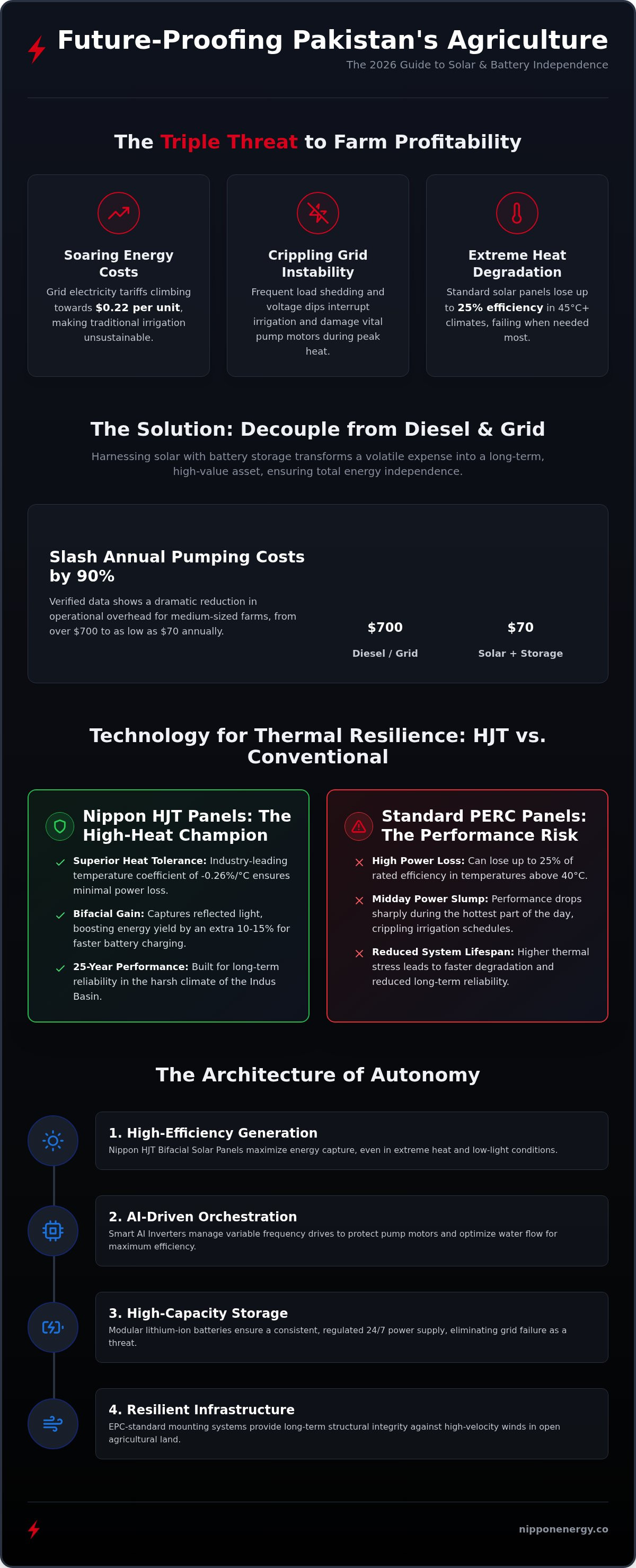
In 2026, the profitability of a Pakistani farm is no longer dictated by the price of diesel; it's defined by the thermal resilience of its energy architecture. You've likely seen crop margins shrink as electricity tariffs climb toward $0.22 per unit and frequent load shedding interrupts vital irrigation schedules during peak heat. It's a reality where generic solar panels often degrade rapidly under the 45°C+ temperatures of Punjab and Sindh, failing exactly when your crops require the most water. Implementing advanced solar battery storage for agriculture pakistan is now the only viable path to decoupling your production from a volatile and unreliable national grid.
This guide explores how high-efficiency HJT technology and AI-managed lithium-ion storage can eliminate diesel costs and ensure consistent water flow during the harshest summers. You'll discover the technical specifications required for a system with a 25-year performance guarantee and how to navigate the 2026 shift toward net billing. We'll provide a methodical breakdown of how to future-proof your irrigation for total energy independence and long-term operational security.
Key Takeaways
- Analyze how modern solar battery storage for agriculture pakistan decouples farming operations from grid instability and the volatility of diesel prices.
- Compare HJT and TOPCon cell architectures to determine which technology provides the highest thermal stability in Pakistan's extreme 45°C+ summer climates.
- Evaluate the role of Smart AI Inverters in managing variable frequency drives to protect irrigation pump motors and optimize water flow.
- Review the structural engineering requirements for EPC mounting systems to ensure long-term resilience against high-velocity winds in open agricultural land.
- Map out a scalable path toward total energy independence using modular lithium-ion storage and professional maintenance protocols for a 25-year system life.
The Economic Shift: Why Solar and Battery Storage are Essential for Pakistani Agriculture in 2026
The agricultural landscape in Pakistan is undergoing a fundamental transformation. For decades, irrigation remained a volatile cost center dictated by diesel price fluctuations and rising state utility tariffs. In 2026, electricity prices have exceeded $0.22 per unit for many commercial consumers. This pricing reality makes traditional farming models increasingly unsustainable. High-performing farms are now transitioning toward asset-based energy infrastructure. By investing in Solar power adoption in Pakistani agriculture, landowners convert an unpredictable monthly expense into a fixed, long-term capital asset that generates value for decades.
Eliminating Diesel Dependency in the Indus Basin
Diesel-powered pumps represent a significant logistical and financial burden for modern growers. Remote farms in the Indus Basin face the added complexity of fuel transport and secure storage, which adds hidden costs to every liter. The Levelized Cost of Energy (LCOE) for solar is now substantially lower than diesel alternatives. Verified data from 2026 indicates that solar irrigation can reduce annual pumping costs from $700 to as low as $70 for medium-sized operations. This represents a 90% reduction in operational overhead. Energy independence for a 50-acre commercial farm is the total elimination of external fuel or grid reliance through synchronized on-site generation and high-capacity storage.
Grid Instability and the Case for Solar Battery Storage
Traditional grid-tie systems without storage are no longer sufficient to protect crop yields during the frequent load shedding of peak summer. When the grid fails, irrigation stops, regardless of how much sun is hitting the panels. This vulnerability is why solar battery storage for agriculture pakistan has become the critical component of modern energy architecture. Integrating lithium ion battery storage ensures that pump motors receive a consistent, regulated voltage supply 24/7. It effectively prevents the brownouts and voltage dips that frequently damage sensitive automation and motor windings in rural areas.
This shift also addresses the environmental footprint of Pakistan's Green Revolution. Replacing fossil fuel combustion with Nippon HJT solar panels and smart storage systems aligns with global sustainability standards. It secures the farm's future against potential carbon-based export regulations while providing the energy density required for high-yield precision agriculture. The transition isn't just about saving money; it's about building a resilient, autonomous food production system that thrives despite national energy crises.
HJT vs TOPCon: Selecting Heat-Resilient Solar Panels for the Indus Basin
The thermal environment of the Indus Basin presents a rigorous challenge to photovoltaic performance. Standard PERC (Passivated Emitter and Rear Cell) panels, while common, frequently lose up to 25% of their rated efficiency when ambient temperatures in Sindh and Punjab exceed 40°C. This degradation occurs because conventional silicon cells have high temperature coefficients, meaning their power output drops sharply as the module heats up. For a farm relying on high-volume water discharge, this midday power slump can cripple irrigation schedules during the most critical periods of the cropping cycle.
In the arid regions of Pakistan, sandy or dry agricultural soil offers excellent albedo, or reflectivity. Utilizing bifacial panels allows your system to capture light reflected from the ground, boosting energy yield by an additional 10% to 15% compared to monofacial setups. This increased energy density is vital when sizing solar battery storage for agriculture pakistan, as it ensures the batteries reach full charge even during shorter winter days or hazy conditions.
Nippon HJT Solar Panels: The High-Heat Champion
Nippon HJT (Heterojunction) panels utilize a sophisticated N-type cell architecture that combines crystalline silicon with amorphous silicon layers. This hybrid design results in a superior temperature coefficient, typically around -0.26%/°C, which is the highest performing metric for the extreme Pakistani summer. These panels excel in low-light conditions, allowing irrigation pumps to begin operation earlier in the morning before peak evaporation starts. Their robust encapsulation provides a critical defense against the high humidity and fine dust prevalent in rural environments, ensuring the system doesn't lose capacity due to environmental stress.
Nippon TOPCon: Balancing Efficiency and Capital Cost
For large-scale projects where initial capital expenditure is a primary constraint, Nippon TOPCon solar panels offer a strategic middle ground. TOPCon (Tunnel Oxide Passivated Contact) technology provides higher efficiency than PERC while maintaining a lower cost profile than HJT. They are particularly effective for medium-to-large farm sizes with stable soil conditions. While HJT leads in absolute heat resilience, TOPCon systems provide a highly reliable 30-year power warranty. Understanding the opportunities and risks of solar-assisted irrigation is essential for long-term planning. You can consult with our technical architects to determine which cell architecture fits your specific land topography and budget.
AI-Driven Orchestration: Smart Inverters and Battery Integration
The efficiency of a solar installation is increasingly dependent on the intelligence of its control systems. While panels capture energy, it's the smart ai solar inverter that governs how that power is utilized across the farm's infrastructure. These units act as the central nervous system, integrating Variable Frequency Drive (VFD) technology to modulate pump motor speeds based on real-time irradiance. This precision prevents the mechanical stress caused by abrupt starts and stops, effectively extending the operational lifespan of expensive submersible motors.
During the monsoon season, erratic cloud cover can lead to rapid fluctuations in solar output. AI-driven Maximum Power Point Tracking (MPPT) algorithms respond to these changes in milliseconds, ensuring that the pump maintains the highest possible discharge rate despite atmospheric interference. This level of orchestration is a cornerstone of Pakistan's solar energy transition, where farmers are moving beyond basic setups toward sophisticated energy management. Through integrated remote monitoring, landowners can now manage complex irrigation schedules from a smartphone in Lahore or Karachi, receiving real-time data on energy harvest and water flow.
Optimizing Water Discharge with AI Algorithms
AI-managed systems provide a level of protection that manual or generic inverters cannot match. By constantly monitoring input voltage and load requirements, the system adjusts current flow to maintain consistent water pressure across the irrigation network. This is critical for protecting pumps from dry-running conditions or sudden voltage surges that often occur in rural grids. Predictive maintenance alerts go a step further; they analyze harmonic distortions in the motor to identify wear before a catastrophic failure occurs. This proactive approach ensures that solar battery storage for agriculture pakistan delivers maximum reliability during the peak growing season.
The NipponHev Approach to Integrated Farm Management
For operations requiring 24-hour power, the nipponhev system represents the pinnacle of integrated solar architecture. It facilitates seamless switching between direct solar generation, stored battery reserves, and secondary backup sources without interrupting the water column. As farm operations expand, the modular design allows for rapid scaling of energy storage capacities. This flexibility ensures that the energy infrastructure can grow alongside the farm's output, meeting the heavy demands of peak harvest cycles without requiring a total system overhaul.
EPC Standards: Building Resilient Solar Infrastructure for Large-Scale Farms
High-velocity winds in open agricultural land create significant uplift forces on solar arrays. Cheap mounting structures provided by "Solar Cowboys" often lack the structural integrity to withstand these conditions; this leads to catastrophic equipment failure during storm seasons. Nippon Energy’s solar epc services mitigate these risks by applying Japanese engineering standards to every agricultural installation. We conduct rigorous soil testing to ensure foundation stability, preventing the shifting or tilting that degrades system performance over time.
Transmission efficiency is another critical factor in large-scale farm layouts. Long-distance pumping often requires extensive wiring between the solar field and the motor. We prioritize high-grade DC cabling to minimize voltage drops and transmission losses, ensuring that the maximum amount of generated power reaches the pump. This technical precision is essential when integrating solar battery storage for agriculture pakistan, as every watt saved contributes to the overall autonomy of the irrigation network.
The Agricultural EPC Lifecycle
- Step 1: We perform a comprehensive hydrological and solar irradiance site survey to map water availability and peak sunlight hours.
- Step 2: Our architects design custom system sizing based on specific crop water requirements and pump horsepower.
- Step 3: Precision engineering and Japanese-standard construction ensure the final build meets global durability benchmarks.
Operations and Maintenance (O&M) in Rural Pakistan
In the dusty agricultural zones of Punjab and Sindh, soiling can reduce panel efficiency by 10% to 30% within weeks. Regular cleaning is a technical necessity, not an optional task. Our solar system maintenance protocols include thermal imaging and string-level monitoring to detect underperformance before it impacts crop yield. Adopting professional O&M protocols ensures that the system maintains its peak efficiency for its entire 25-year lifespan, significantly accelerating the return on investment for the farm owner.
Contact our EPC specialists to begin your site-specific engineering assessment and secure your agricultural infrastructure.
Future-Proofing Your Farm: The Nippon Energy Advantage
The transition to autonomous energy requires more than just hardware; it demands a comprehensive architectural strategy. Nippon Energy operates as a High-Tech Architect for the Pakistani agricultural sector, moving beyond simple equipment sales to provide integrated energy ecosystems. Our approach prioritizes structural integrity and technical precision to ensure that solar battery storage for agriculture pakistan remains a high-yielding asset for its entire 25-year lifecycle. By choosing a partner focused on Japanese engineering standards, large-scale landowners secure their operations against the volatility of national energy markets and the physical demands of the Indus Basin climate.
Scalability is a core component of our system design. Agricultural operations are rarely static; they evolve as acreage increases or as farmers transition to higher-value crops. Our modular lithium-ion storage solutions and Smart AI Inverters allow for the seamless addition of panels or battery capacity without requiring a total system redesign. This forward-thinking methodology protects your initial capital expenditure by ensuring the infrastructure grows alongside your farm’s productivity requirements.
Local Expertise, Global Standards
Our operational hubs in Lahore and Karachi provide the localized technical support necessary for rural agricultural zones. We recognize that energy requirements vary significantly between a high-water-demand rice plantation in Punjab and a precision-irrigated orchard in Sindh. Our engineers develop custom profiles for specific crop cycles, including:
- Rice and Wheat: Optimized for high-volume, consistent water discharge during critical growth stages.
- Orchards and Vineyards: Precision-tuned for drip irrigation systems that require stable, low-voltage power over extended periods.
- Livestock Operations: Integrated power for climate control and automated feeding systems that require 24/7 reliability.
Requesting a High-Performance Consultation
Initiating your transition to energy independence begins with a data-driven feasibility study. To provide an accurate proposal, our team analyzes your land’s topography, soil composition, and existing hydrological data. In 2026, our turnkey agricultural projects follow a streamlined deployment schedule that minimizes operational downtime. We coordinate every phase of the EPC lifecycle, from initial irradiance mapping to final commissioning and long-term O&M integration. Secure your farm’s future by partnering with an industry leader dedicated to monumental impact and technical excellence. Consult with Nippon Energy’s Agricultural Specialists to receive a bespoke energy architecture plan for your agricultural land.
Securing the Future of Pakistani Food Production
The integration of high-efficiency HJT and TOPCon cell architectures is now a fundamental requirement for commercial agricultural viability. By implementing solar battery storage for agriculture pakistan, landowners successfully insulate their operations from volatile energy markets and the extreme thermal stresses of the Indus Basin. This transition converts an unpredictable operational cost into a resilient, long-term capital asset that generates value for decades.
Nippon Energy provides the technical authority required for this scale of transformation. Our turnkey EPC services in Lahore and Karachi utilize Japanese Engineering Standards to ensure structural integrity and maximum power density. Through advanced HJT and TOPCon thermal resilience, your irrigation systems will maintain peak performance during the most demanding summer cycles. It's time to secure your yields against grid instability and rising utility tariffs.
Design Your High-Efficiency Agricultural Solar Infrastructure and begin your journey toward total energy independence today.
Frequently Asked Questions
What is the average lifespan of a Nippon HJT solar battery system in Pakistan?
Nippon HJT panels and lithium-ion storage are engineered for a 25-year performance lifecycle. While the panels maintain high efficiency beyond two decades, the lithium-ion batteries typically offer 6,000 to 10,000 cycles, translating to roughly 10 to 15 years of daily operation depending on depth of discharge. Using Japanese engineering standards ensures that the structural components and inverters are resilient enough to match this long-term operational horizon.
Can these solar systems power both submersible and surface pumps?
Our systems are compatible with both submersible and surface-mounted agricultural pumps. The Smart AI Inverter manages the high inductive start-up loads characteristic of both motor types by utilizing Variable Frequency Drive (VFD) technology. This modulation allows the motor to ramp up speed gradually, which prevents mechanical stress and voltage dips. Whether your farm utilizes deep tube wells or canal-based surface suction, the energy delivery remains consistent.
Is it better to use HJT or TOPCon panels for farms in the Sindh region?
Nippon HJT panels are generally superior for the Sindh region due to their industry-leading temperature coefficient. In areas where ambient temperatures frequently exceed 45°C, HJT technology experiences significantly less power drop than TOPCon or PERC alternatives. While TOPCon panels are highly efficient and cost-effective, the extreme thermal stress in Sindh makes the heat resilience of HJT a more strategic long-term investment for maximizing water discharge.
How much land is required for a 10 HP solar water pump system with storage?
A standard 10 HP solar pump system typically requires approximately 80 to 100 square meters of land for the panel array. The exact footprint depends on whether you utilize high-wattage Nippon HJT panels, which have a higher energy density and require less space. Adding solar battery storage for agriculture pakistan doesn't significantly increase the land requirement, as the battery cabinets are compact and usually housed in a small, ventilated control room.
Does Nippon Energy provide O&M services for remote farms in South Punjab?
Nippon Energy provides comprehensive Operations and Maintenance (O&M) services across South Punjab through our regional technical hubs. We understand that rural reliability is critical for crop survival, so we offer structured maintenance protocols including thermal imaging and string-level performance analysis. Our teams ensure that remote installations receive the same Japanese-standard care as urban projects, addressing issues like dust accumulation and electrical wear before they impact your irrigation schedule.
What happens if the solar panels are covered in dust during the harvest season?
Dust accumulation, or soiling, can reduce energy yields by up to 30% in arid agricultural zones. During the harvest season, increased airborne particulates make regular cleaning essential to maintain the charge rates required for storage. Our maintenance protocols emphasize scheduled cleaning and the use of anti-soiling coatings where applicable. If yield drops, our remote monitoring system alerts you immediately so that corrective cleaning can be performed before water discharge is affected.
Can the Smart AI Inverter be used with existing electric pump motors?
The Smart AI Inverter is designed to integrate seamlessly with most existing three-phase electric pump motors. It acts as a sophisticated power manager that can blend energy from solar panels, battery reserves, and the national grid or a backup generator. By replacing a standard starter with our AI-driven inverter, you gain the benefits of VFD control and remote monitoring without needing to replace your functional submersible or surface pump hardware.
How does solar battery storage improve ROI compared to solar-only systems?
Solar battery storage improves ROI by enabling 24/7 irrigation and eliminating the need for expensive diesel backup during evening hours or load shedding. While a solar-only system only works during peak sunlight, adding storage ensures that your investment continues to provide value during the night and on cloudy days. This consistency prevents crop stress and maximizes yields, allowing the system to pay for itself faster through increased agricultural output and total energy independence.


