

What if the projected internal rate of return for your utility-scale asset is actually a liability disguised by unmodeled thermal degradation in high-temperature zones like Bahawalpur? In 2026, the transition from net metering to a net billing regime has fundamentally rewritten the energy economics across the nation. Relying on legacy spreadsheets is no longer a viable strategy for institutional investors. Professional solar project financial modeling pakistan now requires a sophisticated integration of NEPRA’s latest Prosumer Regulations, evolving wheeling charges, and the technical realities of high-efficiency hardware deployment.
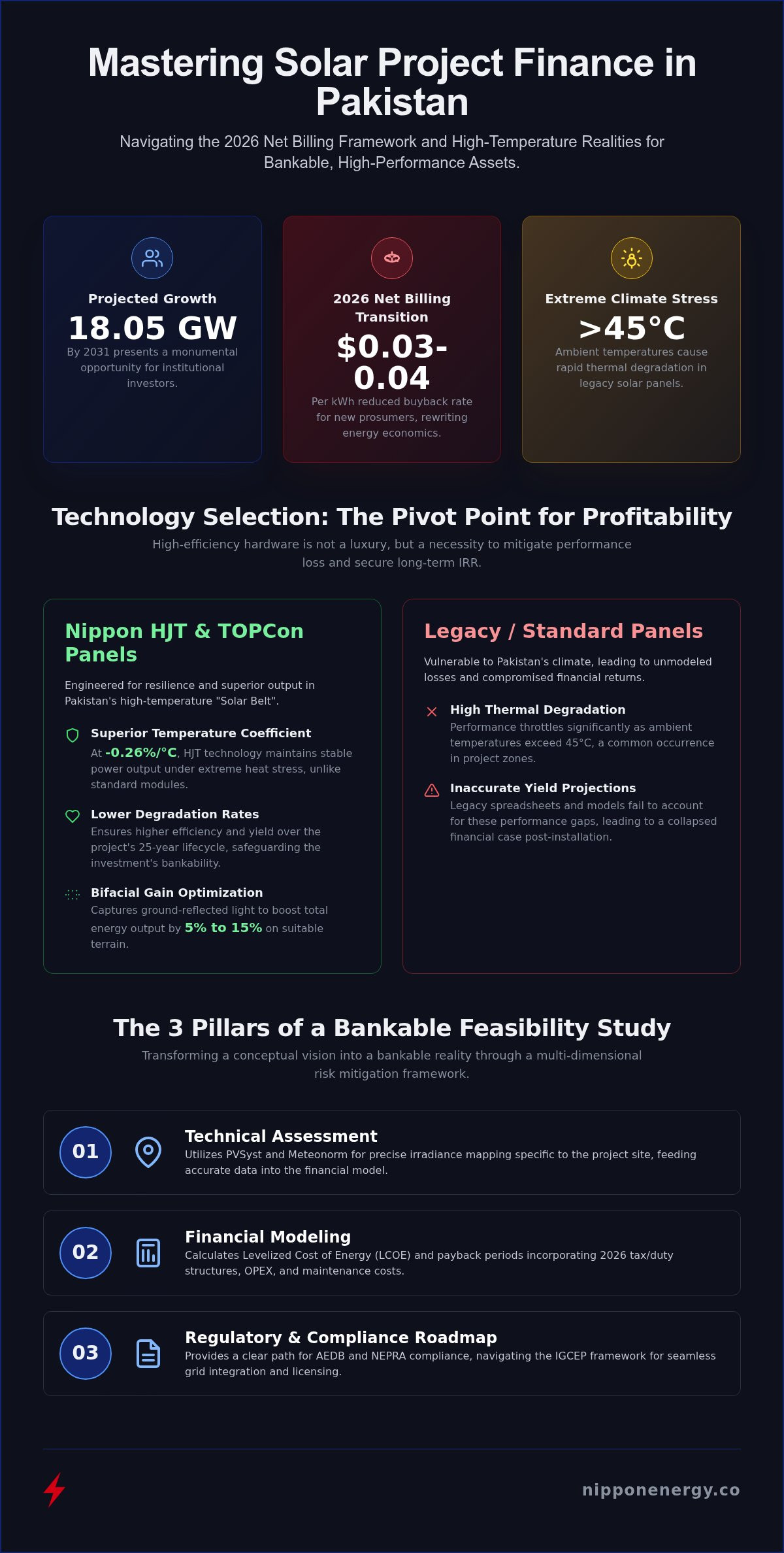
It's clear that while the projected growth to 18.05 gigawatts by 2031 presents a monumental opportunity, the persistent challenges of circular debt and grid volatility introduce variables that can compromise long-term bankability. This guide provides the technical and regulatory framework necessary to master these complexities and secure your investment's structural integrity. We'll examine how optimized technology selection, such as Nippon HJT and TOPCon solar panels, mitigates performance loss. We also provide a clear roadmap for regulatory compliance under the 2026 fiscal framework to ensure your project remains a high-performance asset.
Key Takeaways
- Understand how a multi-dimensional feasibility study acts as a critical risk mitigation tool against Pakistan’s 2026 energy volatility.
- Identify the performance advantages of HJT and TOPCon hardware in high-temperature zones to maximize project yield and durability.
- Learn the structural requirements for solar project financial modeling pakistan to ensure CAPEX accuracy and long-term bankability.
- Navigate the 5-step regulatory approval process and the IGCEP framework for seamless grid integration and compliance.
- Bridge the gap between theoretical modeling and operational reality through a precision-led EPC execution strategy.
The Strategic Importance of a Solar Project Feasibility Study in Pakistan
A feasibility study serves as the structural foundation for any utility-scale or industrial solar deployment. It isn't merely a procedural hurdle; it's a multi-dimensional risk mitigation tool that transforms a conceptual vision into a bankable reality. For Pakistani IPPs and industrial investors, this document is essential to navigate the complexities of solar project financial modeling pakistan, ensuring every technical variable aligns with long-term fiscal objectives. Without this preliminary architecture, projects risk significant performance gaps that can't be corrected post-installation.
In 2026, the transition to net billing and the inherent volatility of the national grid make rigorous pre-project analysis mandatory for industrial business continuity. Investors must account for the 70/30 debt-to-equity financing structures typically required by local commercial banks. Moving beyond "basic solar" to high-efficiency energy architecture, featuring Nippon HJT or TOPCon hardware, ensures the project can withstand both financial and environmental pressures. A well-executed study proves to lenders that the project is resilient, efficient, and capable of delivering the promised Internal Rate of Return (IRR).
De-risking Investments in the Pakistani Energy Market
The broader landscape of Renewable Energy in Pakistan is currently defined by the circular debt crisis and fluctuating grid reliability. Strategic self-generation allows industrial units to decouple from this instability, providing a predictable energy cost floor. A robust feasibility study protects against shifting NEPRA tariff structures, which have reduced buyback rates for new prosumers to approximately $0.03 to $0.04 per kWh (PKR 8-11 equivalent). Reliability is also a technical concern; systems must be engineered for extreme South Asian climates where temperatures frequently exceed 45°C. High-efficiency hardware like Nippon HJT panels maintains superior performance in these conditions, preventing the rapid thermal degradation common in legacy technologies.
The Core Components of a Bankable Report
A bankable report relies on precision data rather than optimistic estimates. Technical assessments utilize PVSyst and Meteonorm to provide accurate irradiance mapping specific to the project site. This data feeds directly into the solar project financial modeling pakistan phase, where the Levelized Cost of Energy (LCOE) and payback periods are calculated with 2026 tax and duty structures in mind. Precise modeling must also include Solar system maintenance and AI-driven monitoring costs to reflect true OPEX over a 25-year lifecycle. Finally, the report provides a legal roadmap for AEDB and NEPRA compliance, ensuring the project meets all current regulatory milestones for grid integration and licensing.
Technical Assessment: Irradiance and Technology Selection
Mapping the "Solar Belt" is the first step in technical de-risking for any utility-scale investment. High-irradiance zones stretching from Bahawalpur through the industrial corridors of Punjab to the Korangi Industrial Area in Karachi offer massive potential, but they also present unique environmental hurdles. Technology selection acts as the pivot point for project feasibility. If the hardware can't handle the thermal load, the entire financial model collapses. Standard panels often fail in the extreme heat of Sindh and Punjab because their temperature coefficients aren't optimized for ambient temperatures frequently exceeding 45°C. Integrating bifacial gain into yield projections is also essential for projects on sandy or barren land, as ground-reflected light can boost total energy output by 5% to 15%.
HJT vs. TOPCon: Selecting the Optimal Cell Architecture
Comparing Nippon HJT solar panels against standard N-type modules reveals significant performance deltas that directly impact solar project financial modeling pakistan. HJT (Heterojunction) technology offers a superior temperature coefficient, typically around -0.26%/°C. This ensures that power output remains stable when traditional modules begin to throttle due to heat stress. Lower degradation rates are equally critical; they ensure that a 25-year project remains viable by maintaining higher efficiency levels throughout its operational lifecycle. For investors, this resilience translates to a lower Levelized Cost of Energy (LCOE) and a more secure ROI in high-ambient temperature zones. You can consult with our engineering team to see how these cell architectures perform under specific local conditions.
Solar Resource Measurement and Shading Analysis
Relying solely on satellite data is a common error in large-scale deployments across Pakistan. While satellite models provide a helpful baseline, on-site meteorological stations offer the precision required for truly bankable reports. This is particularly relevant in Pakistani industrial hubs where high aerosol and dust levels can reduce irradiance by up to 10% if they aren't modeled correctly. Optimizing pitch and tilt for maximum seasonal yield in cities like Lahore and Karachi requires a granular understanding of the solar path to prevent "hot spots" and ensure every string operates at peak efficiency. Understanding Pakistan's Renewable Energy Policy is vital here, especially as the national market scales toward a projected capacity of 7.95 gigawatts in 2026. Accurate shading analysis and resource measurement ensure that your project meets the technical standards required for modern grid-connected assets.
Financial Modelling and Economic Viability in 2026
Structuring CAPEX for utility-scale assets requires a granular breakdown of hardware, EPC services, and land acquisition costs. In the 2026 fiscal environment, investors must account for a 10% General Sales Tax (GST) on imported modules, though they currently remain exempt from customs duties. Inverters and batteries carry higher import burdens, with duties ranging from 5% to 15%. Accurate solar project financial modeling pakistan must weigh these upfront costs against the Levelized Cost of Electricity (LCOE) to determine grid parity. Effective modeling also incorporates long-term OPEX, specifically Solar system maintenance and AI-integrated monitoring, to ensure the asset's performance doesn't degrade prematurely in harsh environments.
ROI Optimisation through Energy Storage
The transition from net metering to a net billing system has reduced buyback rates for new connections to approximately $0.03 to $0.04 per kWh. This shift necessitates a focus on self-consumption to maintain project viability. Integrating lithium ion battery storage is no longer an optional upgrade but a core requirement for peak shaving and load shifting. By storing surplus generation during the day, industrial users can offset expensive peak-hour grid tariffs and reduce reliance on high-cost diesel backup systems. This "solar-plus-storage" architecture improves the project's economic viability by providing a stable energy supply that's decoupled from grid volatility.
Financing and Equity Structures in Pakistan
Securing capital involves navigating the State Bank of Pakistan’s (SBP) renewable energy refinancing schemes, which currently offer concessional rates between 5% and 9%. However, commercial bank financing is often benchmarked at KIBOR plus a spread, which can result in effective rates near 14% for non-concessional loans. According to Pakistan's Renewable Energy Sector Overview, these financing mechanisms are vital for reaching national capacity targets. Corporate Power Purchase Agreements (PPAs) are also gaining traction, allowing C&I investors to lock in long-term energy prices. A critical component of any bankable study is a sensitivity analysis that models currency devaluation. Since hardware is primarily imported, even minor fluctuations in the exchange rate can impact the project's IRR and debt-servicing capability.
Regulatory Framework and Grid Integration Challenges
The transition from a theoretical model to an operational asset requires navigating a complex 5-step regulatory approval process. This journey begins with securing a Generation License from NEPRA, followed by tariff determination and rigorous interconnection studies conducted by NTDC or the relevant DISCO. These studies are critical for ensuring grid stability at the point of common coupling, particularly in high-load industrial nodes. Within the context of solar project financial modeling pakistan, investors must account for the lead times associated with these permits, as delays directly impact the project's debt-servicing schedule. The IGCEP 2022-2031 framework further dictates the volume of new capacity the national grid can absorb, making early-stage regulatory alignment a prerequisite for any utility-scale project.
Managing the inherent variability of solar generation is no longer a manual task. AI-driven orchestration now plays a central role in balancing supply with grid demand. By utilizing predictive algorithms, project owners can mitigate the risk of forced curtailment during periods of low demand or grid instability. This technical foresight ensures that the project remains a reliable contributor to the national energy mix while protecting the owner's revenue streams. Accurate solar project financial modeling pakistan must incorporate the costs of these technical studies and the potential for AI-driven curtailment to reflect realistic energy yields.
Smart Inverters and Grid Synchronisation
Modern grid codes require more than just power conversion; they demand active participation in grid health. Implementing smart ai solar inverters allows for precise voltage regulation and reactive power support. These systems are engineered to meet NEPRA’s stringent grid code requirements regarding harmonic distortion, ensuring that the solar plant doesn't introduce electrical noise into the local network. Automated curtailment features and real-time performance monitoring provide the DISCOs with the reassurance needed for seamless grid synchronisation, even in areas with high penetration of renewable energy.
Land Use and Environmental Impact Assessment (EIA)
Securing the right site involves more than just irradiance mapping. For utility-scale projects, acquiring 'Barren Land' certificates from provincial authorities is a necessary step to avoid conflicts with agricultural priorities. An Environmental Impact Assessment (EIA) must also be conducted to mitigate risks in sensitive ecological zones. Beyond the technicalities, successful solar EPC requires proactive community engagement. Integrating local employment opportunities into the project development phase fosters social acceptance and ensures long-term operational security. If you're ready to initiate your project's regulatory roadmap, partner with our development experts to ensure every milestone is met with precision.
From Study to Execution: The Nippon Energy EPC Advantage
A feasibility study is only as effective as the physical execution that follows. Theoretical projections in solar project financial modeling pakistan require a seamless transition to robust, turnkey delivery to realize the modeled ROI. Nippon Energy’s "High-Tech Architect" approach ensures that every technical specification identified during the analytical phase is implemented through precision-led engineering. This methodology bridges the gap between data-driven expectations and operational reality, providing a reassuringly stable path to energy independence.
Our local expertise is anchored by a physical presence in the Korangi Industrial Area, Karachi, and our regional office in Lahore. This allows us to address site-specific challenges, such as coastal salinity or the intense thermal loads of the Punjab solar belt, with immediate technical authority. By transitioning to solar epc services, investors move from abstract spreadsheets to a commissioned asset. We manage the entire lifecycle, ensuring that the structural integrity and technical performance of the plant remain uncompromised from day one.
Customised Engineering for Industrial Success
We tailor Nippon HJT panels to match specific industrial load profiles, ensuring that power generation aligns with peak operational demand. AI-driven O&M is integrated into the initial project design, which facilitates predictive maintenance and minimizes downtime. This engineering mindset focuses on long-term impact; it isn't just about installation, but about securing a 25-year performance guarantee through technical precision. The result is a resilient system that empowers industrial units to achieve growth while maintaining a predictable energy cost floor.
Next Steps for Your Solar Project
Initiating a pre-feasibility analysis with Nippon Energy is the first step toward securing your energy future. The timeline from initial irradiance mapping to final grid connection follows a logical, engineering-led progression. This includes site assessment, regulatory filing under the 2026 framework, and EPC deployment. Professional solar project financial modeling pakistan provides the clarity needed for bankability, but our turnkey execution provides the power. You can contact our Karachi or Lahore offices to schedule a site visit and begin the technical validation of your utility-scale asset.
Securing the Future of Industrial Energy Architecture
Success in the 2026 energy landscape requires more than just rapid installation; it demands a rigorous technical and financial foundation. We've established that high-efficiency cell architecture and precise regulatory alignment are the primary drivers of bankability. Professional solar project financial modeling pakistan acts as the essential blueprint for this long-term stability, ensuring that every variable from irradiance to tax regimes is accounted for with absolute precision.
By leveraging Japanese engineering standards and our proprietary HJT and TOPCon technology, investors can mitigate thermal risks and maximize operational yield. With a dedicated local presence in both Karachi and Lahore, we provide the technical authority needed to navigate site-specific challenges and complex NEPRA compliance. You can Request a Professional Solar Feasibility Study from Nippon Energy to transform your energy vision into a high-performance asset. It's time to lead the transition toward a resilient and decentralized power future for Pakistan.
Frequently Asked Questions
What is the typical cost of a solar feasibility study in Pakistan?
Costs are determined by the project's complexity and the depth of technical analysis required. For utility-scale assets, the process involves on-site assessments and precise irradiance modeling. While small-scale estimates exist, professional studies for IPPs require a customized approach. Investors should seek detailed proposals from engineering firms to understand the financial commitment needed for a bankable document that satisfies both lenders and regulators.
How long does it take to complete a bankable solar feasibility report?
Completing a bankable report typically requires a timeline of 4 to 8 weeks. This period allows for comprehensive on-site data collection, technical shading analysis, and the final solar project financial modeling pakistan. Delays often occur during the grid interconnection study phase, so early initiation is vital. A finished report provides the structural integrity needed for institutional financing and ensures all technical variables are validated before execution.
Does NEPRA require a feasibility study for all commercial solar projects?
NEPRA requires a detailed feasibility study for all commercial projects intending to sell power to the grid or seeking a Generation License. This document proves that the proposed system adheres to the national grid code. It addresses critical stability factors like voltage regulation and harmonic distortion. Without this verified technical foundation, a project cannot progress through the five-step regulatory approval process required for legal operation.
What is the difference between a pre-feasibility and a detailed feasibility study?
A pre-feasibility study acts as an initial filter to determine if a project warrants further investment. It focuses on high-level ROI estimates and basic site suitability. A detailed feasibility study is a much more granular, bankable document. It includes precise PVSyst modeling, detailed interconnection studies, and environmental impact assessments. This comprehensive version is what banks and NEPRA require for final project approval and financing.
How do high temperatures in Pakistan affect HJT solar panel efficiency?
High ambient temperatures in Pakistan, often exceeding 45°C, cause standard panels to lose efficiency rapidly. However, HJT panels utilize a superior temperature coefficient that minimizes these thermal losses. This allows the system to maintain a higher power output during peak summer months compared to traditional N-type modules. This technical resilience is a core component of future-proofing an industrial energy architecture against the harsh South Asian climate.
Can a feasibility study help in securing SBP renewable energy financing?
A detailed feasibility study is essential for securing concessional loans under the State Bank of Pakistan’s renewable energy refinancing scheme. Financial institutions rely on this document to verify the project's technical viability and projected cash flows. It demonstrates that the solar project financial modeling pakistan is based on verified irradiance data and realistic OPEX. Without a bankable study, lenders cannot accurately assess the risk profile of the investment.
What are the common pitfalls in Pakistani solar project site selection?
Pitfalls often include failing to verify Barren Land certificates or ignoring local environmental hazards like coastal corrosion in Karachi. Many investors also underestimate the impact of high dust levels in Punjab, which can significantly reduce energy yield if not modeled correctly. Selecting a site too far from the point of common coupling also leads to inflated EPC costs that can compromise the project's overall economic viability.
How does the 2026 wheeling policy affect industrial solar ROI?
The 2026 wheeling policy introduces specific charges for utilizing the national grid to transport solar energy from remote sites to industrial loads. These costs must be balanced against the savings achieved by bypassing high retail tariffs. If the financial model accounts for these charges and utilizes high-performance hardware, wheeling offers a stable path for industries to achieve 100% renewable energy targets even with limited on-site space.


