

The 2026 landscape for commercial solar project investment pakistan has evolved into a complex exercise in precision engineering where a 1% efficiency loss equates to millions in forfeited yield over a twenty-year lifecycle. You've likely felt the mounting pressure of unpredictable grid pricing and the frustration of standard hardware that degrades rapidly under Pakistan's extreme thermal stress. It's clear that generic energy solutions are now insufficient for the rigorous industrial demands of an economy shifting toward self-consumption and technical resilience.
This guide provides a high-level technical framework to help you maximize capital efficiency and secure superior long-term yield through advanced solar architecture. We'll examine the critical shift toward N-type HJT technology, the impact of the new net-billing regulations, and the strategic integration of AI-driven storage systems. By the end of this analysis, you'll have a clear roadmap for executing a solar project that prioritizes structural integrity and verifiable financial performance in a volatile energy market.
Key Takeaways
- Align your commercial solar project investment pakistan with 2026 net-billing regulations to prioritize self-consumption and insulate your operations from rising industrial power tariffs.
- Analyze the technical advantages of N-type HJT architecture, focusing on how superior temperature coefficients maintain high performance during Pakistan's peak thermal periods.
- Navigate the structured application process for State Bank of Pakistan (SBP) renewable energy refinancing to secure low-interest capital for large-scale deployments.
- Establish rigorous engineering benchmarks for EPC execution, including site-specific wind load calculations and structural audits, to protect the long-term integrity of your energy assets.
- Integrate AI-driven inverters and lithium-ion storage to orchestrate complex energy loads, ensuring your facility remains resilient against grid curtailment and load shedding.
The Economic Landscape of Commercial Solar Investment in Pakistan (2026)
The fiscal environment for industrial energy in 2026 is defined by a widening divergence between escalating grid tariffs and the plummeting Levelized Cost of Energy (LCOE) for onsite generation. For Pakistani enterprises, a commercial solar project investment pakistan represents a strategic hedge against the volatility of fossil-fuel-linked power costs. While grid electricity prices are subject to frequent adjustments driven by currency fluctuations, solar assets provide a fixed-cost energy baseline for 25 years. This transition is accelerated by the 'Alternative and Renewable Energy Policy', which has streamlined the CAPEX requirements for large-scale industrial deployments through targeted tax incentives.
Energy security is no longer an optional sustainability goal; it's a prerequisite for manufacturing survival in industrial hubs like Lahore and Karachi. Frequent curtailment and load shedding disrupt precision manufacturing lines, often resulting in production losses that far exceed the initial cost of solar hardware. Consequently, the market has shifted from simple grid-tie setups toward sophisticated hybrid energy architectures that prioritize autonomy. Reliable energy is the foundation of global competitiveness, and solar provides the most predictable path to achieving it.
Grid Parity and Industrial Competitiveness
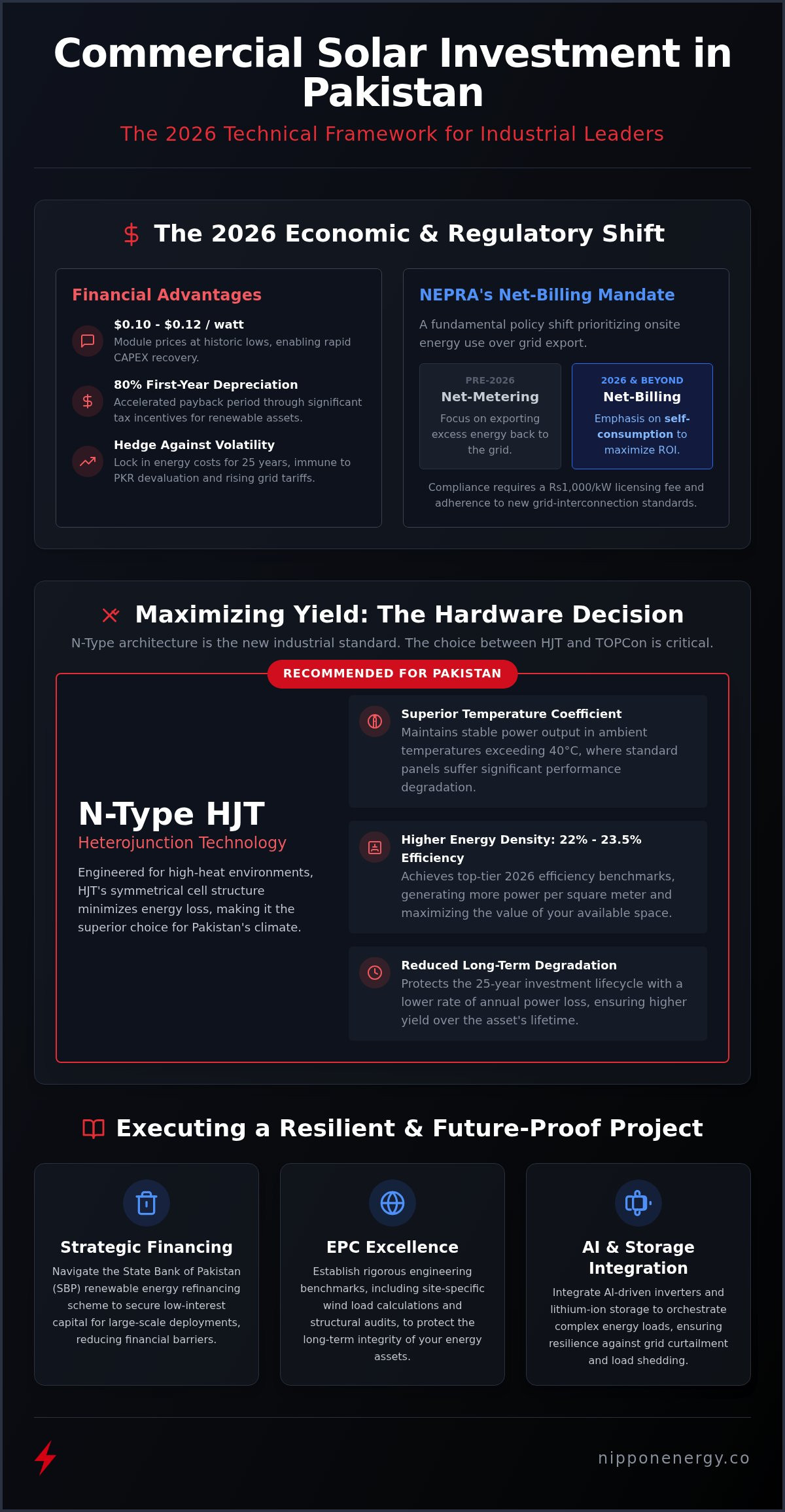
The LCOE for 1MW+ systems in 2026 has reached historic lows, with module prices falling to approximately $0.10 to $0.12 per watt. This financial advantage is reinforced by the 80% first-year depreciation allowance available for renewable assets, which significantly accelerates the payback period. By deploying high-efficiency modules, businesses lock in energy rates that are immune to PKR devaluation or global oil price spikes. A typical manufacturing facility experiencing four hours of daily downtime can see a payback period reduction of nearly 18 months when factoring in the avoided cost of idle labor and wasted raw materials. The result is a more resilient balance sheet and a lower unit cost of production.
Regulatory Framework and Net Metering 2.0
The regulatory environment underwent a fundamental shift in February 2026 when NEPRA transitioned from traditional net-metering to a net-billing system. This policy change emphasizes self-consumption over grid export, significantly altering the ROI calculations for distributed generation. For multi-site industrial groups, the introduction of 'wheeling' regulations allows for the transmission of solar energy from a primary generation site to secondary facilities, optimizing the group-wide energy footprint. Understanding Solar power in Pakistan and its evolving policy framework is essential for compliance. Current 2026 mandates also include a licensing fee of Rs1,000 per kilowatt for new installations, requiring precise engineering documentation to ensure that every commercial solar project investment pakistan complies with the latest grid-interconnection standards.
Maximizing Yield with Advanced Hardware: HJT vs. TOPCon
The selection of photovoltaic cell technology represents the most critical decision in any commercial solar project investment pakistan. In 2026, the industrial sector has moved beyond standard PERC modules, favoring N-type architectures that offer superior resilience. While the global market for Pakistan's renewable energy sector continues to expand, the technical differentiation between Heterojunction (HJT) and Tunnel Oxide Passivated Contact (TOPCon) hardware determines the actualized ROI. Precision in hardware selection ensures that the system doesn't just generate power, but does so with the highest possible density per square meter.
Heterojunction (HJT) Technology for High-Heat Environments
HJT technology is engineered for regions where ambient temperatures frequently exceed 40°C. Nippon HJT Solar Panels utilize a symmetrical cell structure that minimizes recombination losses, achieving 2026 efficiency benchmarks of 22% to 23.5%. The most vital metric here is the temperature coefficient. While standard panels lose significant power as they heat up, HJT maintains a stable output. This thermal stability protects the 25-year investment lifecycle by reducing the rate of annual power degradation to approximately 0.25%. For industrial sites in Sindh and Southern Punjab, this precision engineering ensures that peak solar production aligns with peak cooling loads without the thermal throttling seen in older technologies.
TOPCon: The New Standard for Commercial Scale
For large-scale industrial parks where CAPEX optimization is paramount, Nippon TOPCon Solar Panels provide a balanced performance-to-cost ratio. TOPCon technology currently captures 60% to 70% of the global silicon market due to its high efficiency (21.5% to 22.5%) and lower manufacturing costs compared to HJT. These modules perform exceptionally well in the low-light and dusty conditions typical of Northern Punjab. Their integration with high-power string inverters allows for 1MW+ blocks to be managed with high granular control. Businesses seeking to maximize surface area utility should consider bifacial TOPCon modules, which can deliver up to 20% higher yield by capturing reflected light from industrial roof surfaces or high-albedo ground mounts.
Choosing the correct hardware requires a site-specific audit of thermal profiles and albedo potential. If you're planning a megawatt-scale deployment, you can consult with our technical architects to determine the optimal cell technology for your specific location.
Strategic Financing Models and Incentives in Pakistan
The financial viability of a commercial solar project investment pakistan is underpinned by a robust framework of fiscal incentives and concessional credit. While technical hardware ensures performance, the capital structure determines the ultimate velocity of the payback period. Current 2026 tax regulations offer an 80% first-year depreciation allowance for renewable energy assets, which significantly offsets the initial tax liability for profitable industrial groups. Additionally, imported panels are subject to a 10% GST with 0% customs duty, while inverters and batteries carry duties of 5-10% and 10-15% respectively. These fiscal levers work in tandem with Pakistan's renewable energy policy to lower the barrier for megawatt-scale entry.
The SBP Renewable Energy Scheme: 2026 Update
The State Bank of Pakistan (SBP) continues to provide the most attractive capital path through its Renewable Energy Financing Scheme (REFS). For industrial borrowers, the scheme is divided into specific categories: Category I for large projects up to 50 MW, Category II for medium-scale up to 5 MW, and Category III for smaller distributed systems. In 2026, indicative interest rates range from 5% to 9% per annum, offering a stark contrast to market-linked KIBOR rates. Repayment tenures extend up to 12 years, providing the long-term horizon required for infrastructure-grade assets. Documentation requirements focus on NEPRA licensing, technical feasibility audits, and proof of grid-interconnection readiness, ensuring that only bankable, high-integrity projects receive approval.
Leasing and PPA: Alternative Capital Structures
Enterprises prioritizing liquid capital often opt for Corporate Power Purchase Agreements (PPA) or the 'Build-Own-Operate-Transfer' (BOOT) model. These zero-CAPEX structures allow factories to host solar systems owned by a third-party developer, paying only for the electricity generated at a rate lower than the grid tariff. It's a strategic hedge against future price hikes without the burden of asset ownership. When evaluating the Internal Rate of Return (IRR), businesses must compare the direct ownership model using SBP financing against the PPA model. While ownership yields the highest long-term savings, the PPA provides immediate cash-flow relief and transfers operational risk to the provider. Shariah-compliant financing options, offered by major Pakistani banks like Meezan and Bank Alfalah, further diversify the available structures for large-scale energy infrastructure.
Solar EPC Excellence: Mitigating Execution Risks
The bankability of any commercial solar project investment pakistan depends entirely on the technical rigor of the Engineering, Procurement, and Construction (EPC) phase. Investors and financial institutions require verifiable assurance that the system will perform to its modeled specifications for at least 25 years. Utilizing professional Solar EPC Services ensures that every component, from the racking systems to the AI-driven inverters, is integrated into a cohesive, high-performance asset. Precision in the execution phase eliminates the hidden costs of poor installation that often plague sub-standard projects.
Engineering standards must be adapted to Pakistan's diverse geography. Coastal sites in Karachi demand specialized wind load calculations to withstand monsoon gusts, requiring high-grade, corrosion-resistant mounting hardware. Inland sites in the Punjab plains must account for high-velocity dust storms that impact both structural stress and panel cleaning cycles. By integrating structural stress tests into the initial design phase, we mitigate the risk of catastrophic failure during extreme weather events. Our procurement strategy focuses on Tier-1 hardware and complete supply chain transparency. This eliminates the risk of sub-standard modules entering the project site. Construction management must be surgical. Industrial facilities cannot afford prolonged downtime. We utilize phased installation schedules that keep manufacturing lines operational during the transition to renewable power.
Feasibility and Site Analysis
Precision begins with advanced LIDAR and 3D modeling. This technology allows for granular industrial roof shading analysis, identifying micro-obstructions that simple site surveys miss. For high-voltage clients, we conduct comprehensive grid impact studies to ensure interconnection feasibility without destabilizing existing electrical infrastructure. Ground-mounted commercial arrays further require rigorous soil testing and foundation engineering to prevent settlement-related panel misalignment over the system lifecycle. These preliminary steps ensure that the commercial solar project investment pakistan is built on a foundation of data-driven certainty.
Quality Assurance and Commissioning
Compliance with international IEC standards is the baseline for our project execution. Commissioning involves a multi-stage audit of every string and inverter to verify that real-world output aligns with the strategic ROI framework. Long-term yield is preserved through professional Solar System Maintenance. Our AI-driven monitoring systems detect performance anomalies, such as micro-cracks or shading losses, before they escalate into costly hardware failures. This methodical approach ensures that energy assets remain productive and bankable for decades.
Secure the future of your industrial facility by partnering with our EPC experts for a comprehensive technical audit.
Future-Proofing: Lithium-Ion Storage and AI Orchestration
The final phase of a sophisticated commercial solar project investment pakistan is the transition from passive generation to active energy orchestration. As the 2026 net-billing regulations prioritize self-consumption, the ability to store and dispatch energy intelligently becomes the primary driver of industrial profitability. Simple grid-tie systems no longer suffice in an environment where peak grid tariffs continue to escalate. Integrating Lithium-Ion Battery Storage allows facilities to capture surplus generation during midday peaks and deploy it during high-cost evening windows. This strategic load shifting ensures that every kilowatt-hour generated by the array delivers its maximum possible value. By decoupling consumption from generation, enterprises insulate themselves from the volatility of the national grid.
Commercial Battery Energy Storage Systems (BESS)
Nippon Lithium-ion solutions are engineered specifically for 24/7 industrial operations that require high-density power delivery. These systems are sized to eliminate reliance on expensive peak-grid units, providing a stable buffer against load shedding and frequency fluctuations. In Pakistan's harsh thermal environment, proprietary thermal management systems regulate internal cell temperatures. This preserves cycle life and ensures that the investment maintains its capacity over thousands of discharge cycles. As lithium-ion battery imports in Pakistan have surged to $280 million in FY26, the market has clearly recognized storage as a non-negotiable component of energy autonomy. Deploying these BESS units protects manufacturing schedules from the vulnerabilities of the national grid, ensuring that production lines remain active during curtailment events.
AI and Remote Performance Monitoring
Intelligent energy management is facilitated by Smart AI Solar Inverters that act as the neural center of the facility. These units provide real-time diagnostics, identifying panel-level underperformance caused by dust accumulation or micro-cracks before they impact the bottom line. Automated cleaning cycles and predictive maintenance alerts reduce operational overhead by targeting interventions only when they're technically necessary. For corporate groups, cloud-based reporting provides the granular data required for ESG audits and sustainability compliance. The integration of NipponHev systems creates a unified energy ecosystem where generation, storage, and consumption are optimized through a single, intelligent interface. This architecture ensures that your commercial solar project investment pakistan remains technically relevant and financially productive as the regional energy landscape continues to evolve toward total decentralization.
Architecting Energy Independence for the Industrial Decade
Securing a high-yield commercial solar project investment pakistan requires a shift from viewing solar as a commodity to treating it as a precision-engineered financial asset. Success in 2026 depends on the strategic integration of proprietary HJT and TOPCon technology to withstand extreme thermal profiles while leveraging the latest SBP financing and net-billing frameworks. By prioritizing hardware with superior temperature coefficients and AI-driven orchestration, your facility transitions from a grid-dependent consumer to an autonomous energy producer. It's no longer just about installing panels; it's about building a resilient energy ecosystem.
Nippon Energy stands as a turnkey commercial EPC specialist, bringing Japanese engineering excellence to the local industrial landscape. We ensure that every megawatt deployed is backed by rigorous structural standards and predictive performance monitoring. This methodical approach guarantees that your energy infrastructure remains a competitive advantage for decades. To begin your transition toward technical and financial resilience, you can Request a Strategic Solar Investment Consult for Your Industrial Site. The path to energy autonomy is built on data, precision, and world-class engineering. We're ready to help you lead the industrial transition.
Frequently Asked Questions
What is the typical ROI for a commercial solar project in Pakistan in 2026?
The typical ROI for a commercial solar project investment pakistan in 2026 ranges between three and five years, depending on the specific industrial tariff category. This accelerated payback is driven by the 80% first-year tax depreciation allowance and high grid electricity costs. High-efficiency hardware like Nippon HJT panels further reduces the Levelized Cost of Energy (LCOE) by ensuring consistent yield over a 25-year lifecycle. Strategic system sizing is essential to maximize these financial returns.
How do HJT panels perform differently than standard PERC panels in Karachi's heat?
Nippon HJT Solar Panels outperform standard PERC modules in Karachi by maintaining a superior temperature coefficient during peak thermal windows. While PERC panels experience significant power loss when ambient temperatures exceed 35°C, HJT technology utilizes a symmetrical cell structure to minimize heat-induced degradation. This resilience ensures that industrial facilities capture maximum energy during the hottest hours of the day. Consistent performance in high-heat environments is vital for protecting the long-term bankability of the asset.
Can I export excess solar energy to the grid under the current 2026 net-metering policy?
Industrial sites can still export surplus energy, but the mechanism shifted from net-metering to a net-billing system in February 2026. Under the new NEPRA (Prosumer) Regulations, the buyback rate for exported electricity is significantly lower than the retail grid tariff. This policy change makes a commercial solar project investment pakistan more profitable when businesses prioritize self-consumption. Integrating Nippon Lithium-ion Battery Storage Systems allows you to store excess midday generation for use during high-cost peak hours.
Is SBP financing still available for large-scale industrial solar projects?
The State Bank of Pakistan (SBP) continues to offer its Renewable Energy Refinancing Scheme (REFS) with concessional rates typically ranging from 5% to 9%. This program is structured into categories for projects up to 50 MW, providing repayment tenures of up to 12 years. Commercial banks like HBL and Meezan facilitate these loans for industrial borrowers who meet technical and regulatory benchmarks. Securing this financing requires a comprehensive feasibility study and a NEPRA-approved interconnection license.
What are the maintenance requirements for a 1MW+ commercial solar plant?
A 1MW+ commercial plant requires a structured maintenance regime that includes automated cleaning cycles, string-level monitoring, and annual thermal imaging audits. Nippon Energy provides Solar System Maintenance and Monitoring services that utilize AI to detect micro-cracks or shading losses in real-time. Regular structural inspections are also mandatory to ensure that mounting systems remain secure against high wind loads. Proactive maintenance is the only way to prevent the gradual degradation of yield and preserve the system's 25-year lifespan.
How does Lithium-ion storage affect the overall payback period of a commercial system?
Adding Nippon Lithium-ion Battery Storage Systems initially increases the project's CAPEX but significantly improves energy autonomy and peak shaving capabilities. While it may extend the nominal payback period by 18 to 24 months, it hedges against the rising costs of peak-hour industrial electricity. In 2026, the value of storage is found in its ability to eliminate reliance on expensive grid units during curtailment. This strategic integration transforms a solar array into a reliable, 24/7 power source for manufacturing.
Why is a turnkey EPC partner better than buying individual components?
A turnkey EPC partner like Nippon Energy ensures total system bankability by managing the complex integration of hardware, structural engineering, and grid-interconnection. Buying individual components often leads to technical mismatches and fragmented warranties that complicate long-term maintenance. A professional EPC specialist provides a single point of accountability, ensuring that the system meets international IEC standards. This architectural approach minimizes execution risks and guarantees that the actualized yield aligns with your initial financial projections.
Are there tax exemptions for importing solar hardware for commercial use in Pakistan?
Imported solar panels are currently subject to a 10% GST and 0% customs duty as of August 2026. While inverters and batteries carry higher import duties between 5% and 15%, the 80% first-year depreciation allowance remains the most significant tax lever for Pakistani enterprises. These incentives are designed to lower the barrier for industrial-scale renewable adoption. Navigating these exemptions requires precise documentation and compliance with the latest FBR and NEPRA regulatory guidelines to ensure maximum capital efficiency.


