

The 2026 transition to NEPRA’s net billing framework has fundamentally rewritten the financial logic for every factory in Karachi and Lahore. Industrial solar energy optimization pakistan is no longer a simple matter of installation; it’s an engineering challenge of maximizing self-consumption through technical precision. You’ve likely watched your electricity costs climb toward $0.25 per unit, compounded by Fuel Price Adjustments and aggressive penalties for exceeding Maximum Demand Indicator limits. These overheads don’t just affect your bottom line; they threaten your competitiveness in global export markets that now demand strict adherence to ESG standards.
We’ve designed this guide to help you master the technical architecture and financial strategies needed to regain control. You’ll learn how to integrate Nippon HJT solar panels with AI-driven lithium-ion storage, the NipponHev advantage, to eliminate peak demand surcharges and slash your utility bills by up to 90%. We’ll explore the transition toward a self-consumption model, the mechanics of the State Bank’s 6% green financing, and the path to achieving 25 years of predictable, independent power.
Key Takeaways
- Decode the 2026 industrial tariff structure to identify how Maximum Demand Indicator (MDI) penalties and Fuel Price Adjustments (FPA) inflate operational costs.
- Compare the technical yields of HJT and TOPCon solar modules to determine which high-efficiency technology best maintains performance in Pakistan’s extreme heat.
- Master the strategies for industrial solar energy optimization pakistan to transition from grid-dependence to a self-consumption model that slashes bills by up to 90%.
- Understand the role of lithium-ion battery storage in peak shaving to neutralize high-cost demand surcharges and ensure power quality for sensitive machinery.
- Review the five-stage EPC framework necessary for ensuring structural integrity and long-term compliance with global ESG standards in export markets.
The 2026 Industrial Energy Crisis: Decoding Pakistan's Skyrocketing Factory Bills
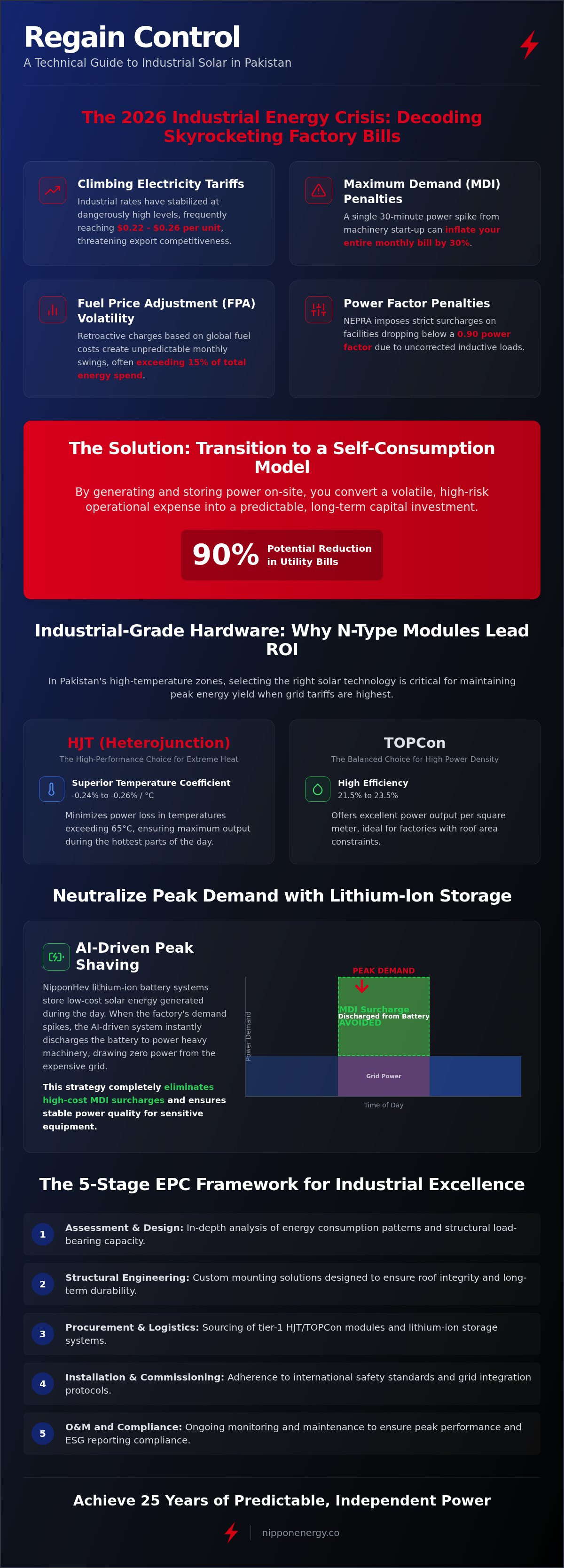
The industrial sector in Pakistan currently consumes 28% of the nation's total electricity, yet it bears the heaviest financial burden of grid instability. As of July 2026, base tariffs have stabilized at high levels, with rates frequently reaching between $0.22 and $0.26 per unit. Effective industrial solar energy optimization pakistan requires a granular understanding of how these costs are calculated. Beyond the base rate, factories face the Maximum Demand Indicator (MDI) trap. This surcharge is based on the highest level of electricity drawn during any 30-minute interval. If your machinery start-up sequences aren't synchronized, a single power spike can inflate your entire monthly bill by 30%.
Power factor penalties represent another hidden drain on factory resources. When inductive loads like heavy motors operate without correction, they draw reactive power that the grid must supply but cannot be billed as active work. NEPRA regulations in 2026 impose strict surcharges on facilities that drop below a 0.90 power factor. Industrial solar energy optimization pakistan solves this by utilizing smart inverters that provide reactive power compensation locally, improving your facility's energy quality and eliminating these fines.
Understanding Industrial Time-of-Use (ToU) Tariffs
Time-of-Use (ToU) tariffs are variable electricity rates based on the time of day, designed to penalize consumption during high-demand periods and incentivize usage during off-peak hours. In the current regulatory environment, peak hours typically occur in the evening when solar generation is zero. Shifting heavy inductive loads, such as large-scale milling or cooling, to daylight hours allows the facility to run on direct solar generation. This strategy reduces the reliance on expensive grid units during ToU peaks. The history of Solar Power in Pakistan shows a clear trend: companies that fail to align their production cycles with solar availability face diminishing margins.
The Volatility of Fuel Price Adjustments (FPA)
Fuel Price Adjustments (FPA) represent the most significant risk to monthly budget forecasting because they are applied retroactively based on the global cost of imported fuels. Between 2025 and 2026, FPA volatility has made it nearly impossible for factory managers to maintain fixed operational costs. Solar energy serves as a definitive hedge against this volatility. By generating power on-site, you lock in a fixed-cost asset for 25 years. This transition converts a variable, high-risk expense into a predictable capital investment.
The compounding effect of energy price increases has created a survival-of-the-fittest environment for Pakistani exporters. While competitors in other regions benefit from stable utility markets, local manufacturers must navigate monthly price swings that can exceed 15% of their total energy spend. Transitioning to a solar-first model isn't just about saving money. It's about de-risking your entire supply chain from government-mandated tariff adjustments and global fuel market shocks.
Industrial-Scale Hardware: Why HJT and TOPCon Lead ROI in 2026
Selecting the correct photovoltaic cell architecture is the foundation of industrial solar energy optimization pakistan. Standard PERC modules often fail to meet the rigorous demands of local manufacturing environments. In high-temperature zones like Karachi and Lahore, solar panels frequently exceed 65°C during peak sunlight. This heat triggers a significant drop in power output for traditional hardware. Heterojunction (HJT) technology addresses this through a superior temperature coefficient of -0.24% to -0.26%/°C. This technical advantage ensures that your factory maintains peak energy yield during the intense afternoon intervals when grid tariffs are highest.
While HJT offers the highest performance in extreme heat, TOPCon (Tunnel Oxide Passivated Contact) modules provide a balanced alternative for factories with specific roof area constraints. TOPCon achieves efficiencies between 21.5% and 23.5%, offering a higher power density than older technology. Choosing between these N-type architectures depends on your facility's thermal profile and available mounting space. Most modern industrial facilities also utilize bifacial gains. By installing bifacial modules on reflective factory roof surfaces, you can capture reflected light on the rear side. This can increase total energy yield by up to 15% without expanding the system's physical footprint.
Nippon HJT Solar Panels: Maximum Yield per Square Meter
Nippon HJT Solar Panels utilize a sophisticated cell architecture that combines crystalline silicon with amorphous silicon thin films. This design minimizes electron recombination. The reduction in energy loss allows for a higher open-circuit voltage and better low-light performance. In dusty industrial zones, these panels exhibit high resistance to Potential Induced Degradation (PID). This durability is critical for maintaining long-term ROI. For a detailed comparison of cell architectures, you should review our guide on Topcon Solar Panels.
Performance Warranties and Long-Term Degradation
The Alternative and Renewable Energy Policy 2019 set the stage for large-scale adoption, but the focus has now shifted to long-term asset reliability. N-type technology is fundamentally more stable than P-type PERC. It doesn't suffer from Light-Induced Degradation (LID), which leads to a lower Levelized Cost of Energy (LCOE) over a 25-year period. Most industrial-grade modules now come with performance warranties that guarantee over 87% of the original output after two and a half decades. Investing in high-performance hardware ensures that your initial capital expenditure delivers compounding returns. You can request a technical architecture consultation to determine which N-type technology fits your specific factory load profile.
Peak Shaving with Nippon Lithium-ion Battery Storage Systems
Industrial solar energy optimization pakistan is incomplete without a strategy to address instantaneous power consumption spikes. While solar panels reduce the total volume of energy purchased from the grid, they don't always align with the surges caused by starting heavy industrial motors or peak production shifts. This is where peak shaving becomes essential. By utilizing stored energy during these high-demand intervals, factories can effectively "shave" the top off their power profile. This ensures the grid-supplied electricity never exceeds the pre-set Maximum Demand Indicator (MDI) threshold, neutralizing the associated surcharges.
The transition from legacy lead-acid systems to modern Lithium-Ion Battery Storage is driven by fundamental engineering advantages. Traditional lead-acid batteries suffer from limited Depth of Discharge (DoD) and rapid degradation in the high-temperature environments typical of Karachi or Lahore. In contrast, Nippon Lithium-ion systems offer a DoD of up to 90%, allowing for a much smaller physical footprint for the same usable capacity. This efficiency is a cornerstone of Pakistan's renewable energy market, where space and thermal management are at a premium for dense industrial zones.
Financial Impact of Demand Charge Reduction
The ROI of industrial storage is increasingly calculated by the avoidance of MDI surcharges rather than just energy displacement. Nippon Lithium-ion systems provide a millisecond-fast response to industrial load spikes, discharging power the moment a machine starts up to prevent the grid meter from registering a new peak. The cycle life of Nippon Lithium-ion systems is engineered as a 10-year asset, providing a decade of reliable demand-charge suppression. This longevity ensures that the capital expenditure is amortized over a period where it can generate millions in cumulative savings for large-scale facilities.
Intelligent Energy Management via AI
Orchestrating these complex power flows requires the integration of Smart AI Solar Inverters. These systems act as the brain of the facility, using machine learning to forecast solar yield based on local weather patterns and predicting battery discharge cycles. AI-driven monitoring identifies energy leaks across the factory floor, such as compressed air leaks or inefficient cooling cycles, which often go unnoticed by manual audits. Automated load orchestration prioritizes critical machinery, ensuring that production never halts even if grid stability fluctuates. This level of intelligence is the final step in achieving true industrial solar energy optimization pakistan.
The Industrial EPC Framework: Implementing Solar Excellence
The successful execution of industrial solar energy optimization pakistan relies on a disciplined Engineering, Procurement, and Construction (EPC) framework. This process begins with a rigorous structural audit. Many industrial facilities in Karachi and Lahore utilize aging steel or concrete roof structures that were not originally designed to support the static and wind loads of a multi-megawatt solar array. Our engineers perform detailed stress analysis to ensure the roof can sustain the weight of Nippon HJT modules for 25 years. Electrical integration follows, where we connect the system to high-voltage panels. This requires precise synchronization to manage the transition between grid, solar, and battery power without interrupting sensitive manufacturing lines.
Navigating the 2026 regulatory shift is the final hurdle in implementation. NEPRA’s transition from net metering to a net billing framework has altered the financial logic of surplus energy. Under the 2026 Prosumer Regulations, the buyback rate for exported power is significantly lower than the cost of imported units. This shift makes the "self-consumption" model the only viable path to high ROI. Our EPC process prioritizes the orchestration of local loads to ensure that every kilowatt generated is used behind the meter, effectively neutralizing the need to export power at unfavorable rates.
Feasibility and Financial Modeling
Precise financial modeling is the first stage of any industrial project. We utilize advanced 3D modeling to conduct shadow analysis, accounting for nearby chimneys, water tanks, or neighboring structures that could cause partial shading. This data feeds into our Internal Rate of Return (IRR) calculations. In the current market, most industrial systems achieve a payback period between 3.5 and 5 years. For factory managers seeking a turnkey implementation, our guide on Solar EPC Services provides a deeper breakdown of the engineering standards required for large-scale energy independence.
Maintenance and Performance Monitoring
Dust and particulate matter in industrial zones create significant soiling losses, often reducing system efficiency by 15% or more if left unmanaged. Regular Solar System Maintenance is a technical necessity, not an option. We implement predictive monitoring systems that use AI to compare actual yield against theoretical performance. If a string of panels underperforms, the system flags a potential fault before it leads to downtime. Automated cleaning cycles or scheduled manual maintenance ensure that your investment continues to operate at its nameplate efficiency despite the harsh local environment. To begin your transition, you can schedule a comprehensive industrial energy audit with our engineering team.
Nippon Energy: Your Partner in Industrial Decarbonization
Nippon Energy operates as a global high-tech architect, rooted in Japanese engineering precision and dedicated to the development of large-scale energy infrastructure. This global perspective is essential, as expert consulting firms like Doradcy Energetyczni demonstrate how specialized energy advisory can transform industrial efficiency across diverse international markets. For manufacturers in Karachi and Lahore, industrial solar energy optimization pakistan represents the definitive path toward long-term operational resilience. Our strategic presence in Tokyo, Dubai, Karachi, and Lahore ensures that every project benefits from international technical standards while remaining grounded in local regulatory realities. We don't simply supply hardware; we engineer customized EPC solutions that address the specific thermal and electrical demands of sectors like textiles, chemicals, and heavy metallurgy.
The complexity of modern energy markets requires an orchestration of disparate technologies that work in perfect synchronicity. The NipponHev System provides this coordination by integrating Nippon HJT panels, lithium-ion storage, and AI-driven inverters into a single, cohesive architecture. Piecemeal setups from multiple vendors often suffer from communication latencies, mismatched performance warranties, and fragmented monitoring. By maintaining single-point accountability, Nippon Energy ensures that every component is optimized for maximum system uptime and peak efficiency. This integrated approach is designed for future-proofing; as your factory production grows or your energy needs evolve, the system scales without requiring a total overhaul of the existing electrical framework.
Securing Your Industrial Future
Industrial decarbonization is a core strategy for neutralizing operational risk in a volatile utility market. Proprietary energy infrastructure provides the cost predictability required for rigorous 25-year business planning, shielding your facility from future tariff hikes. Beyond the immediate financial returns, achieving 'Green Factory' status through high-efficiency solar deployment adds significant branding value within the global export supply chain. International buyers in Europe and North America increasingly prioritize manufacturing partners who demonstrate strict compliance with global ESG standards. Transitioning to a solar-first model is a clear signal of technical maturity and environmental leadership. To begin the transformation of your facility into a self-sustaining power plant, contact Nippon Energy for a professional industrial energy audit and a comprehensive technical feasibility study.
Securing Industrial Autonomy in the 2026 Energy Landscape
The transition from grid dependence to a self-consumption model is no longer optional for Pakistani manufacturers. By integrating proprietary HJT technology with AI-orchestrated lithium-ion storage, factories can effectively neutralize MDI surcharges and insulate themselves from volatile fuel price adjustments. This technical synergy ensures that industrial solar energy optimization pakistan delivers a compounding ROI while meeting the strict ESG mandates required for global export competitiveness.
Implementing these systems requires a high-tech architect capable of maintaining Japanese engineering standards across the full project lifecycle. Nippon Energy provides full-cycle EPC excellence in Karachi, Lahore, and Dubai, ensuring your 25-year energy asset is built for maximum resilience. It's the definitive move for factory leaders who value technical precision over grid-dependent guesswork. The path to cost predictability and energy independence begins with a precise technical assessment of your facility’s current load profile and structural capacity.
Request a Professional Industrial Energy Audit from Nippon Energy to begin your transition toward a decarbonized, high-performance manufacturing future.
Frequently Asked Questions
How much can solar actually reduce my factory's monthly electricity bill in Pakistan?
Industrial solar energy optimization pakistan can reduce monthly electricity bills by up to 90% depending on your roof area and load profile. With 2026 industrial tariffs reaching approximately $0.22 per unit, the primary savings come from displacing expensive grid units and avoiding peak-hour surcharges. By generating power on-site, factories bypass Fuel Price Adjustments and quarterly tariff hikes. Total reduction is maximized when production schedules align with peak solar generation periods.
What is the typical payback period for an industrial solar system in 2026?
The typical payback period for a well-engineered industrial system ranges from 3.5 to 5 years. This ROI is accelerated by the State Bank of Pakistan's green financing scheme, which offers subsidized rates as low as 6%. Additionally, businesses can claim up to 90% accelerated depreciation in the first year. These fiscal incentives, combined with rising utility costs, ensure the system pays for itself long before its 25-year performance warranty expires.
Does my factory need to stop production during the solar installation process?
Professional EPC providers ensure that installation doesn't require production downtime. We conduct structural audits and mounting bracket installations without entering the internal production floor. The final electrical integration is scheduled during planned maintenance windows or off-peak hours. Our engineers use synchronized cut-over techniques to connect the solar array and Nippon Smart AI Inverters to your high-voltage panels, ensuring a seamless transition between energy sources.
Can HJT panels survive the extreme heat and dust of industrial zones like Korangi or Hub?
HJT panels are specifically engineered for the high-temperature environments of Korangi and Hub. Unlike standard modules that lose efficiency as temperatures exceed 45°C, HJT technology maintains a superior temperature coefficient of -0.24%/°C. These panels also feature advanced glass-to-glass encapsulation, which provides exceptional resistance to Potential Induced Degradation and the abrasive effects of industrial dust. This durability ensures consistent energy yields for over two decades in harsh conditions.
What is the difference between HJT and TOPCon panels for industrial use?
HJT panels offer the highest efficiency in extreme heat and the lowest long-term degradation rates. TOPCon panels are a cost-effective alternative that provides high power density for factories with limited roof space. While both are N-type technologies, HJT is generally preferred for high-ambient temperature zones due to its superior thermal stability. We select the specific module type based on your facility's thermal profile and structural constraints to ensure maximum performance.
How does net billing work for industrial consumers under current 2026 regulations?
Under the NEPRA Prosumer Regulations 2026, net billing has replaced the old one-for-one net metering system. Surplus electricity exported to the grid is credited at a buyback rate of approximately $0.04 per unit. This regulatory shift makes industrial solar energy optimization pakistan focused on maximizing behind-the-meter consumption. By using all generated power on-site rather than exporting it, factories avoid the high cost of importing units at retail rates.
Is battery storage mandatory for reducing industrial electricity bills?
Battery storage isn't legally mandatory, but it's technically essential for neutralizing Maximum Demand Indicator (MDI) charges. Without storage, a factory remains vulnerable to peak demand surcharges during cloud cover or machine start-up spikes. Nippon Lithium-ion Battery Storage Systems allow for peak shaving, where stored energy is discharged to keep grid draw below penalty thresholds. This strategy often accounts for 30% of the total financial savings on an industrial bill.
What kind of maintenance is required for a multi-megawatt industrial solar plant?
Multi-megawatt plants require a combination of automated cleaning and predictive monitoring. In dusty industrial zones, soiling can reduce yield by over 15% in a single month. We implement AI-driven monitoring that identifies string-level faults before they lead to downtime. Maintenance schedules include thermal imaging of panels, inverter health checks, and torque testing of mounting structures. These professional services ensure the system operates at its nameplate capacity throughout its 25-year lifespan.


