

The traditional approach to industrial solar sizing in Pakistan is now a primary cause of systemic failure. You understand that in an environment where load shedding in Special Economic Zones often exceeds 12 hours, relying on a grid-tied system without robust storage is no longer a viable strategy. Successfully sizing battery storage for off-grid industrial solar pakistan requires a shift from simple load-matching to a sophisticated battery-first architecture that accounts for 45°C thermal degradation and high inductive startup currents. This technical necessity ensures that your facility remains operational when the grid inevitably fails.
This 2026 guide establishes the engineering parameters for deploying Nippon Lithium-ion Battery Storage Systems to secure 24/7 operational continuity. We will detail the exact calculations for capacity, the impact of the latest net billing policies on your return on investment, and how Smart AI Inverters ensure a system lifespan exceeding ten years. By the end of this analysis, you will possess the technical framework to transition from grid dependence to a resilient, high-performance energy architecture designed for the Pakistani climate.
Key Takeaways
- Identify why off-grid solar-plus-storage has reached fuel parity with diesel generators, making energy independence a financial imperative for the 2026 industrial landscape.
- Master the technical framework for sizing battery storage for off-grid industrial solar pakistan by calculating specific inductive load surges for heavy machinery.
- Apply industrial temperature de-rating factors to ensure battery chemistry maintains peak performance despite Pakistan's 45°C+ ambient temperatures.
- Compare the performance architecture of Nippon Lithium-ion systems against lead-acid alternatives to secure a 6,000-cycle lifespan and decade-long reliability.
- Utilize AI energy orchestration to intelligently shift industrial loads, allowing for a more compact and cost-effective battery bank without risking downtime.
The Industrial Energy Crisis in Pakistan: Why Off-Grid is the 2026 Standard
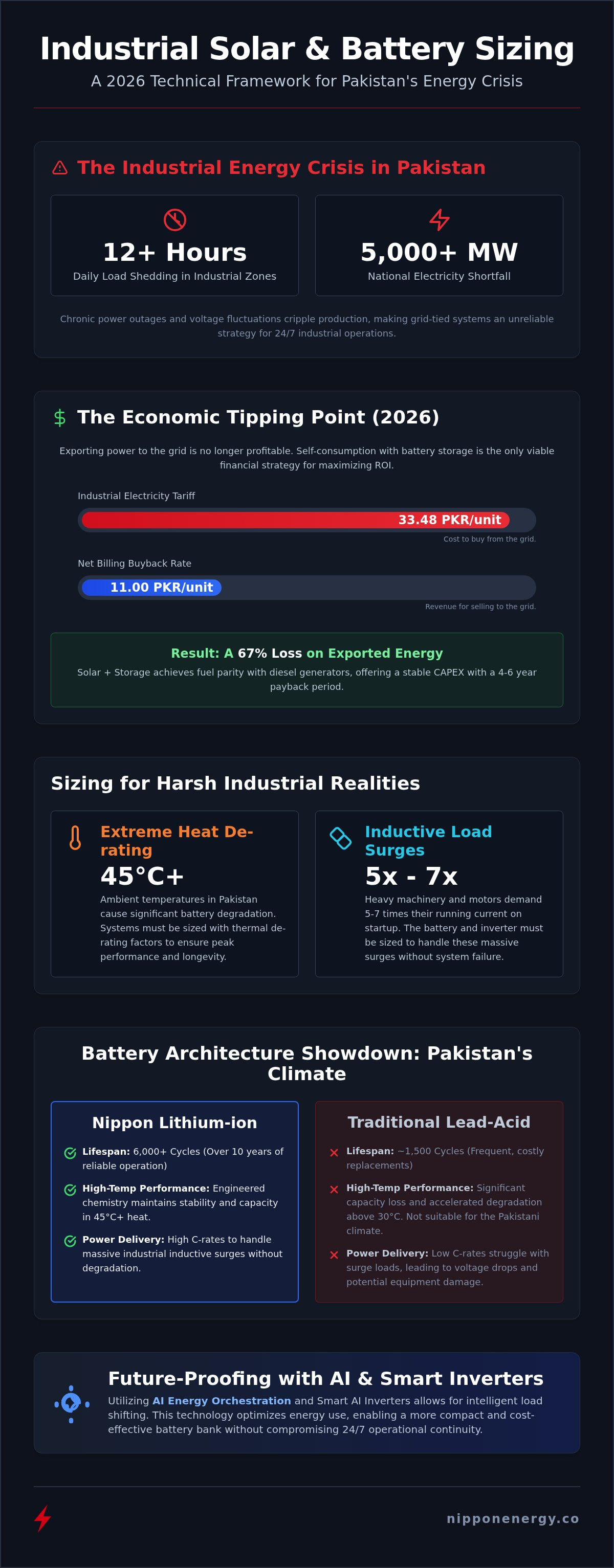
The Pakistani industrial sector faces an existential energy deficit. In 2026, the national electricity shortfall exceeds 5,000 MW, resulting in chronic load shedding even within designated Special Economic Zones (SEZs). Manufacturing hubs in Karachi and Lahore can't rely on the aging national grid for precision-heavy operations anymore. This instability has forced a paradigm shift where industrial independence is the only path to survival. Transitioning to a dedicated battery energy storage system (BESS) allows factories to decouple from a volatile utility provider and secure their production schedules against unpredictable outages.
Load Shedding Dynamics in Industrial Zones
While urban centers endure 6 to 12 hours of outages, the industrial impact is compounded by severe voltage fluctuations. These transients degrade sensitive CNC machinery and automated assembly lines, leading to costly downtime and hardware failure. A standard hybrid system often lacks the instantaneous response required for high-load industrial environments. True 24/7 manufacturing demands a battery-first architecture. This approach prioritizes sizing battery storage for off-grid industrial solar pakistan to absorb the massive inductive surges associated with motor startups and heavy industrial equipment without relying on grid assistance.
The Economic Case for Solar Architecture in 2026
The fiscal argument for off-grid solar has reached a definitive tipping point. With industrial electricity tariffs at approximately 33.48 PKR/unit and the February 2026 net billing policy offering a low buyback rate of 11 PKR/unit, exporting energy is no longer a profitable venture. Self-consumption via high-capacity storage is the only logical financial strategy for maximizing ROI. Integrating Nippon Lithium-ion Battery Storage Systems replaces the unpredictable OPEX of diesel generators with a stable, front-loaded CAPEX that typically pays for itself within four to six years.
International market pressures also dictate this transition. Global export requirements increasingly mandate carbon-neutral production chains. Factories that adopt solar-plus-storage models satisfy these compliance standards while insulating themselves from domestic fuel price volatility. By shifting to an off-grid mindset, manufacturers prioritize reliability and long-term cost control over the diminishing returns of grid dependency. It's a strategic move from being a passive consumer to becoming an active, resilient energy architect.
The Physics of Industrial Sizing: Beyond Simple kWh Calculations
Industrial energy architecture requires a granular understanding of load dynamics. Unlike residential systems, industrial facilities operate with distinct baseload, peak load, and surge load profiles. Accurately following a Step-by-Step: Sizing Your Industrial Battery Bank involves calculating the Total Energy Requirement (TER) over a full 24-hour cycle. This calculation must integrate every operational component, from high-consumption climate control and security lighting to the heavy-duty machinery that defines your production output.
Sizing battery storage for off-grid industrial solar pakistan is not a linear calculation. It's a rigorous engineering challenge that balances total storage capacity with the instantaneous power delivery needed for inductive loads. Failure to account for specific motor startup currents often leads to system tripping and premature battery degradation. Precision here is the difference between seamless operation and catastrophic production stops.
Inductive Surge and Inverter Coordination
Industrial batteries must sustain high C-rates to manage the startup of massive motors. These inductive loads can demand five to seven times their rated running current for several seconds, creating a massive strain on the storage architecture. To prevent voltage sags and maintain power quality, the battery bank must be perfectly coordinated with a smart ai solar inverter capable of intelligent energy orchestration. Using soft-starters or variable frequency drives (VFDs) helps mitigate these peaks, allowing for a more optimized and cost-effective battery configuration. If you require technical assistance in mapping these surges, you can consult with our engineering team to ensure your system architecture is sound.
Determining Autonomy and Depth of Discharge (DoD)
Reliability in the Pakistani context often translates to the "Autonomy" of the system, which refers to the number of days it can operate without solar input. For most industries in Special Economic Zones, 1.5 to 2 days is the strategic sweet spot. While lead-acid systems are limited by shallow discharge cycles, industrial-grade lithium systems safely support a 95% Depth of Discharge (DoD).
- 80% DoD: This setting extends the overall cycle life but requires a larger initial battery bank to meet the same energy needs.
- 95% DoD: This maximizes usable energy from a compact footprint, which is essential for facilities with limited space.
- The 20% Rule: Always include a 20% safety margin in your TER calculations to accommodate future industrial expansion and unexpected peak events.
This structured approach ensures your energy architecture is not just sufficient for today, but resilient for a decade of growth. By balancing these physics-based parameters, you create a system that withstands the unique pressures of the Pakistani industrial environment.
Lithium-ion vs. Lead Acid: Performance Architecture in Pakistan’s Heat
Pakistan’s extreme thermal profile acts as a rigorous filter for industrial energy storage technologies. Ambient temperatures exceeding 45°C in regions like Sindh and Punjab accelerate chemical degradation in conventional systems. When sizing battery storage for off-grid industrial solar pakistan, engineers must prioritize thermal resilience over the initial purchase price. Lead-acid batteries suffer from a severe risk of thermal runaway in these conditions, where heat increases internal resistance, further elevating temperatures and leading to premature failure. This thermal instability makes them a liability for high-stakes manufacturing environments.
Cycle life represents the most significant divergence between these chemistries. Traditional lead-acid units typically offer 1,500 cycles at a shallow depth of discharge. In contrast, Nippon Lithium-ion Battery Storage Systems deliver over 6,000 cycles at 95% DoD. This fourfold increase in longevity ensures that an industrial plant avoids the disruptive and expensive replacement cycles that plague inferior architectures. Investing in superior chemistry is a strategic decision that secures operational continuity for over a decade.
Megawatt-scale storage in urban centers like Karachi introduces significant logistical constraints. Lithium-ion systems provide a high energy density that requires approximately one-third of the floor space of lead-acid banks. This compact footprint allows for easier integration into existing factory layouts where real estate is at a premium. Additionally, the round-trip efficiency of lithium-ion remains above 95%, even during high-temperature charging cycles, ensuring minimal energy loss compared to the 80% efficiency common in lead-acid alternatives.
Thermal Management Systems for Industrial BESS
Industrial-grade performance requires sophisticated cooling. While passive cooling suffices for smaller installations, large-scale manufacturing demands active liquid cooling or precision air-handling in enclosures. Nippon Energy utilizes advanced thermal engineering to stabilize internal cell temperatures, preventing the capacity fade associated with high-ambient environments. This architectural focus maintains consistent internal resistance and preserves usable capacity throughout the hottest months of the year, ensuring the system performs to its rated specifications regardless of external conditions.
Total Cost of Ownership (TCO) Analysis
A ten-year industrial lifecycle analysis reveals that lead-acid is the more expensive option. The hidden costs of frequent distilled water replenishment, gas ventilation requirements, and biannual terminal cleaning inflate the OPEX significantly. Transitioning to lithium ion battery storage eliminates these maintenance burdens entirely. From an environmental compliance standpoint, modern lithium systems offer superior recycling pathways, aligning your facility with international industrial standards and sustainability mandates that are increasingly required for global export partners.
Step-by-Step: Sizing Your Industrial Battery Bank for Pakistan
Precision engineering is the foundation of energy independence. When sizing battery storage for off-grid industrial solar pakistan, relying on monthly utility bills is insufficient. You must execute a methodical five-step framework to ensure the system architecture withstands the specific rigors of the South Asian industrial environment. This process moves beyond theoretical capacity to establish a high-performance energy reservoir capable of sustaining 24/7 manufacturing cycles.
- Step 1: Energy Audit and Peak Logging. Deploy high-resolution power quality analyzers to log your load profile over a 72-hour period. This data identifies the true baseload and captures the inductive spikes from heavy machinery that standard billing cycles miss.
- Step 2: Apply the Industrial Temperature De-rating Factor. Standard specifications are measured at 25°C. You must adjust these values to reflect the real-world performance of hardware operating in the heat of Karachi or Multan.
- Step 3: Calculate Required Usable Capacity. Use the industrial formula to determine the total kWh required to meet your autonomy targets without over-stressing the battery chemistry.
- Step 4: Determine Bank Configuration. Select a series configuration to achieve the high-voltage DC bus requirements of industrial inverters, then parallel these strings to meet your total capacity needs.
- Step 5: Validate Against Inverter Peak Current. Ensure the battery management system (BMS) can discharge the instantaneous current required by your inverter during peak surge events without triggering a safety shutdown.
The Industrial Sizing Formula for Pakistan
To calculate a resilient battery bank, you must account for system losses that occur during conversion and transmission. Use the following equation: (Daily Load × Autonomy) / (DoD × Temperature Factor × Efficiency). This formula ensures that your storage capacity isn't just sufficient on paper, but remains robust during the hottest months. The Temperature De-rating Factor is a coefficient used to adjust the theoretical battery capacity to account for the accelerated loss of chemical efficiency and usable energy storage when operating in the ambient heat profiles of Sindh and Punjab, which frequently exceed 40°C. Neglecting this factor is the primary reason most industrial systems fail during the peak of summer.
Solar Array Integration
Your storage system is only as effective as the generation source that feeds it. High-efficiency topcon solar panels are the preferred choice for industrial charging because their superior low-light performance and better temperature coefficients ensure batteries reach full charge even on hazy or high-heat days. In industrial rooftop environments, utilizing bifacial gain can increase generation by up to 15%, providing the extra overhead needed to run daytime operations while simultaneously replenishing the battery bank. If you are ready to secure your facility's energy future, request a technical site evaluation from our EPC experts to begin your transition to off-grid resilience.
Nippon Energy: Future-Proofing Industrial Power with AI-Managed Storage
Nippon Energy operates as a global pioneer in industrial energy architecture. We recognize that the technical complexity of sizing battery storage for off-grid industrial solar pakistan requires more than just hardware; it demands a unified ecosystem. Our proprietary Nippon Lithium-ion Battery Storage Systems are specifically engineered for the South Asian climate, featuring thermal management protocols that maintain cell integrity even during the peak summer months of Punjab and Sindh. By providing localized solar epc services from our offices in Karachi and Lahore, we ensure that every installation is calibrated for the specific environmental and regulatory conditions of the region.
The integration of AI energy orchestration represents a fundamental shift in system design. Traditional sizing methods often result in oversized, cost-inefficient banks to handle peak events. Nippon's Smart AI Inverters utilize predictive algorithms to orchestrate load shifting, prioritizing critical machinery and deferring non-essential processes. This intelligent management allows us to optimize the battery bank size, reducing initial CAPEX while maintaining 24/7 reliability. To ensure this performance architecture remains peak-efficient, we offer comprehensive solar system maintenance and real-time monitoring, providing industrial operators with total transparency over their energy assets.
The NipponHev Advantage
The nipponhev system represents the pinnacle of integrated solar architecture. By combining high-efficiency Nippon HJT panels with AI-driven storage, we eliminate the compatibility risks associated with "orphan" components from disparate manufacturers. This unified framework is already yielding results. For instance, a major textile mill in Pakistan recently achieved total grid independence by deploying this integrated architecture, securing their production schedules against the 12-hour load shedding cycles common in their industrial zone. The centralized management interface allows for granular control over energy flows, ensuring that every harvested photon is either consumed or stored with maximum efficiency.
Next Steps for Industrial Energy Independence
Achieving energy autonomy is a structured process that begins with technical evidence. We recommend a site-specific energy audit to accurately profile your facility's power quality and load dynamics. Our BESS racks are designed for modularity, allowing your energy storage capacity to scale in parallel with your industrial expansion. This future-proofing ensures that your initial investment remains relevant as your production capacity grows. To begin your transition toward a resilient, high-performance energy future, you should Consult with Nippon Energy’s Pakistan Engineering Team for a comprehensive feasibility study and architectural proposal.
Architecting a Resilient Industrial Future
Transitioning to an off-grid model is no longer a speculative choice for Pakistani manufacturers; it's a strategic necessity for survival in a volatile energy market. This guide has detailed why precision in sizing battery storage for off-grid industrial solar pakistan is critical to managing inductive surges and extreme thermal degradation. By moving beyond basic kWh calculations and adopting AI-driven orchestration, your facility can achieve a level of reliability that the national grid cannot match. High-performance lithium-ion chemistry remains the only viable architecture for sustaining 24/7 production in 45°C+ environments.
Nippon Energy stands as your high-tech partner in this transition. Our systems leverage Japanese engineering precision and proprietary high-temp lithium technology to ensure a decade of stable performance. With localized support in Karachi and Lahore, we provide the technical framework and operational monitoring required for large-scale success. It's time to decouple your production from the grid and take control of your energy destiny. Secure Your Industrial Energy Independence with Nippon Energy and build a legacy of efficiency and growth.
Frequently Asked Questions
How many years do lithium-ion batteries last in Pakistan's heat?
Nippon Lithium-ion Battery Storage Systems typically last 10 to 12 years in Pakistan’s high-temperature environments. While standard lead-acid units often fail within 2 to 3 years due to thermal degradation, our proprietary chemistry is engineered to sustain over 6,000 cycles at a 95% depth of discharge. This longevity is maintained through advanced thermal management protocols that stabilize internal cell temperatures even when ambient heat exceeds 45°C.
Can an off-grid solar system run heavy industrial motors?
Yes, a correctly engineered off-grid system can power heavy industrial motors by accounting for inductive load surges. These motors often require five to seven times their running current during startup. By coordinating Nippon Smart AI Inverters with high-discharge lithium banks, the system manages these instantaneous peaks without voltage sags. Implementing soft-starters further optimizes the architecture, ensuring seamless operation for automated assembly lines and CNC machinery.
What is the typical ROI for an industrial off-grid system in 2026?
The typical return on investment for an industrial off-grid system in Pakistan is currently between 4 and 6 years. This ROI is driven by the high industrial electricity tariff of approximately 33.48 PKR/unit and the elimination of expensive diesel generator operation. Businesses also benefit from accelerated depreciation of up to 90% in the first year, significantly improving the financial viability of sizing battery storage for off-grid industrial solar pakistan.
Is it better to use a 48V or high-voltage (HV) battery system for a factory?
High-voltage (HV) battery systems are superior for industrial applications due to their higher efficiency and lower transmission losses. While 48V systems are suitable for residential use, factories with large-scale loads benefit from HV architectures that reduce cable thickness and improve inverter performance. HV systems allow for a more streamlined integration with industrial-grade Smart AI Inverters, facilitating the rapid energy discharge required for heavy machinery startups.
How much space is required for a 500kWh industrial battery bank?
A 500kWh Nippon Lithium-ion Battery Storage System typically requires approximately 10 to 15 square meters of floor space. This compact footprint is nearly one-third the size of an equivalent lead-acid bank, making it ideal for urban factories in Karachi or Lahore where real estate is limited. Our modular rack designs allow for vertical stacking, further optimizing the spatial efficiency of your energy infrastructure while maintaining necessary ventilation clearances.
Do I need a backup generator if I have a large battery storage system?
While a properly sized battery system can provide 100% energy independence, many industrial facilities retain a backup generator as a secondary fail-safe for prolonged low-solar periods. However, the primary goal of sizing battery storage for off-grid industrial solar pakistan is to minimize generator run-time to near zero. This shift converts high fuel OPEX into a stable CAPEX model, using the generator only for extreme emergency scenarios rather than daily load shedding.
What maintenance is required for Nippon industrial lithium batteries?
Nippon industrial lithium batteries require zero active maintenance, representing a significant upgrade over lead-acid systems. There is no need for distilled water replenishment or gas ventilation monitoring. Our systems include an integrated Battery Management System (BMS) that automatically balances cells and monitors thermal health. We provide professional solar system maintenance and monitoring services to remotely track performance architecture and ensure maximum uptime without requiring on-site technical intervention.
How does AI improve the sizing and performance of my battery storage?
AI improves system performance by orchestrating intelligent load shifting and predictive energy management. Nippon Smart AI Inverters analyze consumption patterns to defer non-essential loads during peak demand or low solar generation. This orchestration allows for a more compact battery bank, as the AI reduces the total surge capacity required at any single moment. The result is a more cost-effective system that prioritizes critical industrial processes automatically.


