

The initial investment in a high-performance energy storage system might feel like a significant capital expenditure, but in Pakistan's current economic climate, the higher upfront Nippon lithium ion battery price pakistan represents a strategic hedge against decades of rising utility costs. You've likely experienced the frustration of tubular batteries failing after just two seasons or watched your monthly PKR per-unit rate climb despite frequent load-shedding. It's a cycle of inefficiency that drains both financial resources and operational stability. We agree that reliability is the only metric that matters when your appliances and business continuity are on the line.
This guide provides a technical deep dive into Nippon Lithium-ion Battery Storage Systems, analyzing how Japanese-engineered durability translates into a lifespan exceeding 10 years. You'll discover the precise ROI calculations for the 2026 market, a breakdown of cell chemistry, and how our smart AI integration secures your energy independence. We begin with a macro-economic analysis of storage trends before detailing the specific engineering benchmarks that define Nippon's global standard. By the end of this analysis, you'll understand why modern storage is no longer an accessory, but a foundational pillar of sustainable infrastructure.
Key Takeaways
- Evaluate how the 2026 electricity tariff restructuring necessitates a shift toward high-efficiency storage to maintain residential and commercial energy ROI.
- Analyze the technical superiority of Tier-1 LiFePO4 chemistry and 90% Depth of Discharge (DoD) benchmarks in securing a 10-year operational lifecycle.
- Understand how the Nippon lithium ion battery price pakistan translates into a lower Levelized Cost of Storage (LCOS) compared to replacing traditional lead-acid banks every two years.
- Learn the methodical process for auditing critical loads and synchronizing battery capacity with solar PV generation to achieve maximum energy independence.
- Access information on local technical support and warranty fulfillment through Nippon Energy's strategic industrial hubs in Karachi and Lahore.
The 2026 Energy Landscape: Why Pakistan is Shifting to Lithium-Ion
Pakistan's energy infrastructure is undergoing a fundamental transformation. The 2026 electricity tariff hikes have fundamentally altered the ROI calculation for residential and commercial solar installations. Traditional backup solutions, once sufficient for brief outages, now fail to meet the demands of a market defined by high per-unit costs and extended load-shedding windows. We've observed a definitive move away from "backup power" toward "energy orchestration," where storage systems actively manage consumption patterns to minimize grid reliance. Nippon Energy facilitates this transition by providing the architectural stability required for decentralized energy networks.
Load Shedding vs. Continuous Storage
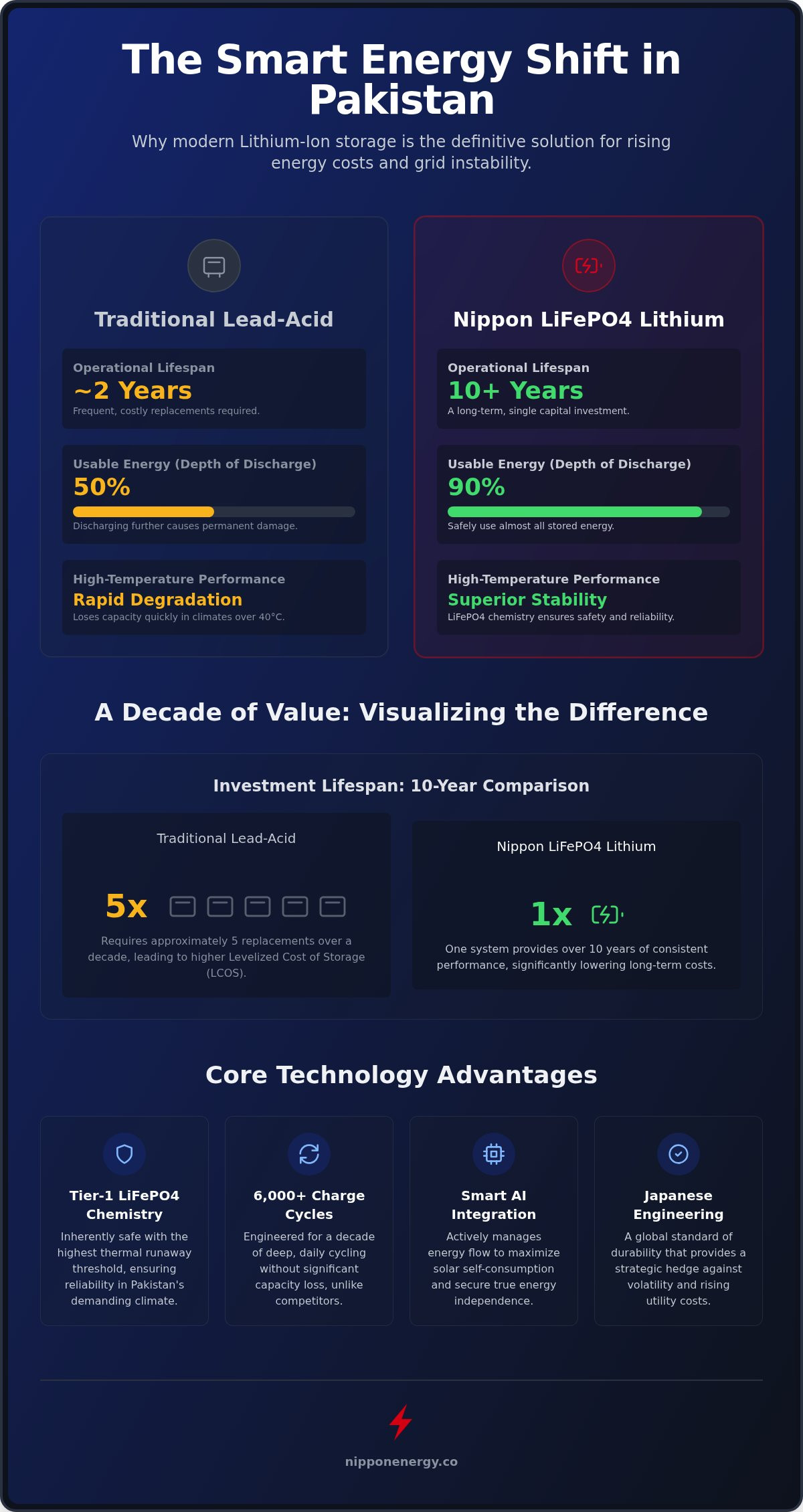
Traditional lead-acid banks cannot sustain the deep discharge cycles required by modern 4-6 hour load-shedding windows without rapid capacity loss. These legacy systems typically degrade if discharged beyond 50%, whereas Nippon Lithium-Ion Battery Storage Systems maintain integrity at 90% Depth of Discharge. In high-temperature industrial zones like Karachi, thermal stability is a critical engineering requirement. LiFePO4 chemistry provides the highest thermal runaway threshold, ensuring safety and performance in tropical climates where ambient temperatures often exceed 40 degrees Celsius. Understanding the Technical Architecture of Lithium-Ion Batteries reveals why these advanced cells are necessary for the Pakistani climate. LiFePO4 chemistry is the only viable storage medium for maintaining high cycle life in tropical high-ambient environments.
Economic Resilience Through Solar Storage
Investing in durable hardware is a strategic hedge against PKR volatility and the rising cost of imported energy components. While the initial Nippon lithium ion battery price pakistan reflects its premium Japanese engineering, the 10-year levelized cost of storage is significantly lower than replacing lead-acid banks every 24 months. As net metering regulations evolve in 2026, the ability to store and prioritize self-consumption has become more valuable than exporting excess energy at depreciated rates. This shift allows urban centers like Lahore to stabilize local demand through intelligent storage. For complex commercial deployments, our solar epc services provide the technical framework to synchronize high-capacity storage with HJT solar generation. The result is a self-sustaining energy ecosystem that protects the owner from external market shocks. The Nippon lithium ion battery price pakistan is therefore a capital investment in long-term operational certainty rather than a mere recurring expense.
Technical Architecture of Nippon Lithium-Ion Battery Storage Systems
The engineering of Nippon Lithium-ion Battery Storage Systems begins with the selection of Tier-1 Lithium Iron Phosphate (LiFePO4) cells. This chemistry is specifically chosen for its inherent safety and chemical resilience. It provides a significantly higher thermal runaway threshold compared to standard lithium-ion variants, which is essential for maintaining performance during Pakistan's peak summer months. This technical superiority directly impacts the Nippon lithium ion battery price pakistan, positioning it as a premium industrial-grade solution rather than a standard consumer-grade backup. Such robust storage technology is a critical component for achieving Pakistan's 2030 Renewable Energy Goals by stabilizing decentralized solar grids.
Performance benchmarks further distinguish these systems from legacy storage. While lead-acid batteries are limited to a 50% Depth of Discharge (DoD) to avoid permanent damage, Nippon systems safely operate at 90% DoD. This provides nearly double the usable energy from the same rated capacity. When combined with a cycle life of 6,000+ charges, the long-term Nippon lithium ion battery price pakistan becomes a fraction of the cost associated with frequent lead-acid replacements. This endurance allows for a decade of consistent energy delivery without the steep degradation curves seen in cheaper alternatives. You can explore our full range of Nippon Lithium-ion Battery Storage Systems to find the configuration that matches your specific load requirements.
BMS: The Intelligence Behind the Power
The modular architecture of Nippon storage allows for seamless expansion as energy needs grow. Our systems offer plug-and-play compatibility with existing solar arrays, ensuring that upgrades don't require a complete infrastructure overhaul. Residential users typically opt for wall-mounted configurations to save floor space, while commercial clients utilize rack-mounted systems for large-scale energy density. This flexibility ensures that whether you're powering a home in Lahore or an industrial facility in Karachi, the storage capacity can be scaled with precision. The robust outer casing is designed to withstand local environmental challenges, maintaining the structural integrity of the internal cells over their entire 10-year lifecycle.
Nippon Lithium-Ion Battery Price vs. Value Analysis
Analyzing the Nippon lithium ion battery price pakistan requires a strategic shift from viewing storage as a simple commodity to treating it as a high-yield infrastructure asset. While the initial capital requirement is higher than legacy alternatives, the Levelized Cost of Storage (LCOS) provides a more accurate metric for long-term financial planning. LCOS measures the total cost of the system divided by the total energy it will discharge over its functional life. Because Nippon systems utilize high-grade LiFePO4 chemistry, the cost per kilowatt-hour delivered is significantly lower than that of any lead-acid variant. This value proposition is further strengthened by the zero-maintenance requirement of lithium technology, which eliminates the recurring costs of water topping and terminal cleaning.
External economic factors in 2026, including fluctuating import duties and international shipping rates, continue to influence the landed cost of storage hardware. However, Nippon Energy leverages its local presence in the Korangi Industrial Area to optimize logistics and assembly, providing a more stable pricing structure for the Pakistani market. By investing in Japanese-engineered hardware with local execution, users insulate themselves from the frequent hardware failures that plague lower-tier imports. The Nippon lithium ion battery price pakistan represents a decade-long hedge against energy inflation, ensuring that your initial investment delivers consistent performance without the hidden costs of operational downtime.
Lead-Acid vs. Nippon Lithium: The PKR Comparison
A standard 5kW system using traditional tubular or lead-acid batteries may appear attractive due to a lower entry price. However, these batteries typically require replacement every 18 to 30 months when subjected to Pakistan's deep-discharge cycles and high ambient temperatures. Over a 10-year horizon, a property owner will likely purchase four separate lead-acid banks to match the endurance of a single Nippon unit. This constant replacement cycle, coupled with the labor costs of installation and the rising price of lead, makes the Total Cost of Ownership (TCO) for lead-acid nearly three times higher than a single lithium-ion investment. Nippon's 6,000+ cycle life effectively redefines the investment horizon from a recurring expense to a one-time capital placement.
ROI and Payback Period
The payback period for a Nippon storage system is accelerated by the extreme utility tariff hikes witnessed in urban centers like Lahore and Karachi. High round-trip efficiency ensures that over 95% of the energy generated by your solar panels is successfully stored and retrieved, compared to the 70-80% efficiency of lead-acid systems. This efficiency reduces the total number of solar panels required to meet your energy goals, lowering the overall system cost. For a deeper understanding of how these systems integrate into modern buildings, consult the definitive guide to lithium-ion battery storage. By maximizing self-consumption and minimizing grid reliance during peak hours, most users achieve a full ROI within 3 to 5 years, leaving over half a decade of "free" energy storage thereafter.
Sizing and Installation Guide for Pakistan
Precision in sizing is the difference between a functional energy system and a failed investment. We don't recommend estimating storage needs based on anecdotal evidence; instead, we apply a methodical four-step engineering audit. First, you must categorize your loads into critical (lighting, networking, refrigeration) and non-critical (air conditioning, water pumps). This distinction allows the system to prioritize essential services during extended outages. Second, your battery capacity must be synchronized with your solar PV generation. A battery that is too large for the solar array will never reach a full state of charge, while a battery that is too small wastes excess generation potential.
Third, inverter compatibility is paramount. Nippon Lithium-ion Battery Storage Systems are engineered for seamless synergy with Nippon Smart AI Inverters, utilizing advanced communication protocols to manage charge cycles dynamically. Finally, professional installation is the only way to ensure the structural and electrical integrity of the system. While the Nippon lithium ion battery price pakistan includes the cost of Japanese-engineered cells, the value is only realized when the system is integrated by a certified technical team. Contact our engineering department to request a custom sizing audit for your facility.
Optimizing for Load Shedding
Managing a 4-hour or 6-hour load-shedding window requires an understanding of C-ratings, which dictate how quickly a battery can charge and discharge. In many Pakistani urban centers, the grid may only be available for short intervals. Nippon's high C-rating allows the system to fast-charge during these limited windows, ensuring you have a full reservoir of power before the next outage begins. To design for 100% energy independence, we calculate your "Hours of Backup" by dividing the total usable kilowatt-hours by your average hourly critical load. This scientific approach ensures your home or business remains operational regardless of grid instability.
Installation Standards in Pakistan
Lithium technology requires specific environmental conditions to maintain its 10-year lifecycle. Although LiFePO4 chemistry is thermally stable, professional EPC services must ensure adequate ventilation and temperature control to prevent heat soak in confined spaces. Our installation protocols include dedicated circuit protection and localized cooling strategies for indoor storage banks. Proper physical placement is just as important as electrical configuration. To keep your system running at peak efficiency after the initial setup, follow our comprehensive guide on solar system maintenance. Adhering to these rigorous standards protects your investment and ensures the Nippon lithium ion battery price pakistan delivers the expected long-term ROI.
Procuring Nippon Solutions: Lahore, Karachi, and Beyond
Transitioning from technical evaluation to procurement requires a partner with a robust local infrastructure. Nippon Energy maintains a significant strategic presence in Pakistan, anchored by our primary hub in the Korangi Industrial Area, Karachi, and our regional office in Lahore. This local footprint is not merely a logistical advantage; it's the foundation of our long-term reliability. While many storage providers operate as simple importers, we function as a world-class partner providing the tools for large-scale energy success. Our local teams understand the specific challenges of the Pakistani grid, ensuring that every deployment is optimized for the local environment.
The final Nippon lithium ion battery price pakistan is often influenced by the specific requirements of the installation site, whether it's a high-density industrial park or a residential villa. We provide personalized PKR quotes for 2026 that account for current import dynamics and project-specific engineering needs. By securing a quote directly from our technical architects, you gain access to a transparent pricing structure that includes comprehensive after-sales support. This eliminates the risks associated with third-party vendors who lack the technical prowess to service advanced LiFePO4 systems over their 10-year lifecycle.
Nippon Energy EPC Excellence
Our Engineering, Procurement, and Construction (EPC) services move beyond simple hardware delivery to provide a turnkey execution model. We begin with detailed feasibility studies to determine the optimal storage-to-generation ratio for your facility. Once the system is operational, users maintain full visibility through Nippon's intelligent management portal, which provides real-time data on battery health and discharge patterns. This methodical approach ensures that the structural integrity of your energy network is never compromised. For those seeking comprehensive mobility and storage solutions, we also offer NipponHev integrated systems across our Pakistani service areas. This level of integration allows for a seamless transition to a fully electrified, self-sustaining lifestyle.
Contact and Consultation
We invite commercial and industrial (C&I) stakeholders to visit our Lahore or Karachi offices for a live demonstration of our storage technology. These sessions allow you to witness the synergy between our Tier-1 cells and Smart AI Inverters in a controlled environment. Our High-Tech Architects are available to customize storage solutions that align with your specific ROI goals and operational constraints. Whether you're looking to stabilize an industrial manufacturing line or future-proof a residential development, our team provides the technical authority required for a successful transition. The Nippon lithium ion battery price pakistan is a reflection of this end-to-end expertise and our commitment to national energy independence. Consult with Nippon Energy's High-Tech Architects today to begin your technical audit.
Securing Your Energy Infrastructure for the Next Decade
The transition toward decentralized energy storage is no longer a luxury but a technical necessity in Pakistan's 2026 economic landscape. By prioritizing Japanese engineering and Tier-1 LiFePO4 cells, you're investing in a system designed to outlast traditional storage by nearly a decade. Evaluating the Nippon lithium ion battery price pakistan requires a focus on long-term levelized costs rather than short-term sticker prices. Our local support hubs in Karachi and Lahore ensure that your high-performance storage remains operational through every load-shedding cycle and temperature peak. We provide the architectural stability needed to achieve total energy independence through precision-engineered hardware and local EPC expertise.
Your path to a resilient, self-sustaining power network begins with a detailed technical audit of your specific load requirements. Our team of High-Tech Architects is ready to synchronize your solar generation with the most advanced storage technology available in the market today. Request a Custom Storage Quote from Nippon Energy Pakistan to secure your facility's future. Build a legacy of reliability and efficiency with a partner committed to global excellence and local execution.
Frequently Asked Questions
What is the expected price range for a 5kWh Nippon lithium-ion battery in Pakistan?
The Nippon lithium ion battery price pakistan is determined by several variables, including current 2026 import duties and the specialized Tier-1 LiFePO4 cell chemistry. We don't provide generic price lists because each system is sized to match the specific architectural requirements of your facility. A customized quote ensures that the capital investment aligns with your long-term ROI goals, accounting for Japanese engineering standards and local logistics through our Karachi industrial hub.
Can I use a Nippon lithium battery with my existing non-Nippon solar inverter?
You can integrate Nippon storage systems with most high-quality existing solar inverters, provided they support lithium-ion communication protocols. However, we recommend the Nippon Smart AI Inverter for maximum operational efficiency. This combination enables advanced energy orchestration and real-time cell balancing, which extends the overall system lifespan. Using a unified Nippon ecosystem ensures that the hardware and software communicate without the latency issues often found in mixed-brand configurations.
How many years of warranty does Nippon Energy provide for storage systems in Pakistan?
Nippon Energy provides a comprehensive manufacturer warranty for all storage systems, which is managed directly through our local support hubs in Lahore and Karachi. This local presence ensures that technical teams can provide rapid assistance without the delays associated with international shipping. While the hardware is engineered for a 10-year functional life, our warranty protocols are designed to protect the structural integrity and discharge performance of your investment throughout its operational duration.
Is it safe to install lithium-ion batteries inside a home in Karachi's heat?
It's entirely safe to install our lithium-ion systems in high-temperature environments like Karachi when professional installation protocols are followed. We utilize LiFePO4 chemistry, which has a significantly higher thermal runaway threshold than other lithium variants. Our technical teams in the Korangi Industrial Area ensure that every installation includes proper ventilation and heat management strategies. These safety measures prevent thermal stress and maintain the battery's efficiency during Pakistan's peak summer months.
How does the Nippon battery perform during 6-hour load shedding cycles?
Nippon batteries are specifically engineered to handle extended 6-hour load-shedding cycles without the rapid degradation seen in lead-acid banks. The 90% Depth of Discharge (DoD) benchmark allows the system to provide nearly its full rated capacity during prolonged outages. Because the cells support high C-ratings, they can also fast-charge during the limited windows when the grid is available. This ensures your energy reservoir is always replenished before the next scheduled outage begins.
What is the difference between Nippon HJT panels and battery storage synergy?
The synergy between Nippon HJT panels and our storage systems creates a high-efficiency energy loop. HJT panels provide superior yields in Pakistan's high-temperature climate, generating more energy per square foot. Our storage systems then capture this excess generation, allowing the Smart AI Inverter to orchestrate its use during peak tariff hours. This combination maximizes your self-consumption and provides a faster path to total energy independence compared to using standard panels.
Does Nippon Energy provide installation services in Lahore?
We provide full-cycle EPC services in Lahore, covering everything from initial feasibility studies to turnkey system execution. Our Lahore office serves as a regional hub for residential and commercial project development, ensuring that local clients receive professional engineering support. This includes site audits, custom system sizing, and ongoing maintenance. Having a local team in Lahore allows us to maintain the high standards of Japanese engineering while providing the responsive service required by Pakistani property owners.
How do I calculate the ROI of switching from lead-acid to Nippon lithium-ion?
To calculate the ROI, you must compare the Levelized Cost of Storage (LCOS) against the recurring costs of lead-acid replacements. While the initial Nippon lithium ion battery price pakistan is higher, a single lithium unit outlasts approximately four lead-acid banks over a decade. You should also factor in the 95% round-trip efficiency and the monthly savings on utility bills. Most commercial and residential users find that the system pays for itself within three to five years.


