

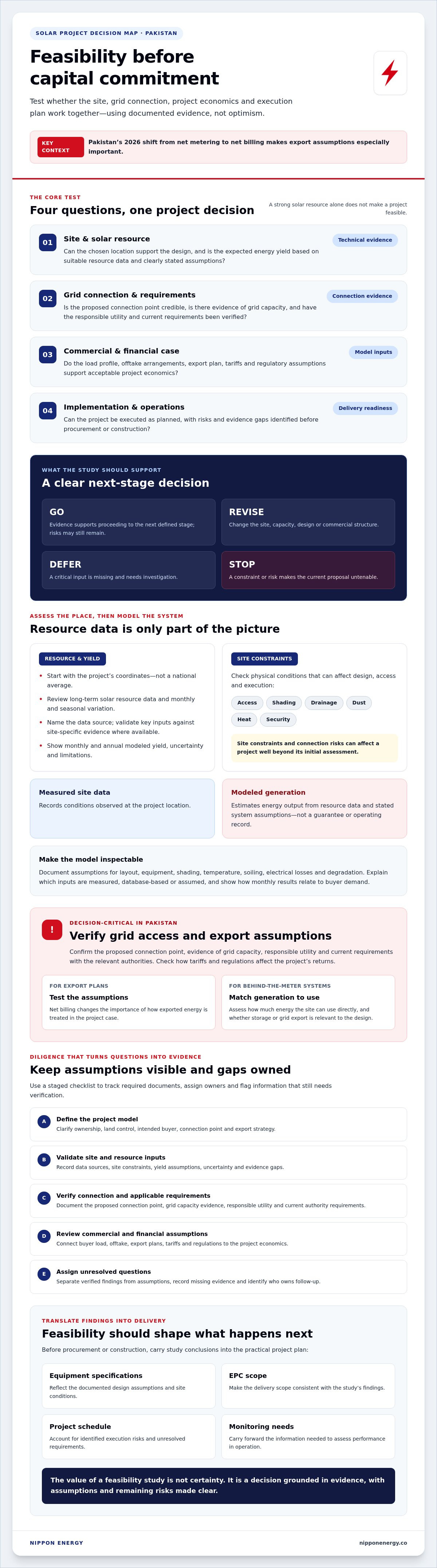
A strong solar resource does not make a project feasible on its own. A solar project feasibility study pakistan investors can rely on must test whether the site, grid connection, project economics, and execution plan work together before capital is committed. Pakistan’s 2026 shift from net metering to net billing makes export assumptions especially important. Site constraints and connection risks can also affect a project well beyond its initial assessment.
If you are unsure how much energy a site can produce, whether the grid can accept the project, or how changing tariffs and regulations affect returns, treat these as decision-critical questions, not details to leave until procurement. A rigorous study identifies them early, highlights evidence gaps, and separates assumptions from verified findings.
This guide explains the technical, commercial, financial, and regulatory scope of a solar feasibility assessment in Pakistan. It covers what to examine in solar resource and site data, grid access, project economics, and execution risks, as well as the evidence to request from a development or EPC partner before moving forward.
Key Takeaways
- A solar project feasibility study pakistan should distinguish early screening from documented technical, commercial, financial, and implementation due diligence.
- Assess solar resource data alongside site constraints such as access, shading, drainage, dust, heat, and security before selecting a location.
- Verify the proposed connection point, grid capacity evidence, responsible utility, and current requirements with the relevant authorities.
- Use a staged diligence checklist to track required documents, assign owners, and flag information that still needs verification.
- Translate study findings into equipment specifications, EPC scope, schedule, and monitoring needs before procurement or construction.
What a solar project feasibility study in Pakistan must establish
A feasibility study turns a project concept into a documented decision. It assesses whether a solar installation can be built at a specific location and perform as intended, based on defined technical, commercial, financial, and implementation evidence. It is not a production guarantee. Its conclusions depend on input quality, design maturity, and the risks that remain unresolved.
A solar feasibility study is a documented assessment of a proposed project’s ability to be built, connected, and operated as intended, with its expected performance, economics, assumptions, and risks clearly stated.
That distinction matters to project sponsors, investors, industrial buyers, landowners, and lenders. A preliminary screen can compare locations or flag obvious constraints, but it cannot replace detailed due diligence. The central test is whether the project has a credible generation estimate, viable grid access, acceptable economics, and manageable execution risks, supported by evidence rather than optimism.
Which Pakistan solar projects need a feasibility study?
The scope depends on the project model. A utility-scale proposal must examine land, connection options, offtake arrangements, and export plans. A commercial or industrial project needs to match expected generation with the buyer’s load profile and operating requirements. A behind-the-meter system needs an assessment of how much energy the site can use directly and whether storage or grid export is relevant to the design.
Capacity alone does not define the work. Ownership, land control, intended buyer, connection point, and export strategy all affect the questions the study must answer. Pakistan’s solar sector includes varied project types, as outlined in this overview of Solar power in Pakistan. Confirm project-specific requirements and the applicable utility process before finalizing the study scope.
What decisions should the study support?
A useful study gives decision-makers a clear path: go, revise, defer, or stop. “Go” means the evidence supports proceeding to the next defined stage, not that every risk has disappeared. “Revise” may mean changing the site, capacity, design, or commercial structure. “Defer” means a critical input is missing. “Stop” means a constraint or risk makes the current proposal untenable.
For readers searching “solar project feasibility study pakistan,” the key is to distinguish verified findings from assumptions that still need investigation. The report should identify the evidence behind generation and grid conclusions, record financial model inputs, and assign unresolved issues for follow-up. A landowner, for example, should be able to see whether site access is confirmed or simply assumed. This clarity helps sponsors and lenders decide what evidence they need before committing further capital.
How Pakistan solar feasibility studies assess resource, site, and system design
A credible energy-yield estimate starts with the project’s coordinates, not a national average. A solar project feasibility study pakistan should examine long-term solar resource data, monthly and seasonal variation, and the limits of the available information. A resource such as the Global Solar Atlas can provide an initial reference, but the study should identify its data source and validate key inputs against site-specific evidence where available.
Measured site data records conditions observed at the project location, while modeled generation estimates calculate expected energy output from resource data and stated system assumptions. These are not interchangeable. The report should show monthly as well as annual yield, disclose uncertainty, and document assumptions for layout, equipment, shading, temperature, soiling, electrical losses, and degradation. Modeled output is an estimate, not a guarantee or a record of operating performance.
How should solar resource and energy yield be assessed?
Ask the study team to explain which inputs are measured, which come from databases, and which are assumptions. Seasonal results matter because an annual total can conceal months when generation may not align with a buyer’s demand. The model should make loss factors and limitations visible so sponsors can test how changes in assumptions affect expected production.
What site and system factors shape the design?
Compare candidate sites against practical constraints before fixing a layout. Check land rights and boundaries, geotechnical evidence, road and equipment access, shading, topography, drainage, dust exposure, heat, security, and environmental constraints. For example, a site with suitable solar resource may still need design changes if drainage or access limits installation and maintenance.
Then assess module, inverter, mounting, and storage choices against the site and project requirements. If you are exploring tracking mechanisms to optimize daily generation, discover Ecoplant® to see how sun-tracing solar systems are configured. Nippon HJT solar panels and Nippon TOPCon solar panels are options to evaluate alongside other design inputs, not default selections. Storage may be relevant when the project’s load or operating objectives support it. Inverter requirements also depend on the system design and connection conditions. The study should connect each recommendation to evidence and explain trade-offs rather than assume one configuration suits every project.
For projects involving formal development or investment processes, consult relevant official sources, including the Private Power and Infrastructure Board (PPIB), and verify project-specific requirements with the responsible authorities. Once feasibility establishes the technical basis, Nippon Energy’s solar project development and EPC capability may help carry study findings into execution planning.
How grid access, Pakistan policy, and project economics change feasibility
A strong generation forecast is not enough if the project cannot connect on viable terms. Map the proposed connection point, identify the responsible utility for the exact site, and request evidence of available grid capacity and any required interconnection works. Depending on the location, the utility may be a distribution company (DISCO) or K-Electric. Treat a nearby line or substation as a starting point for investigation, not proof that capacity is available.
Pakistan’s policy position can also change the value of generated electricity. The 2026 move from net metering to net billing for new solar consumers, introduced on February 9, 2026, makes it especially important to distinguish energy used on site from energy exported to the grid. Confirm the policy’s current status and applicability with NEPRA and the relevant DISCO or K-Electric. Date-stamp findings and flag any licensing, export, interconnection, or approval question that needs confirmation from the responsible authority or a specialist.
How should project economics and risk be tested?
A decision-useful model should show sourced inputs for capital and operating costs, energy value, financing, taxes, and project life. Compare self-consumption, power purchase, and export cases only where the project’s ownership and commercial structure allow them. Avoid relying on a generic payback claim. The investment case depends on site-specific generation, how electricity is used or sold, and the terms that can actually be secured.
Test sensitivities that could materially change the result, including exchange rates, financing terms, lower generation, curtailment, and changes in offtake conditions. Keep verified inputs separate from estimates and items awaiting confirmation.
| Model category | What to show | How to treat it |
|---|---|---|
| Base case | Documented generation, cost, financing, and offtake assumptions | Use sourced inputs and record their dates |
| Downside sensitivities | Lower generation, adverse exchange-rate movement, financing changes, curtailment, or weaker offtake terms | Show how each change affects project returns and cash flow |
| Unverified inputs | Grid capacity, approvals, export terms, or commercial conditions not yet confirmed | Identify the evidence needed, responsible party, and decision impact |
This structure makes a solar project feasibility study pakistan more useful to sponsors, lenders, and buyers. It shows not only whether a project appears viable, but also which assumptions must hold and what evidence is still required before capital is committed.
A step-by-step diligence checklist for a Pakistan solar project
A disciplined diligence process turns scattered documents into a decision record. For a solar project feasibility study pakistan, move through screening, site confirmation, engineering, grid review, financial modeling, and a final decision. At each stage, record what is known, what remains assumed, and what evidence is needed before proceeding.
Which project documents and data should sponsors collect?
Start a document register and give every material input an owner and verification status. Request site coordinates and land documentation, load or offtake data, utility correspondence, and available resource assessments. Add boundary and topographic surveys, geotechnical and environmental evidence, and preliminary design documents as they become available. Record each item’s source, date, responsible party, and confidence level so outdated or unverified information is easy to spot.
- Screening: Confirm the project purpose, ownership, site location, and intended energy use or offtake.
- Site and engineering: Verify land rights and site evidence, then document the preliminary layout, equipment assumptions, and key design constraints.
- Grid review: Collect utility correspondence, connection-point details, capacity evidence, and the status of applicable requirements.
- Financial model: Trace generation, cost, financing, and revenue assumptions to dated sources, and identify inputs that still need confirmation.
- Decision: Consolidate findings, outstanding actions, risk owners, and the evidence required for the next project gate.
How can the study identify risks before investment?
Rank material risks by likelihood and impact rather than listing them without priority. Consider grid capacity and connection scope, land rights, permitting, offtake, construction, logistics, and operations. For each risk, state whether it is fatal to the current proposal, potentially mitigable, or unresolved. Assign a mitigation action, responsible party, target date, and decision gate. For example, an unconfirmed connection route should remain an open risk until the relevant utility provides evidence.
- Go: Decision-critical evidence supports the project’s current design and commercial case. Remaining risks have accountable owners and defined actions.
- Revise or defer: A material assumption is unverified or a risk needs mitigation. Change the design or wait for evidence before advancing.
- Stop: Evidence identifies a fatal constraint, or the project cannot meet a core requirement under a revised case.
Use this matrix to guide decisions, not as a substitute for documented evidence or project-specific thresholds. If the findings support moving toward delivery, review Nippon Energy’s solar project development and EPC capabilities and clarify how the study’s requirements would translate into execution scope. Define the interface between feasibility findings and any proposed solar EPC services.
From feasibility decision to solar project execution with Nippon Energy
A feasibility decision should come before procurement or construction. A decision-ready report gives the sponsor a traceable design basis, documented energy-yield assumptions, a confirmed or clearly defined grid pathway, an agreed commercial structure, and a register of remaining risks. It should distinguish approved inputs from items that still need verification. These findings help determine whether the project is ready to advance, needs revision, or should wait for more evidence.
Before moving into EPC, confirm that land control, offtake arrangements, grid pathway, design basis, and applicable permits or approvals are sufficiently clear for the next project stage. Resolve or assign outstanding risks rather than letting them disappear during handoff. Translate accepted assumptions into procurement specifications and measurable acceptance criteria, such as equipment requirements, design parameters, and the documents needed to verify delivery against the agreed scope.
How can an EPC partner carry findings into delivery?
The handoff should preserve the logic of the study. Engineering develops the design from verified inputs; procurement aligns selected equipment with that design; construction follows the defined scope and schedule; and commissioning checks the completed system against agreed criteria. Set monitoring requirements in advance so operational data can be compared with the study’s expectations without treating modeled yield as guaranteed output.
Nippon Energy provides solar project development and EPC, Nippon HJT and TOPCon solar panels, Smart AI Inverters, lithium-ion battery storage systems, and solar system maintenance and monitoring. Evaluate these capabilities against the feasibility findings rather than assuming every project needs the same equipment or services. Storage, for example, belongs in the design only when the project’s load profile and operating objectives support it.
For sponsors planning a solar project feasibility study pakistan, a clear handoff keeps site, grid, financial, and performance assumptions connected to execution decisions. Sharing the project location, approximate scale, objectives, and available site information can help start a focused discussion about requirements. Discuss your solar project requirements with Nippon Energy.
Move from project assumptions to a confident next step
A well-prepared solar project feasibility study pakistan gives decision-makers a defensible basis to proceed, revise the project, or pause until critical evidence is available. Its value lies not only in the forecast, but also in showing which assumptions support it and where unresolved risks could change the investment case.
Carry verified findings into the next stage by using them to define equipment requirements, EPC scope, delivery planning, and performance monitoring. Nippon Energy lists solar project development and EPC among its services, with solar panels, inverters, lithium-ion storage, and maintenance and monitoring among its offerings. The project’s established requirements determine which options fit.
To discuss your project, share its location, scale, objectives, and the site information currently available. Discuss your solar project requirements with Nippon Energy and take the next step with a clearer technical and commercial foundation.
Frequently Asked Questions
What does a solar project feasibility study in Pakistan include?
A solar project feasibility study in Pakistan assesses whether a proposed project can be built and perform as intended. It typically evaluates solar resource and expected generation, site and land conditions, preliminary system design, grid access, project economics, and implementation risks. The report should identify its data sources, assumptions, unresolved questions, and decision implications. Its scope should reflect the project type, ownership, intended energy use, offtake arrangements, and export plans.
How long does a solar project feasibility study take in Pakistan?
There is no single duration that applies to every project. Timing depends on study scope, project complexity, site access, available land and load information, engineering needs, and how quickly utilities or other parties provide evidence. A preliminary screen can be narrower than full technical and commercial due diligence. Before starting, agree on deliverables, required inputs, review stages, and dependencies. Ask the study team to identify which missing documents could affect the schedule.
How is solar generation estimated for a project site in Pakistan?
Generation is modeled from the site’s coordinates and solar resource data, then adjusted for system design and expected losses. A credible assessment explains its data sources, equipment and layout assumptions, shading, temperature, dust, electrical losses, and degradation. It should present monthly and annual estimates and disclose uncertainty. Modeled output is not measured operating performance or guaranteed production, so ask which inputs are site-specific and which rely on regional datasets or assumptions.
What grid approvals should be checked before developing a solar project in Pakistan?
First identify the utility responsible for the exact site, which may be a distribution company or K-Electric. Confirm current interconnection, export, licensing, and approval requirements directly with NEPRA and that utility, because requirements depend on project structure and can change. Request written correspondence or other evidence for the proposed connection point, capacity, and required works. Date-stamp findings and record any unresolved approval question for confirmation before investment or procurement.
Can a solar project in Pakistan be feasible without battery storage?
Yes. A project may be feasible without batteries if its generation profile, energy use, grid arrangement, and commercial case support a solar-only design. Storage is a project-specific option, not a universal requirement. Compare the load profile with expected solar output and assess the value of shifting or storing energy against added equipment and operating considerations. The study should explain why storage is included or excluded, rather than treating it as an automatic part of the system.
How much does a solar project feasibility study cost in Pakistan?
The cost depends on the study’s scope, project scale, site conditions, required engineering, and the extent of grid and commercial assessment. A preliminary screening is not equivalent to full technical, financial, and implementation due diligence, so compare proposals by deliverables rather than headline price alone. Request a written scope that specifies included analyses, required client inputs, exclusions, assumptions, and any additional work that may be needed if material information gaps emerge.
What happens if a feasibility study finds grid or land constraints?
The study should classify each issue as a fatal constraint, a risk that may be mitigated, or an unresolved question. A grid concern may require utility confirmation or review of an alternative connection approach. A land issue may prompt verification of rights, boundaries, access, or another site. Assign each action an owner and decision point. The appropriate outcome may be to revise the design, defer until evidence is available, or stop if the constraint undermines the project case.


