
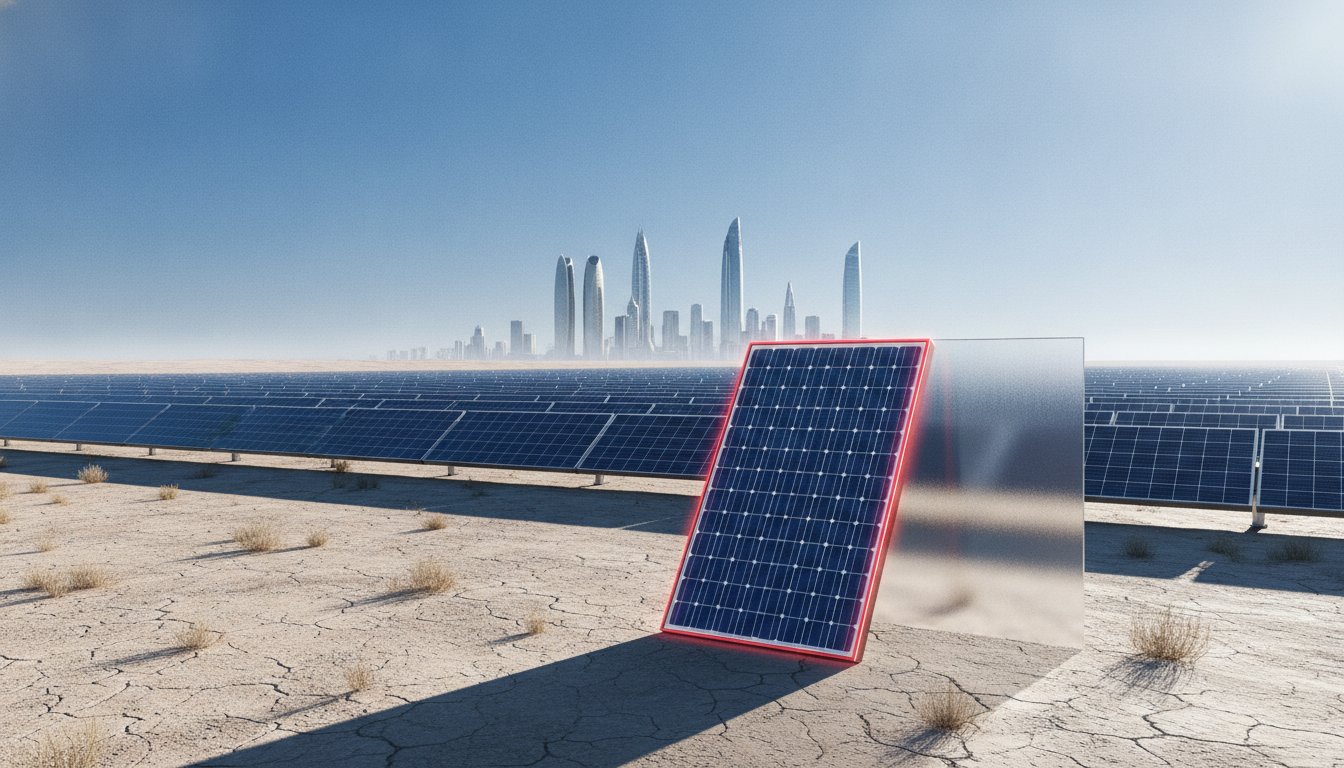
Why does the very source of a solar system's energy often act as its most persistent performance bottleneck? While it's a common assumption that more sunlight always equals more power, the technical reality of solar panel performance in high temperature reveals a far more complex challenge. In extreme climates where ambient heat exceeds 50°C, legacy systems often suffer from significant energy yield loss and accelerated hardware degradation. This "Heat Paradox" means that at the exact moment demand peaks during the summer months, many standard modules are operating well below their rated capacity.
You understand that protecting a long-term investment requires technical precision rather than just generic specifications. This guide clarifies the myth versus the reality of thermal efficiency in 2026, focusing on how HJT technology delivers a superior temperature coefficient of -0.243%/°C to maintain stability in harsh environments. We will analyze the Pmax coefficient, compare HJT against TOPCon and PERC architectures, and provide the data necessary to quantify the ROI of heat-resistant solar infrastructure. By identifying the best cell technology for hot climates, you can ensure your project remains a high-performance asset for decades.
Key Takeaways
- Understand the "Heat Paradox" and how thermal agitation creates a significant gap between laboratory ratings and real-world energy yields in extreme climates.
- Identify why solar panel performance in high temperature depends on the Pmax coefficient and learn how to locate this critical metric on a technical datasheet.
- Differentiate between the myth of peak summer production and the technical reality of higher photovoltaic efficiency during cool, high-irradiance periods.
- Evaluate the structural advantages of HJT architecture and POE encapsulants in preventing long-term hardware degradation in high-UV, high-heat zones.
- Quantify the long-term ROI of selecting modules with a -0.26%/°C temperature coefficient to future-proof large-scale energy infrastructure.
The Heat Paradox: Why Sunlight Powers Panels but Heat Weakens Them
The fundamental contradiction of solar energy lies in the relationship between irradiance and temperature. Photovoltaic cells require high levels of sunlight to generate current, yet that same solar radiation introduces thermal energy that compromises the system's internal physics. This phenomenon is the core challenge of solar panel performance in high temperature. While photons strike the silicon to displace electrons and create flow, excessive heat increases the vibrational energy of the silicon atoms, creating a chaotic environment that hinders efficient electron transport. This thermal agitation essentially turns the panel's power source into its own performance bottleneck.
The Physics of Electron Resistance
Inside the silicon lattice, rising temperatures trigger a measurable increase in internal resistance. As the semiconductor material heats up, electrons become easier to excite but harder to direct. This leads to a significant decrease in Open Circuit Voltage (Voc), which is the maximum voltage a cell can provide when no current is being drawn. Because power is the product of voltage and current, a collapsing voltage curve directly results in a lower total wattage. The thermal stability of a photovoltaic cell is determined by the semiconductor's ability to maintain a consistent bandgap energy as increasing thermal energy attempts to narrow the gap and reduce voltage potential. This loss of solar cell efficiency isn't just a minor fluctuation; it's a structural limitation of legacy silicon technology.
Understanding Standard Test Conditions (STC) vs. Real-World Heat
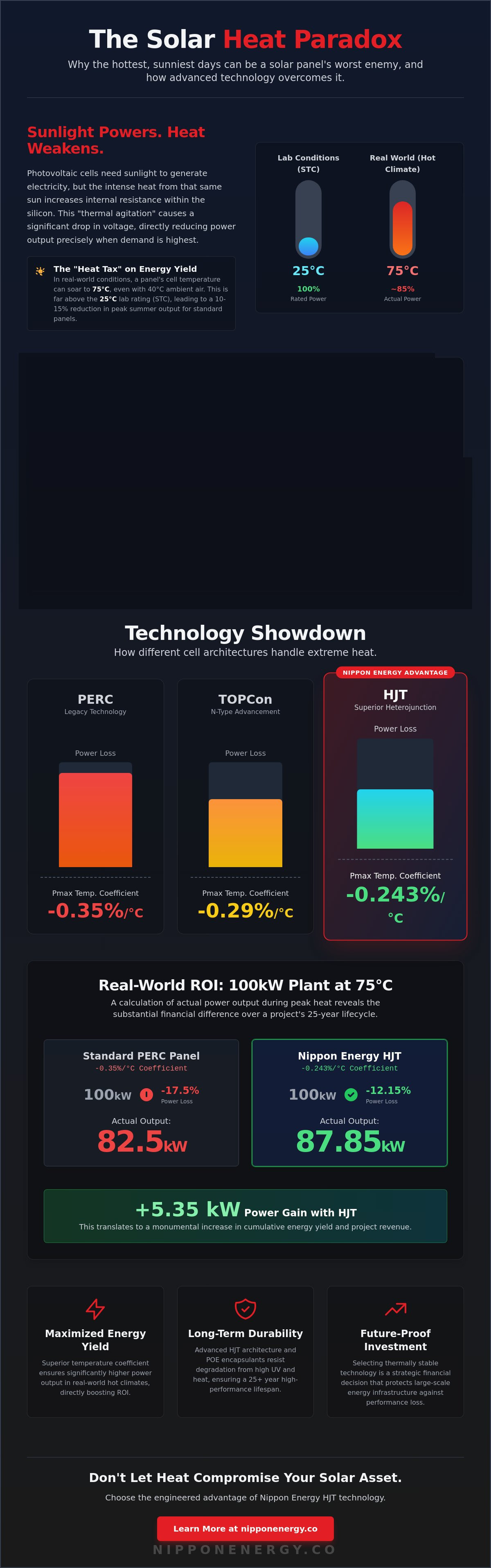
Most solar modules carry a nameplate rating based on Standard Test Conditions (STC), which assumes a cell temperature of 25°C. In practical applications, this benchmark is rarely achieved. Consider a 500W panel installed in an environment with 40°C ambient air. Due to the "solar soak" effect, where the dark surface of the panel absorbs and retains heat, the actual cell temperature can easily reach 70°C or 75°C. This 50-degree discrepancy is why the Nominal Operating Cell Temperature (NOCT) provides a more accurate metric for project planning. Relying solely on STC ratings in desert or tropical climates leads to significant overestimations of system capabilities.
This degradation results in a literal "Heat Tax" on annual energy yield. Standard PERC panels often lose 0.35% to 0.45% of their total power for every degree Celsius above the 25°C threshold. For a commercial array in a high-heat zone, a 10% to 15% reduction in peak summer output is a common reality. These losses accumulate over the 25 year lifecycle of the hardware, directly impacting the project's internal rate of return. Optimizing solar panel performance in high temperature isn't just a technical preference; it's a financial necessity for large scale energy infrastructure.
Decoding Temperature Coefficients: The Metric That Defines ROI
The Pmax Temperature Coefficient is the definitive metric for evaluating solar panel performance in high temperature. Found within the "Thermal Characteristics" section of a technical datasheet, this value quantifies the percentage of power output lost for every degree Celsius the cell temperature rises above the 25°C baseline. While legacy PERC modules often exhibit coefficients as high as -0.45%/°C, premium N-type architectures have reduced this to -0.26%/°C or lower. Understanding how rising temperatures impact solar efficiency is vital for developers because a panel with high nameplate efficiency but a poor temperature coefficient will consistently underperform in desert or tropical environments.
The Math of Thermal Degradation
Calculating actual power loss requires a structured formula: Power Loss (%) = (Cell Operating Temperature - 25) × Pmax Coefficient. Consider a 100kW utility-scale plant in Riyadh during July, where cell temperatures frequently reach 75°C. A standard panel with a -0.45% coefficient loses 22.5% of its capacity, reducing output to 77.5kW. In contrast, a high-performance panel with a -0.26% coefficient loses only 13%, maintaining 87kW. Over a 25-year lifecycle, this 9.5kW delta represents a monumental difference in cumulative energy yield and project ROI. Efficiency is merely a static snapshot of performance in a controlled lab; the temperature coefficient is the dynamic reality of performance in the field.
Material Science: Why Some Silicon Handles Heat Better
The transition from P-type to N-type silicon is the primary driver behind these thermal improvements. P-type silicon is traditionally doped with Boron, which reacts with oxygen to cause Light-Induced Degradation (LID), a process significantly accelerated by heat. N-type silicon utilizes Phosphorus doping, which is inherently immune to Boron-Oxygen defects and provides superior carrier lifetimes. This fundamental shift in material science allows technologies like TOPCon and HJT to maintain structural integrity and voltage stability under extreme thermal stress. For a detailed technical analysis of these competing architectures, you can explore our guide on HJT vs TOPCon: Comparing the Pinnacle of N-Type Solar Technology in 2026.
Selecting the correct cell architecture is the most effective way to future-proof your energy infrastructure against rising global temperatures. You can review the precision engineering of our Nippon HJT Solar Panels to see how low-coefficient modules maximize energy harvest in high-heat zones.
Myth-Busting: "All Solar Panels Perform the Same in the Sun"
A persistent misconception in the renewable energy sector is the assumption that maximum irradiance always translates to peak power production. While high sunlight intensity is the fuel for photovoltaic systems, it's frequently accompanied by thermal loads that compromise the very physics of energy conversion. In reality, optimal solar panel performance in high temperature is often achieved on clear, frigid winter afternoons rather than during mid-summer heatwaves. This occurs because the photovoltaic effect operates with greater precision when the silicon lattice is cool, allowing for higher voltage levels and more efficient electron transport.
Another common myth suggests that active cooling systems, such as water sprays or mechanical fans, are the most effective way to combat thermal loss. These solutions introduce significant mechanical complexity, parasitic power consumption, and ongoing maintenance costs. Relying on advanced cell architecture is a far more stable and cost-effective strategy. High-performance modules are engineered to handle thermal stress at the molecular level, eliminating the need for external cooling hardware that can fail in harsh environments.
HJT vs. PERC: The Thermal Battleground
The structural design of a solar cell determines its resilience under extreme conditions. Traditional PERC (Passivated Emitter and Rear Cell) technology utilizes an asymmetrical architecture that is highly sensitive to temperature fluctuations. When cell temperatures reach 50°C, the internal components of a PERC cell expand at different rates, creating microscopic stress points that hinder current flow. In these environments, PERC systems often experience power retention drops to 80% of their rated capacity.
Heterojunction (HJT) technology provides a superior architectural solution through its symmetrical structure. By sandwiching a crystalline silicon wafer between layers of amorphous silicon, HJT modules distribute thermal energy more evenly across the cell. This balanced design minimizes mechanical stress and maintains high voltage even as the temperature climbs. Consequently, HJT modules typically retain over 90% of their rated power in conditions where legacy systems begin to fail, providing a more reliable energy yield for large-scale infrastructure.
The Longevity Factor: Heat-Induced Degradation
Thermal stress isn't just a daily performance issue; it's a primary driver of long-term hardware failure. Many investors believe that heat only impacts temporary output, but the reality is that high temperatures accelerate permanent degradation. A major threat in hot climates is LeTID (Light and elevated Temperature Induced Degradation). This phenomenon can cause a significant drop in efficiency within the first few years of operation if the cell chemistry isn't specifically treated for thermal resilience. To understand how different N-type technologies compare over a 25-year lifespan, you can examine our analysis on HJT vs TOPCon Degradation: Analyzing Long-Term Reliability in 2026. Selecting heat-resistant architecture is the only way to protect the structural integrity of your energy assets against the cumulative effects of extreme solar exposure.
Engineering for Extreme Heat: Beyond the Cell
Optimizing solar panel performance in high temperature requires a holistic engineering approach that extends far beyond the photovoltaic cell itself. While cell architecture defines the baseline efficiency, the surrounding structural components and power electronics determine whether that efficiency is maintained or lost to environmental stress. In 2026, the industry has moved toward integrated thermal management, where every element of the array, from the chemical composition of the encapsulant to the logic of the inverter, is designed to dissipate heat and mitigate resistance.
System-Level Thermal Management
Passive ventilation remains the most cost-effective method for cooling rooftop and ground-mount arrays. Engineering specifications now prioritize airflow-optimized racking systems that utilize 14mm frame gaps to create a natural chimney effect, pulling heat away from the rear of the module. This structural ventilation can reduce cell temperatures by several degrees, preventing the thermal bottlenecks that trigger system-wide performance drops. To manage the remaining thermal load, the Nippon Smart AI Inverter utilizes string-level monitoring and advanced algorithms to identify specific modules under thermal stress. This intelligent oversight allows the system to dynamically adjust voltage parameters, compensating for the natural voltage decay that occurs during peak thermal hours and ensuring consistent power delivery to the grid.
Encapsulation and Backsheets
The choice of encapsulant is a critical factor in long-term reliability within high-UV and high-heat environments. Standard EVA (Ethylene Vinyl Acetate) often yellows and degrades when exposed to the extreme temperatures of regions like Dubai or Karachi, leading to permanent transmission loss. In contrast, POE (Polyolefin Elastomer) offers superior chemical stability and moisture resistance, providing a secure 30-year lifespan without the risk of acetic acid formation. This material excellence is further enhanced by glass-on-glass module construction, which provides a symmetrical thermal barrier that prevents delamination and optimizes heat dissipation. Glass-on-glass construction ensures that thermal expansion is uniform across the module, maintaining the structural integrity of the internal circuitry under cyclic thermal stress.
Implementing these advanced structural standards is essential for achieving the highest possible energy density in volatile climates. You can explore our full range of thermal-optimized solutions, including the Nippon Smart AI Inverters, to secure your energy infrastructure against climate volatility.
The Nippon HJT Advantage: Engineered for Global Heat Zones
Nippon HJT Solar Panels represent the pinnacle of thermal resilience in the 2026 energy market. With an industry-leading temperature coefficient of -0.26%/°C, these modules are specifically engineered to maintain peak solar panel performance in high temperature environments where standard silicon architectures frequently fail. By minimizing the voltage decay described in previous sections, Nippon Energy ensures that energy density remains consistent throughout the most intense diurnal heat cycles. This technical advantage is further amplified when integrated with NipponHev, creating a holistic energy architecture that balances generation, storage, and thermal management for the world's most demanding climates.
Our Solar Project Development and EPC expertise is particularly valuable in regions like the Middle East and South Asia, where ambient temperatures often exceed 50°C. We don't just supply hardware; we engineer comprehensive systems that account for local albedo, dust accumulation, and extreme thermal loads. This precision engineering translates directly into long-term ROI. Because Nippon HJT modules experience significantly lower annual degradation than legacy PERC systems, they produce a higher volume of "free" energy after the tenth year of operation, maximizing the project's net present value.
Strategic Procurement in 2026
Evaluating a project's Levelized Cost of Energy (LCOE) requires a granular analysis of site-specific meteorological data. In desert environments, the higher initial investment in HJT technology is rapidly offset by the substantial increase in annual energy yield. Nippon HJT panels are the preferred choice for utility-scale desert farms because they maintain structural integrity and power output under conditions that would trigger rapid degradation in lesser modules. For a detailed technical breakdown of capital expenditure versus long-term performance gains, you can review our Nippon HJT Solar Panel Price: A 2026 Procurement and ROI Guide.
Conclusion: Future-Proofing Your Energy Infrastructure
The reality of solar panel performance in high temperature in 2026 is that technology choice is the only sustainable defense against thermal loss. Relying on outdated hardware in an era of rising global temperatures is a strategic risk that compromises the financial viability of energy assets. Professional thermal audits and precision engineering are the essential tools required to future-proof your infrastructure. We invite you to consult with Nippon Energy on your high-temperature solar project to ensure your next installation is built for resilience, longevity, and monumental impact.
Securing Your Energy Future in an Escalating Climate
As global temperatures continue to rise, the technical divide between legacy systems and high-performance architecture becomes a critical factor in project bankability. We've established that the "Heat Paradox" is a structural reality; the thermal agitation of silicon atoms directly compromises voltage and total output. By prioritizing the Pmax coefficient and selecting N-type HJT cells, developers can mitigate the performance bottlenecks that traditionally plague arrays in extreme environments. Optimizing solar panel performance in high temperature is no longer an optional upgrade. It's a fundamental requirement for infrastructure longevity and predictable energy yields.
For readers seeking localized implementation of these standards in tropical regions like Australia, you can learn more about G-Solar & Electrical and their specialized solar energy solutions.
Nippon Energy provides the technical precision needed to excel in these conditions, offering an industry-leading -0.26%/°C temperature coefficient and proven operational success in 50°C+ desert environments. Through our end-to-end EPC services in the Middle East and South Asia, we deliver the structural integrity and engineering oversight required for large-scale success. The transition to heat-resilient energy systems ensures that your assets remain productive for their entire 30-year lifecycle. We invite you to lead the transition toward a more resilient energy future today.
Maximize your solar yield with Nippon HJT Technology
Frequently Asked Questions
Do solar panels work better in hot weather?
Solar panels do not work better in hot weather. While they require solar irradiance to generate power, high temperatures increase the internal resistance of the silicon cells. This thermal agitation reduces the voltage potential, causing a decline in overall energy output. Most systems achieve their highest efficiency on cold, clear days where the photovoltaic effect operates with minimal thermal interference.
What is the best solar panel for high-temperature climates?
Heterojunction (HJT) technology is currently the most resilient choice for extreme climates. These modules utilize a combination of crystalline and amorphous silicon layers, which provides a superior temperature coefficient compared to traditional PERC or TOPCon designs. This structural advantage allows HJT panels to maintain higher power density in environments where ambient temperatures frequently exceed 40°C.
How much efficiency do solar panels lose in the heat?
The rate of loss is dictated by the specific temperature coefficient of the module. Standard legacy panels typically lose between 0.35% and 0.45% of their rated power for every degree Celsius the cell temperature rises above 25°C. In contrast, premium modules like Nippon HJT Solar Panels limit this loss to approximately 0.26% per degree, preserving significantly more energy during peak summer months.
Can solar panels overheat and catch fire?
While high-quality solar panels are engineered to withstand extreme heat, thermal stress can lead to hot spots if cells are shaded or defective. Modern modules utilize bypass diodes and advanced encapsulation to mitigate these risks. Total failure or fire is extremely rare in systems that adhere to current international safety and engineering standards and utilize high-grade materials like POE encapsulants.
What does the temperature coefficient on a solar datasheet mean?
The temperature coefficient is a metric that quantifies how much power output decreases as the panel heats up. It's usually expressed as a negative percentage per degree Celsius. A lower numerical value, such as -0.26% versus -0.45%, indicates a more stable panel that is better equipped to handle the challenges of solar panel performance in high temperature.
Does humidity affect solar panel performance in hot areas?
Humidity impacts performance primarily by reducing the effectiveness of convective cooling. In high-humidity environments, air is less efficient at carrying heat away from the panel surface, leading to higher operating temperatures. Additionally, moisture can accelerate the degradation of standard EVA encapsulants, making the use of POE (Polyolefin Elastomer) essential for maintaining long-term structural integrity.
Are HJT panels worth the extra cost for hot regions like Pakistan or the UAE?
HJT panels provide a superior return on investment in high-heat regions due to their increased annual energy yield. In countries like Pakistan or the UAE, where cell temperatures can reach 75°C, the power retention of HJT technology results in significantly more kilowatt-hours generated per year. This extra production often offsets the initial procurement cost by optimizing solar panel performance in high temperature over the system's lifespan.
How can I cool down my solar panels to improve performance?
Passive cooling through proper system design is the most reliable method for managing thermal loads. Ensuring a minimum gap of 10 to 15cm between the roof and the panels allows for natural airflow to dissipate heat through the chimney effect. You should avoid using water sprays for cooling, as this can lead to mineral deposits, thermal shock, or the unnecessary waste of resources in arid climates.


