
As of May 2026, the solar landscape has undergone a total structural shift; PERC technology now accounts for less than 5% of global production. For industrial leaders facing rising electricity tariffs and grid instability, the transition to bifacial topcon solar panels isn't just an upgrade, it's a strategic necessity for asset protection. You're likely managing operations where traditional modules struggle with high-temperature degradation and limited rooftop space. It's a calculated risk to rely on aging hardware when modern N-type architecture offers significantly higher resilience and efficiency.
We understand that your primary objective is securing a predictable, 30-year energy yield while achieving the lowest possible Levelized Cost of Energy (LCOE). This article demonstrates how bifacial TOPCon technology leverages albedo gain and superior thermal stability to maximize your return on investment. You'll gain a technical overview of current efficiency benchmarks and bifaciality factors. We'll examine why this specific technology represents the most stable, future-proofed foundation for modern energy infrastructure.
Key Takeaways
- Analyze the fundamental shift from PERC to N-type architecture to understand how TOPCon technology eliminates Light Induced Degradation for superior asset longevity.
- Evaluate the structural benefits of dual-glass construction and multi-busbar technology in enhancing moisture resistance and reducing internal electrical resistance.
- Compare the CAPEX and OPEX trade-offs between bifacial topcon solar panels and Heterojunction (HJT) alternatives to identify the most efficient path to a lower LCOE.
- Identify the critical role of the Albedo Effect and mounting height optimization in capturing rear-side energy gain for maximum system yield.
- Explore how the integration of high-power modules with Smart AI Inverters facilitates granular performance tracking and future-proofs energy infrastructure.
The Evolution of N-Type Architecture: Why TOPCon Dominates in 2026
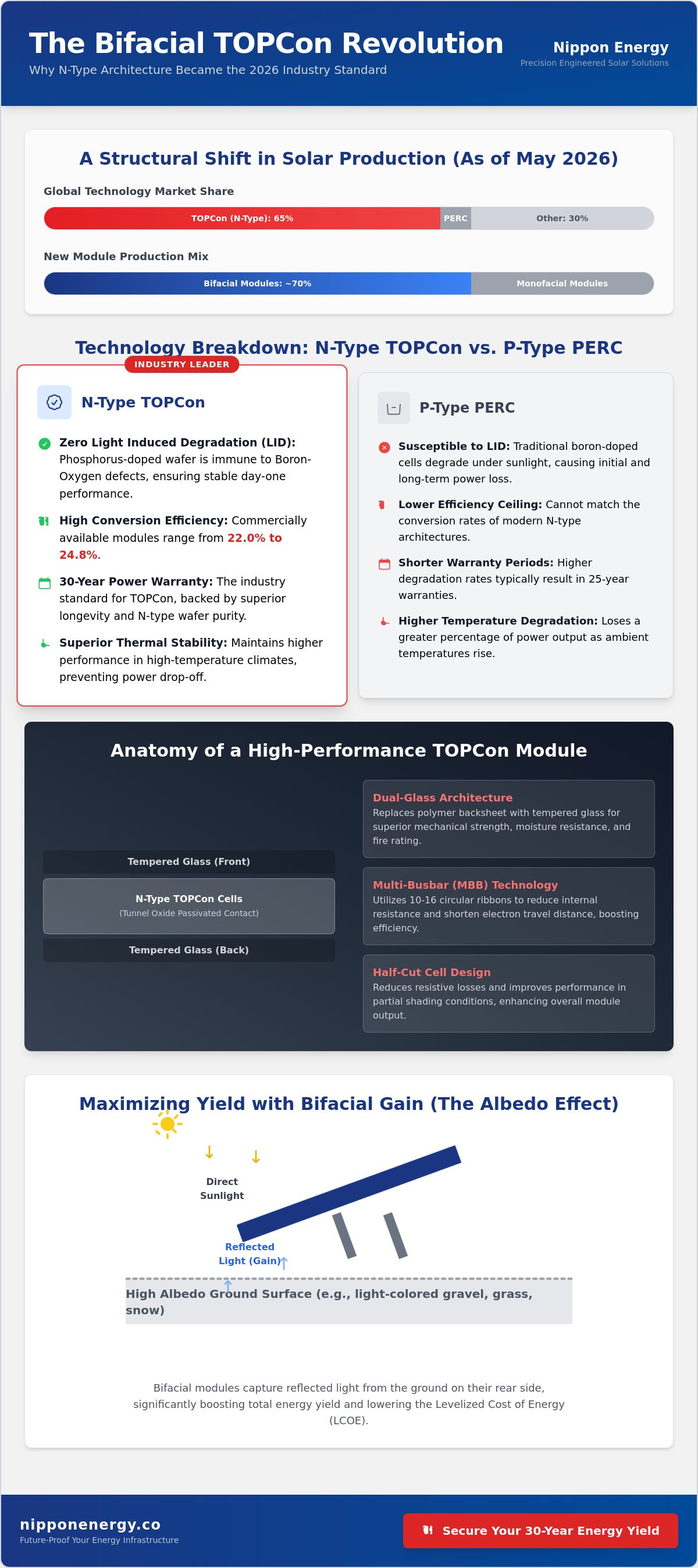
The solar industry's transition from P-type PERC to N-type architectures represents a fundamental pivot toward long-term reliability and higher efficiency. By May 2026, the market has spoken; TOPCon technology now accounts for roughly 65% of global production, while the once-dominant PERC has plummeted to under 5%. This shift isn't merely a trend. It's a technical response to the demand for superior energy density and lower degradation. For commercial and industrial investors, bifacial topcon solar panels have become the default choice, offering a sophisticated balance of high efficiency and cost-effectiveness that P-type modules simply cannot match.
The core advantage of this transition lies in the wafer's chemical composition. Traditional P-type cells are doped with boron, which reacts with oxygen under sunlight to cause Light Induced Degradation (LID). N-type cells utilize phosphorus, effectively eliminating this defect. This fundamental change in N-Type Architecture ensures that the module maintains its rated power from the first hour of operation through decades of service. In high-irradiance regions, monofacial modules have been almost entirely phased out in favor of bifacial designs, which now comprise nearly 70% of new module production worldwide.
The Science of the Tunnel Oxide Layer
The "Tunnel Oxide Passivated Contact" (TOPCon) name refers to a microscopic layer of silicon dioxide followed by a doped polycrystalline silicon layer. This ultra-thin oxide layer acts as a selective barrier. It allows electrons to "tunnel" through to the contacts while significantly reducing carrier recombination. By minimizing these losses, TOPCon cells achieve a higher open-circuit voltage (Voc) than PERC counterparts. In practical terms, this engineering translates to conversion efficiencies for bifacial topcon solar panels ranging from 22.0% to 24.8% in commercially available modules. The electron flow is more streamlined, ensuring that more captured photons are converted into usable electricity rather than lost as heat.
N-Type Wafer Purity and Longevity
Purity is the hallmark of the N-type wafer. Because these cells are resistant to boron-oxygen defects, they exhibit exceptional long-term power stability. This resilience is the reason why the 30-year linear power warranty has become the industry standard for TOPCon modules in 2026. This technology is particularly essential for high-temperature climates such as Pakistan, the UAE, and the southwestern United States. N-type cells maintain higher performance levels as temperatures rise, preventing the steep drop-off in power output common in older PERC systems. When you invest in this architecture, you're securing a system designed for the structural integrity and environmental challenges of the next three decades.
The dominance of TOPCon in 2026 is also driven by its manufacturing scale. It has reached cost parity with older technologies while delivering a 25-40% price premium in value over standard monofacial alternatives. This makes it the most logical choice for utility-scale projects where every fraction of a percentage point in efficiency directly impacts the project's bottom line and the eventual LCOE.
Anatomy of a Bifacial TOPCon Module
The structural integrity of bifacial topcon solar panels relies on a dual-glass architecture that replaces the traditional polymer backsheet with a second layer of tempered glass. This design choice ensures that the module remains impervious to moisture ingress and chemical corrosion, which are common causes of long-term degradation. By encasing the N-type cells between two layers of glass, the module achieves superior mechanical strength and a higher fire rating. This level of protection is vital for maintaining the 30-year operational lifespan expected in modern utility-scale investments.
Multi-busbar (MBB) integration further enhances performance by utilizing 10 to 16 circular ribbons to collect current. These ribbons shorten the distance electrons travel across the cell surface, which reduces internal resistive losses. High-density interconnects minimize the inactive space between cells, improving the overall cell-to-module (CTM) efficiency. This engineering precision allows commercially available modules to reach efficiency ranges between 22.0% and 24.8%. Engineers seeking to optimize these technical parameters often specify Nippon TOPCon Solar Panels for high-performance industrial deployments.
Half-cut cell technology is another critical feature of the TOPCon anatomy. By splitting each cell into two equal parts, the current flowing through each busbar is halved. Because resistive power loss is proportional to the square of the current, this configuration significantly reduces heat generation. It also improves shading tolerance. If the bottom half of a module is shaded, the top half continues to produce power at full capacity. This redundancy is essential for mitigating the impact of dust or structural shadows in complex installation environments.
Bifaciality Factor Explained
The bifaciality factor represents the ratio of rear-side efficiency to front-side efficiency. For bifacial topcon solar panels, this factor typically ranges from 80% to 88%. While Heterojunction (HJT) panels can reach 90%, TOPCon remains more cost-effective for large-scale applications. The symmetrical cell design of TOPCon architecture also ensures even stress distribution across the wafer. This symmetry reduces the likelihood of micro-cracks during thermal expansion and contraction cycles, preserving the electrical pathways over decades of exposure.
Thermal Stability and Temperature Coefficient
Thermal performance is where N-type technology truly diverges from older P-type standards. TOPCon modules feature a temperature coefficient of -0.29%/°C. As ambient temperatures rise, the power output of these modules declines at a much slower rate than PERC alternatives. This stability is a direct result of The Evolution of N-Type Architecture, which prioritizes material purity to maintain high open-circuit voltage. In arid regions like the UAE or Pakistan, this thermal resilience prevents the "heat island" effect and ensures peak energy yield during the hottest summer months.
Bifacial TOPCon vs. HJT: A Performance Comparison
Choosing between N-type architectures requires a granular analysis of upfront capital expenditure (CAPEX) against long-term operational returns. As of early 2026, bifacial topcon solar panels represent the optimal intersection of manufacturing maturity and high-performance output. While Heterojunction (HJT) technology offers a marginal efficiency lead, TOPCon's 65% global production share ensures a more stable supply chain and lower procurement costs. This scale allows TOPCon to reach cost parity with legacy systems while delivering significantly higher energy density.
The primary debate involves bifacial gain potential. HJT modules often achieve a bifaciality factor of 90% or higher. In contrast, TOPCon modules typically range between 80% and 88%. This gap in rear-side absorption can be significant in specific ground-mounted scenarios with high reflectivity. However, the price premium for HJT modules, which were priced at approximately RMB 0.750/W in February 2026 compared to RMB 0.715/W for TOPCon, often offsets these gains for standard commercial installations. TOPCon's ability to utilize existing PERC manufacturing lines has accelerated its adoption, making it the more accessible choice for rapid infrastructure scaling.
Performance in low-light conditions is a shared strength of N-type technologies. Both architectures excel at absorbing diffuse radiation during overcast days or early morning hours. This capability ensures a smoother power curve and more predictable daily yields. For developers, the decision often hinges on whether the slight bifaciality advantage of HJT justifies the higher CAPEX in a market where TOPCon has already achieved dominant industrial scale.
Efficiency Benchmarks in 2026
In 2026, commercial efficiency for TOPCon typically sits between 22.5% and 23.5%, while HJT ranges from 23.5% to 24.5%. First-year degradation for both is exceptionally low, usually under 1%, followed by an annual linear decline of approximately 0.4% over 30 years. This stability is a massive improvement over older P-type cells. For a detailed technical breakdown of these metrics, you can review the Nippon HJT vs TOPCon comparison to determine which technology aligns with your specific site conditions.
Regional Suitability: South Asia and Middle East
In high-temperature environments like South Asia and the Middle East, thermal stability dictates the return on investment. While HJT has a slightly better temperature coefficient, TOPCon's -0.29%/°C rating provides excellent resilience in arid regions. For a 1MW industrial installation, TOPCon often yields a faster payback period due to lower initial equipment costs. Furthermore, the secondary market value for N-type assets is projected to remain high through 2030, as these modules are built on the same N-type architecture that is currently setting the global standard for energy infrastructure.
Engineering for Maximum Bifacial Gain
Maximizing the energy yield of bifacial topcon solar panels requires more than just high-efficiency hardware; it demands precise site engineering. While the front side captures direct irradiance, the rear side relies on Ground-Reflected Irradiance (GRI). This secondary energy source is dictated by the Albedo Effect, which measures the reflectivity of the surface beneath the array. If you install these modules on a dark, non-reflective surface, you're essentially leaving a significant portion of your potential energy yield on the table. Proper planning ensures that your energy infrastructure is optimized for the highest possible bifacial boost.
Surface selection is the most critical variable in determining rear-side generation. For commercial rooftop applications, utilizing Thermoplastic Polyolefin (TPO) or white-painted surfaces can dramatically increase reflectivity. In ground-mounted utility projects, light-colored gravel or sand provides the necessary environment for high-gain performance. It's a technical calculation that transforms a standard installation into a high-performance asset. Raising the modules is equally important. Research indicates that 1.0 meter is the "sweet spot" for mounting height. This elevation allows more diffuse light to circulate and reach the rear side, whereas low-profile mounting creates shadows and limits the albedo effect.
Engineers must also ensure that mounting rails don't obstruct the rear-side cells. Even minor shading on the back can disrupt the electrical balance of the entire string, leading to hot spots or reduced efficiency. Pitch and tilt angles must be calculated to maximize GRI without causing inter-row shading. This level of precision is why bifacial topcon solar panels are often paired with single-axis trackers in large-scale solar farms to maintain the optimal angle to the sun throughout the day.
Surface Reflectivity (Albedo) Cheat Sheet
To calculate your expected "Bifacial Boost," you must first identify the reflectivity of your installation surface. According to verified industry data, ground-mounted systems over highly reflective surfaces see gains of 15% to 30%. In contrast, typical residential rooftop installations on dark surfaces see a more modest 3% to 7% improvement. Use these standard reflectivity values for your initial yield projections:
- White Gravel or TPO Membrane: 60% to 80% reflectivity
- Dry Concrete or Light Soil: 20% to 30% reflectivity
- Green Grass or Vegetation: 10% to 25% reflectivity
- Dark Asphalt or Bitumen: 5% to 10% reflectivity
EPC and Racking Requirements
Project success depends on selecting a partner who understands these granular requirements. Your choice of racking must account for bifaciality to ensure structural integrity and yield. This level of technical oversight is a core component of professional solar EPC services. Maintenance protocols also shift in these environments; keeping the rear side free of dust and debris is just as important as front-side cleaning to maintain peak performance. Consult with our project development team to optimize your site's albedo profile for maximum ROI.
Nippon TOPCon Solutions: Precision Engineering for Global Markets
Nippon Energy's high-performance bifacial topcon solar panels are engineered to exceed standard commercial benchmarks. Our current product lineup features power ratings from 580W to over 630W, utilizing 210mm large-area wafers and high-density interconnects to maximize energy density. Unlike generic alternatives, these modules are designed to integrate seamlessly with Nippon Smart AI Inverters. This integration allows for granular performance tracking at the string level, ensuring that any deviation in yield is identified and addressed immediately. The result is a synchronized system that prioritizes reliability and long-term output across your entire energy portfolio.
We adhere to the Japanese Quality Standard throughout our manufacturing process. Every module undergoes rigorous electroluminescence (EL) testing and thermal cycling to ensure structural integrity before it leaves the facility. Our commitment extends beyond the hardware. We provide a full lifecycle of professional support, beginning with detailed feasibility studies and continuing through decades of solar system maintenance. This comprehensive approach ensures that your energy infrastructure remains a high-yielding asset for its entire 30-year operational life. It's about building systems that don't just work today, but lead the industry for decades.
Tier 1 Supply Chain and Reliability
Nippon Energy maintains a Tier 1 supply chain, prioritizing ethically sourced materials and sustainable manufacturing practices. Our bifacial topcon solar panels carry prestigious third-party certifications from organizations like TÜV SÜD and PVEL, validating their resilience against potential-induced degradation (PID) and mechanical stress. Our reliability testing results consistently place our modules in the top tier for performance in extreme environmental conditions. With a robust global logistics network, we provide localized technical support and rapid equipment deployment in key industrial hubs including Karachi, Dubai, and Riyadh.
Next Steps for Commercial Solar Procurement
Transitioning to N-type architecture in 2026 requires a partner capable of precise ROI modeling and technical simulation. Our engineers provide site-specific bifacial gain simulations to help you visualize the impact of albedo and mounting height on your specific project. We offer various procurement structures and ROI modeling tailored for industrial solar projects to facilitate a smooth transition to modern energy standards. To begin your infrastructure upgrade, Consult with Nippon Energy Experts for your TOPCon Project and secure your long-term energy independence with the global leader in N-type technology.
Future-Proofing Your Energy Infrastructure
The transition to N-type architecture represents a permanent shift in global energy standards. By prioritizing material purity and thermal stability, bifacial topcon solar panels provide a resilient solution for high-temperature industrial environments. You've seen how precise engineering, from the tunnel oxide layer to strategic albedo optimization, creates a measurable impact on long-term energy yield. It's no longer just about generating power; it's about architecting a system that maintains peak efficiency through decades of environmental stress. Selecting a partner who combines technical authority with a Tier 1 supply chain is the final step in securing your investment's durability.
Nippon Energy remains committed to this standard of excellence. Our Japanese-engineered N-type cells and 30-year performance warranty ensure that your infrastructure delivers consistent results well into the mid-century. With the potential for up to a 25% bifacial energy boost, these systems are designed to maximize every square meter of your facility. When paired with our Smart AI Inverters, your project gains the granular oversight necessary for modern asset management. We invite you to Explore Nippon TOPCon Solar Panel Specifications and begin the process of architecting a more profitable, stable energy future.
Frequently Asked Questions
What is the typical bifacial gain for TOPCon solar panels?
The typical energy gain for bifacial topcon solar panels ranges from 5% to 30% depending on the site's albedo. Ground-mounted systems installed over highly reflective surfaces, such as white gravel or sand, see the highest gains between 15% and 30%. Standard residential rooftop installations usually see a more modest improvement of 3% to 7% because of lower mounting heights and darker surfaces.
Can I install bifacial TOPCon panels on a flat roof?
You can install bifacial modules on flat roofs provided you optimize the surface reflectivity and mounting height. Utilizing a white TPO membrane or light-colored roof coating significantly increases the albedo effect. To achieve maximum yield, engineers recommend a mounting height of at least 1.0 meter to allow reflected light to reach the rear side of the module without obstruction.
How does TOPCon technology differ from standard PERC panels?
TOPCon technology utilizes N-type silicon wafers which are fundamentally resistant to Light Induced Degradation (LID). Standard PERC panels use P-type wafers that are prone to boron-oxygen defects, leading to higher power loss over time. TOPCon modules also feature an ultra-thin tunnel oxide layer that reduces electron recombination, resulting in higher conversion efficiencies and better performance in low-light conditions.
Are bifacial TOPCon panels more expensive than monofacial ones?
Bifacial TOPCon modules generally carry a price premium of 25% to 40% compared to legacy monofacial PERC panels. This higher upfront capital expenditure is offset by the significantly lower Levelized Cost of Energy (LCOE) achieved through higher energy yields and a longer 30-year lifespan. For most commercial and industrial projects, the increased return on investment justifies the initial cost difference.
What is the expected lifespan of a Nippon TOPCon module?
A Nippon TOPCon module is engineered for a 30-year operational lifespan, backed by a comprehensive linear power warranty. Because these panels utilize N-type architecture, they exhibit extremely low annual degradation rates of approximately 0.4%. This longevity ensures that your energy infrastructure remains a productive asset for three decades, providing stable and predictable power generation throughout its service life.
Do bifacial panels work on cloudy days?
Bifacial panels remain highly productive on cloudy days by capturing diffuse radiation from both the front and rear sides. N-type TOPCon cells are particularly efficient at converting low-intensity light into electricity. While direct sunlight provides peak output, the ability to absorb reflected and scattered light ensures a more consistent energy yield throughout the year, even in overcast or humid conditions.
Is N-type TOPCon better than HJT for high-temperature climates?
Both technologies excel in high-temperature climates, but they offer different value propositions. HJT has a slightly superior temperature coefficient, yet bifacial topcon solar panels provide a more balanced profile of high efficiency and manufacturing scale. For large-scale projects in arid regions like the UAE or Pakistan, TOPCon often delivers a faster payback period while maintaining excellent thermal stability at -0.29%/°C.
What maintenance is required for bifacial solar modules?
Maintenance for bifacial modules is similar to monofacial systems but requires attention to both sides of the glass. Regular cleaning of the front surface is essential, and the rear side should be checked periodically for dust accumulation or debris. Ensuring the ground surface remains reflective and free of vegetation is also a critical part of maximizing the long-term energy yield.


