

Paying a premium for solar hardware today is the most effective strategy to ensure your energy infrastructure actually pays you back tomorrow. You've likely watched electricity tariffs climb while standard panels lose significant efficiency during the 45°C summers in Lahore or Multan. It's a common frustration to invest in technology that underperforms exactly when your cooling demand peaks. When calculating ROI for HJT solar panels in Pakistan, the upfront cost per watt is merely a single data point in a much larger engineering equation.
This analysis provides a precise financial framework for Heterojunction technology, showing how its superior thermal coefficient and low degradation rates offset the 10% GST and the new five year net metering buyback period. You'll master the metrics required to determine your exact payback period and long-term yield. We'll provide a clear mathematical justification for HJT investment, compare it against TOPCon alternatives; and demonstrate how this hardware reduces your Levelized Cost of Energy to secure total energy independence.
Key Takeaways
- Master the engineering-grade methodology for calculating ROI for HJT solar panels in Pakistan, factoring in the 10% GST and updated 2026 NEPRA net metering cycles.
- Quantify the thermal resilience of Nippon HJT panels; these modules utilize a -0.26%/°C temperature coefficient to mitigate efficiency drops in extreme summer climates.
- Analyze how bifacial cell technology leverages light reflection from standard Pakistani roof surfaces to significantly accelerate your investment's payback period.
- Assess the synergy between high-performance hardware and Nippon Smart AI Inverters to achieve a lower Levelized Cost of Energy through predictive yield optimization.
- Determine the strategic value of integrating lithium-ion storage to transition toward total energy independence and intelligent peak-load management.
The Economic Case for HJT Solar Technology in Pakistan's 2026 Energy Landscape
HJT represents the fusion of crystalline silicon and thin-film technologies; creating a high-efficiency architecture that excels in thermal stability. This Heterojunction solar cell technology minimizes the energy losses typical of traditional P-type modules by combining the best attributes of two different materials into a single cell structure. In 2026, Pakistan's energy landscape is defined by aggressive grid tariff hikes and a decisive shift toward distributed generation. Standard solar panels often fail to meet long-term financial expectations because they degrade too quickly under the intense UV and heat loads of Sindh and Punjab.
True financial performance isn't measured by the initial purchase price alone. It's determined by the Levelized Cost of Energy (LCOE). LCOE accounts for the total cost of building and operating a system over its entire lifecycle relative to the total energy it generates. For commercial and residential investors, calculating ROI for HJT solar panels in Pakistan requires shifting focus from upfront capital expenditure to the cost per kilowatt-hour produced over 25 years. This shift is essential as grid electricity prices continue to fluctuate, making self-generation the only stable hedge against inflation.
Understanding the HJT Efficiency Premium
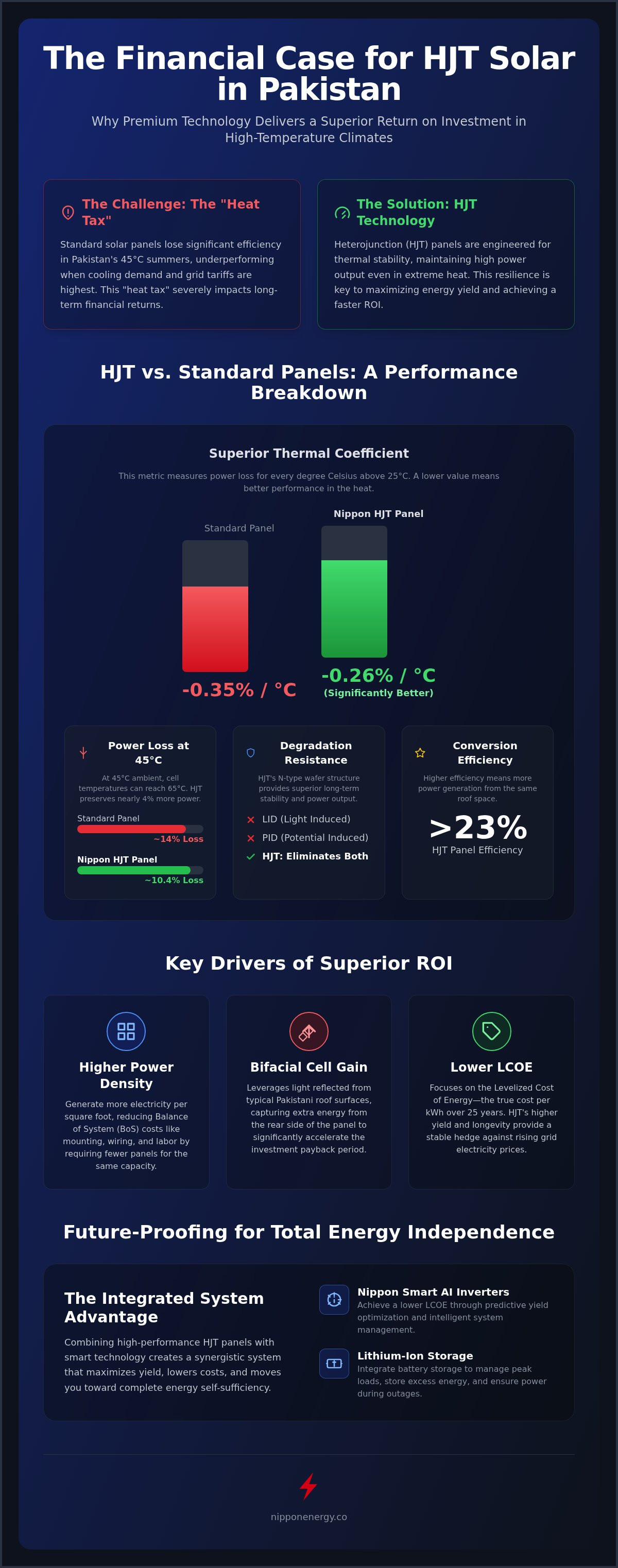
Nippon HJT Solar Panels utilize high-purity N-type wafers that eliminate Light Induced Degradation (LID) and Potential Induced Degradation (PID). This structural integrity allows for conversion efficiencies exceeding 23%, which generates significantly more units of electricity per square foot of installation space. When comparing roof space utilization, HJT modules produce higher power density than legacy PERC modules, which often struggle with efficiency drops after just a few years of operation. This efficiency reduces the balance of system costs; fewer panels are required to achieve the same nameplate capacity, which lowers mounting, wiring, and labor expenses during the installation phase.
Why ROI Calculation Must Be Region-Specific
Pakistan's high solar irradiance provides a massive generation potential that standard hardware cannot fully capture due to heat-related resistance. While standard panels suffer in the summer months, HJT's architecture maintains high output even when ambient temperatures exceed 40°C. The 2026 NEPRA net metering regulations, which feature a five year buyback cycle, place a premium on maximizing daytime generation for export. Calculating ROI for HJT solar panels in Pakistan must account for these localized variables to ensure the math reflects real-world performance rather than theoretical laboratory conditions. HJT ROI is the ultimate measure of long-term energy security through resilient, high-yield infrastructure.
Technical Drivers of ROI: Why HJT Outperforms in High Temperatures
Thermal resistance is the silent architect of solar profitability. While nameplate capacity provides a baseline, the actual energy yield in Pakistan’s extreme climate is dictated by a module's temperature coefficient. Standard solar panels typically carry a coefficient of -0.35%/°C, meaning they lose significant power for every degree above the standard test condition of 25°C. In contrast, HJT technology operates with a superior coefficient of -0.26%/°C. When calculating ROI for HJT solar panels in Pakistan, this 0.09% difference represents a critical advantage during the peak summer months when cooling demand and electricity tariffs are at their highest.
The "Heat Tax" in regions like Sindh and Punjab is substantial. If ambient temperatures reach 45°C, internal cell temperatures often climb to 65°C or higher. For a standard panel, this 40-degree delta results in a 14% drop in power output. Nippon HJT Solar Panels limit this loss to approximately 10.4%, preserving nearly 4% more of the system's rated capacity. This consistent generation during peak sunlight hours ensures that commercial entities can service solar debt faster by maximizing self-consumption and reducing reliance on high-tier grid energy. As Pakistan's renewable energy market continues to mature, investors are prioritizing hardware that maintains performance under such thermal stress.
The Thermal Advantage in Karachi and Lahore
Operational data shows that HJT performs exceptionally well in both the high-humidity environment of Karachi and the arid heat of Lahore. High humidity can often lead to "power clipping" where standard inverters struggle with the erratic voltage of overheating panels. Nippon HJT Solar Panels maintain a stable voltage profile, which mitigates clipping and provides a 3-5% higher summer yield compared to legacy P-type technologies. This incremental gain directly accelerates the payback period by generating more bill-offsetting units when they are most valuable. You can explore how Nippon HJT Solar Panels optimize these specific variables for localized engineering projects.
Low Degradation and the 25-Year Revenue Stream
Beyond immediate thermal performance, the long-term revenue stream is dictated by degradation rates. HJT modules feature an N-type architecture that is inherently immune to Light Induced Degradation. While TOPCon panels often degrade at 0.5% annually, HJT maintains a superior 0.25% rate. Over a 30-year lifecycle, this results in a cumulative energy gain that significantly lowers the Levelized Cost of Energy. Calculating ROI for HJT solar panels in Pakistan must include this 25-year performance tail; lower degradation reduces the risk profile for investors by ensuring the system remains a high-yielding asset well into its third decade.
Key Variables in the ROI Equation: Net Metering and Bifacial Yield
The financial viability of a solar project in 2026 is heavily influenced by the regulatory framework established by NEPRA. Recent policy shifts have reduced the net metering buyback agreement period from seven years to five years; a change that places a premium on immediate generation density. When calculating ROI for HJT solar panels in Pakistan, investors must recognize that a shorter buyback window necessitates hardware that can export more units during the early years of the contract. HJT's high efficiency ensures that every hour of peak sunlight is converted into maximum grid credit, effectively neutralizing the impact of a compressed policy timeline.
Bifaciality serves as a significant, often overlooked, ROI booster in the Pakistani context. Most industrial and residential structures in the region feature flat, light-colored concrete roofs that possess high albedo values. Nippon HJT Solar Panels are engineered with a dual-glass structure that allows the rear side of the cells to capture light reflected from these surfaces. This bifacial gain typically ranges between 10% and 20% depending on the installation environment. By harvesting energy from both sides of the module, the system generates more kilowatt-hours without increasing the physical footprint of the array.
However, the "Soiling Tax" remains a persistent challenge for performance architecture. In arid cities such as Multan or Faisalabad, dust accumulation can degrade output by as much as 30% if left unmanaged. Professional upkeep is not merely a service; it's a financial requirement to preserve the transparency needed for bifacial cells to function. Consistent maintenance ensures that the rear-side irradiance is not blocked by debris, maintaining the integrity of your yield projections over the system's life.
Maximizing Bifacial Gain in Industrial Applications
To extract the highest yield from HJT systems, mounting heights must be optimized to allow reflected light to reach the rear of the modules. Proper elevation increases the diffuse light capture, which can add several percentage points to the annual energy production. Implementing a rigorous schedule for solar system maintenance is vital to prevent the gradual erosion of these gains. The albedo effect, derived from the reflective properties of light-colored industrial surfaces, serves as a passive multiplier for rear-side energy harvest, directly shortening the payback timeline.
Policy Risks and Mitigation Strategies
If net metering rates are revised downward in the future, the most resilient strategy is to pivot toward a self-consumption model. High-efficiency hardware ensures that your facility relies less on the grid during expensive peak hours. Utilizing smart ai solar inverters allows for intelligent energy orchestration; these systems manage grid export versus local use in real-time based on current tariff structures. This level of control is essential when calculating ROI for HJT solar panels in Pakistan, as it allows owners to hedge against future regulatory volatility by prioritizing high-value local consumption.
Step-by-Step Guide to Calculating Your HJT Solar Investment Return
Quantifying the financial performance of a high-tech energy asset requires a rigorous, multi-variable approach. Calculating ROI for HJT solar panels in Pakistan differs from standard calculations because the technology’s resilience directly counters the country's aggressive 10-15% annual electricity price inflation. To determine the precise fiscal impact, investors must move beyond simple cost-per-watt metrics and analyze the total system lifecycle through five technical stages.
- Step 1: Determine Total System CAPEX. This includes the procurement of Nippon HJT Solar Panels, Nippon Smart AI Inverters, and the professional engineering costs associated with Nippon EPC services.
- Step 2: Estimate Annual Energy Production (AEP). Utilize localized irradiation data for your specific city; most regions in Pakistan receive between 5.0 and 6.0 kWh/m2/day.
- Step 3: Factor in Electricity Price Inflation. Historical data in Pakistan suggests a baseline inflation rate of 10-15%. This compounding factor significantly increases the value of every unit generated over time.
- Step 4: Subtract Annual OPEX. Deduct the costs for system monitoring and professional maintenance to ensure the bifacial transparency and thermal efficiency remain at peak levels.
- Step 5: Calculate NPV and IRR. Use Net Present Value and Internal Rate of Return to compare the solar investment against other corporate capital allocations.
The Math of Payback Periods
While the "Simple Payback" method merely divides the initial cost by annual savings, the "Discounted Payback" method is more accurate. It accounts for the time value of money and the escalating cost of grid power. Despite a higher initial CAPEX, HJT systems in Pakistan typically achieve full payback within 3-4 years. For a 100kW commercial installation, the combination of HJT’s 23% efficiency and the high local irradiance generates a surplus of units that offsets the initial premium much faster than legacy P-type systems. This accelerated return is a direct result of the technology's ability to maintain high output during peak tariff hours.
Factoring in Financing and Incentives
Corporate adopters can leverage tax benefits and accelerated depreciation allowances to further enhance their return profile. Local bank interest rates for renewable energy projects often provide favorable terms that reduce the liquidity pressure on the business. By utilizing the NipponHev system, owners can bundle hardware, storage, and intelligent management into a single, bankable asset. This integrated approach simplifies the financing process and ensures that all components are optimized for maximum yield. You can consult with our engineering team to receive a customized ROI projection tailored to your facility's specific load profile.
Future-Proofing Your Investment with Nippon HJT and Integrated Systems
The integration of lithium ion battery storage transforms the financial profile of a solar asset by enabling intelligent peak-shaving. In the context of Pakistan's fluctuating grid stability, the ability to store excess daytime generation for use during high-tariff evening hours significantly enhances the net present value of the system. This storage capacity mitigates the impact of the five year net metering buyback cycle by prioritizing self-consumption over low-value grid export. When calculating ROI for HJT solar panels in Pakistan, the inclusion of storage shifts the narrative from simple bill reduction to total energy autonomy.
Nippon Smart AI Inverters complement this high-performance hardware by providing a layer of intelligence that automates yield optimization. These systems utilize machine learning to predict weather patterns and local load requirements; ensuring that energy is dispatched with maximum efficiency. Predictive maintenance algorithms identify technical anomalies before they lead to system downtime, which preserves the 25-year revenue stream. Nippon’s adherence to Japanese engineering standards ensures that every component is built for extreme durability. This technical precision reduces the long-term risk profile for industrial stakeholders, making HJT the most resilient choice for the country's high-temperature environment.
The Synergy of HJT and Storage
Calculating ROI for off-grid HJT systems focuses on the total elimination of diesel generator costs, whereas hybrid systems balance grid interaction with localized storage to minimize peak-hour expenses. Nippon Lithium-ion systems utilize advanced cell chemistry to extend the operational life of the total energy architecture, providing a stable voltage environment that reduces stress on the inverter. Integrated EPC services are vital to ensuring that HJT panels, storage, and AI components are synchronized for peak performance across the entire system lifecycle. This holistic approach ensures that the calculating ROI for HJT solar panels in Pakistan accounts for the longevity of the entire system rather than just the panels.
Nippon Energy’s Commitment to Pakistan
Nippon Energy maintains a robust operational presence with EPC capabilities spanning Karachi, Lahore, and Islamabad. This localized expertise ensures that every installation is engineered to withstand the specific environmental variables of each region, from coastal humidity to arid heat. Our local monitoring services provide real-time data transparency, protecting your investment ROI through 2030 and beyond. HJT remains the strategic choice for a high-temperature, high-cost energy future where efficiency and durability are the primary drivers of wealth. Consult with Nippon Energy for a custom ROI analysis to secure your facility's financial and energy independence today.
Securing Your Energy Infrastructure for the Next Decade
Investing in HJT technology is a strategic decision that prioritizes long-term yield over short-term savings. You've seen how a superior temperature coefficient and bifacial gain directly accelerate payback periods, even within Pakistan's evolving net metering landscape. By calculating ROI for HJT solar panels in Pakistan with an eye toward Levelized Cost of Energy, you ensure your capital is allocated to an asset that resists the degradation common in standard modules. This engineering-first approach transforms solar from a simple utility into a high-performance financial vehicle.
Nippon Energy brings Japanese engineering standards and Tier-1 HJT technology with 30-year performance insurance to every project. Our local EPC presence in Karachi and Lahore ensures that your system is optimized for regional irradiance and thermal loads. It's time to move beyond generic estimates and ground your energy future in technical precision. Request a Detailed HJT ROI Feasibility Study for Your Project to determine the exact performance architecture required for your facility. Achieving energy independence is a monumental milestone, and the right hardware makes it inevitable.
Frequently Asked Questions
Why is HJT better for Pakistan's climate than standard TOPCon panels?
HJT technology provides a superior temperature coefficient of -0.26%/°C; while standard TOPCon panels typically range around -0.30%/°C or higher. This technical advantage allows HJT to maintain higher voltage and power output during the intense 45°C summer peaks in Pakistan. Because TOPCon suffers more from thermal degradation, HJT delivers a more consistent energy yield throughout the year. This makes it the more resilient choice for local climate extremes where peak demand aligns with peak heat.
What is the typical payback period for a commercial HJT solar system in Pakistan?
Most commercial HJT systems in Pakistan achieve a full payback within 3 to 4 years despite the higher initial capital expenditure. This accelerated return is driven by the technology's high power density and its ability to generate significant energy during high-tariff peak hours. When calculating ROI for HJT solar panels in Pakistan, the combination of high irradiance and rising grid costs ensures that the efficiency premium pays for itself much faster than legacy technologies.
Does HJT technology require more maintenance than traditional solar panels?
HJT technology doesn't require more mechanical maintenance than traditional panels, but it demands consistent cleaning to preserve its bifacial gains. Because HJT captures light from both sides, dust accumulation on the rear glass can impede the secondary energy harvest. Regular cleaning ensures the dual-glass structure remains transparent; which is essential for maintaining the high-yield performance projected in your initial financial analysis. This preventative care protects the integrity of your long-term energy architecture.
How do high temperatures in cities like Multan affect solar ROI?
High ambient temperatures in cities like Multan create a "heat tax" that reduces the energy output of standard solar hardware by up to 15%. This loss directly extends the payback period and lowers the overall return on investment. HJT panels mitigate this effect through their advanced cell architecture; which maintains structural efficiency at higher temperatures. This resilience ensures that your ROI remains stable even during the most severe heatwaves, securing your energy yields when they're most critical.
Can I use HJT panels with existing net metering setups in Pakistan?
You can integrate HJT panels with any existing net metering setup in Pakistan, provided the inverter is compatible with the system's high-current output. HJT modules are fully compliant with NEPRA's technical standards and function seamlessly within the current regulatory framework. Upgrading to HJT allows you to export more units to the grid within your existing agreement. This maximizes the financial value of your net metering contract without requiring you to expand your physical installation footprint.
What is the warranty period for Nippon HJT Solar Panels in 2026?
Nippon HJT Solar Panels are backed by a 30-year performance insurance policy that guarantees long-term energy production. This extensive coverage reflects the durability of the N-type cell architecture and the dual-glass design; which protects the system against environmental degradation. This long-term commitment reduces the financial risk for investors and provides a stable foundation for calculating ROI for HJT solar panels in Pakistan. It ensures that the system remains a productive asset well into the 2050s.
How does the bifacial gain of HJT panels impact the total energy yield?
The bifacial gain of HJT panels typically adds a 10% to 20% boost to the total annual energy yield. By capturing reflected light from the roof surface, the rear side of the panel generates additional power without requiring more sunlight. This extra generation is a performance multiplier that significantly lowers the Levelized Cost of Energy (LCOE) and shortens the time required to reach your break-even point. It effectively turns your roof surface into an active participant in energy generation.
Is it worth investing in HJT if electricity prices stabilize?
Investing in HJT remains financially sound even if electricity prices stabilize because the primary value lies in high efficiency and low degradation. A stable price environment still rewards systems that produce the maximum number of units per square foot of space. HJT's 0.25% annual degradation rate ensures that your system remains a high-yielding asset for 30 years. This provides a permanent hedge against future volatility and ensures your facility maintains a competitive operational cost structure.


