
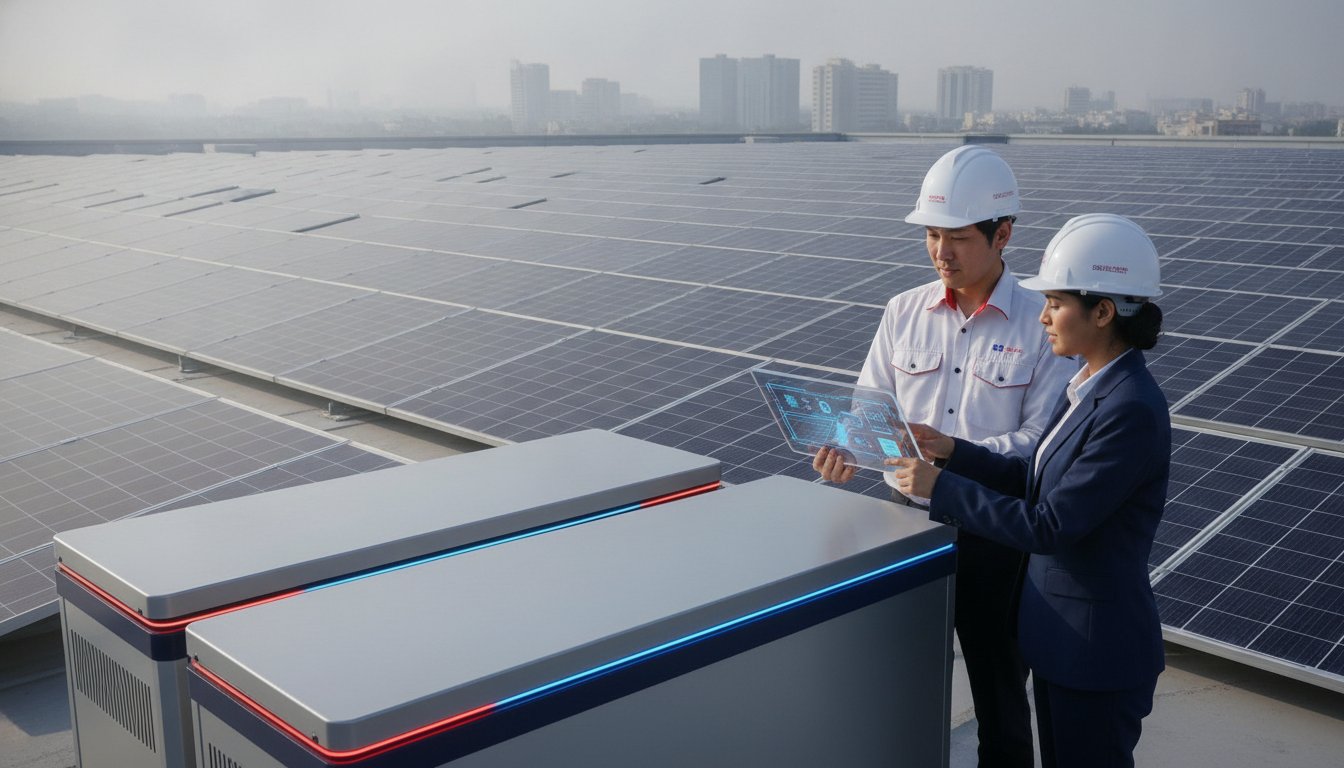
While distributed solar capacity in Pakistan surged to 38 gigawatts by late 2025, many commercial enterprises still struggle with grid tariffs reaching as high as Rs. 60 per unit. The transition to the Prosumer Regulations 2026 has fundamentally altered the economic landscape, shifting the focus from simple export credits to sophisticated self-consumption. You've likely noticed that standard panels often fail under extreme thermal stress, leading to a higher commercial solar lcoe pakistan than originally projected. This reality is frequently exacerbated by substandard EPC quality and unpredictable LNG fuel shocks that compromise long-term energy security.
We provide the technical precision required to master these economic variables and maximize your lifetime ROI. You'll learn how to leverage HJT and TOPCon technologies to counteract high-temperature degradation while reducing annual OpEx through rigorous engineering standards. This analysis moves from macro-level regulatory shifts to granular hardware specifications; it offers a clear blueprint for achieving the lowest possible levelized cost in the current market environment.
Key Takeaways
- Understand why Levelized Cost of Energy (LCOE) has become the definitive metric for evaluating solar profitability under Pakistan's 2026 net-billing regulations.
- Learn how N-type technologies like HJT and TOPCon provide superior thermal resilience to maintain energy yields during extreme Karachi and Lahore summers.
- Discover how to optimize your commercial solar lcoe pakistan by utilizing AI-driven orchestration and lithium-ion storage to maximize self-consumption.
- Identify the critical EPC quality factors, such as DC cabling and mounting integrity, that prevent hidden maintenance costs from inflating your lifetime expenses.
- Explore the NipponHev integrated system as a roadmap for combining Japanese engineering with local execution to secure 25 years of energy stability.
Understanding LCOE in the 2026 Pakistani Energy Landscape
In the current Pakistani energy market, the Levelized Cost of Electricity (LCOE) serves as the definitive economic benchmark for any serious energy investment. It represents the "all-in" cost per kilowatt-hour (kWh) over the entire 25-year lifecycle of a solar asset. While many stakeholders focus on the initial check they write, LCOE accounts for every variable: initial capital, maintenance, degradation, and financing costs. For Commercial and Industrial (C&I) projects, this is the only metric that provides a direct comparison to grid electricity tariffs. It moves the conversation from "how much does it cost today" to "how much will it save over two decades."
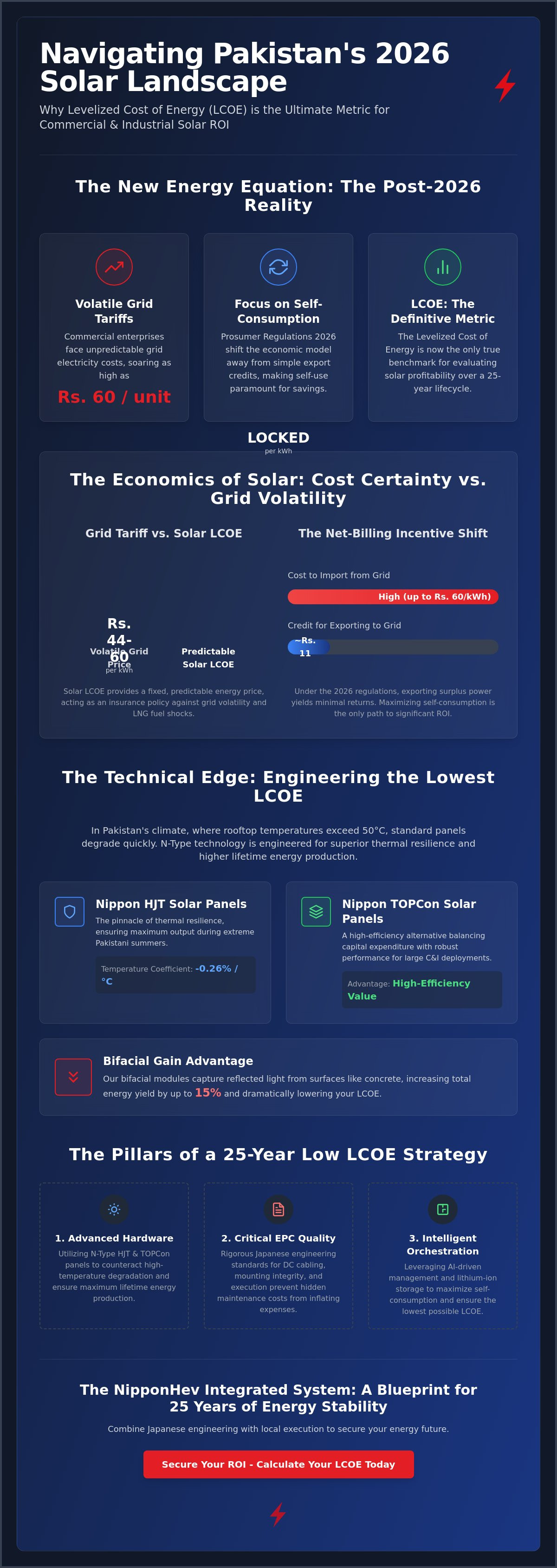
Pakistan’s reliance on "take-or-pay" LNG contracts has created a floor for grid electricity prices that remains stubbornly high. Since these contracts are often pegged to international indices, any geopolitical tension in the Strait of Hormuz or supply chain disruption translates directly into fuel price shocks for local businesses. In 2026, grid tariffs for industrial consumers have fluctuated between Rs. 44 and Rs. 60 per kWh. Calculating your commercial solar lcoe pakistan allows you to lock in a predictable energy price. This strategy essentially decouples your manufacturing costs from global fuel volatility, providing a level of fiscal security that the national grid simply cannot offer.
The Shift from CapEx to Lifetime Value
Procurement teams often prioritize "Price per Watt," a metric that rewards low-quality components with high degradation rates. This is a strategic error. A cheap panel that loses 1% of its efficiency annually results in a significantly higher LCOE than a high-performance N-type panel with minimal degradation. You calculate LCOE by dividing the Total Life Cycle Cost by the Total Lifetime Energy Production. In 2026, PKR exchange rate stability remains a critical factor in procurement. High-quality engineering mitigates currency-related inflation risks by ensuring the system performs optimally without requiring expensive, imported replacement parts mid-lifecycle.
Grid Parity and Economic Resilience
Grid parity isn't just a future goal; it's the current reality for Pakistani commerce. NEPRA’s 2026 commercial tariff structures have pushed businesses toward hybrid billing models. Under the new net-billing framework, the export rate is roughly Rs. 11 per kWh, while import rates remain high. This disparity makes LCOE the ultimate fixed-cost insurance policy for manufacturers. By investing in a system designed for high self-consumption, companies ensure their cost of energy remains stable regardless of how the national grid evolves or how fuel prices fluctuate in the coming decades. It's a transition from being a passive consumer to an active, resilient prosumer.
Technical Variables Driving LCOE: Efficiency and Thermal Resilience
The operational environment in Lahore and Karachi presents a significant challenge to solar asset longevity. High ambient temperatures cause standard photovoltaic modules to experience voltage drops; this directly inflates the commercial solar lcoe pakistan by reducing energy harvest during peak sunlight hours. Standard PERC panels often suffer from high temperature coefficients. Conversely, N-type technology maintains structural and electrical stability under thermal stress. This resilience ensures the system delivers the projected kilowatt-hours even when rooftop temperatures exceed 50 degrees Celsius.
A recent IEEFA report on net-metered solar power highlights that the economic viability of distributed generation depends heavily on technical efficiency and degradation management. Modern industrial zones often feature high albedo surfaces, such as concrete or light-colored roofing, which allow bifacial modules to capture reflected light from the rear side. This bifacial gain can increase total energy yield by up to 15%, effectively lowering the cost per unit produced over the system’s 25-year lifespan.
HJT vs. TOPCon: The Battle for Lowest LCOE
Nippon HJT Solar Panels represent the pinnacle of thermal resilience. They utilize a symmetrical cell structure that minimizes carrier recombination. This architecture results in a temperature coefficient as low as -0.26%/°C, which ensures maximum output during extreme Pakistani summers. Nippon TOPCon Solar Panels offer a high-efficiency alternative that balances capital expenditure with performance. They're ideal for massive C&I deployments where scale is a primary driver. In 2026, HJT technology generally achieves cell efficiencies exceeding 26%, while TOPCon maintains a robust presence at approximately 25.5%.
You can view the technical specifications of Nippon HJT Solar Panels to understand how they integrate into high-performance energy architectures.
The Cost of Degradation
Degradation rates are often overlooked in initial ROI calculations. They're a primary driver of long-term LCOE. An annual degradation rate of 0.25% preserves significantly more generation capacity over 25 years compared to the industry standard 0.5%. In humid coastal regions like Karachi, Potential Induced Degradation (PID) can further erode yields if low-quality encapsulation materials are used. Utilizing high-quality silicon wafers and advanced passivation layers ensures long-term yield security. This prevents the hidden costs of early module replacement or underperformance from compromising your financial objectives.
The Role of Storage and AI in LCOE Optimization
The transition from net-metering to the 2026 net-billing framework has fundamentally altered the financial math for Pakistani businesses. Under the current regulations, the export rate for excess energy is significantly lower than the cost of importing power during peak hours. Integrating lithium ion battery storage allows firms to capture excess daytime production for use when grid tariffs are at their highest. This shift is critical in Pakistan's renewable energy market, where the export-to-import price ratio is increasingly unfavorable. By prioritizing self-consumption, the Levelized Cost of Storage (LCOS) becomes a strategic asset that offsets grid draws priced at Rs. 50 or more per unit.
AI-driven orchestration serves as the central nervous system of a modern energy architecture. These systems prevent expensive peak-hour grid draws by intelligently managing the discharge of stored energy based on real-time tariff data. Intelligent fault detection further optimizes the commercial solar lcoe pakistan by identifying performance bottlenecks before they lead to system downtime. When a system remains operational without interruption, the total lifetime energy production increases, which directly lowers the cost per kilowatt-hour. The ROI for storage now crosses the threshold of viability much earlier because it acts as a hedge against both high tariffs and grid instability.
Smart Management: Nippon Smart AI Inverters
Smart ai solar inverters utilize predictive algorithms to analyze local load patterns and grid reliability. This capability allows for the precise mixing of solar, battery, and grid power to ensure industrial processes never face an energy deficit. Real-time monitoring tools provide granular data that prevents OpEx bloat by enabling proactive maintenance. In industrial clusters prone to frequent outages, these inverters manage grid-outage transitions seamlessly, protecting sensitive machinery from voltage fluctuations and ensuring business continuity.
Lithium-Ion vs. Traditional Storage
Cycle life is the primary differentiator in 2026 LCOE models. Lithium-ion systems offer 6,000 or more cycles, whereas traditional lead-acid alternatives often fail after 1,500 cycles. A high Depth of Discharge (DoD) of up to 90% ensures that almost all stored energy is usable, which maximizes the value of every stored kilowatt. Advanced thermal management systems are also essential for maintaining battery health in Pakistan's high-ambient temperature environments. These features ensure that the storage component remains a reliable part of the energy infrastructure for its entire 10 to 15 year service life.
Mitigating LCOE Risks: EPC Quality and Maintenance
Cheap solar epc services often prioritize immediate savings at the expense of long-term structural integrity. This approach creates significant financial liabilities that inflate the commercial solar lcoe pakistan over the system's lifespan. In regions like Karachi or Punjab, where wind loads and seismic activity are high, a failure in mounting hardware or soil anchoring can lead to catastrophic module loss. Even if the system remains intact, the use of undersized DC cabling leads to resistive losses; this results in a permanent reduction in energy yield that can never be recovered. High-quality EPC is the primary defense against these hidden costs.
Soiling presents a persistent threat to energy production in Pakistan's arid and industrial climates. Dust accumulation often reduces energy yields by 10% to 25% within a few weeks of dry weather. Implementing an automated cleaning schedule or a rigorous manual protocol is essential to maintain the performance levels mentioned in earlier sections. The ROI of these cleaning strategies is verified by the prevention of "lost energy" costs, which otherwise degrade the financial health of the project over its 25-year lifecycle.
The Engineering Benchmark
Standardizing the EPC process requires a methodical progression from geotechnical soil testing to advanced structural wind-load analysis. These steps ensure that the system foundation is capable of withstanding local environmental pressures for decades without shifting or failing. Professional commissioning is also a mandatory requirement to validate manufacturer warranties; it provides the documented proof of correct installation that manufacturers demand for part replacements. Implementing high-standard EPC protocols typically reduces annual OpEx by 15% to 20% compared to systems installed by uncertified or low-cost providers.
Performance Architecture
Maintaining peak efficiency requires a transition from reactive repairs to predictive solar system maintenance. Thermal imaging allows technical teams to identify hot spots on modules before they cause cell failure or fire risks. String-level monitoring provides the granular data needed to detect early-stage failures in wiring or inverter components. Professional Operations and Maintenance (O&M) minimize "lost energy" costs by ensuring the system operates at its theoretical maximum at all times. This discipline is what separates a high-performing asset from a deteriorating liability.
You can consult with our project development team to receive a comprehensive O&M roadmap for your existing or planned solar assets.
The Nippon Energy Advantage: Engineering Low LCOE in Pakistan
Nippon Energy operates at the intersection of global engineering standards and local operational realities. We combine Japanese precision with deep-rooted Pakistani execution capabilities to deliver energy assets that outperform the market. This synergy ensures that every component, from the silicon wafer to the mounting bolt, contributes to a lower commercial solar lcoe pakistan. By controlling the entire value chain through Solar Project Development and EPC, we eliminate the technical gaps that often occur when using disparate providers. Our approach treats a solar installation not as a commodity purchase, but as a high-performance energy architecture designed for a 25-year horizon.
The NipponHev integrated system represents our unified approach to energy cost reduction. This ecosystem synchronizes Nippon HJT Solar Panels with Nippon Smart AI Inverters and lithium-ion storage into a single, optimized platform. In the Pakistani textile and manufacturing sectors, where energy can account for a significant portion of total production costs, this integration has successfully achieved grid parity. By maximizing self-consumption and minimizing thermal degradation, our clients secure a fixed, predictable energy price that protects their margins against future grid tariff hikes.
Turnkey Excellence for C&I
We provide end-to-end project development services that move seamlessly from initial feasibility studies to final grid-connection. Our technical teams in Lahore and Karachi conduct site-specific analyses to account for local variables like wind loads and soiling patterns. We provide every client with custom LCOE modeling; this ensures transparent ROI projections based on actual historical data rather than optimistic estimates. This granular level of planning allows industrial leaders to make capital allocation decisions with absolute confidence in the long-term financial outcome.
Our regional presence ensures that technical support is always accessible. We maintain a robust local infrastructure to manage Solar System Maintenance and Monitoring, ensuring that any performance deviation is addressed before it impacts your bottom line.
Future-Proofing Your Investment
Technology in the renewable sector evolves rapidly. Nippon Energy builds systems with clear upgrade paths for battery storage and AI-driven management. This modular philosophy allows your facility to integrate future advancements without requiring a complete system overhaul. We remain committed to the long-term reliability of your asset, providing the local technical support necessary to sustain peak performance through 2050 and beyond. It's a partnership focused on durability, intelligence, and monumental impact.
You can request a custom LCOE analysis for your facility from Nippon Energy to begin your transition toward energy independence.
Securing Industrial Energy Autonomy Through Engineering Excellence
Mastering the economic variables of the 2026 net-billing era requires moving beyond capital expenditure toward a lifetime value model. You've seen how high-efficiency HJT and TOPCon technologies mitigate thermal degradation while AI-driven orchestration maximizes self-consumption. These technical variables are the primary drivers of a competitive commercial solar lcoe pakistan in an increasingly volatile energy market. High-performance hardware combined with rigorous engineering standards creates a permanent hedge against rising grid tariffs.
Nippon Energy delivers this performance through Japanese-engineered modules and proprietary Smart AI Inverters. Our full-cycle EPC services in Lahore and Karachi provide the local technical support necessary to validate your 25-year investment. By prioritizing structural integrity and predictive maintenance, we ensure your facility achieves grid parity and long-term fiscal resilience. This calculated approach to energy architecture provides the stability required for large-scale industrial success. Consult with Nippon Energy to lower your commercial LCOE today and transform your power infrastructure into a monumental asset for growth.
Frequently Asked Questions
What is the average LCOE for commercial solar in Pakistan in 2026?
The average LCOE for commercial solar projects typically ranges between PKR 15 and PKR 22 per kWh, depending on the scale of the installation and the level of storage integration. This cost is significantly lower than the grid electricity tariffs for commercial consumers, which fluctuate between Rs. 44 and Rs. 60 per unit. Calculating the commercial solar lcoe pakistan allows businesses to lock in a fixed energy price for 25 years, providing a hedge against future inflation.
How do HJT panels reduce LCOE compared to standard PERC modules?
Nippon HJT Solar Panels reduce LCOE by delivering higher energy yields in extreme temperatures and exhibiting lower annual degradation. Standard PERC modules suffer from higher voltage drops when rooftop temperatures exceed 45 degrees Celsius, whereas HJT technology maintains electrical stability. This superior temperature coefficient ensures more kilowatt-hours are produced over the system's lifecycle, which directly lowers the cost per unit of energy generated.
Does the current NEPRA net-metering policy affect the LCOE calculation?
The transition to the Prosumer Regulations 2026 has introduced a net-billing framework that fundamentally changes LCOE calculations. Under this model, the buyback rate for excess energy is approximately Rs. 11 per kWh, while the cost of importing power remains high. To achieve the lowest LCOE, businesses must prioritize self-consumption and storage rather than relying on grid exports, as the value of consumed energy is much higher than the value of exported energy.
What is the impact of Pakistani climate on solar panel degradation and LCOE?
Pakistan's climate, characterized by extreme summer heat and high soiling levels, can accelerate thermal degradation and reduce total energy harvest. Standard modules often degrade faster in these conditions, which increases the lifetime cost of energy by lowering total production. Utilizing N-type technology with low degradation rates and implementing automated cleaning protocols are essential steps to preserve the 25-year yield curve and maintain a low LCOE.
Is Lithium-ion storage necessary to achieve the lowest LCOE for a factory?
Lithium-ion storage is increasingly necessary to achieve the lowest LCOE under the current net-billing regulations. Since grid tariffs during peak hours are high, storing excess daytime production for use during expensive periods offers a better financial return than exporting power at the lower buyback rate. Nippon Lithium-ion Battery Storage Systems enable factories to maximize their self-consumption ratio, which is the most effective way to reduce the all-in cost of power.
How does professional EPC service lower the lifetime cost of energy?
Professional EPC services lower LCOE by ensuring optimal system design, high-quality DC cabling, and structural integrity. Substandard installations often lead to resistive losses and premature hardware failures, which increase long-term maintenance expenses and reduce system uptime. Rigorous engineering and professional commissioning protect the system's output and ensure that manufacturer warranties remain valid for the full term of the investment.
Can Nippon Energy provide regional LCOE modeling for Karachi vs. Lahore?
Nippon Energy provides localized LCOE modeling that accounts for the specific meteorological data of Karachi and Lahore. Karachi's coastal humidity and Lahore's extreme summer heat require different technical configurations to optimize performance and durability. Our regional teams use these variables to deliver precise ROI projections that reflect the actual environmental conditions of your facility's location, ensuring the system is engineered for its specific environment.
What is the expected ROI for a 1MW commercial solar project in Pakistan?
A 1MW commercial solar project typically achieves a payback period of three to five years, depending on the displacement of expensive grid electricity. The ROI is driven by the substantial gap between the solar LCOE and the prevailing commercial grid tariffs. By utilizing high-efficiency Nippon TOPCon Solar Panels and AI orchestration, industrial users can secure stable energy costs and significant long-term savings for over two decades.


