

By 2026, relying on standard monofacial solar technology in Pakistan's 45°C corridors isn't just an inefficiency; it's a financial liability. With grid electricity costs reaching PKR 80 per unit, the margin for technical error has vanished. You've likely noticed that many existing systems see a performance crater during the peak of June, precisely when cooling demands are highest. This degradation isn't an inevitability of the climate. Optimizing bifacial solar panel performance in pakistan requires a shift from basic silicon to advanced N-type architectures like Heterojunction (HJT) and Tunnel Oxide Passivated Contact (TOPCon) that thrive under intense irradiance.
We understand that your objective is to achieve a 3-4 year ROI while securing 25-year system reliability. This engineering analysis explores how HJT modules utilize rear-side albedo and superior temperature coefficients to maintain high yields in dusty environments. You'll discover the specific impact of 2026 net billing regulations on system design and why cell architecture dictates long-term resilience. We provide a granular breakdown of site-specific testing in Lahore and Karachi to ensure your infrastructure delivers maximum energy density per square foot.
Key Takeaways
- Compare HJT and TOPCon cell architectures to determine which technology provides the highest thermal resilience during extreme South Asian summer peaks.
- Identify how surface albedo optimization on concrete roofs or sandy soil can increase your total energy harvest through the capture of reflected irradiance.
- Evaluate the engineering variables that dictate bifacial solar panel performance in pakistan, including mounting height precision and rear-side shading mitigation.
- Implement specialized maintenance and cleaning protocols designed to combat high dust density and prevent accelerated module degradation.
- Align your solar infrastructure with 2026 net billing frameworks by integrating high-efficiency modules with intelligent energy management systems.
The Economic Imperative of Bifacial Technology in Pakistan (2026)
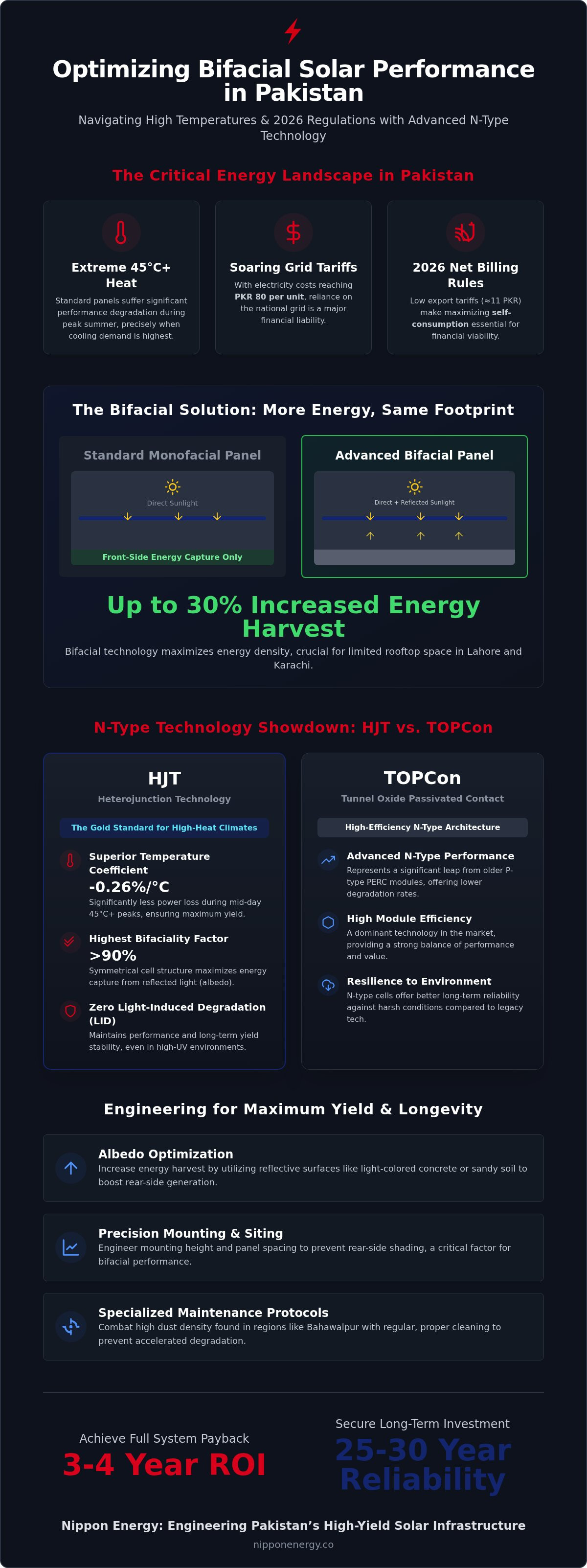
Pakistan's energy infrastructure is currently undergoing a radical transformation. With retail electricity tariffs frequently exceeding 60 to 80 PKR per unit in 2026, the demand for high-efficiency hardware has moved from a luxury to a technical necessity. Bifacial modules represent the frontier of this shift. Unlike traditional monofacial panels that only utilize the front-facing surface, bifacial solar cell technology captures irradiance from both the direct sun and the light reflected off the ground or roof surface. This dual-sided architecture can increase total energy harvest by up to 30%, directly addressing the yield gaps caused by Pakistan's variable weather patterns.
NEPRA's 2026 prosumer regulations have shifted the market from net metering to a net billing framework. This policy change compensates exported electricity at a rate significantly lower than the retail purchase price, often around 11 PKR per unit. Consequently, the financial viability of a solar investment now depends on maximizing self-consumption and energy density. Enhancing bifacial solar panel performance in pakistan is the most effective method to ensure that every square foot of installation generates the highest possible wattage, reducing the reliance on the expensive national grid.
Combating Rising Tariffs with Increased Energy Density
In densely populated urban centers such as Lahore and Karachi, rooftop real estate is often the primary constraint for solar expansion. Bifacial technology allows for greater energy density, meaning you can generate more power from a smaller footprint. This is particularly vital for industrial facilities where high-load machinery demands consistent, high-wattage output during peak daylight hours. By utilizing the bifacial gain, project developers can offset the rising cost per kWh in DISCO territories more effectively than with legacy monofacial systems. The result is a compressed ROI timeline, typically achieving full system payback within three to four years despite the initial hardware investment.
2026 Market Trends: The Dominance of N-Type Technology
The local market has seen a decisive move away from P-type PERC modules toward N-type architectures, specifically TOPCon and HJT. These technologies offer lower degradation rates and superior bifaciality factors. For instance, Nippon HJT solar panels utilize a symmetrical cell structure that inherently supports high rear-side efficiency. This design is far more effective at converting scattered light into usable energy than older technologies.
The glass-on-glass construction common in bifacial modules provides a robust barrier against the harsh monsoon seasons and high dust densities found in regions like Bahawalpur. This structural integrity prevents micro-cracks and potential-induced degradation (PID), ensuring the system maintains its performance for the duration of its 25 to 30 year warranty. Choosing N-type bifacial hardware is no longer just a performance preference; it's a strategy for long-term investment security in a volatile energy market.
Thermal Stability and Bifaciality: HJT vs. TOPCon in 45°C+ Climates
Standard solar panels lose efficiency as temperatures rise. In Pakistan, where summer peaks regularly hit 45°C, the "Temperature Coefficient" is the most critical technical metric. While many installers focus solely on peak wattage, the real-world bifacial solar panel performance in pakistan is determined by how well cells resist heat-induced voltage drops. High-performance N-type cells maintain structural integrity under extreme thermal stress, preventing the performance craters common in legacy systems.
HJT Technology: The High-Temperature Architecture
Heterojunction (HJT) technology is specifically engineered for high-irradiance, high-heat zones. With an industry-leading temperature coefficient of -0.26%/°C, Nippon HJT modules lose significantly less power than conventional panels during mid-day peaks. This makes them the gold standard for the scorching climates of Sindh and Southern Punjab. HJT cells achieve a bifaciality factor of over 90%. This symmetry between front and back surfaces ensures that energy harvested from rear-side reflection is maximized. The architecture also eliminates Light-Induced Degradation (LID) in high-UV environments, securing long-term yield stability.
TOPCon Bifaciality: Balancing Cost and Efficiency
TOPCon modules provide a calculated balance between manufacturing cost and thermal resilience. While their temperature coefficient typically sits around -0.30%/°C, they remain vastly superior to legacy PERC modules. N-type TOPCon cells are inherently resistant to Boron-Oxygen related degradation, a common failure point for lower-tier panels in South Asia. For commercial rooftops in urban Lahore or Karachi, Nippon TOPCon modules offer a high-yield solution that withstands the rigors of the Pakistani climate without the premium cost of HJT.
Engineering data indicates that bifacial modules exhibit superior thermal management compared to monofacial counterparts. The glass-on-glass structure and rear-side energy generation help reduce internal resistance. By utilizing NREL's bifacial_radiance modeling toolkit, engineers can simulate how air circulation beneath elevated bifacial arrays contributes to passive cooling. This cooling effect ensures that bifacial systems outperform monofacial arrays during the critical June-July period. To optimize these thermal variables for your facility, our Solar Project Development and EPC specialists can provide site-specific yield projections.
Maximizing Bifacial Gain through Albedo Optimization in Pakistani Landscapes
Albedo is the technical measure of a surface's reflectivity, representing the fraction of solar energy reflected back from the ground or roof. In the context of bifacial solar panel performance in pakistan, this variable is the primary driver of the "bifacial bonus." While front-side generation remains relatively constant based on direct irradiance, the rear-side harvest is entirely dependent on the environment beneath the array. Engineering a high-yield system requires more than just premium modules; it necessitates a calculated approach to surface optimization and structural geometry.
The efficiency of rear-side capture is dictated by the view factor, which is the proportion of reflected light that actually reaches the back of the solar cells. Factors such as mounting height, tilt angle, and racking obstructions determine how effectively the system utilizes the available albedo. Without proper site-specific engineering, even the most advanced N-type modules will underperform their theoretical yield potential.
Optimizing Residential Flat Roofs in Lahore and Karachi
Residential rooftops in urban centers like Lahore and Karachi typically consist of weathered concrete. This material offers a baseline albedo of approximately 20%, which provides only a marginal boost to energy production. By applying high-reflectivity white paint or specialized cool-roof coatings, prosumers can increase this reflectivity to 60% or 80%. This simple surface treatment directly impacts the system's financial return. For example, a residential project in Karachi recently achieved a documented 15% yield increase by treating the roof surface before installation.
Mounting height is equally vital for these flat-roof applications. Low-profile installations often stifle rear-side irradiance uniformity, creating hot spots and reducing overall efficiency. Elevating the array to a height of at least 1 meter allows light to propagate more evenly across the rear surface. This clearance ensures that the energy density benefits of bifacial technology are fully realized in cramped urban environments.
Industrial Ground-Mount Systems: Sand and Gravel Albedo
Large-scale industrial parks in Southern Punjab frequently utilize ground-mounted configurations. The natural sandy soil of these desert climates provides a baseline albedo that inherently outperforms urban concrete. Engineering teams can further enhance this by using light-colored gravel or crushed stone. This strategy increases rear-side production with minimal long-term maintenance costs. Our local EPC teams in Karachi and Lahore conduct site-specific testing to determine the optimal ground material for each project environment.
Designing these systems requires a balance between bifacial gain and structural stability. While higher mounting heights maximize the view factor, they also increase the wind load on the racking system. Specialized racking designs that minimize rear-side shading are essential to prevent mismatch losses. This level of technical precision ensures that the infrastructure can withstand local wind conditions while delivering the high energy yields required for industrial-scale operations.
Mitigating Performance Risks: Dust, Degradation, and Maintenance
Dust accumulation, technically referred to as soiling, represents a primary challenge to bifacial solar panel performance in pakistan. Research highlights the severity of this issue; dust densities in Bahawalpur can reach 10.254 g/m², causing a 25.42% reduction in power output. In Islamabad, the reduction remains significant at 15.08%. While the front-facing glass receives the most attention, rear-side soiling can subtly erode the bifacial gain. This dual-surface exposure requires a more sophisticated maintenance approach than traditional monofacial systems to ensure the investment remains profitable.
Structural resilience is equally vital for long-term yield. Glass-on-glass bifacial modules are inherently more resilient to micro-cracks compared to those with plastic backsheets. This rigid encapsulation protects the sensitive N-type cells from mechanical stress during high-wind events or intense monsoon cycles. By eliminating the backsheet, the module becomes nearly impervious to moisture ingress. This design choice is critical for maintaining high performance in humid coastal territories like Karachi, where salt mist can accelerate the degradation of lower-tier components.
Designing a Maintenance Protocol for South Asia
A methodical maintenance regime is necessary to combat the environmental variables of the Indus Plain. We recommend a three-step protocol to sustain peak efficiency:
- Cleaning Schedules: Implement a frequency based on local dust levels. Automated robotic cleaners are ideal for large-scale industrial arrays, while manual cleaning with demineralized water is sufficient for residential rooftops.
- String-Level Monitoring: Utilize intelligent data from Nippon Smart AI Inverters to detect anomalies. A sudden drop in rear-side harvest often indicates a localized obstruction or extreme soiling that requires immediate intervention.
- Albedo Maintenance: Perform seasonal inspections of the reflective surface beneath the array. Clearing debris from sandy ground or repainting white roof surfaces ensures that the bifacial bonus remains maximized throughout the year.
Long-Term Reliability of Nippon Bifacial Modules
Nippon N-type cells are engineered to resist Potential Induced Degradation (PID), which is often exacerbated by the high temperatures and humidity of the Pakistani summer. The dual-glass architecture provides a stable platform that prevents the delamination and voltage leakage common in standard P-type modules. Nippon Energy provides a comprehensive 25-year performance guarantee for all bifacial modules to secure your long-term capital investment. To protect your infrastructure from environmental hazards, our Solar System Maintenance and Monitoring teams offer specialized support tailored to Pakistani climate conditions.
Nippon Energy: Engineering Pakistan’s High-Yield Solar Infrastructure
Nippon Energy bridges the gap between Japanese engineering precision and the demanding operational reality of the South Asian energy market. While the technical variables governing bifacial solar panel performance in pakistan are complex, our infrastructure is designed to simplify the path to energy independence. We prioritize the integration of Nippon HJT solar panels with advanced energy management protocols to ensure that every photon is converted into high-value electricity. It's this philosophy that's embedded in the NipponHev system, which serves as the definitive architecture for high-density energy production in 2026.
Our local presence in Karachi and Lahore allows for site-specific albedo testing, ensuring that your system isn't just installed, but engineered for its unique environment. By combining high-performance modules with Japanese quality control, we provide the reliability required to overcome Pakistan's extreme heat and dust challenges. We don't just provide hardware; we deliver a future-proof energy asset.
Turnkey EPC Solutions for Industrial and Commercial Clients
Our Engineering, Procurement, and Construction (EPC) teams provide the technical expertise required for sophisticated solar project development. We manage the entire project lifecycle, beginning with feasibility studies and extending through to final grid-interconnection under the latest NEPRA framework. Understanding that Pakistan's geography includes significant seismic zones, our engineers deploy customized racking solutions designed for structural stability and maximum rear-side irradiance capture. These systems are elevated to precise mounting heights to optimize the view factor. To protect these capital assets, our solar system maintenance protocols utilize string-level diagnostics to ensure that environmental variables never degrade your 25-year performance security.
Intelligent Energy Orchestration with AI Inverters
Bifacial arrays produce a dynamic energy profile that requires precise, real-time management. We utilize smart ai solar inverters to optimize string-level performance, automatically adjusting for fluctuations in reflected light and ambient temperature. This intelligent orchestration ensures that your system maintains peak efficiency even during the hazy conditions common in Punjab. These inverters transmit granular data to the Nippon cloud platform, providing you with transparent insights into bifacial solar panel performance in pakistan across your entire portfolio. It's essential for maximizing self-consumption and achieving a 3-4 year ROI in the current tariff context. Consult with Nippon Energy's Pakistan team to design your high-yield system and secure a stable energy future today.
Securing Your Energy Future with High-Yield Bifacial Infrastructure
The 2026 energy landscape in Pakistan demands a transition from legacy solar hardware to high-density, resilient architectures. Achieving optimal bifacial solar panel performance in pakistan requires a sophisticated understanding of how N-type HJT and TOPCon cells interact with local irradiance and thermal peaks. By leveraging Japanese engineering standards, you ensure that your system maintains structural integrity and yield stability even during the 45°C summer peaks of Sindh and Punjab. Local support from our Karachi and Lahore teams provides the site-specific albedo testing necessary to maximize your return on investment under the current NEPRA net billing framework.
Relying on Tier-1 technology isn't just about efficiency; it's about future-proofing your energy independence against rising tariffs. Our dual-glass modules and intelligent AI orchestration provide the precision required for a 3-4 year ROI. It's time to move beyond standard solar and embrace a system engineered for the specific challenges of the Indus Plain. Request a High-Yield Bifacial Feasibility Study from Nippon Energy to begin your transition to a more stable and profitable energy future. We look forward to helping you build a monumental energy asset.
Frequently Asked Questions
Do bifacial solar panels work on flat concrete roofs in Pakistan?
Bifacial modules are highly effective on flat concrete roofs, provided the array is elevated to at least one meter. While weathered concrete offers a baseline albedo of 20%, applying white reflective coatings can increase reflectivity to 80%. This elevation allows reflected light to reach the rear cells uniformly. Without sufficient clearance, the rear-side harvest is restricted, significantly limiting the total energy density of the installation.
Is the extra cost of bifacial panels worth it compared to monofacial?
The investment is justified by the accelerated ROI in Pakistan's 2026 high-tariff environment. Although bifacial modules carry a slight price premium, the 15% to 30% yield boost offsets this cost within the first few years of operation. Higher energy density is crucial for urban Lahore and Karachi, where limited rooftop space requires maximizing every square foot to combat grid electricity costs of PKR 80 per unit.
How much extra energy can I expect from bifacial panels in Lahore?
You can expect a bifacial gain of 10% to 25% in Lahore, depending on the surface treatment beneath the panels. In urban environments, standard concrete provides a modest boost, but optimized rooftops with high-albedo coatings deliver the maximum energy harvest. Total bifacial solar panel performance in pakistan is further enhanced by Lahore's high irradiance levels, making these modules more productive than traditional monofacial alternatives throughout the year.
Does dust on the ground reduce the performance of bifacial solar panels?
Dust accumulation on the ground surface directly reduces albedo, which stifles rear-side energy production. Research indicates that dust densities in regions like Bahawalpur can reach 10.254 g/m², significantly lowering the reflectivity of the soil or gravel. Maintaining a clean reflective surface is just as vital as cleaning the front glass. Regular ground maintenance ensures that the bifacial bonus remains consistent despite the high soiling rates common in Punjab.
Which is better for Pakistan's heat: HJT or TOPCon bifacial panels?
HJT technology is the superior choice for extreme thermal environments like Sindh due to its industry-leading -0.26%/°C temperature coefficient. It maintains higher voltage during 45°C peaks compared to other architectures. TOPCon modules, with a coefficient of -0.30%/°C, offer a highly efficient and cost-effective alternative for regions with slightly lower peak temperatures. Both N-type technologies outperform legacy P-type modules, but HJT provides the highest resilience against heat-induced degradation.
Do bifacial panels require special mounting structures?
Bifacial panels require specialized racking systems designed to minimize rear-side shading and maximize irradiance capture. Standard mounting rails can obstruct the back of the cells, causing mismatch losses and reducing efficiency. Engineering for bifacial solar panel performance in pakistan involves using thin-profile rails and elevated structures. These designs ensure that reflected light reaches the rear surface unobstructed while maintaining the structural integrity required to withstand local wind loads and seismic activity.
What is the lifespan of a bifacial solar panel in Karachi's coastal climate?
The expected operational lifespan is 25 to 30 years, supported by dual-glass encapsulation. This glass-on-glass structure is nearly impervious to the salt mist and high humidity found in Karachi's coastal areas. Unlike modules with plastic backsheets, bifacial N-type cells are highly resistant to moisture ingress and Potential Induced Degradation (PID). This structural durability ensures that the system maintains its electrical integrity and performance standards for the duration of its multi-decade warranty.
Can I use bifacial panels with a standard solar inverter?
Bifacial panels are compatible with standard inverters, but you must ensure the inverter can handle higher DC current inputs. Bifacial modules often produce more current than their monofacial ratings suggest due to rear-side gain. We recommend using Smart AI Inverters for string-level optimization. These intelligent systems manage the variable energy peaks from the rear side more effectively, ensuring that the total system yield is maximized without risking hardware clipping or thermal stress.


