

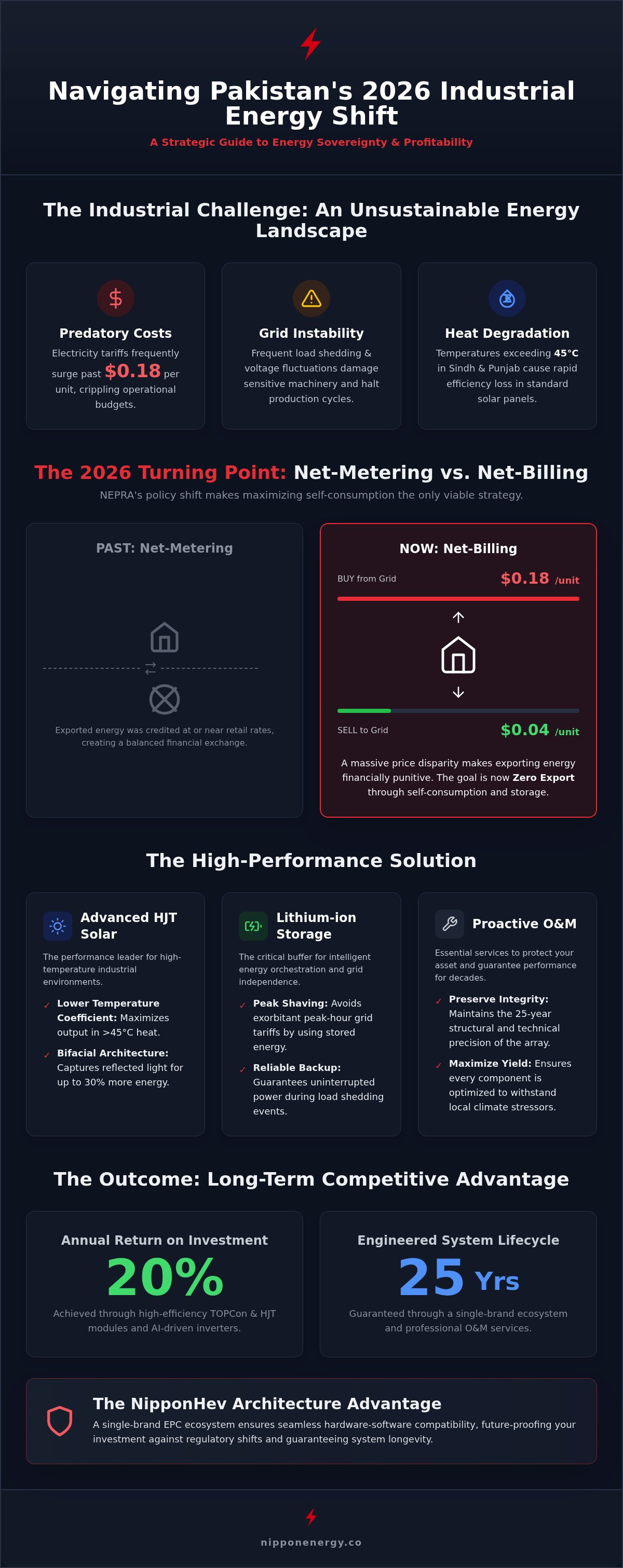
What if your industrial facility could operate entirely outside the volatility of the national grid while slashing operational expenses by over 50%? For Pakistani enterprises in 2026, electricity isn't just a utility; it's a predatory cost center where tariffs often reach $0.18 per unit. You've likely seen how frequent load shedding and grid instability threaten sensitive machinery and disrupt production cycles. To maintain a 25-year system lifecycle, businesses are increasingly prioritizing specialized commercial solar o&m services pakistan to ensure their infrastructure remains resilient against these local environmental stressors.
We understand that navigating the 2026 transition from net-metering to net-billing requires more than just installing panels; it demands a shift toward intelligent energy orchestration. This guide explores how advanced HJT solar engineering and Nippon Lithium-ion storage systems convert high energy costs into a long-term competitive advantage. You'll discover the technical blueprints for achieving a 20% annual ROI through high-efficiency TOPCon modules and AI-driven inverters. We'll detail the strategic integration of the NipponHev architecture to guarantee reliable backup and system longevity in the Karachi and Lahore industrial sectors.
Key Takeaways
- Understand how the 2026 transition to net-billing in Pakistan necessitates a shift toward energy orchestration and self-consumption to protect your bottom line.
- Compare the high-efficiency performance of Nippon HJT and TOPCon solar panels to determine the optimal architecture for high-temperature industrial environments.
- Learn how integrating Nippon Lithium-ion battery storage facilitates peak-shaving, effectively insulating your facility from exorbitant grid tariffs and frequent load shedding.
- Evaluate why professional commercial solar o&m services pakistan are essential for maintaining the 25-year structural integrity and technical precision of industrial-scale arrays.
- Discover the strategic advantage of a single-brand EPC ecosystem to ensure seamless hardware-software compatibility and future-proof your investment against regulatory shifts.
Navigating Pakistans 2026 Commercial Energy Landscape
Industrial sectors in Karachi and Lahore face a critical juncture as 2026 commercial electricity tariffs continue their upward trajectory. Retail rates now frequently exceed $0.18 per unit, placing an unsustainable burden on operational expenditures (OPEX). Grid instability remains a persistent threat. Frequent voltage fluctuations and unscheduled load shedding cause significant equipment damage and production downtime. To mitigate these risks, this Overview of Solar Power in Pakistan highlights how industrial leaders are pivoting toward decentralized power. Relying on legacy PERC panels is no longer sufficient. The 2026 energy landscape demands higher efficiency modules that can maximize yield within limited rooftop footprints. Maintaining these high-performance systems requires specialized commercial solar o&m services pakistan to prevent technical decay and ensure every kilowatt is accounted for. This structured approach to energy management is the only way to secure long-term price stability.
The Shift from Net Metering to Total Energy Sovereignty
The 2026 NEPRA (Prosumer) Regulations have fundamentally altered the financial logic of solar investments by transitioning from net-metering to a net-billing framework. With the buyback rate for exported electricity reduced to approximately $0.04 per unit while import costs remain high, the focus has shifted to "Zero Export" architectures. Large factories now prioritize self-consumption to avoid the price disparity of the grid. Achieving this requires precise energy orchestration. In this setup, lithium ion battery storage serves as the critical buffer between generation and demand. This strategy ensures grid-tie benefits are balanced with the need for immediate on-site power availability during peak hours.
Climate Challenges: Solving the Heat Degradation Problem
Environmental stressors in Sindh and Punjab present a severe technical hurdle for standard hardware. Summer temperatures often exceed 45°C, triggering rapid thermal degradation in conventional solar cells. Over a 25-year lifecycle, the financial cost of this efficiency loss can reach tens of thousands of dollars in unrealized savings. Standard panels lose significant output as they heat up. High-temperature resilient technologies like HJT maintain superior performance coefficients under extreme heat. Implementing robust commercial solar o&m services pakistan is vital to protect these assets. These services ensure that cooling systems, cleaning cycles, and electrical connections are optimized to withstand the intense Pakistani climate. This methodical approach preserves the structural and technical integrity of the industrial array for decades.
Advanced Technology: HJT vs. TOPCon for Industrial Scenarios
Selecting the correct cell architecture is the most critical decision for Pakistani industrial project developers in 2026. While standard PERC technology has reached its theoretical efficiency limit, N-type architectures like HJT (Heterojunction) and TOPCon (Tunnel Oxide Passivated Contact) offer the high-performance thresholds required to offset rising tariffs. Technical precision in hardware selection directly influences the levelized cost of energy (LCOE). Projects like the World Bank Sindh Solar Project demonstrate the importance of scalable, high-efficiency infrastructure in regional development. To maintain these advanced systems, robust commercial solar o&m services pakistan are mandatory to ensure that technical specifications translate into actual yield.
HJT Technology: The High-Temperature Performance Leader
Nippon HJT Solar Panels represent the pinnacle of thermal resilience for the Sindh and Punjab regions. HJT efficiency is defined as the ratio of solar energy converted into electricity versus the energy lost as heat in desert climates. These panels feature a significantly lower temperature coefficient compared to traditional modules, meaning they produce more power when ambient temperatures exceed 40°C. Their bifacial architecture is particularly advantageous for flat-roof industrial warehouses because it allows the rear side to capture reflected light from concrete surfaces. This can increase total energy harvest by up to 25%. When paired with a smart ai solar inverter, the system can dynamically optimize power tracking for both sides of the panel.
TOPCon: The Mid-Range Industrial Standard
For 1MW+ projects or large land-based arrays where rooftop space is less constrained, topcon solar panels provide a highly efficient, cost-optimized alternative. TOPCon technology utilizes a thin tunnel oxide layer to reduce recombination losses, achieving efficiency rates that surpass 22%. These modules exhibit excellent long-term reliability and high resistance to Potential Induced Degradation (PID). This is essential in the dusty, high-humidity environments found in many Pakistani industrial zones. While HJT offers the best absolute performance in extreme heat, TOPCon provides a balanced ROI for massive deployments. Regardless of the chosen technology, professional commercial solar o&m services pakistan are required to manage the cleaning and calibration needs of these sensitive N-type cells.
Tier-1 Japanese engineering focuses on minimizing annual degradation to less than 0.4%, ensuring the system remains productive for over 25 years. This durability allows the initial capital investment to pay for itself by year 5 through avoided grid costs. Lower-tier hardware often suffers from accelerated technical decay, which erodes the financial viability of the project. You can consult with our engineering team to determine which cell architecture fits your specific facility.
Financial Engineering: ROI, Storage, and Energy Orchestration
Calculating the real ROI of commercial solar in Karachi and Lahore requires a departure from simplified residential metrics. In 2026, industrial load profiles are increasingly complex; demand charges often constitute over 30% of a facility's total energy bill. By deploying high-capacity systems, businesses can achieve full capital recovery within 3 to 5 years. This timeline is significantly accelerated by tax benefits like the 80% first-year depreciation allowance available under Pakistan's current fiscal framework for renewable assets. However, achieving these financial targets is impossible without professional commercial solar o&m services pakistan to maintain peak conversion efficiency and minimize technical downtime. As industrial electricity rates fluctuate, the predictability of solar generation becomes a powerful hedge against inflation.
The strategic value of these investments is reinforced by Pakistan's renewable energy policy, which targets a 30% share of renewables in the national grid by 2030. For the private sector, this policy shift translates into a more stable regulatory environment for large-scale solar adoption. To maximize the financial return, companies must shift from simple grid-tied setups to integrated energy orchestration. This involves using AI to manage consumption patterns, ensuring that the cheapest power source is always prioritized. Without this level of engineering precision, the gap between theoretical savings and actual bankable results will continue to widen.
Industrial Storage: Beyond Backup Power
Nippon Lithium-ion systems represent the only viable choice for 24/7 industrial operations. Unlike legacy lead-acid batteries that degrade within 1,500 cycles, lithium ion battery storage offers over 6,000 cycles at a 90% depth of discharge. This durability ensures the storage component matches the 25-year lifespan of the solar panels. Integrating these units within the nipponhev system architecture creates a unified power plant where generation, storage, and consumption are synchronized. This integration allows for peak-shaving, where the system discharges stored energy during the most expensive tariff windows, effectively insulating the business from peak-hour grid pricing.
AI-Driven Energy Orchestration
Smart AI inverters act as the digital brain of the commercial facility. These units analyze historical weather patterns to predict cloud cover in Lahore or coastal humidity spikes in Karachi, adjusting battery discharge rates in real-time. This proactive management prevents expensive grid draws during sudden generation dips. Continuous monitoring through commercial solar o&m services pakistan allows for predictive maintenance, identifying potential cell failures before they cause system-wide downtime. In the Karachi coastal climate, where salt mist can accelerate hardware corrosion, AI-driven alerts ensure that cleaning and maintenance cycles are performed precisely when needed, preserving the system's high-performance yield for decades.
Executing Large-Scale Solar: The EPC Lifecycle in Pakistan
Large-scale industrial solar projects demand a rigorous execution framework to ensure compliance with international engineering standards and local grid codes. Professional solar epc services bridge the gap between conceptual design and commercial reality. The process begins with a comprehensive structural feasibility and geotechnical analysis. This step is critical for heavy industrial arrays where the structural integrity of factory roofs or soil stability for ground-mounted systems determines safety and longevity. Skimping on these initial assessments often leads to catastrophic structural failures during high-stress weather events.
Following the feasibility stage, the engineering and procurement phase focuses on integrating Tier-1 Japanese hardware. This stage ensures that every component, from the Nippon HJT panels to the smart AI inverters, functions as a unified, high-performance ecosystem. The final stage involves construction, commissioning, and obtaining NEPRA net-billing approval under the 2026 regulations. This methodical approach minimizes technical risk and guarantees that the system meets the performance benchmarks required for a 25-year lifecycle. A structured EPC lifecycle is the only way to transform a capital-intensive project into a reliable energy asset.
Site-Specific Engineering for Pakistan
Industrial zones in Pakistan present unique environmental challenges that generic installation teams often overlook. In coastal areas like Port Qasim and Karachi, mounting structures must be engineered to withstand high wind loads and salt-induced corrosion. Conversely, Lahore and the wider Punjab region require specialized dust and soiling mitigation strategies. Standardizing mounting structures with high-grade galvanized steel or aluminum alloys is essential for 25-year durability. These engineering choices prevent structural fatigue and ensure the array remains secure during extreme weather events common in the region. Proper engineering isn't just about output; it's about structural survival.
Commercial Solar O&M Services Pakistan
The transition from commissioning to operation marks the beginning of the most critical phase for ROI. Proactive commercial solar o&m services pakistan serve as the primary defense against technical degradation and unrealized savings. Effective solar system maintenance involves more than just periodic cleaning. It requires predictive schedules based on local pollution data and real-time performance analytics to identify string-level inefficiencies.
Remote monitoring allows our technical teams to identify and rectify anomalies before they impact the facility's total output. For industrial clients, rapid-response technical support is non-negotiable to prevent production bottlenecks. By investing in professional commercial solar o&m services pakistan, enterprises ensure their energy infrastructure remains a high-yielding asset rather than a maintenance liability. You can schedule a technical audit of your industrial facility to evaluate your current system's performance and structural integrity.
Future-Proofing with Nippon Energy: The Integrated Advantage
Deploying a commercial solar system involves more than just purchasing components. It's about ensuring structural and software harmony across the entire power plant. A single-brand ecosystem eliminates the interoperability risks associated with mixing disparate hardware and software from different manufacturers. Nippon Energy's 2026 vision for industrial microgrids in Pakistan centers on creating autonomous energy clusters that operate independently of grid volatility. This integrated approach ensures that every inverter, battery, and panel communicates through a unified protocol, maximizing system uptime and harvest efficiency. By centralizing the technology stack, businesses secure a future-proof asset that can adapt to evolving regulatory requirements and energy demands.
The NipponHev Integrated Solution
The NipponHev architecture represents a fundamental shift toward pre-engineered, turnkey energy plants. This system combines Nippon HJT Solar Panels with Nippon Lithium-ion Battery Storage Systems to create a cohesive power generation and management unit. Reducing installation complexity through pre-engineered modules minimizes on-site errors and accelerates the commissioning timeline. For export-oriented businesses in the textile and pharmaceutical sectors, this integrated approach is essential for meeting international carbon neutrality benchmarks. Achieving these sustainability goals provides a distinct competitive edge in global markets where green supply chains are now a prerequisite for trade. The NipponHev system doesn't just provide power; it provides a pathway to global compliance.
Strategic Partnership and Consultation
Nippon Energy functions as a world-class partner rather than a mere hardware vendor. Our engagement model begins with a professional Nippon commercial energy audit to map specific load profiles and identify latent inefficiencies. We customize system architectures for diverse industries, including food processing, textiles, and pharmaceuticals, ensuring that the technology matches the operational rhythm of the facility. Local support through our Karachi and Lahore offices ensures that commercial solar o&m services pakistan are delivered with technical precision and rapid response times. This local presence is vital for maintaining the 25-year structural and technical integrity of the system.
The security of a Japanese-engineered warranty provides long-term peace of mind for capital-intensive industrial projects. This performance guarantee is backed by our dedicated technical teams who provide ongoing commercial solar o&m services pakistan to prevent technical decay. Moving from a vendor-client relationship to a long-term energy partnership allows your business to focus on core production while we manage the complexities of energy orchestration. To begin your transition toward total energy sovereignty, contact our Lahore or Karachi offices for a professional site survey and technical consultation. Our engineers are ready to design a resilient energy future for your enterprise.
Architecting a Resilient Energy Future for Pakistani Industry
Navigating the 2026 regulatory shift requires a move beyond simple panel installation toward sophisticated energy orchestration. The transition to net-billing and the reality of $0.18 per unit tariffs make high-efficiency HJT technology and integrated lithium-ion storage essential for industrial survival. By leveraging Japanese engineering standards, your facility can transform a volatile cost center into a predictable, high-performance asset. Ensuring this longevity depends on rigorous technical oversight through professional commercial solar o&m services pakistan, which protect your infrastructure from environmental degradation and technical decay.
Our local presence in Karachi and Lahore ensures that your enterprise receives world-class support tailored to regional climate challenges. Specialized HJT technology maintains peak performance in Sindh and Punjab's extreme heat, guaranteeing a 25-year operational lifecycle. It's time to secure your bottom line against grid instability and escalating operational costs. Request a Comprehensive Commercial Energy Audit from Nippon Energy to begin your transition toward total energy sovereignty. We're ready to engineer a sustainable and high-yielding power solution for your industrial legacy.
Frequently Asked Questions
What is the typical payback period for commercial solar in Pakistan in 2026?
The typical payback period for industrial installations in 2026 ranges from 3 to 5 years. This duration is primarily influenced by the facility's self-consumption ratio under the current net-billing framework. Since the export rate is approximately $0.04 per unit while grid imports cost $0.18, maximizing on-site usage accelerates capital recovery. Strategic investment in commercial solar o&m services pakistan ensures that the system maintains the high efficiency required to meet these financial targets.
How do HJT panels perform in Karachis humid and salty coastal environment?
Nippon HJT panels are specifically engineered for Karachi's coastal stressors. Their symmetrical cell structure provides superior resilience against salt mist corrosion and high humidity, which typically degrade lower-tier modules. Additionally, the lower temperature coefficient of HJT technology ensures that output remains stable even when ambient temperatures rise. This thermal stability prevents the power drops commonly seen in standard panels during intense Sindh summers, making them the superior choice for Port Qasim and Korangi industrial zones.
Can a commercial solar system run a factory during a complete grid blackout?
A commercial solar system can sustain industrial operations during a blackout if it includes integrated storage. By utilizing Nippon Lithium-ion Battery Storage Systems and Nippon Smart AI Inverters, the facility can transition to an off-grid microgrid mode. This configuration provides reliable backup power for critical machinery, preventing production downtime and equipment damage. Without storage, a standard grid-tied system will automatically shut down during a failure to comply with anti-islanding safety regulations.
What are the current NEPRA net metering limits for industrial consumers?
Under the 2026 NEPRA (Prosumer) Regulations, net-billing limits are strictly aligned with the consumer's sanctioned load. For most small to medium industrial consumers, these limits typically range between 25kW and 100kW. Larger industrial facilities can install higher capacities, provided they don't exceed their approved connection load. It's important to note that the transition from net-metering to net-billing means export credits are now calculated at a fixed rate rather than a 1:1 unit exchange.
How much space is required for a 500kW industrial solar installation?
A 500kW industrial installation requires approximately 35,000 to 45,000 square feet of unobstructed rooftop or ground space. The exact footprint depends on the efficiency of the modules used; high-efficiency Nippon HJT panels require less area than standard PERC modules to achieve the same power output. Our engineering team conducts a structural feasibility study to optimize the layout, ensuring that the mounting structures are positioned for maximum solar irradiance and maintenance access.
What is the difference between Nippon HJT and standard Mono-PERC panels?
The primary difference lies in cell architecture and thermal performance. Nippon HJT panels utilize an N-type crystalline silicon core sandwiched between layers of amorphous silicon, resulting in higher efficiency and a lower temperature coefficient. Standard Mono-PERC panels suffer from higher LID (Light Induced Degradation) and lose more power as temperatures exceed 25°C. HJT modules offer a 25-year lifecycle with significantly lower annual degradation, ensuring that the total energy yield over time is substantially higher than legacy technologies.
Does Nippon Energy provide financing options for commercial solar projects in Pakistan?
Nippon Energy focuses on providing world-class EPC and technical infrastructure. While we don't directly provide internal financing, we assist industrial clients by providing the technical documentation required for green banking initiatives in Pakistan. Many local commercial banks offer specialized renewable energy loans under State Bank of Pakistan (SBP) schemes. We recommend consulting with your financial advisor to explore these low-interest credit facilities while we handle the technical project development and engineering.
How often do commercial solar panels need cleaning in Lahore due to smog?
In Lahore's high-pollution environment, panels typically require cleaning every 10 to 14 days to maintain peak performance. During the intense smog season between October and January, this frequency may increase to once a week. Accumulated particulate matter can reduce energy harvest by as much as 30% if left unmanaged. Implementing scheduled commercial solar o&m services pakistan is the most effective way to ensure that soiling doesn't erode your ROI or damage the protective glass coating of the modules.


