

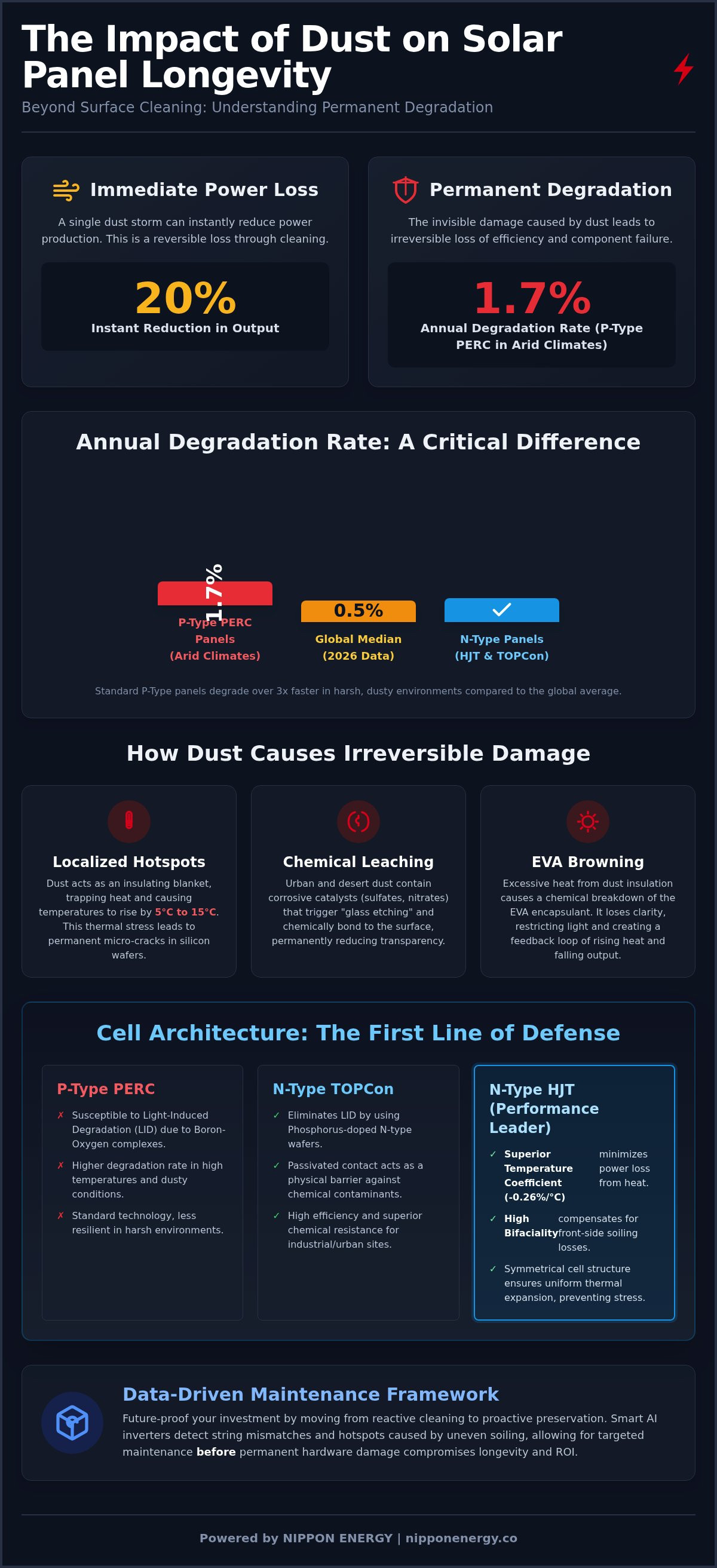
A single dust storm can trigger an immediate 20% reduction in power production, yet the invisible, long-term damage to your energy infrastructure is far more critical for your project's ROI. Many operators view soiling as a surface-level maintenance issue that regular cleaning can easily resolve. In reality, the solar panel degradation rate in dusty conditions is driven by localized thermal stress and chemical leaching that permanently compromises cell integrity. In arid climates like those found in the Middle East, standard P-type PERC modules often see degradation spike as high as 1.7% annually, which is significantly higher than the 2026 global median of 0.5%.
We understand that unexpectedly high O&M costs and output drops are unacceptable for large-scale energy deployments. This analysis provides a deep dive into how N-type HJT and TOPCon architectures mitigate these specific environmental risks through superior temperature coefficients and advanced cell protection. You'll gain a clear understanding of dust-induced degradation mechanisms alongside data-backed justification for selecting high-performance hardware for harsh environments. We'll conclude with a professional maintenance framework designed to preserve your yield and ensure your energy infrastructure remains a stable, high-performing asset for decades.
Key Takeaways
- Distinguish between reversible power loss from surface soiling and the permanent structural damage caused by fine silt abrasion and chemical leaching.
- Analyze why N-type architectures, specifically HJT and TOPCon, maintain a lower solar panel degradation rate in dusty conditions compared to traditional P-type PERC modules.
- Identify the corrosive catalysts in urban and desert dust that trigger irreversible glass "etching" and permanent efficiency drops in arid climates.
- Implement a data-driven maintenance framework using Smart AI inverters to detect string mismatches and hotspots before they compromise hardware longevity.
- Explore how integrated systems like NipponHev future-proof energy infrastructure by maximizing resilience and energy density in high-dust environments.
The Physics of Dust: How Soiling Accelerates Solar Panel Degradation
Dust accumulation is often dismissed as a temporary maintenance hurdle, yet the underlying physics reveals a more destructive reality. While surface soiling creates a reversible power drop, the long-term solar panel degradation rate in dusty conditions is accelerated by irreversible material changes. Understanding The Physics of Soiling is essential for infrastructure longevity. Fine silt particles are particularly hazardous because they create a denser, more uniform layer than coarse sand, which effectively filters the spectral response of the cell. This filtration blocks critical short-wavelength light, forcing the system to operate at sub-optimal efficiency even before permanent damage occurs.
From Soiling to Permanent Material Fatigue
Partial shading from localized dust patches creates high-resistance zones, leading to the formation of "hotspots" where energy is dissipated as heat rather than exported as electricity. This localized thermal stress causes micro-cracking in the silicon wafers, which permanently reduces the electron flow path. In regions with high humidity, such as Karachi or Dubai, dust undergoes a "cementation" effect where it chemically bonds to the glass surface. Soiling-induced degradation is a permanent loss of transparency and conductivity. Over time, these chemical interactions can lead to glass pitting, making subsequent cleaning less effective and permanently altering the module's optical properties.
The Thermal Link: Dust and Temperature Coefficients
Dust acts as an insulating blanket that traps infrared radiation, causing panels to run 5°C to 15°C hotter than their clean counterparts. This temperature surge is critical because every degree above the nominal operating cell temperature compounds the annual degradation rate. Excessive heat triggers a chemical breakdown in the Ethylene Vinyl Acetate (EVA) encapsulant, a process known as browning. As the EVA loses its clarity, it further restricts light transmission to the cells, creating a feedback loop of rising heat and falling output. For project developers in arid climates, this thermal stress isn't just an efficiency loss; it's a structural threat that necessitates hardware with superior temperature coefficients and resilient architecture.
Comparative Degradation: HJT vs. TOPCon vs. PERC in Dusty Environments
Selecting the optimal cell architecture is the primary defense against a high solar panel degradation rate in dusty conditions. Traditional P-type PERC modules are inherently susceptible to Light-Induced Degradation (LID) due to boron-oxygen complexes. In contrast, N-type wafers used in HJT and TOPCon are phosphorus-doped, which eliminates this specific failure mode. Field data from 2026 indicates that while PERC modules in desert climates can degrade by as much as 1.7% annually, N-type technologies maintain significantly higher stability. A comprehensive review of dust deposition confirms that soiling alters the thermal profile of the module, making the architecture's internal resilience a critical factor for long-term ROI.
Nippon HJT Solar Panels: The High-Dust Performance Leader
Nippon HJT Solar Panels utilize a symmetrical cell structure that allows for uniform thermal expansion. This is vital when uneven soiling creates localized temperature gradients across the panel surface. Their superior temperature coefficient of approximately -0.26%/°C minimizes power loss as temperatures rise under dust blankets. These panels also leverage high bifaciality. Rear-side generation can effectively compensate for front-side soiling losses, ensuring a robust 25-year yield in high-dust regions like Lahore and Riyadh. Advanced glass coatings further reduce particle adhesion, simplifying the maintenance cycle for large-scale deployments.
TOPCon Technology for Industrial Dust Resistance
For commercial EPC projects, Nippon TOPCon Solar Panels provide a sophisticated balance of high efficiency and chemical resistance. The tunnel oxide passivated contact acts as a physical barrier against chemical contaminants found in urban dust, such as sulfates and nitrates. These modules exhibit lower Light and elevated Temperature Induced Degradation (LeTID) than P-type alternatives. They maintain an efficiency of 22% or higher even under the diffused light conditions common in hazy or dusty areas. In desert environments, TOPCon modules have demonstrated the most consistent performance, with degradation rates as low as 0.3% per year.
Integrating these advanced architectures ensures your energy infrastructure remains a high-yielding asset despite environmental challenges. You can evaluate the technical specifications of our high-efficiency modules at nipponenergy.co to secure your project's future. Investing in N-type technology is no longer a luxury; it's a technical requirement for arid climate success.
Beyond Surface Dust: Chemical Leaching and Glass Corrosion
Dust is more than a physical obstruction; it's a reactive chemical agent that interacts with the module's surface over time. While the previous sections analyzed electrical and thermal impacts, the long-term solar panel degradation rate in dusty conditions is heavily influenced by the chemical composition of the particulates. Urban dust often contains high concentrations of sulfates and nitrates from industrial activity, whereas desert dust is dominated by calcium carbonate. When these elements accumulate, they don't just sit on the glass. They participate in complex ion-exchange reactions that can permanently compromise the Anti-Reflective Coating (ARC) and the underlying glass structure.
Moisture acts as the primary catalyst for this damage. In coastal hubs like Karachi and Dubai, high humidity and morning dew points turn accumulated dust into an alkaline slurry. This highly basic solution leaches sodium ions from the glass, creating a cloudy appearance that no amount of cleaning can resolve. If operators attempt to clean panels while they are dry and dusty, they risk the "etching" effect. Coarse sand particles act as abrasives under the pressure of brushes, leading to permanent glass pitting. These microscopic scratches scatter light rather than allowing it to pass through, resulting in a permanent loss of light transmission.
Regional Dust Profiles: Pakistan and the Middle East
Site-specific environmental data is crucial for accurate performance modeling. In Lahore, the primary challenge is industrial soot and smog, which creates a sticky, carbonaceous film that is difficult to remove without specialized detergents. Conversely, Karachi's coastal location introduces salt-laden dust that accelerates the corrosion of frame components and electrical connectors. In Riyadh and Dubai, high-velocity sandstorms present a mechanical threat. The kinetic energy of wind-blown sand can strip away protective coatings in a single season. Standard maintenance protocols often fail in these regions because they don't account for the specific chemical and mechanical stressors unique to the local geography.
Preventing Irreversible Optical Loss
To mitigate these risks, modern hardware must utilize advanced material science. Nippon Energy selects materials specifically engineered to resist chemical leaching in harsh environments, ensuring that the module's optical properties remain stable over its 25-year lifespan. We utilize hydrophobic and omniphobic coatings that reduce the surface energy of the glass, making it harder for dust and moisture to bond. This technology is vital because chemical leaching from dust can permanently alter the refractive index of solar glass. By maintaining the integrity of the ARC and the glass-dust interface, we ensure that the system's spectral response remains consistent even in the world's most demanding arid climates.
Strategic Mitigation: Engineering Maintenance for Arid Climates
Effective mitigation requires a shift from reactive cleaning to predictive operations. Traditional maintenance schedules based on calendar days often fail to account for the dynamic nature of the solar panel degradation rate in dusty conditions. Instead, operators must engineer O&M protocols around real-time soiling ratios. This data-driven approach ensures that cleaning interventions occur precisely when the projected energy gain exceeds the cost of the operation. In water-stressed environments, balancing the financial impact of "Cleaning Optimization" is a technical necessity, as it prevents both unnecessary water expenditure and the potential for abrasive wear from excessive handling.
Modern robotic systems and waterless cleaning technologies are critical for preserving the integrity of the module surface. These automated solutions provide consistent pressure and eliminate the risk of alkaline slurries that form when manual teams use unfiltered water sources. Advanced diagnostics now allow operators to distinguish between temporary soiling losses and permanent hardware failure. By isolating these variables, project managers can prevent unnecessary truck rolls and focus resources on sections of the array where thermal stress is most acute.
AI-Enhanced Monitoring and Performance Architecture
The Nippon Smart AI Inverters serve as the central intelligence for modern mitigation strategies. These units identify localized hotspots and string mismatches by analyzing granular performance data in real time, allowing for Solar System Maintenance that is proactive rather than corrective. When the AI detects the specific signature of dust-induced resistance, it alerts the O&M team before localized heat can cause irreversible micro-cracking or EVA browning. This granular oversight is essential for maintaining the high energy density required in commercial and industrial deployments.
EPC Design Considerations for Dusty Zones
Future-proofing an asset begins during the initial site layout. Selecting Solar EPC Services with specific expertise in desert climates ensures that the physical architecture minimizes the solar panel degradation rate in dusty conditions. Our engineers optimize tilt angles to encourage gravity-assisted dust shedding, which significantly reduces the accumulation of fine silt. Furthermore, row spacing and wind corridor designs are calculated to influence airflow patterns, discouraging dust from settling on the module surfaces. These structural optimizations, combined with resilient N-type hardware, create a robust energy infrastructure. You can explore our full range of project development and EPC solutions at nipponenergy.co to ensure your energy assets are engineered for maximum longevity.
Nippon Energy’s Resilience Architecture: Future-Proofing Solar Investments
Nippon Energy’s Resilience Architecture isn't just a design philosophy; it's a technical response to the harsh realities of arid climate energy production. By prioritizing HJT and TOPCon technologies, we address the root causes of the solar panel degradation rate in dusty conditions identified throughout this analysis. These modules serve as the foundation for our integrated NipponHev Systems, which are engineered to deliver maximum energy density in environments where soiling and heat typically compromise output. This architecture creates a stable, high-performance ecosystem by pairing high-efficiency generation with resilient Lithium-Ion Battery Storage. This synergy ensures that energy is not only captured efficiently but is also available when grid stability is compromised by environmental factors.
Our commitment to 25-year asset reliability is backed by hardware specifically engineered for the high-temperature and high-dust environments of South Asia and the Middle East. We don't just provide panels; we provide the structural integrity required for monumental energy projects. By integrating smart AI-driven monitoring with superior cell architecture, we ensure that every kilowatt-hour of potential is realized. This methodical approach to energy infrastructure transforms environmental challenges into manageable technical variables.
The ROI of Material Excellence
Investors must look beyond upfront capital expenditures to calculate the "Dust-Adjusted" Levelized Cost of Energy (LCOE). A marginal difference in annual degradation, such as 0.4% for Nippon HJT modules versus the 0.7% often seen in standard crystalline panels, can equate to millions in additional revenue for utility-scale plants over a 25-year lifecycle. In hubs like Riyadh and Karachi, where environmental stressors are most aggressive, this delta in performance directly influences the long-term bankability of the project. We focus on material excellence to ensure that your infrastructure remains a high-yielding asset, resisting the chemical leaching and thermal fatigue that degrade lesser hardware.
Partnering with Nippon Energy for Long-Term Success
Our presence across major dust-prone regions, from Tokyo to Dubai, provides us with a unique global footprint of technical authority. We provide end-to-end EPC and maintenance solutions that future-proof energy infrastructure for the commercial and industrial sectors. This comprehensive approach ensures that every component, from the cell architecture to the AI-driven monitoring system, is optimized for the specific challenges of South Asia and the Middle East. Project developers seeking to secure their energy future can consult with Nippon Energy’s engineering team to design systems that transcend environmental limitations. We invite you to explore our full suite of solutions at nipponenergy.co to begin your transition toward a more resilient energy architecture.
Engineering Longevity in the World’s Most Demanding Climates
Arid climate energy production demands a strategic shift from simple reactive cleaning to comprehensive structural resilience. This analysis has demonstrated that the solar panel degradation rate in dusty conditions is a complex function of chemical leaching, thermal fatigue, and abrasive wear. Standard P-type modules lack the internal architecture to withstand these stressors without suffering accelerated yield loss. In contrast, N-type technologies provide the necessary barrier against environmental catalysts, ensuring that your energy infrastructure remains a high-performing asset for decades.
By deploying Nippon HJT and TOPCon high-resilience modules, you're investing in a foundation of material excellence. Our global maintenance network across Tokyo, Dubai, and Karachi ensures that every installation benefits from Red Dot Design-level engineering precision. This integrated approach transforms environmental challenges into a calculable advantage for utility-scale and commercial projects. Secure your energy future by partnering with a leader in resilient technology. Consult with Nippon Energy’s Engineers to Future-Proof Your Solar Project. Your vision for sustainable growth is achievable when backed by world-class technical authority.
Frequently Asked Questions
What is the average annual solar panel degradation rate in dusty conditions?
The 2026 industry standard for the solar panel degradation rate in dusty conditions typically ranges between 1.0% and 1.7% for P-type PERC modules. While the global median for modern panels is approximately 0.5%, arid regions experience accelerated aging due to thermal stress and chemical interactions. N-type technologies like TOPCon and HJT maintain significantly lower rates, often staying below 0.4% even in high-dust corridors.
Does dust cause permanent damage to solar panels or just temporary power loss?
Dust results in immediate power loss through soiling and long-term structural damage through material fatigue. While surface accumulation blocks sunlight, it also creates localized hotspots that trigger micro-cracks in silicon wafers. These thermal anomalies lead to permanent efficiency drops that cleaning cannot reverse. Chemical leaching from urban soot or coastal salt further degrades the glass transparency, transforming a temporary maintenance issue into a permanent hardware failure.
How much does soiling affect the ROI of a solar project in Pakistan or the UAE?
Soiling can reduce monthly power output by 25% to 35% in regions like Lahore or Dubai, directly impacting the project's payback period. High accumulation requires frequent professional cleaning, which increases operational expenditures. If the solar panel degradation rate in dusty conditions isn't mitigated by high-resilience hardware, the cumulative loss over 25 years can diminish the net present value of a utility-scale asset by millions.
Are HJT solar panels better than PERC panels for dusty environments?
HJT modules are technically superior for arid climates because their symmetrical cell structure manages uneven thermal expansion more effectively than PERC. Their low temperature coefficient minimizes the efficiency drop as panels heat up under dust blankets. Additionally, high bifaciality allows HJT systems to capture reflected light from the rear side, partially compensating for the energy lost due to front-side soiling accumulation.
Can Smart AI inverters help reduce the impact of dust on solar degradation?
Nippon Smart AI Inverters provide granular diagnostics that distinguish between uniform soiling and critical hardware failures. By monitoring string-level performance, these systems identify localized resistance increases before they escalate into permanent hotspots. This intelligence allows operators to optimize cleaning schedules based on actual performance data, reducing unnecessary abrasive wear and extending the operational lifespan of the entire energy infrastructure.
How often should solar panels be cleaned in high-dust regions like Riyadh or Lahore?
Cleaning frequency depends on the local soiling ratio, but high-dust hubs like Riyadh or Lahore often require interventions every two to four weeks. During peak sandstorm seasons or heavy smog periods, weekly cleaning may be necessary to prevent the cementation effect. Utilizing automated robotic systems or waterless cleaning methods helps maintain output without the high labor costs or water consumption associated with traditional manual washing.
What is the "cementation" effect in solar panel soiling?
Cementation occurs when high humidity or morning dew mixes with accumulated dust to form a sticky, alkaline slurry. As this mixture dries, it chemically bonds to the glass surface, creating a "cemented" layer that is extremely difficult to remove. This process often leaches sodium from the glass, permanently altering its refractive index and reducing the amount of light that reaches the solar cells.
Does abrasive cleaning accelerate solar panel degradation?
Abrasive cleaning, particularly dry brushing of dusty modules, causes microscopic scratches known as glass etching. These pits scatter incoming sunlight rather than allowing it to pass through to the silicon wafers. This permanent optical damage reduces the module's light transmission efficiency for the remainder of its lifespan. Using soft brushes and filtered water is essential to prevent this irreversible mechanical degradation.


