

In the 50°C reality of a Karachi or Multan summer, the standard solar panel isn't an asset; it's a thermal liability that loses up to 25% of its rated capacity the moment it's needed most. You've likely noticed that your energy yields plummet during peak afternoon hours, precisely when cooling demands are at their highest. This performance gap isn't just a technical quirk; it's a structural failure of conventional P-type modules that leads to inaccurate ROI projections and accelerated hardware degradation. Selecting the best solar panels for high temperatures is no longer a matter of preference but a requirement for long term financial viability in Pakistan's intensifying climate.
This 2026 engineering guide explores why Heterojunction (HJT) and Tunnel Oxide Passivated Contact (TOPCon) technologies are the only viable solutions for maintaining solar ROI in extreme heat. We will examine how Nippon HJT and TOPCon architectures minimize thermal de-rating and extend hardware lifespan through superior temperature coefficients. You'll gain a technical understanding of the structural differences between these cells and learn how to future proof your energy infrastructure against rising global temperatures. By the end of this analysis, you'll be equipped to transition from standard efficiency models to high performance systems that thrive under extreme thermal stress.
Key Takeaways
- Quantify the impact of thermal de-rating by understanding the Pmax temperature coefficient, the definitive metric for calculating real-world performance in Pakistan's climate.
- Evaluate the structural differences between HJT and TOPCon technologies to determine which architecture provides the highest thermal stability for your specific infrastructure.
- Identify the best solar panels for high temperatures to prevent accelerated hardware degradation and ensure your ROI projections remain accurate over a 25 year lifespan.
- Leverage environmental factors like the Albedo Effect in sandy terrains to capture up to 20% additional energy yield through bifacial panel engineering.
- Discover how Nippon Energy's high-tech architecture integrates HJT modules with Smart AI Inverters to maintain peak efficiency during extreme summer surges.
The Thermal Paradox: Why Heat is the Enemy of Solar Efficiency
The industrial solar sector often operates under a dangerous misconception: that more sunlight always equates to more power. While irradiance is the fuel for photovoltaic systems, the ambient heat accompanying that light acts as a silent tax on energy production. In Pakistan, where summer temperatures regularly exceed 45°C, the gap between theoretical nameplate capacity and actual energy yield becomes a critical financial risk. Standard panels engineered for temperate climates struggle to maintain structural integrity under these conditions, leading to significant power de-rating when demand peaks. Identifying the best solar panels for high temperatures requires moving beyond marketing brochures and into the fundamental physics of semiconductor behavior.
Thermal stress doesn't just reduce daily output; it causes long term damage to the module's internal chemistry. High heat accelerates Potential Induced Degradation (PID), a phenomenon where stray currents leak from the cells to the frame, permanently reducing the module's capacity. This degradation isn't reflected in short term performance tests but becomes painfully obvious in the third or fourth year of operation when ROI projections begin to fail. To future proof an energy investment, engineers must prioritize hardware that maintains a stable voltage even as the mercury rises.
The Physics of Photovoltaic Heat Loss
Solar cells are semiconductors, and their efficiency depends on the movement of electrons across a P-N junction. As a panel absorbs thermal energy, the internal resistance of the silicon increases, which directly impedes current flow. This leads to a measurable "Voltage Drop" because the increased kinetic energy of the atoms interferes with the orderly movement of charge carriers. As temperature rises, the rate of electron recombination increases, effectively neutralizing charge carriers before they can contribute to the electrical circuit. This physical limitation explains why a panel rated for 550W at 25°C may only produce 420W during a Karachi heatwave.
Real-World Operating Temperatures (NOCT vs. STC)
Standard Test Conditions (STC) evaluate panels at a cell temperature of 25°C, a baseline that is virtually non-existent in South Asian outdoor environments. When ambient air reaches 40°C, the dark surface of a solar module can easily climb to 65°C or higher due to thermal absorption. This reality makes Nominal Operating Cell Temperature (NOCT) a far more reliable metric for commercial project feasibility in Pakistan. NOCT measurements assume more realistic variables, including an 800 W/m² irradiance and moderate wind speeds. Project developers must also account for mounting height and airflow; systems installed too close to a roof surface trap heat, exacerbating thermal stress. Selecting the best solar panels for high temperatures means looking for modules with the lowest possible temperature coefficients to mitigate these environmental variables.
Temperature Coefficients: The Metric That Defines 2026 Performance
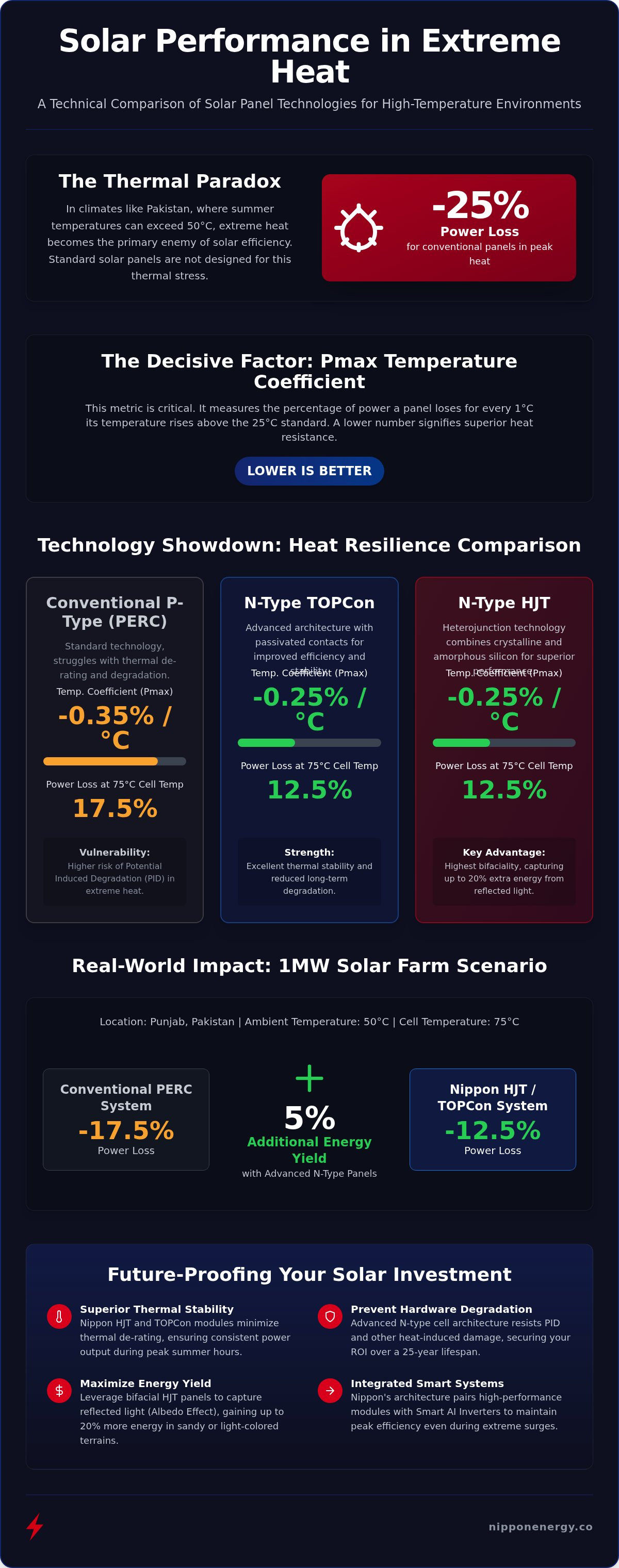
The technical viability of a solar asset in Pakistan's high-irradiance zones depends on a single specification: the Pmax temperature coefficient. This figure represents the percentage of power output a module loses for every degree Celsius the cell temperature rises above the standard 25°C. While standard P-type PERC modules typically feature a coefficient of -0.35%/°C, advanced N-type technologies like HJT and TOPCon have pushed this boundary down to -0.25%/°C. This 0.1% delta may appear negligible on a single panel, but it represents a massive shift in energy density when scaled across a commercial or industrial array. Selecting the best solar panels for high temperatures requires a shift from prioritizing upfront cost to prioritizing this specific thermal resilience metric.
Consider the performance of a 1MW solar farm during a 50°C ambient afternoon in Punjab. Under these conditions, cell temperatures frequently reach 75°C, creating a 50-degree deviation from standard test conditions. A standard PERC system would suffer a 17.5% power loss due to heat alone. In contrast, an N-type system using Nippon HJT or TOPCon architecture limits that loss to 12.5%. This 5% recovery translates to an additional 50kW of instantaneous power during peak demand hours. Over a 25 year lifecycle, this efficiency gain significantly accelerates the Internal Rate of Return (IRR) and ensures the project remains profitable even as global temperatures continue to rise.
Understanding Pmax, Voc, and Isc Coefficients
Thermal energy impacts the electrical characteristics of a solar cell unevenly. Open-circuit voltage (Voc) is highly sensitive to heat, dropping sharply as temperatures rise, while short-circuit current (Isc) may see a marginal, though insufficient, increase. This voltage instability is a primary driver of system inefficiency because it forces the inverter to work harder to find the optimal operating point. Utilizing Smart AI solar inverters is essential for managing these fluctuations, as they use high-speed MPPT algorithms to maintain string stability despite rapid thermal shifts. Without this orchestration, the voltage drop from heat can push the system outside the inverter's peak efficiency window.
Calculating Your Heat-Adjusted Energy Yield
To estimate your actual summer output, you can use a straightforward formula: Power Loss = (Cell Temperature - 25) × Temperature Coefficient. In the Pakistani market, assuming a cell temperature 25°C to 30°C above ambient is a safe engineering baseline. Protecting this yield also requires rigorous solar system maintenance to ensure that dust accumulation doesn't create localized hotspots. Even the best solar panels for high temperatures can fail if thermal dissipation is blocked by debris. For developers seeking to maximize their energy infrastructure, Nippon Energy provides the technical modeling necessary to predict these heat-adjusted yields with precision.
HJT vs. TOPCon: Which Architecture Survives the Heat?
The transition from P-type to N-type silicon represents the most significant shift in solar engineering for the 2026 market. Traditional P-type cells, which utilize boron-doped silicon, are inherently susceptible to boron-oxygen defects that trigger Light Induced Degradation (LID). In high-heat environments like Pakistan, this degradation is often accelerated by thermal stress. N-type architectures, including HJT and TOPCon, are doped with phosphorus, making them immune to these specific defects. This foundational material advantage makes them the best solar panels for high temperatures, as they maintain their structural integrity and power output far longer than legacy modules.
Beyond material composition, the physical cell structure determines how a panel manages thermal energy. Bifaciality also plays a critical role in cooling; by capturing reflected light on the rear side, these modules achieve higher energy density without increasing the thermal load on the front-facing cells. This dual-sided generation allows for better heat dissipation compared to monofacial panels, which trap heat against an opaque backsheet. For large scale infrastructure, selecting between HJT and TOPCon requires an analysis of how these specific layers respond to ambient extremes.
The HJT Advantage: Symmetrical Structure and Low Temperature Processing
Heterojunction (HJT) technology is engineered for maximum thermal stability. Unlike standard cells, HJT utilizes a symmetrical structure with thin layers of intrinsic and doped amorphous silicon surrounding a crystalline N-type wafer. These amorphous layers act as a thermal buffer, significantly reducing the rate of electron recombination as temperatures rise. Nippon HJT solar panels leverage this architecture to achieve an industry-leading temperature coefficient of approximately -0.26%/°C. Because HJT cells are manufactured at temperatures below 200°C, they experience less internal mechanical stress during production, resulting in a more resilient finished product that can withstand the daily thermal cycling of desert climates without micro-cracking.
TOPCon Resilience: High Efficiency at Scale
Tunnel Oxide Passivated Contact (TOPCon) technology offers a high-performance alternative that balances manufacturing scalability with impressive thermal characteristics. By adding a thin tunnel oxide layer and a phosphorus-doped polysilicon layer to the cell, TOPCon solar panels minimize carrier recombination and maximize voltage. While their temperature coefficient is slightly higher than HJT, typically around -0.29%/°C to -0.30%/°C, they remain far superior to traditional PERC modules. This makes TOPCon the preferred choice for massive utility-scale projects in moderate-to-high heat regions where cost-per-watt is a primary driver. In tropical humidity, TOPCon's robust passivation layers provide an extra level of protection against moisture-induced degradation, ensuring the best solar panels for high temperatures also remain durable against environmental corrosion.
Engineering for Extreme Climates: UAE, Saudi Arabia, and Pakistan
The Sun Belt regions, spanning from Karachi to Riyadh, present a unique set of atmospheric challenges that demand more than just standard hardware. High UV indices and ambient heat are compounded by heavy particulate matter, which can significantly degrade performance if not managed through advanced engineering. Deploying the best solar panels for high temperatures is only the first step; the surrounding infrastructure must be designed to mitigate the specific stressors of these desert and tropical hubs. Nippon Energy’s localized engineering teams in Karachi, Dubai, and Riyadh apply these principles to ensure long-term hardware survival in the world's most demanding climates.
Sandy terrains, characteristic of many Pakistani and Middle Eastern project sites, offer a distinct advantage through the Albedo Effect. When using bifacial N-type modules, the high reflectivity of the ground surface allows the rear side of the panel to capture significant additional irradiance. This can result in a 20% or greater increase in energy yield compared to monofacial systems in the same location. To maximize this gain, the system must be integrated with high-capacity lithium-ion battery storage, ensuring that the midday surge in production is preserved for peak evening demand.
Combating Dust and Soiling in High-Heat Zones
Dust accumulation is more than an optical obstruction; it's a thermal hazard that directly impacts the lifespan of your investment. Particulate matter on the glass surface increases thermal absorption, leading to localized "hot-spots" that can permanently damage solar cells. In large-scale utility farms, manual cleaning is often insufficient and water-intensive. Automated dry-cleaning robotics and the NipponHev system provide a more sustainable solution by maintaining surface clarity without risking micro-cracks from thermal shock during washing.
Structural Design for Thermal Ventilation
The physical layout of an array dictates its ability to shed heat through natural convection. Increasing the mounting height and optimizing the gap spacing between modules allows for better airflow, which can reduce cell temperatures by several degrees. While tracking systems are often used to maintain optimal incidence angles, they must be engineered to withstand high-velocity wind loads common in coastal cities like Karachi. Comprehensive solar EPC services are vital for performing site-specific thermal modeling, ensuring that the best solar panels for high temperatures are supported by an equally resilient mounting architecture. To ensure your project is engineered for maximum thermal resilience, consult with Nippon Energy for specialized high-heat solar architecture.
The Nippon Energy Solution: Future-Proofing with HJT and TOPCon
Integrating the best solar panels for high temperatures into a cohesive energy strategy requires a partner that understands the intersection of advanced materials and regional environmental stressors. Nippon Energy bridges this gap by combining Japanese engineering precision with the operational scale required for South Asian and Middle Eastern energy markets. Our HJT and TOPCon modules aren't merely components; they're the foundational architecture for high-reliability energy infrastructure. By prioritizing N-type silicon and specialized passivation layers, we provide hardware that remains stable where conventional systems fail. This commitment to structural integrity ensures that your investment is protected against the intensifying thermal cycles of the next three decades.
The Nippon Advantage is defined by a rigorous approach to project development and EPC services. We don't just supply panels; we engineer complete thermal management solutions that account for local wind loads, soil types, and irradiance profiles. Our global presence in high-heat hubs like Karachi and Dubai has allowed us to refine our hardware for real-world extremes. This experience translates into 25 to 30 year performance warranties that are among the most robust in the industry, providing a level of financial security that is essential for large scale utility and industrial projects.
Nippon HJT: The Gold Standard for 2026
Nippon HJT Solar Panels represent the pinnacle of thermal engineering for the 2026 market. These modules achieve ultra-low annual degradation rates of under 0.4%, ensuring that the energy yield you project today remains consistent over a 25 to 30 year lifecycle. This longevity is supported by a high bifaciality factor of up to 90%, which allows for maximized energy harvest from reflected irradiance in sandy or light-colored terrains. In 2026, Nippon HJT modules have set new efficiency records, surpassing 23.5% at the module level while maintaining the lowest temperature coefficients in the industry. This performance is backed by comprehensive warranties that reflect the structural durability of our heterojunction architecture.
Integrated Energy Ecosystems
Reliability isn't achieved through hardware alone; it requires an intelligent orchestration of the entire power plant. Nippon Smart AI Inverters serve as the brain of the system, using predictive algorithms to optimize power output during extreme thermal de-rating events. When ambient heat begins to impact voltage, the AI-driven MPPT adjustments ensure the system operates at its peak possible efficiency. This technical ecosystem is further supported by Nippon Energy’s professional solar system maintenance and monitoring services, which provide real-time data on thermal health and soil accumulation. This holistic approach ensures that the best solar panels for high temperatures are always operating within their optimal parameters. To secure the ROI of your next infrastructure development, consult with Nippon Energy for your high-temperature solar project.
Engineering Thermal Resilience for the Next Decade
The intensifying thermal reality in Pakistan requires a transition from standard solar components to high-performance energy architecture. As established, the Pmax temperature coefficient is the definitive metric for preserving ROI, with N-type technologies providing the only viable path for extreme heat. Selecting the best solar panels for high temperatures is no longer an optional upgrade; it's a structural requirement for ensuring energy security during peak summer demand. This technical shift allows operators to move beyond laboratory benchmarks and achieve predictable, long-term financial outcomes.
Nippon Energy provides the specialized hardware and localized EPC expertise necessary to navigate these environmental stressors. Our Nippon HJT Solar Panels feature an industry-leading -0.26%/°C temperature coefficient, ensuring maximum efficiency in hubs like Karachi and Lahore. Backed by Japanese-engineered durability, these systems are built for 30-year lifespans and supported by a global footprint across the UAE, Saudi Arabia, and Pakistan. Future-proofing your investment requires a partner that understands the physics of thermal resilience and the necessity of precision engineering.
Optimize your high-temperature solar project with Nippon Energy’s HJT technology and secure the future of your energy infrastructure today.
Frequently Asked Questions
Do solar panels work better in hot weather?
Solar panels perform less efficiently in hot weather because heat increases the internal resistance of the semiconductor cells. While they require light to generate power, the thermal energy that accompanies intense sunlight causes a voltage drop that reduces overall wattage. Systems in Pakistan typically see their lowest efficiency during peak summer afternoons when cooling demand is highest. This is why selecting the best solar panels for high temperatures is essential for maintaining a stable energy yield.
What is a good temperature coefficient for solar panels?
A good temperature coefficient for modern high-performance modules is typically -0.30%/°C or lower. Legacy P-type panels often sit around -0.35%/°C, while advanced N-type technologies like Nippon HJT achieve industry-leading figures of -0.26%/°C. A lower coefficient ensures that the panel retains a higher percentage of its rated capacity as the cell temperature exceeds the standard 25°C benchmark. This metric directly determines the long-term ROI and performance stability in desert environments.
Why are HJT solar panels better for desert climates?
HJT solar panels are superior for desert climates because their symmetrical heterojunction structure utilizes amorphous silicon layers that act as a thermal buffer. This architecture significantly reduces electron recombination at high temperatures, allowing the cells to maintain higher voltage stability. Additionally, HJT cells are manufactured using low-temperature processes that minimize internal mechanical stress. This results in a module that is more resilient to the extreme thermal cycling common in regions like Sindh and Punjab.
Can solar panels melt or catch fire in extreme heat?
Solar panels don't melt from ambient environmental heat, but extreme temperatures can exacerbate underlying faults like micro-cracks or poor electrical connections. These issues can lead to localized hotspots where temperatures exceed the module's safety limits, potentially causing internal arcing or fire. Utilizing high-quality N-type modules and professional EPC services ensures that the system is engineered to manage these thermal risks safely through proper ventilation and the use of high-grade, fire-rated materials.
How much efficiency do solar panels lose at 40 degrees Celsius?
At an ambient temperature of 40°C, a solar panel's internal cell temperature often reaches 65°C, creating a 40-degree deviation from standard test conditions. For a panel with a -0.35%/°C coefficient, this results in a 14% power loss. By choosing the best solar panels for high temperatures with a -0.26%/°C coefficient, that loss is reduced to approximately 10.4%. This recovered energy represents a significant increase in total system output during the hottest hours of the day.
Is TOPCon better than PERC for high temperatures?
TOPCon is significantly better than traditional PERC for high-temperature applications due to its N-type silicon wafer and advanced tunnel oxide passivation. These features reduce carrier recombination and provide a superior temperature coefficient compared to legacy P-type modules. While HJT remains the premium choice for thermal stability, TOPCon offers a highly efficient and cost-effective alternative for utility-scale projects. It maintains a higher voltage at peak heat, ensuring better compatibility with modern high-speed inverter systems.
What is the Nominal Operating Cell Temperature (NOCT)?
Nominal Operating Cell Temperature (NOCT) is a standardized metric that reflects how a panel performs under realistic outdoor conditions rather than laboratory settings. It assumes an irradiance of 800 W/m², an ambient temperature of 20°C, and a wind speed of 1 m/s. Most modules have an NOCT rating between 42°C and 46°C. This figure provides engineers with a more accurate baseline for calculating energy yields in the field compared to the unrealistic 25°C STC benchmark.
How does bifacial technology help with solar panel cooling?
Bifacial technology assists with thermal management by utilizing a dual-glass structure that allows for better heat dissipation than standard panels with opaque backsheets. Because bifacial modules generate power from both sides, they achieve a higher energy density without a proportional increase in the thermal load on the front cells. The glass-on-glass design also provides superior structural rigidity, which helps the module resist the mechanical stresses caused by rapid thermal expansion and contraction in extreme climates.


