

If your solar investment loses 20% of its generation capacity the moment the Karachi summer hits 40°C, is it truly an asset or simply a depreciating liability? For most industrial operators in the city, heat derating and salt-induced corrosion are daily financial drains. You deserve a system that maintains peak performance. Identifying the right hjt solar panel suppliers in Karachi is the first step toward reclaiming that lost energy potential through superior cell architecture.
This 2026 guide explains why Heterojunction (HJT) technology is the only logical choice for Karachi's extreme micro-climates. We'll show you how to secure maximum energy yield per square foot. You'll learn to verify K-Electric net-metering proficiency and choose a partner capable of future-proofing your energy independence with monumental precision. We're moving beyond standard hardware toward a permanent, high-performance structural investment for a three-decade horizon in a marine environment.
Key Takeaways
- Master the technical benefits of Heterojunction technology, which fuses crystalline and thin-film silicon for superior energy conversion in urban environments.
- Understand why HJT’s low temperature coefficient ensures minimal power degradation during Karachi’s extreme 45°C summer heatwaves.
- Identify leading hjt solar panel suppliers in karachi that utilize dual-glass encapsulation to prevent salt-mist corrosion in coastal zones like DHA and Clifton.
- Streamline your 2026 K-Electric net-metering application by coordinating with EPC partners who manage the complete NEPRA documentation and approval process.
- Access localized technical support and Japanese-engineered hardware through Nippon Energy’s specialized operational base in the Korangi Industrial Area.
The Rise of HJT Solar Panel Suppliers in Karachi's 2026 Market
Heterojunction (HJT) technology represents a monumental shift in photovoltaic engineering. It functions as a sophisticated hybrid, fusing the high-power density of crystalline silicon with the superior temperature resilience of amorphous silicon thin-film layers. This dual-layer architecture allows for higher conversion efficiencies and a significantly lower temperature coefficient than traditional mono-PERC modules.
Karachi's 2026 energy crisis has accelerated the adoption of these ultra-high efficiency modules. As grid volatility increases, industrial hubs like Korangi and SITE are pivoting toward HJT to secure long-term energy price stability. Finding qualified hjt solar panel suppliers in karachi is no longer just a procurement task; it's a strategic move to protect industrial margins against rising operational costs.
A specialized supplier provides the technical authority required to manage complex HJT deployments. Unlike general solar traders who move volume based on price, a dedicated partner understands the engineering nuances of HJT. This includes optimizing the bifacial gain and ensuring the structural integrity of the mounting systems to handle the increased weight of dual-glass encapsulation.
Why Karachi's Grid Needs HJT Efficiency
K-Electric's 2026 tariff slabs have made inefficient solar systems a financial risk. In dense urban areas like PECHS and Gulshan, where rooftop real estate is restricted, maximizing energy yield per square foot is the only way to achieve a viable ROI. HJT technology excels here because its high bifaciality factor allows the rear side of the panel to harvest reflected light from Karachi's flat, concrete rooftops, significantly increasing total generation without expanding the system footprint.
Identifying Tier-1 HJT Suppliers in Pakistan
Distinguishing Tier-1 hjt solar panel suppliers in karachi involves looking at bankability, manufacturing scale, and the depth of their local infrastructure. A genuine Tier-1 partner offers a 25-30 year hardware warranty backed by a physical presence in the city. This local footprint, such as Nippon Energy’s operational base in the Korangi Industrial Area, is vital for rapid after-sales support and system monitoring. It's also critical to verify the technology; while N-type TOPCon panels are an improvement over older tech, only HJT provides the symmetrical cell structure and low-temperature processing that ensures the lowest possible annual degradation rates in Pakistan's harsh climate.
HJT vs TOPCon: Performance Analysis for Karachi's Extreme Heat
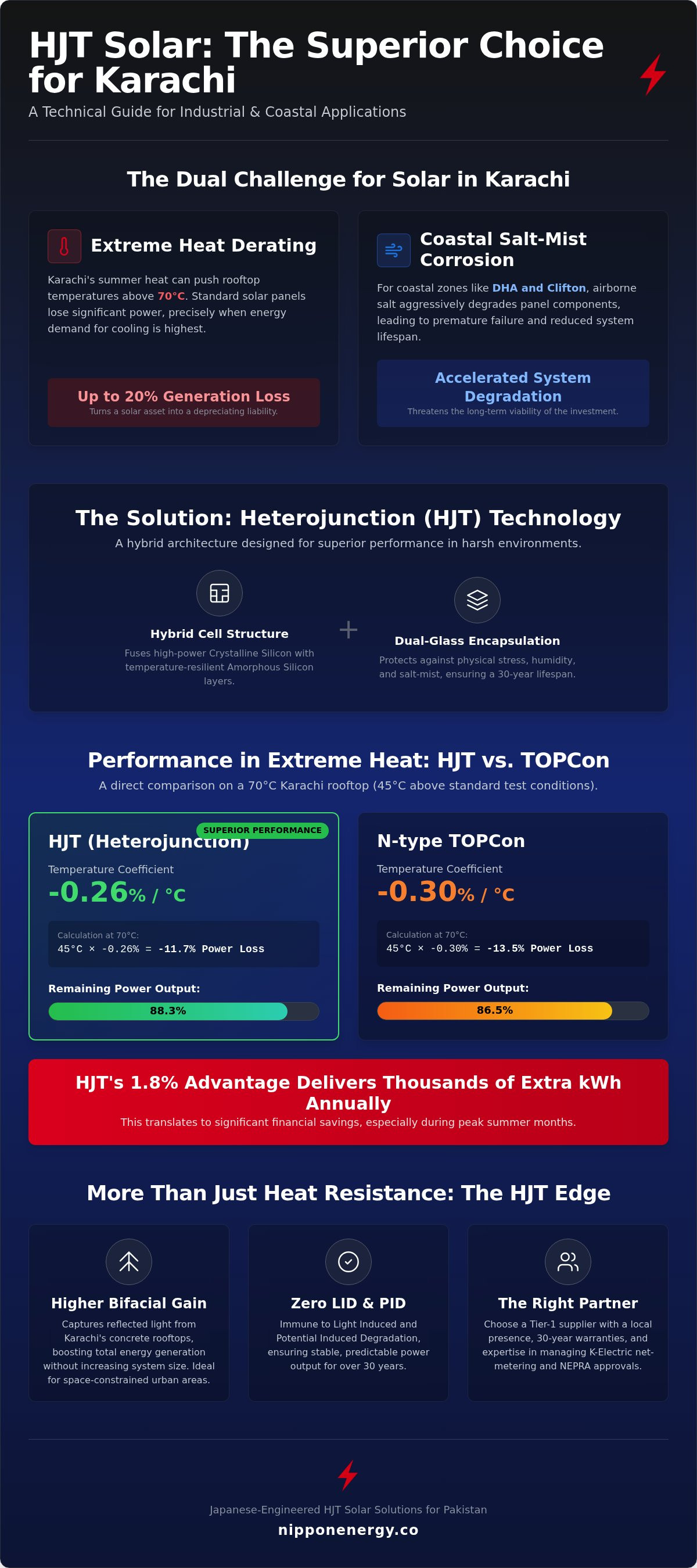
Thermal stability is the primary differentiator when evaluating solar architectures for Pakistan's coastal climate. While most modules perform optimally at 25°C, Karachi's rooftop temperatures frequently exceed 70°C during the peak summer months. In these conditions, standard panels suffer from significant heat derating, leading to a substantial drop in energy harvest precisely when cooling demands are highest. Choosing hjt solar panel suppliers in karachi who prioritize low temperature coefficients is essential for maintaining system efficiency.
HJT technology utilizes an N-type silicon wafer that's inherently immune to Light Induced Degradation (LID) and Potential Induced Degradation (PID). This immunity ensures that the initial power output doesn't drop after the first few weeks of intense UV exposure. Over a 30-year lifecycle, this resilience results in a significantly higher cumulative energy yield compared to older P-type technologies. The long-term financial viability of a solar project depends on this sustained performance, making the hardware's structural integrity as vital as its peak wattage.
The Temperature Coefficient Advantage
The temperature coefficient measures how much power a panel loses for every degree Celsius above the standard test condition of 25°C. HJT modules typically feature a coefficient of -0.26%/°C, whereas even advanced Topcon Solar Panels usually hover around -0.30%/°C. When a Karachi rooftop hits 70°C, the temperature delta is 45°C. In this scenario, a TOPCon system loses 13.5% of its rated capacity, while an HJT system loses only 11.7%. This 1.8% gap might seem minor, but for an industrial plant in SITE or Korangi, it translates into thousands of additional kilowatt-hours produced annually during the hottest hours of the day.
Bifacial Gain on Concrete Rooftops
Karachi's architectural landscape, dominated by flat concrete and white-washed rooftops, provides an ideal environment for bifacial modules. These surfaces act as natural reflectors, bouncing sunlight onto the rear side of the solar cells. HJT's symmetric cell structure enables higher bifaciality than TOPCon because the solar cell is identical on both sides, allowing for nearly equal light absorption from the rear. Local residential installations often see a rear-side gain of 10% to 15% depending on the mounting height and surface albedo. This additional harvest effectively lowers the levelized cost of energy (LCOE) for the homeowner. To maximize these gains, it's advisable to seek a technical assessment of your specific site conditions before finalizing your hardware selection.
Coastal Resilience: Solving the Corrosion Problem in DHA and Clifton
Karachi’s coastal geography presents a unique engineering challenge that standard solar installations often fail to address. The South-West Monsoon delivers a persistent salt-mist that penetrates standard module backsheets, leading to internal delamination and rapid hardware failure. For property owners in DHA and Clifton, the proximity to the Arabian Sea means that atmospheric salinity is a constant threat. Selecting specialized hjt solar panel suppliers in karachi is critical because they provide hardware specifically engineered for these high-salinity marine environments.
Nippon Energy approaches coastal engineering with a focus on monumental durability. By utilizing Japanese-inspired precision, we ensure that every component, from the cell architecture to the mounting rails, is rated for long-term exposure to humid, salt-laden air. This methodical approach to material science prevents the premature degradation that often plagues generic solar setups in Karachi's southern districts.
Dual-Glass Protection Against Salt-Mist
HJT technology typically employs a glass-to-glass (dual-glass) encapsulation method, which is fundamentally superior to the plastic backsheets used in older PERC modules. This symmetrical glass structure is impermeable to moisture ingress, effectively eliminating the risk of acetic acid formation that corrodes internal circuits. Furthermore, the use of Polyolefin (POE) encapsulants instead of standard EVA provides a more stable chemical barrier. POE doesn't degrade into acidic byproducts when exposed to high humidity, which is essential for preventing Potential Induced Degradation (PID). This technical choice directly reduces the long-term solar system maintenance burden for coastal residents, ensuring the system remains an asset rather than a liability.
Mounting Standards for High-Wind Coastal Zones
High-rise installations in Clifton and beachfront properties in DHA face intense wind loads that can compromise structural integrity. Standard mounting rails often lack the tensile strength required for these zones. Engineering a resilient system requires the use of Hot-Dip Galvanized (HDG) steel or anodized aluminum structures with a minimum coating thickness to resist oxidation. It’s also vital to address galvanic corrosion, which occurs when dissimilar metals like aluminum frames and steel fasteners meet in a salty atmosphere. Using marine-grade stainless steel (SS316) fasteners and specialized isolation washers ensures the frame remains secure for its 30-year lifecycle. Leading hjt solar panel suppliers in karachi prioritize these structural details to ensure that the monumental power of HJT is matched by a foundation that won't buckle under Karachi's coastal pressures.
Selecting an HJT Supplier: K-Electric Net-Metering and EPC Excellence
The deployment of a high-efficiency solar plant in Karachi requires more than just high-wattage modules. It demands a partner capable of navigating the complex regulatory and technical landscape of the city’s power grid. Leading hjt solar panel suppliers in karachi must demonstrate a deep understanding of the 2026 K-Electric prosumer framework. This expertise ensures that the technical superiority of HJT technology translates directly into financial credits on your monthly utility bill through seamless grid integration.
A high-performance installation is an integrated ecosystem rather than a collection of separate components. While HJT panels provide the raw generation power, the intelligence of the system resides in the power conversion stage. Pairing these modules with smart ai solar inverters allows for real-time energy orchestration. These intelligent units manage grid fluctuations and optimize the export of surplus energy, protecting your hardware from the voltage instability often seen in industrial areas like North Karachi or Landhi.
Navigating K-Electric Net-Metering in 2026
The 2026 K-Electric net-metering process has evolved into a highly structured coordination between the consumer, the EPC provider, and NEPRA. Residents must provide a specific set of documentation, including proof of property ownership, a valid CNIC, and a technical feasibility report signed by a PEC-certified engineer. Managing the 'Peak vs Off-Peak' window is essential for financial optimization; the system must be configured to maximize exports during daylight hours when generation is at its peak. A qualified solar epc services provider acts as your technical advocate, managing the inspection timelines and ensuring the bi-directional meter is installed without bureaucratic delays.
Technical Support and Warranty Fulfillment
Longevity in a marine environment depends on rapid, local support. You should verify that your chosen hjt solar panel suppliers in karachi maintain a physical service center within the city, such as Nippon Energy’s facility in the Korangi Industrial Area. This ensures that any technical anomalies are addressed within hours rather than weeks. It’s also vital to distinguish between a product warranty, which covers manufacturing defects, and a performance warranty, which guarantees a specific energy yield over 30 years. For commercial HJT installations, 24/7 remote monitoring is a non-negotiable requirement. This proactive approach allows engineers to detect and rectify string-level issues before they impact your overall ROI. To secure your energy future with a partner that understands Karachi's unique grid requirements, consult with our technical team today.
Nippon Energy: Karachi's Partner for HJT Solar Excellence
Nippon Energy functions as a technical authority within the Pakistan market, bridging the gap between global manufacturing standards and local engineering requirements. Our operational base in Plot 14, Sector 15, Korangi Industrial Area, Karachi, allows us to serve as a premier choice among hjt solar panel suppliers in karachi. We provide Japanese-engineered hardware designed specifically for high-temperature resilience, ensuring that our systems maintain structural integrity where generic modules fail. This local infrastructure ensures that our visionary technology is backed by grounded, technical support.
Our commitment to excellence extends beyond the hardware itself. We focus on creating a monumental impact through long-term reliability and precision engineering. By controlling the logistics and deployment from our Karachi facility, we ensure that every HJT project adheres to the highest safety and performance protocols. This methodical approach is designed to inspire trust through technical prowess, providing industrial and residential clients with the tools for large-scale energy success.
Localized Engineering for Global Standards
Our engineering team customizes every solar project to meet the specific load profiles of Karachi’s diverse consumer base. By maintaining a direct manufacturer-to-consumer supply chain, we eliminate the technical gaps often found in third-party trading. This streamlined logistics model ensures that every Nippon HJT panel arrives with its structural integrity intact. We provide a 30-year performance warranty on Nippon HJT panels, which serves as a testament to our confidence in the hardware’s longevity. This commitment to durability is essential for clients who view solar as a permanent, multi-decadal asset rather than a temporary fix.
Future-Proofing with AI and Storage
True energy independence requires an architecture that extends beyond daylight hours. Integrating HJT modules with lithium ion battery storage creates a resilient backup system that mitigates the impact of grid load-shedding. Our Nippon Smart AI Inverters manage these transitions with millisecond precision, protecting sensitive industrial equipment from voltage spikes. For those seeking a unified energy solution, the NipponHev system offers a pre-engineered, integrated solar architecture that simplifies the transition to renewable energy.
As Karachi moves toward the 2026 shift in time-of-use (ToU) battery arbitrage, having a system capable of intelligent energy orchestration becomes a financial necessity. Our Smart AI inverters ensure your storage system charges during low-tariff windows and discharges during peak hours, maximizing your ROI. To begin your transition toward monumental energy efficiency, contact Nippon Energy's Karachi Office for a Technical Feasibility Study.
Engineering Your 30-Year Energy Legacy
The transition to Heterojunction technology is a strategic necessity for any operator facing Karachi’s dual challenges of extreme thermal stress and coastal salinity. HJT’s superior temperature coefficient and dual-glass architecture provide a level of resilience that standard modules simply can't match. By choosing among the most technically proficient hjt solar panel suppliers in karachi, you secure a system designed for maximum yield and structural longevity in a demanding marine environment.
Nippon Energy brings Japanese engineering excellence directly to your site through our specialized facility in the Korangi Industrial Area. Our Karachi-based EPC support simplifies the 2026 K-Electric net-metering process, while our 30-year performance guarantee protects your investment for decades. We don't just install panels; we architect high-performance energy ecosystems that empower your growth. It’s time to move beyond temporary energy fixes toward a permanent, intelligent power solution that withstands the test of time.
Secure Your 2026 Energy Future with Nippon HJT Solar Solutions
Frequently Asked Questions
Is HJT solar technology worth the higher price in Karachi compared to TOPCon?
HJT technology represents a superior long-term investment in Karachi because its lower temperature coefficient ensures higher energy yields during peak summer heat. While the initial capital expenditure is higher than TOPCon, the increased generation capacity and slower annual degradation result in a lower levelized cost of energy. Choosing hjt solar panel suppliers in karachi ensures you receive hardware capable of maintaining performance levels for over three decades.
How do HJT panels perform during Karachi's humid monsoon season?
HJT panels demonstrate exceptional performance during the monsoon season due to their dual-glass encapsulation and Polyolefin (POE) encapsulants. These specific materials are impermeable to moisture, which prevents internal corrosion and the formation of acetic acid. This structural integrity is vital for maintaining electrical insulation and preventing power leakage in the high-humidity conditions prevalent across Karachi’s coastal districts.
Can I install HJT solar panels on a high-rise building in Clifton?
High-rise installations in Clifton are highly feasible when utilizing marine-grade mounting structures and high-tensile fasteners. Systems must be engineered to withstand the intense wind loads and salt-mist exposure found at elevated altitudes near the Arabian Sea. Using anodized aluminum frames and stainless steel hardware prevents galvanic corrosion, ensuring the structural integrity of the solar array remains monumental for its entire lifecycle.
What is the typical K-Electric net-metering approval time for HJT systems in 2026?
The typical timeline for K-Electric net-metering approval in 2026 generally ranges from four to eight weeks from the date of application. This process involves a technical feasibility study, NEPRA coordination, and the final physical installation of the bi-directional meter. Working with an experienced EPC partner ensures that all documentation is managed with technical precision to avoid bureaucratic delays in the approval cycle.
Do HJT panels require special maintenance in Karachi's dusty environment?
HJT modules don't require specialized maintenance beyond the standard cleaning cycles necessary for Karachi’s dusty environment. Their dual-glass construction makes the surface more resilient to the abrasive effects of wind-blown sand compared to traditional backsheet modules. Regular water-based cleaning is sufficient to maintain peak light absorption, provided the cleaning is performed during early morning or evening hours to avoid thermal shock.
Which HJT solar panel wattage is most efficient for residential use in Karachi?
Modules in the 700W to 720W range are currently the most efficient choice for residential rooftops in Karachi. These high-wattage HJT panels maximize energy yield per square foot, which is essential in dense urban neighborhoods like Gulshan or PECHS. Utilizing higher wattage modules reduces the total number of panels required, thereby minimizing the weight load and the complexity of the mounting structure.
Does Nippon Energy provide financing for HJT solar projects in Pakistan?
Nippon Energy specializes in end-to-end EPC services and the supply of Japanese-engineered hardware from our Korangi facility. While we manage the technical and regulatory aspects of your project, we recommend that clients explore the State Bank of Pakistan’s renewable energy financing schemes. Our team provides the necessary technical documentation and feasibility reports required by local banks to facilitate these specialized green energy loans.
What is the expected degradation rate of HJT panels after 25 years in Karachi?
HJT panels are engineered to maintain approximately 88% to 90% of their original power output after 25 years of operation. This durability is a result of N-type silicon wafers that are inherently immune to Light Induced Degradation. This sustained performance ensures that your system remains a high-yielding asset, providing a reliable energy supply long after the initial investment has been fully recovered through utility savings.


