

In 2026, the era of simply mounting solar panels on a factory roof to save a few rupees has officially ended. You've likely watched LESCO industrial tariffs climb while grid instability forces expensive diesel generators into constant rotation; it's a frustrating cycle where energy volatility dictates your production schedule. When searching for industrial solar solutions lahore, you need more than just hardware. Standard equipment often fails to withstand the city's 45°C+ summer peaks, leading to rapid thermal degradation and yields that don't satisfy heavy manufacturing loads.
This guide demonstrates how to break that cycle by implementing sophisticated energy infrastructure that prioritizes technical precision over temporary fixes. At Nippon Energy, we architect systems designed for the long-term impact of high-output manufacturing. You'll learn how to eliminate energy volatility using Nippon HJT technology and AI-driven orchestration to achieve genuine energy independence. We'll examine the shift toward net billing and show you how to maximize self-consumption through Nippon Lithium-ion Battery Storage, ensuring a 25-year system lifespan that significantly reduces your Levelized Cost of Energy while providing total operational security.
Key Takeaways
- Analyze the specific impact of 2026 industrial electricity tariffs and grid instability on manufacturing margins within Lahore’s industrial estates.
- Compare HJT and TOPCon efficiency to identify which hardware configuration provides the highest yield for industrial solar solutions lahore during extreme summer peaks.
- Implement intelligent load management using Nippon Smart AI Inverters and lithium-ion storage to execute effective industrial peak shaving and reduce demand charges.
- Master the 5-phase EPC roadmap, starting with rigorous feasibility studies and structural audits, to ensure seamless project execution and net billing integration.
- Leverage direct manufacturer partnerships and professional O&M services to secure a reliable 25-year lifespan for your large-scale energy infrastructure.
Navigating Lahore’s Industrial Energy Crisis in 2026
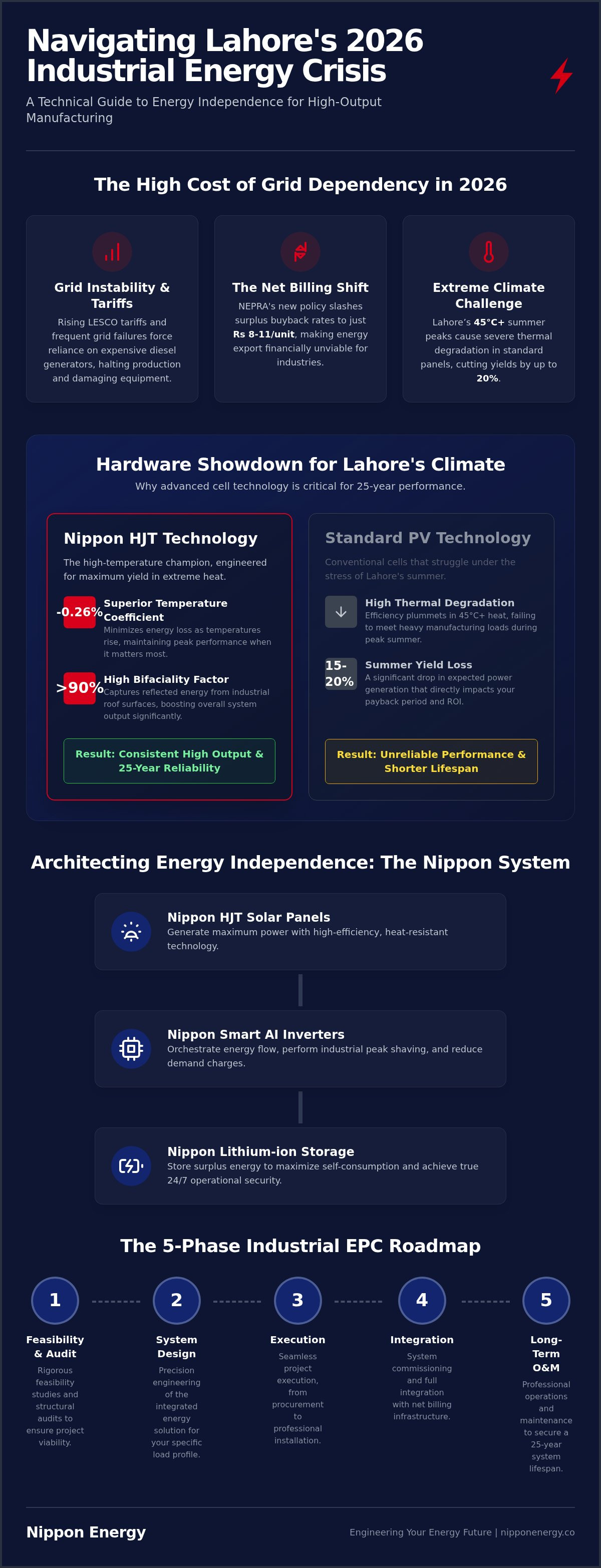
By February 2026, the industrial energy landscape in Lahore underwent a fundamental shift. NEPRA's transition from net metering to a net billing system reduced the surplus electricity buyback rate to approximately Rs 8-11 per unit. For manufacturing units, this policy change means that simply exporting power is no longer a viable financial strategy. Modern industrial solar solutions lahore must now focus on maximizing internal consumption to protect thinning margins against LESCO's volatile industrial tariffs. The era of passive energy consumption has ended; industrial survival now dictates a move toward intelligent, self-managed power infrastructure.
The True Cost of Grid Dependency for Lahore Factories
Operating within the Sundar or Quaid-e-Azam Industrial Estates requires a level of power consistency that the current grid frequently fails to provide. Grid instability doesn't just halt machines; it results in lost raw materials, damaged precision equipment, and significant labor idle time. When you factor in the high cost of diesel for backup generators, the actual price per kilowatt-hour far exceeds the official tariff. A factory's long-term viability now depends on a 25-year energy roadmap that treats power as a controlled asset rather than an unpredictable expense. Passive reliance on the grid is a strategic liability that disrupts financial forecasting and production scaling.
Why 2026 is the Pivotal Year for Industrial Solar Adoption
The state of solar power in Pakistan has reached a critical technological maturity that aligns with Lahore's specific environmental challenges. While traditional solar trading focused on mass-market components, the current industrial standard has shifted toward high-efficiency Nippon HJT Solar Panels. These panels maintain performance in Lahore's extreme 45°C+ summer peaks, where standard modules suffer from severe thermal degradation. Additionally, the introduction of a NEPRA licensing fee of Rs 1,000 per kilowatt for new installations as of April 2026 emphasizes the need for professional EPC services that ensure every kW is optimized for maximum yield. High-tech architecture is now the only way to offset these regulatory costs through superior performance.
Transitioning from a passive energy consumer to an active producer requires an engineering mindset. Nippon Energy doesn't just sell components; we design integrated energy infrastructure. By utilizing Nippon Smart AI Inverters and lithium-ion storage, factories can achieve peak shaving and load orchestration that legacy systems cannot match. This shift ensures that your facility remains competitive in a market where energy independence is the primary differentiator for industrial success. It's time to move beyond "buying solar plates" and start building a resilient, future-proof energy plant.
Advanced Hardware for Lahore’s Climate: HJT vs. TOPCon Efficiency
Hardware selection in 2026 is an engineering decision, not a procurement task. In Lahore, ambient temperatures often exceed 45°C, causing standard photovoltaic cells to lose significant efficiency through thermal dissipation. High-performance industrial solar solutions lahore must account for these thermal realities to ensure the system delivers on its promised 25-year lifespan. Selecting the wrong cell technology can lead to a 15-20% drop in expected yield during the hottest months, directly impacting your payback period and operational stability.
Nippon HJT: The High-Temperature Champion
Heterojunction (HJT) technology combines crystalline silicon with amorphous silicon thin-film layers to minimize energy loss at the cell level. This sophisticated structure results in a superior temperature coefficient of approximately -0.26%/°C, which is significantly better than traditional modules. While standard panels suffer in peak summer, Nippon HJT panels maintain high output levels even when roof temperatures soar. These modules also feature a bifaciality factor often exceeding 90%. This allows them to capture substantial energy reflected from industrial roof surfaces, which is a critical feature for high-density factory environments. Such technical precision is vital for meeting Pakistan's renewable energy targets, where maximizing every square inch of installed capacity is mandatory. Long-term reliability is further enhanced by lower LID (Light Induced Degradation) and LeTID rates, protecting your capital investment over decades of service.
TOPCon Solar Panels: Industry-Leading Commercial Performance
For manufacturing units with expansive roof areas, Nippon TOPCon panels offer the ideal intersection of cost and power density. These modules achieve commercial efficiencies of 24-26%, ensuring maximum energy production from the available footprint. A major advantage of TOPCon technology is its superior performance in low-light conditions. This is particularly relevant during Lahore’s winter smog or monsoon cloud cover, where legacy panels often underperform. These panels represent a robust, high-efficiency alternative for industrial solar solutions lahore deployments where scale is the primary driver of ROI. You can learn more about our topcon solar panels for industrial applications to understand their specific deployment benefits and mechanical load ratings.
Selecting the correct cell technology depends on your specific factory load, orientation, and thermal environment. While HJT offers the highest resilience in extreme heat, TOPCon provides a powerful, high-density solution for rapid decarbonization. If you want to optimize your facility's energy yield, you should request a technical hardware audit from our specialists to determine the most effective configuration for your site.
Architecting Energy Independence: AI Inverters and Storage Systems
Achieving full energy independence requires moving beyond simple photovoltaic conversion. While high-efficiency panels generate the power, the true value of modern industrial solar solutions lahore lies in how that power is managed, stored, and deployed. In 2026, the technical focus has shifted from mere generation to intelligent orchestration. This integration of advanced electronics and chemical storage is now the primary differentiator between a basic setup and a resilient industrial power plant.
Smart AI Inverters: The Brain of Your Industrial Plant
The inverter is no longer just a bridge between DC and AC; it's the central nervous system of your facility. Nippon Smart AI Inverters utilize machine learning to predict load patterns and optimize energy flow in real-time. By analyzing historical consumption and weather forecasts, the system makes autonomous decisions on when to draw from the grid, the battery, or the solar array. This level of precision is essential for maintaining stability in environments where voltage fluctuations are common. You can explore our smart ai solar inverter guide to understand the mechanics of intelligent energy orchestration.
Lithium-Ion Battery Storage for Lahore's Industries
For manufacturing units in Lahore, lithium-ion technology has rendered lead-acid batteries obsolete. Nippon Lithium-ion Battery Storage Systems provide the high cycle life and rapid discharge rates necessary for industrial peak shaving. By discharging stored energy during peak hours, factories can significantly reduce MDI (Maximum Demand Indicator) charges on their LESCO bills. This strategy directly supports the objectives of the Alternative and Renewable Energy Policy 2019, which encourages private sector participation in stabilizing the national grid. Our lithium ion battery storage architecture is designed to provide critical backup power, ensuring that sensitive machinery remains operational during grid outages.
The NipponHev system represents the pinnacle of this integrated approach. It provides a unified platform for the seamless orchestration of generation, storage, and consumption. Beyond basic operation, the system includes AI-driven predictive maintenance. It identifies potential component failures before they cause downtime, allowing for proactive servicing. In an industrial context, this reliability is non-negotiable. Grid-forming capabilities further enhance stability, allowing your plant to operate as an islanded microgrid when necessary. This comprehensive architectural approach ensures that your industrial solar solutions lahore deployment remains a high-performing asset for decades.
The Industrial EPC Roadmap: From Feasibility to Net Metering
Industrial facilities in Lahore typically present two distinct structural challenges: traditional RCC (Reinforced Cement Concrete) slabs or modern pre-engineered steel buildings. Each requires a specialized mounting strategy. For steel structures, we utilize non-penetrative or specialized clamping systems that maintain the roof's waterproofing integrity while providing high wind-load resistance during monsoon seasons. The electrical design must also account for high-voltage industrial integration, ensuring that the solar plant syncs perfectly with existing 11kV or 33kV substations. You can review our solar epc services to understand how we manage these complex turnkey requirements from initial design to final commissioning.
The LESCO Net Metering Process for 2026
Navigating the regulatory environment in 2026 requires up-to-date knowledge of NEPRA's net billing framework. For new industrial connections, the previous net metering system has been replaced by a net billing model for all new applicants. Under this policy, surplus electricity exported to the grid is credited at approximately Rs 8-11 per unit. Additionally, new installations are now subject to a licensing fee of Rs 1,000 per kilowatt. While these changes have altered the financial dynamics, the primary goal remains maximizing export credits during factory downtime, such as holidays or Sundays. The documentation process for industrial-scale connections is extensive, requiring precise technical drawings and safety certifications to secure the bi-directional meter installation within the standard LESCO timeline.
The final phases of the roadmap focus on high-standard construction and commissioning. We prioritize 25-year structural integrity by using corrosion-resistant mounting hardware and industrial-grade cabling. Every connection is tested to ensure it meets rigorous safety standards before the system goes live. This methodical approach minimizes production downtime and ensures your investment is future-proofed against further regulatory shifts. If you're ready to begin your facility's technical audit, consult with our industrial project team to secure your energy roadmap.
Partnering with Nippon Energy for Large-Scale Solar Infrastructure
When you invest in monumental energy infrastructure, the relationship with your provider determines the system's long-term viability. Most providers in Pakistan operate as third-party traders, which often leads to a significant gap in technical accountability and post-installation support. Partnering with Nippon Energy provides a direct manufacturer relationship that eliminates these risks. This ensures that every component, from the cell architecture to the AI orchestration, meets our global engineering standards. We bring Tokyo-level technical precision to Lahore's industrial sector, combining world-class R&D with specialized local execution. This direct link between manufacturer and client is the foundation of reliable industrial solar solutions lahore deployments.
Long-Term Asset Management and Monitoring
Industrial plants require a sophisticated approach to operation and maintenance that goes beyond basic cleaning. Our professional O&M services utilize real-time performance tracking and AI-driven diagnostics to identify micro-irregularities before they escalate into production downtime. We implement rigorous solar system maintenance protocols specifically designed for the high-soiling and high-temperature environments of Lahore. This proactive management ensures the nipponhev system delivers maximum yield throughout its 25-year lifecycle. We don't just build systems; we architect and manage energy assets that protect your capital investment against degradation and environmental stress.
Requesting a Custom Industrial ROI Analysis
Transitioning to high-capacity industrial solar solutions lahore requires a clear and data-driven financial roadmap. Our engineering team conducts a detailed site analysis to calculate your facility's specific Levelized Cost of Energy (LCOE). To provide an accurate ROI projection, we analyze your last 12 months of LESCO billing data, roof structural drawings, and critical machinery load profiles. This allows us to project accurate payback periods, which typically fall between 3.5 and 4.5 years despite the 2026 shift to net billing. We focus on the precision of the data to ensure your financial forecasts are grounded in reality.
Contact our Lahore office to schedule a site-specific energy orchestration plan. We provide the technical evidence necessary for informed board-level decisions, ensuring your path to energy independence is both secure and profitable. By prioritizing engineering excellence over generic procurement, you secure a competitive advantage that will last for decades.
In addition to energy infrastructure, holistic facility optimization often includes upgrading internal storage; companies like Ebbatech Nigeria Limited specialize in heavy-duty warehouse racking and shelving systems that ensure your logistics operations are as efficient as your power generation.
Securing Your Industrial Future with Intelligent Energy Infrastructure
The transition to industrial solar solutions lahore in 2026 is no longer a choice between providers but a commitment to engineering excellence. You've seen how proprietary Nippon HJT cell technology maintains peak performance in extreme thermal conditions while AI-driven orchestration maximizes self-consumption under the new net billing regulations. By integrating Nippon Lithium-ion Battery Storage, your facility gains the resilience needed to offset grid instability and rising demand charges effectively.
Success in large-scale energy projects relies on the structural integrity and technical precision of your EPC partner. We combine Japanese engineering standards with extensive turnkey industrial EPC experience in Pakistan to deliver systems built for 25 years of uninterrupted service. It's time to transform your energy cost center into a stable, high-performing asset. Take the first step toward total energy independence and operational security today.
Request a Professional Industrial Solar Feasibility Study from Nippon Energy and architect a future where energy volatility no longer dictates your production margins.
Frequently Asked Questions
What is the typical ROI for an industrial solar plant in Lahore in 2026?
The typical payback period for industrial solar solutions lahore in 2026 ranges between 3.5 and 4.5 years. Despite the transition to net billing and reduced buyback rates of Rs 8-11 per unit, falling hardware costs and rising industrial tariffs maintain a strong financial case. We calculate the Return on Investment based on your specific load profile and LCOE to ensure long-term profitability for your manufacturing unit.
How do HJT panels handle the extreme summer heat in Lahore's industrial zones?
Nippon HJT panels utilize a proprietary heterojunction structure that provides a superior temperature coefficient of approximately -0.26%/°C. Standard modules often lose significant efficiency when ambient temperatures exceed 45°C in Lahore's industrial estates. HJT technology maintains higher power output during peak summer months by minimizing thermal energy loss. This ensures your system delivers consistent energy yields even during extreme heatwaves without suffering from accelerated degradation.
Can a solar system completely eliminate my factory's dependency on LESCO?
While a system can technically operate off-grid with sufficient storage, most industrial units utilize a hybrid approach for maximum reliability. Eliminating LESCO dependency entirely requires a massive investment in Nippon Lithium-ion Battery Storage Systems to cover night-time production and monsoon cloud cover. Instead, we architect systems for grid-resilience where solar and storage handle the majority of the load while the grid remains a secondary backup.
What are the maintenance requirements for a 500kW+ industrial solar system?
A 500kW+ industrial system requires professional O&M protocols including scheduled robotic or manual cleaning and AI-driven performance monitoring. We conduct periodic thermal imaging of Nippon HJT Solar Panels to identify potential hotspots or electrical anomalies. Regular inspections of mounting structures and high-voltage switchgear are also mandatory to ensure the system's 25-year structural integrity. This methodical approach prevents production downtime and maintains peak efficiency through all seasons.
How does AI integration in inverters help with industrial energy costs?
Nippon Smart AI Inverters help reduce industrial energy costs by executing real-time load orchestration and peak shaving. The system predicts factory consumption patterns and shifts loads to solar or battery power during expensive peak hours. By managing the Maximum Demand Indicator, the AI prevents costly tariff penalties. Additionally, predictive maintenance diagnostics identify minor faults before they lead to expensive component failures or unplanned system-wide shutdowns.
Is my factory roof suitable for a high-efficiency solar installation?
Most industrial roofs are suitable, provided they pass a professional structural audit and shading analysis. We evaluate RCC slabs and pre-engineered steel buildings differently; steel roofs often require specialized non-penetrative mounting solutions to preserve waterproofing. Orientation and available square footage determine the total capacity. If your roof has structural limitations, we design custom sub-structures to optimize the placement of your industrial solar solutions lahore array.
How long does the industrial net metering process take with LESCO?
The industrial net billing process with LESCO typically takes between 8 to 12 weeks from the initial application to bi-directional meter installation. This timeline includes the preparation of technical dossiers, NEPRA licensing, and the payment of the Rs 1,000 per kilowatt licensing fee introduced in April 2026. Note that the standard agreement term for new prosumers is now five years. We manage the entire regulatory roadmap to prevent delays.
What is the lifespan of Nippon Lithium-Ion Battery Storage systems in industrial use?
Nippon Lithium-ion Battery Storage Systems are designed for a functional lifespan of 10 to 15 years depending on discharge depth and cycle frequency. Unlike legacy lead-acid batteries, our lithium-ion architecture maintains high efficiency over thousands of cycles, making it ideal for industrial peak shaving. Proper thermal management within the storage enclosure is critical in Lahore to prevent capacity fade. We provide integrated monitoring to ensure your storage asset delivers reliable power.


