
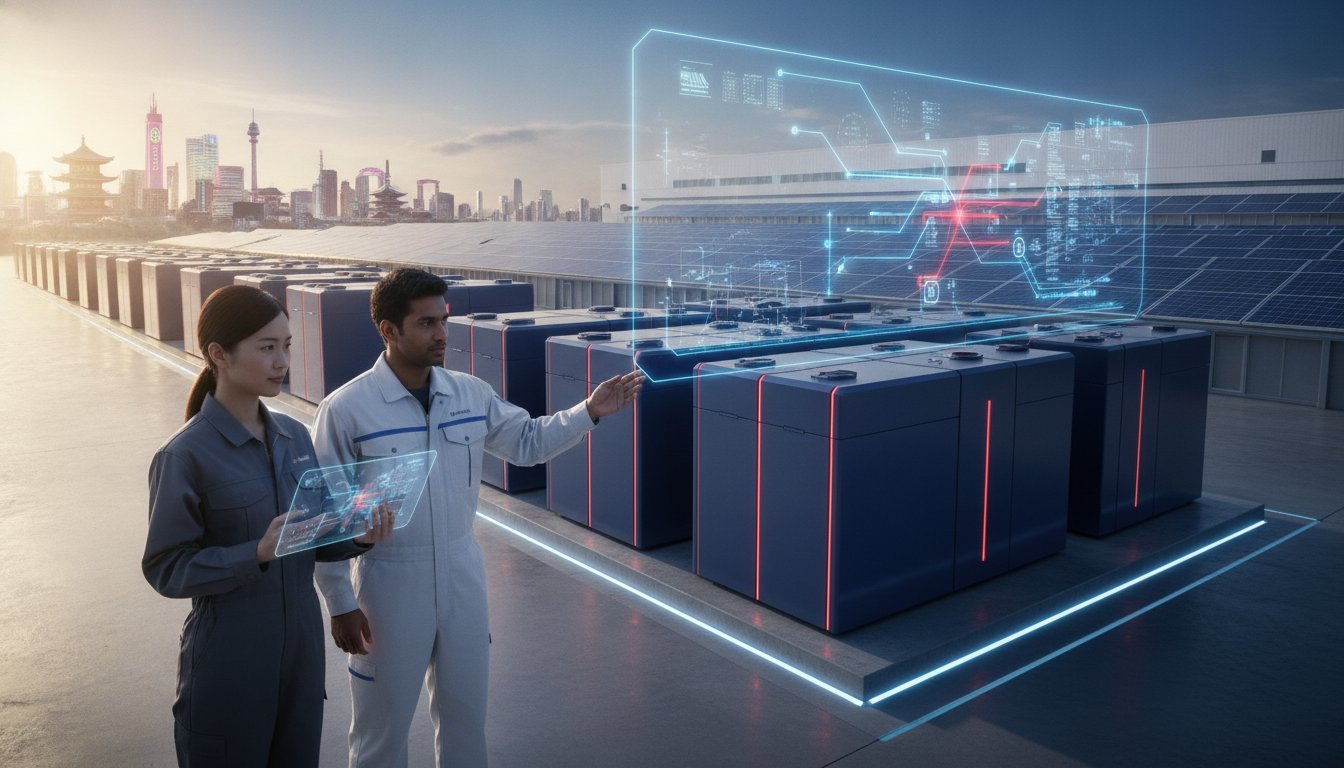
What if your facility's energy strategy was no longer at the mercy of an aging national grid? In Pakistan's industrial corridors, rising peak demand charges and frequent grid instability aren't just operational hurdles; they're direct threats to production uptime and global competitiveness. Implementing a robust commercial solar battery storage solution has become the primary defense against volatile utility rates and inconsistent power quality. Managing the complexity of high-efficiency PV integration requires more than just hardware; it demands a calculated architectural approach.
This guide serves as your strategic blueprint to master the technical and financial layers of industrial-scale energy. We'll show you how to leverage advanced LFP technology and optimize system sizing to achieve full energy autonomy. You'll gain a clear understanding of how a scalable, modular energy architecture reduces your operational expenditure and future-proofs your facility. From navigating local regulatory shifts to implementing AI-driven orchestration, we're detailing the path to a resilient, high-performance energy future.
Key Takeaways
- Transitioning from grid dependence to a strategic energy architecture is critical for mitigating operational risks and rising peak demand charges in the 2026 landscape.
- Integrating commercial solar battery storage with Smart AI Inverters transforms passive hardware into an active orchestration layer for superior energy independence.
- Modular system designs provide the necessary flexibility to scale energy capacity and discharge power as your industrial requirements and facility loads evolve.
- Effective financial modeling requires moving beyond simple payback periods to evaluate the Levelized Cost of Storage (LCOS) and the long-term impact of cycle life.
- A successful turnkey implementation relies on granular load profile analysis and direct manufacturer engineering to ensure system sizing is precisely aligned with operational needs.
The Strategic Necessity of Commercial Solar Battery Storage in 2026
Pakistan's industrial sector faces a volatile energy paradigm where grid reliance translates directly to operational vulnerability. In the current 2026 landscape, the global shift toward integrated storage confirms that commercial solar battery storage has evolved from a secondary backup option into a primary strategic asset. For the modern enterprise, a battery energy storage system (BESS) provides a decisive architectural advantage. It functions as an orchestration layer that stabilizes power quality and ensures compliance with increasingly stringent carbon neutrality mandates required for global trade. By integrating storage, facilities transform energy from a fluctuating operational expense into a controlled, predictable resource.
Value stacking allows a single installation to serve multiple financial objectives simultaneously. Beyond simple backup, these systems perform frequency regulation and load shifting while capturing available localized incentives and reducing reliance on expensive grid power. This multi-layered utility ensures that the capital expenditure delivers returns across several operational categories. As regional regulatory bodies implement stricter standards for grid interconnection and load management, having on-site storage becomes a necessary buffer against infrastructure delays and supply constraints. It is a move toward structural integrity that protects the bottom line from external market shocks.
Peak Shaving and Demand Charge Mitigation
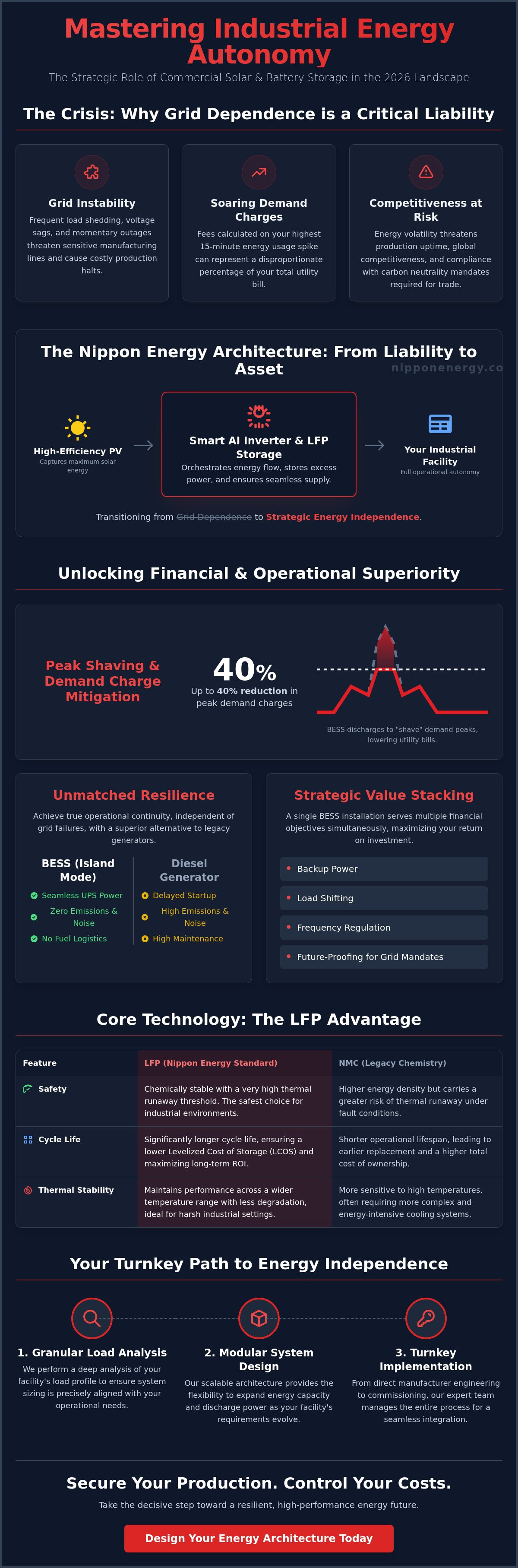
Demand charges often represent a disproportionate percentage of industrial utility bills in Pakistan. These fees are calculated based on the highest 15-minute interval of electricity usage during a billing cycle. A Nippon Lithium-ion Battery Storage System targets these specific spikes by discharging stored energy when facility demand exceeds a predetermined threshold. This mathematical optimization reduces the peak load seen by the utility. Many industrial facilities successfully lower their peak demand charges by up to 40%, which leads to a substantial and immediate reduction in monthly OPEX. The result is a more efficient load profile that maximizes the utility of every kilowatt-hour generated on-site.
Operational Resilience and Grid Independence
Grid instability and frequent load shedding remain constant threats to production uptime. Our advanced storage architecture provides high-speed Uninterrupted Power Supply (UPS) capabilities that protect sensitive manufacturing lines from voltage sags and momentary outages. When regional grid failures occur, the system transitions into "Island Mode." This allows the facility to maintain critical infrastructure and production schedules without the noise, emissions, or high fuel logistics required by traditional diesel generators. It's a shift toward true industrial-scale energy independence that prioritizes longevity and precision. By removing the single point of failure inherent in grid dependence, businesses secure their long-term growth potential.
This focus on long-term stability is not limited to infrastructure; just as industrial systems require a holistic strategy to thrive, the approach to health and peak performance seen at centers like Battersea Park Clinic demonstrates how specialized care can build personal resilience and vitality.
Technical Architecture: Lithium-Ion Chemistry and Smart AI Orchestration
The effectiveness of commercial solar battery storage depends entirely on its underlying architecture; a system is only as capable as its chemistry and control logic. In the 2026 market, the industry has moved away from simple backup hardware toward integrated energy orchestration. This transition ensures that storage isn't just a passive reservoir but an active financial asset that responds to grid conditions in real time. Achieving this level of performance requires a precise combination of stable cell chemistry and intelligent power electronics designed for industrial-scale loads.
Lithium-Ion vs. Traditional Storage Chemistries
Nippon Lithium-ion Battery Storage Systems utilize advanced Lithium Iron Phosphate (LFP) chemistry because it provides the safety profile required for high-density industrial environments. While older Nickel Manganese Cobalt (NMC) cells offer high energy density, they carry a higher risk of thermal runaway. In contrast, LFP is chemically stable and offers a significantly longer cycle life, which is essential for maximizing ROI. For a deeper technical comparison of these technologies, review our guide on Lithium Ion vs Lead Acid Solar Battery: The 2026 Performance Architecture Guide.
Current grid energy storage data highlights that LFP has become the global standard for stationary applications due to its lower degradation rates and superior safety. Nippon Energy has confirmed it'll begin production of proprietary LFP batteries in September 2026 to meet this rising demand. This move ensures that our clients receive hardware that meets the 55% domestic content threshold required for enhanced tax credits while maintaining the highest engineering standards.
AI-Enhanced Energy Management Systems (EMS)
The shift from passive storage to active orchestration is driven by Smart AI Solar Inverters. These systems don't just store electrons; they manage them using predictive analytics. By analyzing historical load patterns and real-time weather forecasts, the Energy Management System (EMS) determines the optimal time to charge or discharge. This capability allows for automated energy arbitrage, where the system charges when grid prices are low and discharges during peak price spikes to protect the facility's OPEX.
Industrial safety remains paramount, particularly in high-temperature environments where thermal management systems must maintain cell integrity. Nippon systems employ liquid-cooling protocols to ensure stable operation even during rapid discharge cycles. This hardware layer integrates seamlessly with Nippon HJT and TOPCon solar arrays through high-speed communication protocols. This synchronization ensures that the generation and storage components act as a single, unified power plant. If you're designing a new facility, you can explore our solar project development and EPC services to ensure every component is optimized from the ground up.
Roundup of Commercial Energy Storage Solutions: Selecting the Right Scale
Selecting the correct scale for commercial solar battery storage is a critical engineering decision that dictates both capital efficiency and operational performance. Sizing must align with the granular load profile of the facility to avoid the technical and financial inefficiencies of over-provisioning. In the 2026 energy landscape, the architecture of these systems is defined by two primary metrics: total energy capacity (kWh) and instantaneous discharge power (kW). While capacity determines how long a system can sustain a load, discharge power determines which specific industrial processes it can support during a peak event.
The modular advantage allows for a "build-as-you-grow" strategy, where additional battery modules integrate into the existing architecture as enterprise loads evolve. This scalability ensures that a facility's initial investment remains relevant even if production capacity increases. Whether a project requires indoor rack-mounted units for urban space optimization or outdoor containerized units for massive industrial loads, the choice of scale must be rooted in data-driven load analysis. It's about matching the storage architecture to the specific rhythm of the facility's energy consumption.
Modular Rack Systems for Small-to-Medium Enterprises
Retailers, office complexes, and light manufacturing facilities typically find the highest utility in modular rack-mounted systems. These units offer a compact footprint, making them ideal for indoor installations in dedicated electrical rooms where space is at a premium. They integrate seamlessly with existing rooftop PV arrays, allowing for a streamlined installation process. These systems scale from 50kWh to 500kWh, providing enough capacity to manage daily peak demand while offering a resilient buffer against local grid fluctuations. Their plug-and-play architecture reduces the time required for on-site commissioning, which translates to shorter project timelines and immediate OPEX reduction.
Containerized BESS for Industrial Parks and Data Centers
For large-scale industrial parks and energy-intensive data centers, containerized BESS solutions provide the necessary power density. These pre-engineered, turnkey units are housed in standardized 10ft or 20ft shipping containers, designed for rapid outdoor deployment. Capacity ranges from 1MWh to 10MWh+, often serving as the central hub for microgrids or utility-scale solar projects. These units feature integrated liquid cooling and fire suppression systems to maintain safety in high-density configurations. By centralizing storage in a containerized format, enterprises achieve significant economies of scale and simplify the management of massive energy loads. This architecture is essential for operations that require multi-hour discharge capabilities to maintain production during sustained grid outages; for those managing high-performance computing workloads, learn more about eCircles LLC.
Financial Engineering: Calculating ROI and Lifecycle Costs
Financial modeling for commercial solar battery storage in Pakistan requires a transition from simple payback metrics to a detailed analysis of the Levelized Cost of Storage (LCOS). In an environment where utility tariffs are subject to frequent adjustments and currency volatility, LCOS provides a stable baseline for evaluating long-term energy costs. By adopting this metric, financial directors can accurately compare the cost of stored solar energy against the rising rates of grid power. This approach ensures that the investment serves as a structural hedge against energy inflation, transforming a fluctuating expense into a controlled asset.
Cycle Life and Degradation Impacts on ROI
The project’s internal rate of return (IRR) is sensitive to the physical degradation of the battery cells over time. Depth of Discharge (DoD) is the primary variable here; while a higher DoD increases usable capacity, it can accelerate the wear on the chemical structure and reduce the total cycle life. Maintaining the structural integrity of the asset requires balancing discharge depth with the required longevity of the system. LCOS is defined as the total lifetime cost of a storage system divided by its cumulative energy throughput. For a deeper analysis of these variables, consult our guide on Lithium-Ion Battery Cycle Life: The Definitive Guide to Storage Longevity in 2026.
Beyond direct energy savings, the ROI of a commercial system is enhanced by tax depreciation benefits and existing duty exemptions for renewable energy equipment. These fiscal tools, when combined with AI-driven energy arbitrage, significantly compress the time required to reach a break-even point. By stacking these financial advantages, industrial facilities can secure a predictable energy cost structure for the next decade, providing a competitive advantage in global markets where energy costs are a major component of production.
Third-Party Ownership and Financing Models
For C&I enterprises prioritizing capital preservation, third-party ownership models provide a viable alternative to direct investment. Solar-as-a-Service and BESS leasing allow facilities to integrate advanced storage as an operational expense (OPEX) rather than a capital one. This off-balance-sheet approach mitigates technical risk while providing immediate savings through avoided demand charges. You can explore the financial trade-offs between ownership and leasing in our cost-benefit study on Solar Battery Lithium.
Implementing a sophisticated energy architecture allows businesses to bypass the limitations of traditional financing while securing modern technology. These models often include performance guarantees and system monitoring, ensuring that the hardware operates at peak efficiency throughout its lifecycle. To start your financial analysis, you can request a customized system sizing and load profile analysis from our engineering team.
Implementing a Turnkey Commercial Storage Strategy with Nippon Energy
The deployment of a commercial solar battery storage system is a complex architectural undertaking that requires more than just high-quality hardware. It demands a unified strategy where engineering, procurement, and construction (EPC) are synchronized to eliminate technical friction. Nippon Energy provides a distinct advantage by serving as both the manufacturer and the lead engineer. This dual role ensures that every component, from the cell chemistry to the power electronics, is optimized for the specific load requirements of your facility. By centralizing the project lifecycle, we remove the fragmentation often found in third-party integrations, resulting in a more resilient and efficient energy asset.
End-to-End EPC Orchestration
A successful implementation begins with a granular load profile analysis and a rigorous feasibility study. Our team manages the entire process, including site engineering, permitting, and final grid interconnection. This comprehensive approach is detailed in our resource on Solar EPC Services: The Definitive Guide to Turnkey Project Excellence in 2026. By maintaining professional project management and local support, we minimize operational downtime during the installation phase. This ensures that the transition to a high-capacity storage architecture is seamless and doesn't disrupt existing production schedules.
Integrated Hardware: HJT Panels and AI Inverters
The synergy between high-efficiency generation and intelligent storage is the core of our technical philosophy. By pairing Nippon HJT Solar Panels with Nippon Lithium-ion Battery Storage Systems, facilities maximize their energy yield per square foot. These panels provide the high-density generation required to charge large-scale storage arrays even during low-light conditions. When managed by Nippon Smart AI Inverters, the system becomes a self-optimizing power plant that anticipates demand and responds to grid signals. This integrated hardware stack is designed for longevity, ensuring that your 2026 investment remains compatible with the evolving grid standards of 2030, including potential grid-forming and frequency response requirements.
Long-term performance is maintained through predictive maintenance protocols and continuous monitoring. These systems identify potential inefficiencies before they impact your OPEX, protecting the structural integrity of the battery cells. We focus on future-proofing every installation to handle the increased bi-directional energy flows expected in the next decade. As the energy landscape continues to shift toward decentralized, AI-driven grids, having a partner with global EPC expertise is essential for maintaining a competitive edge. To begin your transition to energy autonomy, consult with a Nippon Energy Architect for your Commercial Storage Strategy.
Securing Your Industrial Energy Future
Integrating advanced commercial solar battery storage is no longer a discretionary upgrade; it's a fundamental requirement for operational resilience in a volatile landscape. By combining proprietary Nippon Lithium-ion technology with AI-driven performance monitoring, facilities transform fluctuating energy expenses into predictable strategic assets. This architectural approach ensures your infrastructure meets today's production demands while remaining compatible with future grid standards. Achieving industrial-scale energy independence requires a partner with a global EPC footprint and localized support to navigate complex technical requirements.
Our systems utilize redundant safety protocols and precise load-profile matching to guarantee long-term reliability and structural integrity. Transitioning to a self-sustaining energy model protects your facility from grid instability and rising demand charges. The technology is ready to secure your operational uptime and achieve permanent energy autonomy. We invite you to take the next step in future-proofing your enterprise and optimizing your energy architecture for the decades ahead.
Architect Your Energy Independence: Request a Commercial BESS Consultation
Frequently Asked Questions
What is the typical lifespan of a commercial solar battery system in 2026?
A high-performance commercial battery system typically operates for 10 to 15 years depending on the cycle frequency and depth of discharge. Most LFP-based systems are engineered to sustain 6,000 to 8,000 cycles before reaching 80% of their original capacity. Proper thermal management and AI-driven load balancing are essential factors that preserve cell integrity and extend the operational life of the asset.
How much space is required for a 1MWh commercial battery storage unit?
A 1MWh storage unit generally requires the footprint of a standard 20-foot shipping container, which is approximately 160 square feet. This containerized architecture includes the battery racks, thermal management systems, and fire suppression hardware in a single weatherproof enclosure. Urban facilities with limited space may opt for higher-density rack configurations that utilize vertical space more efficiently within a dedicated indoor electrical room.
Can commercial battery storage eliminate demand charges entirely?
While commercial solar battery storage significantly reduces demand charges, it rarely eliminates them entirely due to utility base fees and unpredictable load surges. The system functions by capping your facility's peak draw from the grid, which targets the most expensive 15-minute intervals. By discharging during these periods, you can lower the demand portion of your utility bill by a substantial margin, often reaching 40% or more.
Is Lithium Iron Phosphate (LFP) safer than NMC for industrial applications?
Lithium Iron Phosphate (LFP) chemistry is fundamentally safer for industrial applications because it possesses a much higher thermal runaway temperature than Nickel Manganese Cobalt (NMC). LFP cells don't release oxygen during a failure, which prevents the self-sustaining fires associated with other lithium chemistries. This stability makes LFP the preferred choice for high-density configurations where structural safety and risk mitigation are paramount.
How does AI integration improve the ROI of a commercial solar battery?
AI integration improves ROI by executing automated energy arbitrage and predictive load shifting with high precision. The system analyzes real-time market pricing and weather forecasts to determine when to store energy and when to discharge it for maximum financial gain. This intelligent orchestration ensures that the battery isn't just sitting idle but is actively generating value by avoiding high-cost grid intervals.
What maintenance is required for a large-scale BESS installation?
Large-scale BESS installations require minimal but consistent maintenance focused on thermal management systems and electrical connectivity. Routine protocols involve checking coolant levels in liquid-cooled units, verifying the integrity of fire suppression systems, and performing remote firmware updates to optimize control logic. AI-driven monitoring allows for predictive maintenance, which identifies potential cell imbalances before they cause operational downtime.
Can I add battery storage to an existing commercial solar system?
You can integrate storage into an existing PV array through an AC-coupled architecture, which allows the battery system to operate alongside your current inverters. This approach avoids the need to replace existing solar hardware, making it a cost-effective path to energy independence. For total system overhauls, DC-coupling may be preferred to maximize round-trip efficiency and simplify the overall electrical architecture.
What is the difference between power (kW) and energy (kWh) in a commercial battery?
Power (kW) represents the maximum rate at which a battery can discharge energy, while Energy (kWh) represents the total amount of electricity the system can store. Think of kW as the diameter of a pipe and kWh as the volume of the tank it's connected to. A high-power system can support heavy machinery starts, while a high-energy system can sustain facility operations for several hours during an outage.


