

Can your current energy strategy survive a landscape where industrial tariffs have climbed toward Rs. 60 per unit? As of February 2026, the implementation of the NEPRA (Prosumer) Regulations has replaced traditional net metering with a more complex net billing framework. This regulatory pivot means that successful industrial solar project management pakistan now requires a sophisticated, engineering first approach rather than simple hardware installation. You aren't just looking for lower bills. You're looking for a monumental asset that protects your production lines from grid instability and the volatility of the national energy market.
We understand that the fear of unreliable contractors and low quality hardware often stalls critical infrastructure decisions. This 2026 guide provides the blueprint for mastering large scale solar deployment by integrating Japanese engineering standards with high efficiency HJT technology. You'll learn how to leverage AI driven inverters to maximize self consumption under the new buyback rates and secure a 25 year system life. We will preview the technical requirements for uninterrupted operations, the nuances of the new licensing process, and the clear path to total carbon neutrality for your industrial facility.
Key Takeaways
- Adapt to the 2026 NEPRA regulatory shift by transitioning from supplemental solar to a primary energy architecture that maximizes self-consumption.
- Master the complexities of industrial solar project management pakistan through a unified EPC workflow that eliminates technical gaps between design and execution.
- Evaluate the performance advantages of Nippon HJT Solar Panels and their superior temperature coefficients for sustained output in harsh industrial environments.
- Implement AI-driven monitoring systems to transform real-time data into actionable energy orchestration, ensuring uninterrupted factory operations.
- Secure long-term ROI by leveraging a Tokyo-standard project lifecycle managed through local hubs in the Korangi Industrial Area and Lahore.
The 2026 Industrial Energy Landscape in Pakistan: Why Management Matters
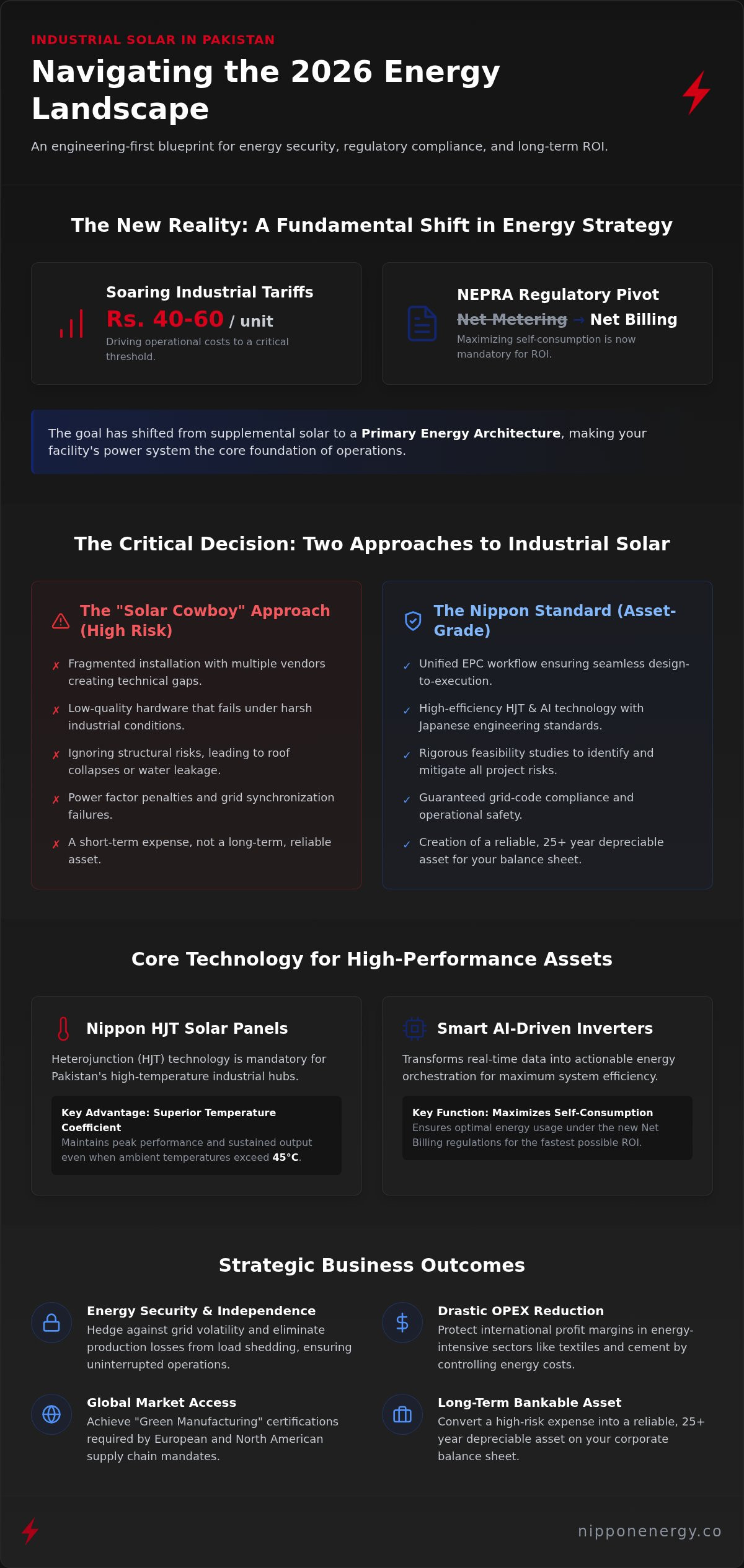
Industrial electricity costs in Pakistan have reached a critical threshold in 2026, with grid tariffs often fluctuating between Rs. 40 and Rs. 60 per unit. This surge forces a fundamental shift in how manufacturers view their power supply. The historical reliance on "supplemental solar" is ending. Factories are now adopting a primary energy architecture where solar is the foundation of the facility’s electrical system. Successful Solar power in Pakistan requires more than just purchasing high-performance modules. It demands sophisticated industrial solar project management pakistan to navigate the transition from simple net metering to the 2026 net billing regime.
Energy Security as a Competitive Advantage
Energy security provides a hedge against the volatility of the national grid. For energy-intensive sectors like textiles and cement, reducing operational expenditure (OPEX) is the only way to protect international margins. Solar installations mitigate the financial impact of unscheduled load shedding. This allows production schedules to remain uninterrupted. Localized generation also aligns with global supply chain mandates for "Green Manufacturing" certifications, which are increasingly required by European and North American buyers. It's no longer just about saving money; it's about securing the right to trade in a carbon-conscious global market.
Identifying Large-Scale Project Risks
The "Solar Cowboy" market presents a significant threat to industrial assets. Poorly engineered systems often ignore the structural integrity of aged industrial rooftops in Karachi and Lahore, leading to catastrophic collapses or water leakage. Professional industrial solar project management pakistan identifies these risks during the feasibility stage. By ensuring rigorous engineering standards, companies secure long-term asset bankability. This technical precision is vital for corporate financial reporting. It transforms a solar installation from a risky expense into a reliable, depreciable asset that stands for 25 years or more.
Engineering Excellence: The Nippon Standard for Industrial EPC
The Future of Net-Metered Solar Power in Pakistan emphasizes that as buyback rates decline, the value of a system lies in its ability to maximize self-consumption through superior efficiency. This is why hardware selection isn't just a matter of cost, but a matter of thermal resilience. Manufacturers looking for this level of reliability often explore Nippon Energy’s industrial solutions to secure their energy future.
High-Efficiency Hardware Selection
For Pakistan’s high-temperature industrial hubs, Heterojunction (HJT) technology has become mandatory. Nippon HJT Panels feature superior temperature coefficients, allowing them to maintain peak performance even when ambient temperatures exceed 45°C. In environments with high-albedo surfaces, such as white-roofed warehouses, integrating topcon solar panels provides an additional yield advantage through bifacial gain. This hardware is managed by smart ai solar inverter systems, which play a critical role in power factor correction. These intelligent "brains" ensure that the solar array doesn't just produce power but optimizes the factory’s entire electrical profile. In coastal industrial zones like Korangi, durability testing for salt mist and ammonia resistance is a non-negotiable requirement to prevent premature asset degradation.
Japanese Engineering Protocols
Adhering to JIS (Japanese Industrial Standards) ensures that mounting structures and electrical safety protocols meet global benchmarks for resilience. Large-scale arrays require string-level monitoring to detect minute performance dips before they escalate into system-wide failures. This granular oversight is a core component of professional industrial solar project management pakistan. It transforms a passive roof installation into an active, data-rich energy asset. Nippon's EPC approach is a fusion of Japanese innovation and local Pakistani expertise. By combining Tokyo-level engineering with an on-the-ground presence in Karachi and Lahore, we provide a stable platform for industrial growth that stands the test of time.
Feasibility and Regulatory Navigation: From NEPRA to Net Metering
Navigating the regulatory environment in 2026 requires precise industrial solar project management pakistan to ensure that large-scale investments align with the latest National Electric Power Regulatory Authority (NEPRA) mandates. Under the NEPRA (Prosumer) Regulations 2026, the transition from net metering to net billing has fundamentally altered the financial equation for manufacturers. New applicants no longer benefit from a one-to-one unit exchange. Instead, surplus energy is exported at the National Average Energy Purchase Price (NAEPP), which is currently approximately Rs. 11 per unit. This shift makes the feasibility stage critical; systems must be sized to prioritize self-consumption rather than grid export to protect margins.
Determining the Levelized Cost of Energy (LCOE) and the Payback Period (PBP) now involves calculating the gap between high grid purchase prices, which can reach Rs. 60 per unit, and the modest export rate. While the export value has decreased, the financial logic remains robust for factories that consume the majority of their generated power on-site. With State Bank of Pakistan (SBP) green financing rates available as low as 6%, the path to energy independence is financially viable if the project is managed with technical foresight.
Regulatory Compliance Roadmap
Securing a Distributed Generation (DG) license is a structured process that involves rigorous documentation and site inspections. For systems up to the 1 MW capacity cap, grid impact studies are essential to prove that your factory's power injection won't destabilize the local transformer or violate safety codes. Professional industrial solar project management pakistan involves proactive coordination with DISCOs like K-Electric, LESCO, or FESCO. This ensures that the physical interconnection and administrative approvals move in parallel, preventing delays that can stall your ROI.
Industrial Energy Audits
A professional energy audit identifies "phantom loads" and operational inefficiencies before system sizing begins. By analyzing load curves, engineers can accurately size lithium ion battery storage for peak shaving, allowing your facility to avoid the most expensive grid tariffs during peak evening hours. This data-driven approach minimizes energy wastage and ensures the solar array is not over-engineered. For facilities requiring absolute autonomy, customizing the nipponhev system provides a path to off-grid industrial resilience, protecting sensitive production lines from the instability of the national grid.
The Industrial Solar Lifecycle: Execution and AI Monitoring
Execution represents the most critical phase of industrial solar project management pakistan, as it translates engineering designs into active power assets. A primary concern for manufacturing facilities is the potential for operational disruption. We address this through phased construction, where installation is scheduled in modules to ensure factory uptime remains at 100%. This methodical approach prevents the logistical bottlenecks common in large-scale deployments, allowing production lines to remain active while the energy transition occurs. By treating the construction site as a controlled engineering environment, we eliminate the chaos often associated with "solar cowboy" installations.
The lifecycle of a solar asset extends far beyond the final connection. To protect the 25-year lifespan of the hardware, a rigorous schedule of solar system maintenance is required, particularly in the high-soiling environments of Karachi’s industrial zones and the smog-heavy regions of Lahore. Reactive maintenance, or waiting for a component to fail, is no longer acceptable for megawatt-scale systems. Instead, we employ predictive protocols that utilize real-time data to identify anomalies before they result in costly downtime. This ensures that the system doesn't just function, but excels under the harsh climatic conditions of Pakistan.
Construction Management & Safety
Large-scale logistics require precision. Managing cranage for heavy HJT modules, safety scaffolding for multi-level warehouses, and high-voltage cabling requires a disciplined EPC team. We utilize comprehensive Quality Assurance (QA) checklists for every stage, from structural anchoring to inverter synchronization. Predictive maintenance is the use of AI to foresee component failure before it impacts factory uptime. This proactive stance ensures that the structural and electrical integrity of the system is never compromised, providing a secure environment for your workforce and your investment.
Digital Energy Orchestration
Modern industrial solar is a digital asset. Using Nippon's AI software, stakeholders can engage in remote monitoring of string-level performance, ensuring that even the smallest deviation in output is flagged. This software provides automated alerts for panel cleaning based on specific soiling loss data, preventing the efficiency drops caused by dust accumulation. These analytics are also vital for corporate ESG (Environmental, Social, and Governance) compliance, providing transparent data for sustainability reporting. To begin your facility's transition with a partner that prioritizes technical longevity, consult with our industrial EPC specialists.
Partnering with Nippon Energy: Future-Proofing Your Asset
Selecting a partner for industrial solar project management pakistan requires more than a comparison of hardware costs. It demands a commitment to end-to-end accountability. Nippon Energy functions as a world-class partner, providing the technical tools and architectural oversight necessary for large-scale success. We eliminate the typical procurement risks by providing direct access to our own Nippon HJT and TOPCon manufacturing lines. This vertical integration ensures that every module is engineered for maximum durability before it ever reaches your site. By removing third-party vendors from the equation, we maintain absolute control over the quality and bankability of your energy asset.
Our project lifecycle management is a disciplined process that transforms energy from a volatile operational expense into a stable, high-performance asset. We don't just install panels; we design energy ecosystems that integrate seamlessly with your factory’s existing infrastructure. This comprehensive oversight includes everything from the initial energy audit to a 25-year operation and maintenance (O&M) strategy. One partner manages the entire workflow, ensuring that the original engineering vision remains intact and that the system delivers its promised ROI for decades.
Local Presence, Global Standards
The Karachi Korangi Industrial Area service hub serves as the operational heart of our Pakistani deployments. This physical presence allows us to maintain a Tokyo-Lahore-Karachi axis that combines global engineering innovation with on-the-ground expertise. We're committed to training local Pakistani engineers in Japanese Industrial Standards (JIS), ensuring that every installation meets international safety and performance benchmarks. To mitigate the risk of operational downtime, we maintain strategic warehousing of critical spare parts in both Karachi and Lahore. This logistical readiness enables response times of less than 24 hours, ensuring that your production lines remain active regardless of grid conditions or component wear.
Next Steps for Industrial Leaders
The journey toward energy independence begins with a monumental energy audit of your facility. This site survey involves a granular analysis of your load curves, structural roof integrity, and electrical synchronization requirements. Once the feasibility study is complete, we help you understand the customized financing options available for large-scale solar projects in Pakistan, ensuring the investment aligns with your corporate fiscal cycles. Transitioning to a primary solar architecture is a strategic move that requires precision and visionary leadership. Consult with Nippon Energy's Industrial Project Division today to schedule your comprehensive site survey and secure your facility’s energy future.
Building the Foundation of Pakistan's Green Industrial Revolution
The transition to a primary energy architecture in 2026 is a strategic necessity for Pakistani manufacturers facing record grid tariffs. Success depends on a disciplined approach to industrial solar project management pakistan that prioritizes thermal resilience and regulatory compliance. By integrating Japanese Precision Engineering with HJT technology optimized for 50°C+ environments, factories can secure energy independence while meeting global ESG standards. Our presence in the Karachi Korangi Industrial Area ensures that your facility receives on-site technical support and rapid response times from a partner committed to excellence.
We provide the architectural oversight needed to transform complex regulatory challenges into long-term competitive advantages. It's time to future-proof your operations with a partner that values technical longevity above all else. Request a Monumental Industrial Energy Audit from Nippon Energy to begin your facility’s transformation into a self-sustaining powerhouse. Secure your production lines today for a more resilient and profitable tomorrow.
Frequently Asked Questions
What is the typical ROI for an industrial solar project in Pakistan in 2026?
The payback period for industrial solar installations currently ranges between 2.5 and 4 years. While the 2026 shift to net billing reduced export rates, the primary driver of ROI is the avoidance of grid tariffs that reach Rs. 60 per unit. When combined with the State Bank of Pakistan’s green financing at rates as low as 6%, the internal rate of return remains exceptionally high for energy-intensive manufacturers.
How does HJT technology perform in Karachi's high-humidity and heat?
Heterojunction (HJT) technology is specifically engineered to excel in Karachi’s coastal climate due to its superior temperature coefficient. Unlike standard modules that lose significant efficiency as temperatures climb above 25°C, HJT panels maintain high output even in 45°C+ heat. Their bifacial architecture also captures reflected light from high-albedo industrial rooftops, ensuring consistent power generation despite high humidity and ambient haze.
Can a solar system handle heavy industrial motor starting loads?
Yes, a professionally engineered system handles inductive starting loads through sophisticated industrial solar project management pakistan. We utilize Nippon Smart AI Inverters that provide precise power factor correction and voltage stabilization. For facilities with massive motor startups, we often integrate Lithium-ion Battery Storage to provide the necessary current burst, preventing grid penalties and ensuring that sensitive machinery operates without voltage dips.
How long does the NEPRA net metering approval process take for megawatt projects?
The approval process for a Distributed Generation (DG) license typically takes between 3 and 6 months for megawatt-scale projects in 2026. This timeline includes the initial application to the local DISCO, the mandatory grid impact study, and final NEPRA notification. Professional project management streamlines this by ensuring all technical documentation and structural certifications meet utility standards on the first submission, preventing administrative delays.
What is the difference between a turnkey EPC and a simple solar installation?
Turnkey EPC is a unified engineering workflow that provides end-to-end accountability from feasibility to 25-year O&M. A simple installation is often limited to hardware mounting without rigorous grid-code synchronization or structural analysis. Turnkey EPC ensures that the system is an optimized energy asset, whereas simple installations often lack the technical depth required to manage complex industrial load profiles or long-term asset bankability.
How often do industrial solar panels need cleaning in dusty areas like Lahore?
Cleaning frequency in Lahore typically ranges from bi-weekly to monthly, depending on real-time soiling loss data. We use AI-driven monitoring to track performance degradation caused by dust and smog. Instead of following a rigid schedule, the system generates automated alerts when soiling reduces output by a specific percentage. This data-driven approach optimizes maintenance costs while ensuring the array always operates at peak efficiency.
What happens to the industrial solar system during a grid outage?
Standard grid-tied systems automatically shut down during an outage to prevent "islanding" and protect utility workers. However, industrial facilities can maintain operations by utilizing the NipponHev system or Nippon Lithium-ion Battery Storage. These configurations allow the solar array to form an independent microgrid, providing uninterrupted power to critical production lines even when the national grid is unavailable.
Is there a specific government subsidy for industrial solar in Pakistan for 2026?
The primary government incentives for 2026 include the State Bank of Pakistan’s subsidized green financing and significant tax benefits. Manufacturers can utilize accelerated depreciation of up to 90% in the first year to reduce taxable income. Additionally, solar equipment remains exempt from General Sales Tax (GST), making the capital expenditure more manageable for large-scale deployments compared to other industrial infrastructure investments.


