
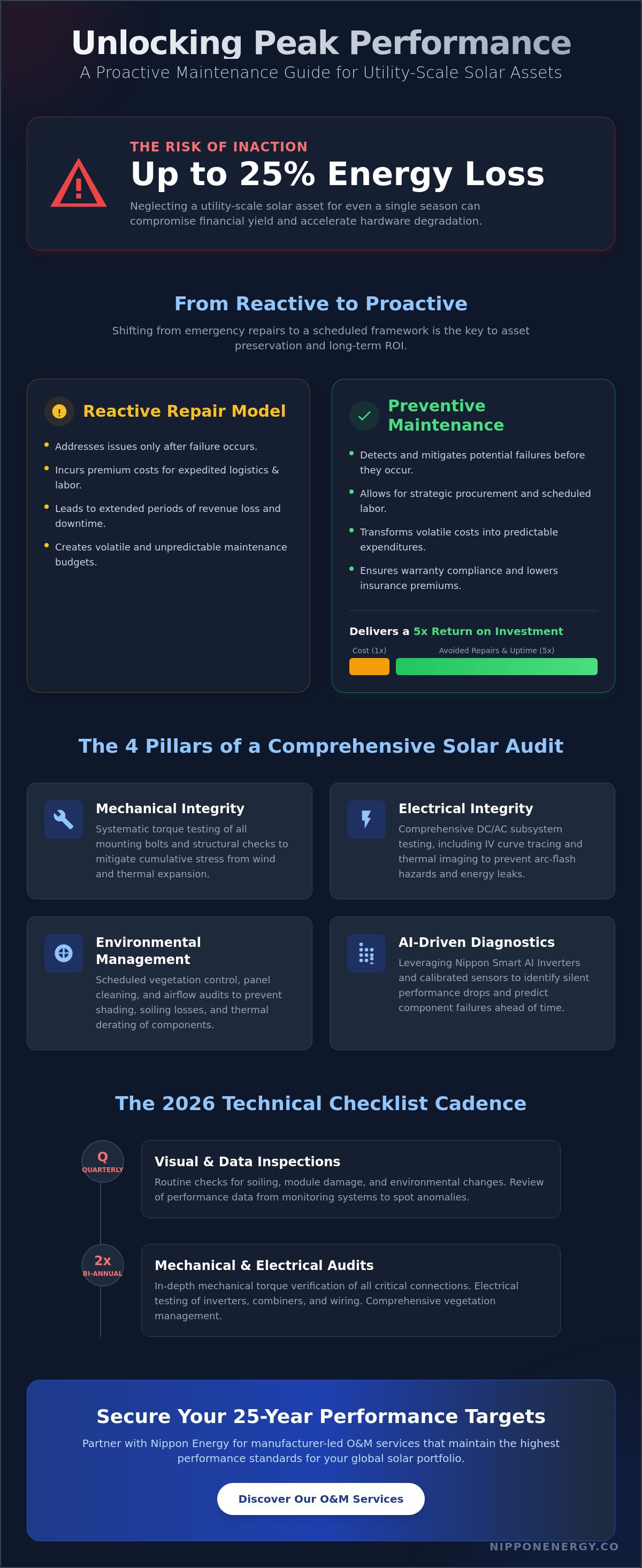
Neglecting a utility-scale solar asset for even a single season can result in energy losses of up to 25 percent, effectively compromising the financial yield of the entire project. It's a harsh reality for many operators who find that high-temperature environments accelerate hardware degradation faster than traditional models predicted. You've likely seen how unexpected downtime and inefficient manual inspections can erode your revenue, making it difficult to justify expanding O&M budgets to stakeholders. Implementing a rigorous strategy for preventive maintenance for solar plants is no longer an optional service; it's a fundamental requirement for asset longevity in 2026.
We understand that your goal is to transform volatile operational risks into predictable, high-performance outcomes. This article provides an engineering-led framework and a repeatable technical checklist designed to protect your investment and ensure maximum uptime. We'll examine the integration of AI-driven diagnostics, NEC 2026 safety compliance, and proactive component replacement strategies. By the end of this guide, you'll have a clear, data-driven roadmap to improve system reliability and secure the 25-year performance targets your portfolio demands.
Key Takeaways
- Master the transition from reactive repair models to a proactive framework for preventive maintenance for solar plants to secure long-term ROI.
- Evaluate critical mechanical and electrical audit points, including mounting architecture stability and comprehensive DC/AC subsystem testing.
- Utilize advanced monitoring tools and Nippon Smart AI Inverters to identify and rectify silent performance drops before they impact revenue.
- Implement a repeatable 2026 technical checklist that synchronizes quarterly visual inspections with bi-annual mechanical torque and vegetation management.
- Understand the benefits of manufacturer-led O&M services in maintaining high-performance standards across global solar project developments.
The Rationale for Preventive Maintenance in Modern Solar Architecture
Preventive maintenance for solar plants is defined as a disciplined, scheduled program of technical inspections and services engineered to detect and mitigate potential hardware failures before they manifest as operational downtime. Historically, the industry relied on reactive repair models that addressed issues only after a significant drop in production occurred. In 2026, the focus has pivoted toward asset preservation. This shift treats utility-scale solar farms as high-precision power plants rather than passive installations. By prioritizing structural and electrical integrity, operators transform volatile maintenance costs into a predictable capital expenditure that safeguards the project's long-term viability.
Implementing these preventive protocols directly optimizes the Levelized Cost of Energy (LCOE) by extending the functional lifespan of the balance-of-system components. Accurate monitoring of Photovoltaic system performance allows engineers to compare actual energy yield against theoretical models, facilitating the early detection of anomalies. Beyond performance, rigorous maintenance is a prerequisite for warranty compliance. Manufacturers increasingly require documented service logs to honor 25-year performance guarantees. Furthermore, insurance providers often offer reduced premiums for plants that demonstrate a robust preventive framework, as it significantly lowers the risk of fire and catastrophic mechanical failure.
Preventive vs. Corrective Maintenance: The Cost Gap
The financial disparity between scheduled audits and emergency corrective actions is immense. Emergency repairs involve expedited logistics, specialized labor at premium rates, and extended periods of revenue loss. In contrast, scheduled preventive maintenance for solar plants allows for the batching of tasks and the strategic procurement of spare parts. Risk mitigation remains the primary driver here. Identifying a loose DC connection during a routine torque check prevents the arc-flash hazards that lead to site-wide fires. Industry benchmarks indicate that the ROI of preventive maintenance delivers a 5x return on O&M spend through avoided repair costs and maximized uptime.
Preserving High-Efficiency Assets (HJT & TOPCon)
Modern high-efficiency modules, such as Nippon HJT Solar Panels and Nippon TOPCon Solar Panels, utilize advanced cell architectures that require specific maintenance cadences. These modules are engineered for maximum light absorption, meaning that even light soiling can cause disproportionate efficiency drops compared to legacy polycrystalline panels. Regular cleaning protocols must be non-abrasive to protect the sophisticated anti-reflective coatings.
Ventilation audits are also critical for these assets. While HJT technology offers a superior temperature coefficient, maintaining optimal airflow around the mounting structure ensures the system operates at peak thermal equilibrium. The NipponHev System provides the integrated architectural context required to manage these high-performance environments effectively. Proper mechanical alignment and vegetation control prevent localized shading, ensuring these premium assets reach their documented 30-year operational targets.
The Core Technical Pillars of a Solar Plant Audit
A comprehensive audit serves as the foundation for successful preventive maintenance for solar plants. It's a systematic evaluation of four critical pillars: mechanical stability, electrical integrity, environmental management, and data accuracy. This process moves beyond simple visual checks. It involves rigorous testing to ensure that every component, from the mounting bolts to the pyranometers used for performance ratio (PR) calculations, operates within its specified engineering tolerances. Optimizing Solar Photovoltaic Performance requires a methodical approach to these audits, ensuring that sensors are calibrated to provide the ground-truth data necessary for AI-driven analytics.
Mechanical and Structural Integrity
Structural failure is often the result of cumulative stress from wind loading and thermal expansion. Torque testing of mounting bolts is a non-negotiable requirement. This practice ensures the structural integrity of the racking system remains intact under extreme weather conditions. For systems utilizing trackers, technicians must inspect drive mechanisms and lubricate moving parts to prevent mechanical seizure. Visual inspections also target module glass integrity and frame corrosion. This is vital in coastal or high-humidity environments where salt-mist can accelerate material degradation. Ensuring these mechanical foundations are secure prevents catastrophic failures during high-wind events.
Electrical Subsystem Audits
Electrical audits focus on identifying high-resistance points and insulation failures that could lead to system fires. Insulation resistance testing, often called Megger testing, is vital for identifying ground faults within the DC strings. Technicians also perform thermographic inspections of combiner boxes and DC disconnect boxes to detect localized hotspots. For plants utilizing Nippon HJT Solar Panels or TOPCon modules, IV curve tracing is essential to monitor for Potential Induced Degradation (PID) or bypass diode failures. These high-efficiency N-type modules require precise electrical characterization to maintain their superior performance profiles. Following these solar system maintenance lifecycle standards ensures that electrical subsystems remain safe and efficient. This level of technical scrutiny is what separates industry leaders from average operators.
Environmental stressors like vegetation growth and soiling patterns can significantly impact yield. Managing these factors through scheduled site clearing and precision cleaning prevents localized shading and hot-spot development. As part of a professional O&M strategy, these pillars ensure that your asset doesn't just survive its 25-year lifespan but thrives. If you're looking to upgrade your current protocols, exploring Solar System Maintenance and Monitoring solutions can provide the technical depth your portfolio requires.
Leveraging Smart AI and Monitoring for Enhanced Protocols
Modern SCADA (Supervisory Control and Data Acquisition) systems have revolutionized how we approach preventive maintenance for solar plants by identifying 'silent' performance drops that visual inspections might miss. These digital platforms aggregate high-frequency telemetry from across the site, allowing engineers to detect subtle deviations in expected yield. By integrating real-time data with field service management (FSM) software, operators can transition from rigid, calendar-based schedules to dynamic, condition-based protocols. This ensures that technical teams are deployed only when the data indicates a genuine need, optimizing labor efficiency and reducing unnecessary site visits. This digital oversight helps operators address common Solar Panel Maintenance Challenges, such as cabling mismanagement and unexpected component fatigue, by providing a transparent, real-time view of asset health.
Inverter-Level Intelligence
Nippon Smart AI Inverters serve as the primary diagnostic engine for the entire array. These units monitor DC/AC conversion efficiency and internal heat dissipation patterns with millisecond precision, generating a continuous stream of performance data. Analyzing these thermal signatures allows for the proactive replacement of cooling fans or internal filters before thermal throttling occurs. For a deeper technical dive into how these components drive system reliability, explore our guide on the modern solar inverter. Beyond performance, automated alerts for arc-fault detection and insulation warnings provide an immediate layer of safety, preventing the electrical hazards that often lead to catastrophic failure in unmonitored systems.
The Synergy with Predictive Maintenance
Rigorous preventive maintenance for solar plants does more than just maintain the status quo; it provides the essential baseline data for AI-driven forecasting. This data-rich environment allows for the evolution toward predictive maintenance for solar farms, where machine learning algorithms anticipate component failure weeks in advance. Implementing AI-driven monitoring systems reduces manual 'truck rolls' by 30 percent by filtering out non-critical alerts and optimizing dispatch schedules. This systematic approach ensures that every technician on-site is equipped with specific, actionable intelligence before they even arrive. By combining human expertise with algorithmic precision, solar plants can achieve the 99 percent uptime required for institutional-grade investments.
The Ultimate Preventive Maintenance Checklist for 2026
To achieve institutional-grade reliability, preventive maintenance for solar plants must follow a rigorous, time-phased execution model. This roadmap transitions from high-frequency visual monitoring to deep-tier technical audits, ensuring every subsystem functions at peak efficiency. While digital monitoring provides real-time oversight, physical interventions remain the primary defense against material degradation. A standardized maintenance cadence prevents small anomalies from evolving into systemic failures, directly supporting the 25-year performance guarantees required for modern utility-scale projects.
- Quarterly: Perform comprehensive visual inspections and soiling analysis. Schedule cleaning cycles based on site-specific dust accumulation rates to prevent energy losses.
- Bi-Annual: Execute mechanical torque checks on racking systems and manage site vegetation to eliminate localized shading risks.
- Annual: Conduct a full electrical audit, including high-resolution thermography and IV curve tracing, to identify cell-level degradation or bypass diode failures.
- Continuous: Review monitoring software logs and AI-generated anomaly reports daily to trigger condition-based maintenance alerts.
PV Array and DC System Checklist
The DC subsystem is the most vulnerable to environmental stressors. Technicians should inspect modules for hot spots using aerial thermal imaging or handheld thermographic cameras, specifically looking for localized heat signatures that indicate cell fractures or shunts. Verifying the integrity of DC connectors, such as MC4 components, is critical for preventing high-resistance thermal events. When cleaning Nippon HJT Solar Panels or TOPCon modules, use only demineralized water and manufacturer-approved, non-abrasive methods. This preserves the delicate anti-reflective coatings and ensures the modules maintain their superior low-light performance characteristics.
Inverter and AC Subsystem Checklist
Inverters are the most complex failure point in the energy chain. Maintenance protocols must include cleaning or replacing air filters and verifying that cooling fans operate within their specified RPM ranges. Check all AC terminations for signs of oxidation or loose connections, as thermal cycling can compromise terminal tightness over time. Testing the emergency stop (E-Stop) functionality and grid protection relays ensures the plant complies with NEC 2026 safety standards. These actions protect the hardware and the technicians who service the high-voltage AC architecture.
Battery Storage Maintenance
For plants utilizing energy storage, maintaining chemical stability is paramount. Technicians must verify State of Charge (SoC) calibration and perform cell balancing to ensure uniform degradation across the stack. Inspecting the thermal management systems within lithium ion battery storage units prevents thermal runaway and optimizes cycle life. Finally, ensure the Battery Management System (BMS) firmware is updated to the latest security patch to protect against cyber-vulnerabilities and improve algorithmic precision. If you're ready to implement these high-tier protocols, contact our specialists for Solar System Maintenance and Monitoring services.
Implementing Professional O&M with Nippon Energy
Professional preventive maintenance for solar plants reaches its highest efficacy when managed by the original equipment manufacturer. This approach ensures that the technicians servicing the site possess an intimate understanding of the specific electrical characteristics and thermal behaviors of Nippon HJT Solar Panels and TOPCon modules. Nippon Energy operates an expansive global O&M network, providing technical coverage from Tokyo to Lahore and Dubai. This international scale allows us to deploy specialized engineering teams who apply a "High-Tech Architect" mindset to maintenance, mirroring the precision used in original project design. We don't just repair components; we optimize the entire energy ecosystem to ensure permanent structural integrity and high-performance output.
Customizing maintenance contracts for HJT and TOPCon portfolios is essential because these N-type technologies operate on different efficiency curves than standard modules. Our engineering teams develop bespoke protocols that account for local climate stressors, whether that involves the high-ambient temperatures of the Middle East or the variable humidity of South Asia. This level of specialization prevents the accelerated degradation often seen in generic O&M programs. By aligning maintenance schedules with the specific thermal coefficients of our hardware, we secure the long-term bankability of your solar asset. This disciplined approach transforms maintenance from a cost center into a strategic tool for revenue protection.
Turnkey Maintenance for Commercial and Utility Plants
Integrating solar EPC services with long-term O&M creates a seamless lifecycle for your project. This unified approach eliminates the technical friction often found between the construction and operational phases of a plant. We provide transparent reporting through advanced KPI tracking, focusing on Performance Ratio (PR), system availability, and maximum uptime. Our Nippon Smart AI monitoring platform offers 24/7 remote support, using algorithmic triggers to identify underperformance before it impacts the bottom line. This methodical oversight ensures that every technical feature of the plant translates directly into a practical financial benefit for the asset owner.
Securing Your Energy Future
Standardizing your portfolio maintenance across multiple regions is the most effective way to ensure long-term bankability for institutional investors. Nippon Energy provides the tools and the technical prowess required to transform volatile energy assets into stable, high-performing infrastructure. Contact our global offices to initiate a comprehensive plant health audit that evaluates your current mechanical and electrical standing. Securing your investment today ensures that your system remains a pillar of reliability for the next three decades. Schedule a Professional Solar Plant Audit with Nippon Energy to begin your transition toward engineering-led asset management and guaranteed system longevity.
Future-Proofing Your Solar Infrastructure
Securing the long-term bankability of utility-scale assets requires a transition from traditional reactive repairs to a disciplined framework of preventive maintenance for solar plants. By integrating mechanical torque testing, high-resolution thermography, and AI-driven performance tuning, operators can effectively mitigate hardware degradation and maximize energy yield. These technical pillars ensure that your infrastructure remains resilient against environmental stressors while maintaining strict compliance with NEC 2026 safety standards. This systematic approach transforms maintenance from an operational burden into a strategic advantage for your entire portfolio.
Nippon Energy stands as your global partner in asset preservation, offering manufacturer-backed technical audits and a dedicated service presence across Japan, the UAE, and Pakistan. Our sophisticated integration with Smart AI monitoring platforms provides the granular data necessary for condition-based maintenance, reducing operational risks and protecting your ROI. Optimize Your Solar Asset Performance with Nippon Energy O&M and transform your energy portfolio into a model of engineering excellence. The vast potential of modern solar technology is within your reach when supported by precision and technical expertise.
Frequently Asked Questions
What is the recommended frequency for preventive maintenance in solar plants?
A tiered approach is recommended, ranging from daily digital monitoring to annual deep-tier audits. Quarterly visual inspections and soiling analyses are standard for maintaining baseline performance. Bi-annual mechanical checks and annual comprehensive electrical testing ensure long-term structural and subsystem integrity. This disciplined cadence allows operators to identify anomalies before they manifest as operational downtime.
Does solar panel cleaning count as preventive maintenance?
Yes, solar panel cleaning is a fundamental component of a preventive maintenance program. It mitigates energy losses caused by soiling, which can reduce output by 20 percent or more if neglected. Regular cleaning prevents the formation of permanent hotspots and ensures that high-efficiency modules operate at their rated capacity throughout their functional lifespan.
How does thermography help in detecting solar panel faults?
Thermography identifies localized temperature anomalies that indicate underlying electrical or mechanical failures. By capturing heat signatures, technicians can pinpoint cell-level shunts, bypass diode failures, or high-resistance DC connections. This non-invasive method allows for the rapid assessment of large-scale arrays without necessitating system shutdowns or manual string testing.
Can I use AI to automate preventive maintenance scheduling?
AI can automate the scheduling of preventive maintenance for solar plants by analyzing real-time telemetry from SCADA systems. When algorithms detect deviations from expected performance, they trigger condition-based maintenance alerts through field service management software. This reduces manual oversight and ensures that technical interventions occur precisely when the data warrants them.
What are the most common electrical failures in utility-scale solar farms?
The most frequent electrical failures include inverter malfunctions, insulation resistance faults, and DC connector degradation. Thermal cycling often leads to loose AC terminations, while environmental stressors can cause cabling wear or rodent damage. Implementing rigorous preventive protocols allows operators to detect these high-risk points before they escalate into fire hazards or site-wide outages.
How does preventive maintenance affect the warranty of Nippon HJT panels?
Maintaining a documented history of preventive maintenance for solar plants is essential for preserving the 25-year performance warranty of Nippon HJT Solar Panels. Manufacturers require evidence of regular inspections and tech-approved cleaning methods to honor claims related to degradation or hardware failure. A professional O&M program ensures that all service actions comply with the specific engineering standards required.
Is IV curve tracing necessary for every maintenance audit?
IV curve tracing is typically reserved for annual comprehensive audits rather than quarterly visual checks. This detailed diagnostic tool provides a complete electrical characterization of the string, identifying subtle issues like Potential Induced Degradation (PID) or mismatched module performance. It's a critical requirement for establishing a performance baseline and verifying the health of high-tier assets.
What is the difference between preventive and predictive maintenance?
Preventive maintenance follows a scheduled cadence of inspections to prevent failure, whereas predictive maintenance uses real-time data to forecast when a failure will occur. While preventive actions are time-based or condition-based, predictive strategies rely on machine learning to identify complex patterns in hardware behavior. Both are essential components of a modern, engineering-led O&M strategy.


