
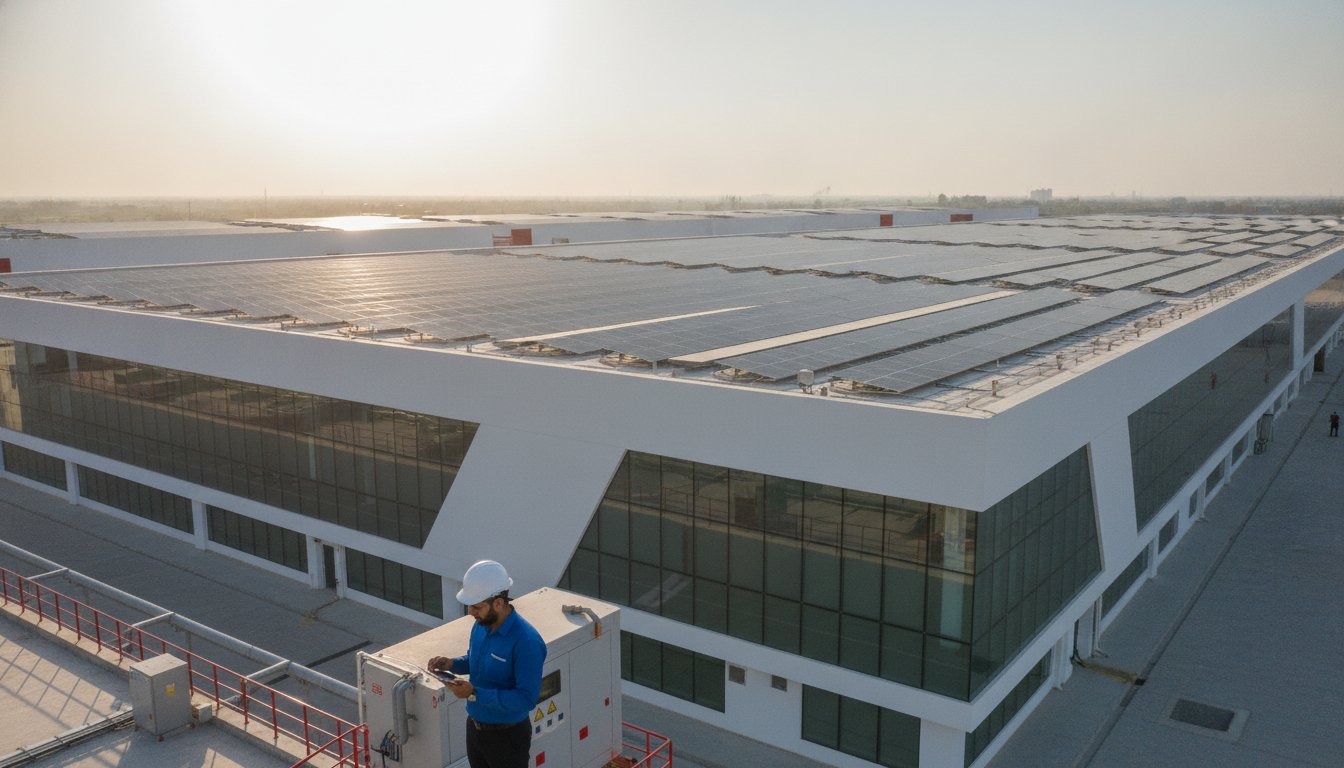
With industrial electricity tariffs reaching a base of Rs 31.59 per unit in 2026, the cost of powering a pharmaceutical facility has shifted from a manageable expense to a structural risk. You know that even a brief power interruption or a voltage surge can jeopardize entire batches of temperature-sensitive medicine and damage calibrated laboratory equipment. Implementing solar power for pharmaceutical industry pakistan is no longer just an environmental initiative; it's a calculated move to protect your operational integrity and bottom line.
This strategic guide provides a technical blueprint for achieving energy independence through high-performance HJT and TOPCon solar architectures. We'll explore how to navigate the 2026 net-billing framework and integrate lithium-ion storage to ensure 24/7 cold chain security. You'll also learn how to leverage government green financing and 90% accelerated depreciation to stabilize your OPEX for the next 25 years while meeting international green manufacturing standards.
Key Takeaways
- Mitigate the impact of escalating NEPRA industrial tariffs by implementing a technical blueprint that delivers a full return on investment within three to four years.
- Identify why HJT and TOPCon architectures outperform standard PERC panels in the high-heat environments of Pakistan's industrial zones.
- Secure 24/7 energy continuity for sensitive cold chain logistics and lab equipment using high-capacity lithium-ion storage solutions.
- Leverage solar power for pharmaceutical industry pakistan to achieve predictable OPEX for 25 years while meeting global green manufacturing compliance requirements.
- Streamline facility upgrades through specialized EPC services designed for the rigorous engineering standards of pharmaceutical manufacturing.
The Strategic Imperative for Solar in Pakistan's Pharmaceutical Sector
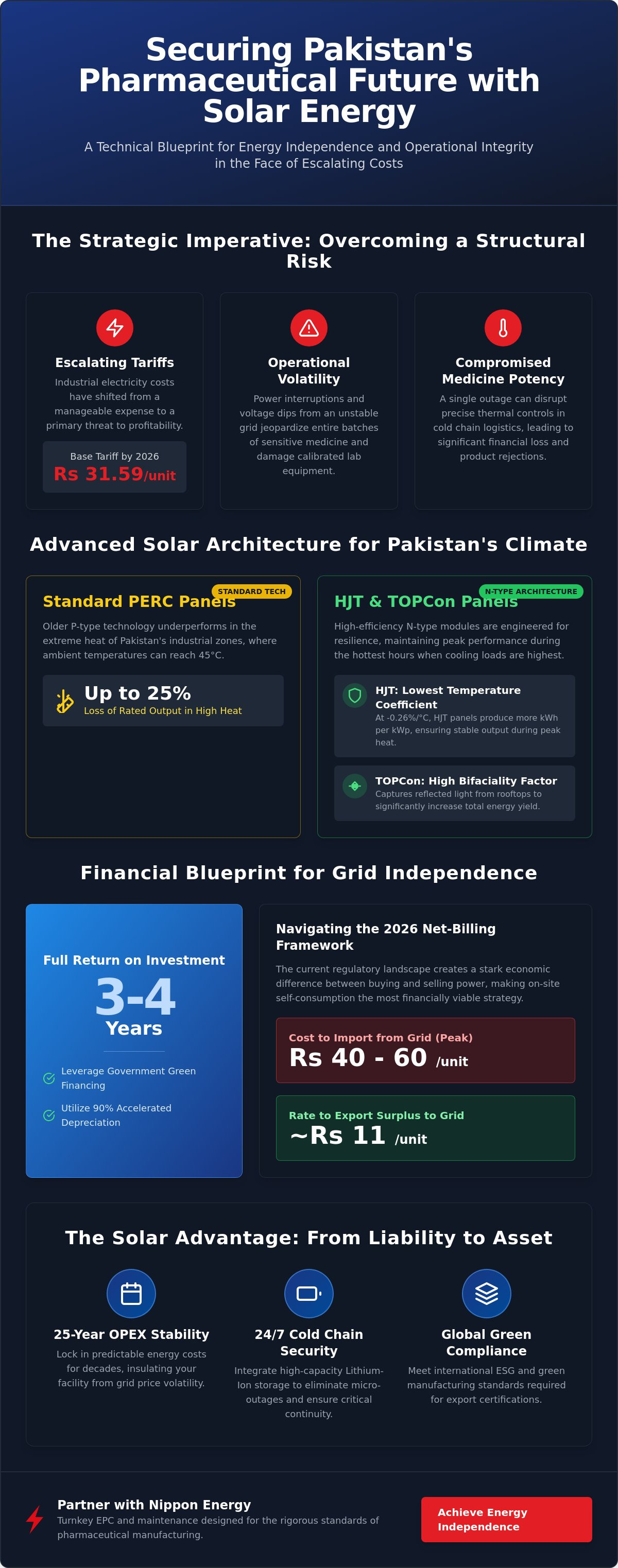
The 2025-2026 fiscal year redefined the economic baseline for pharmaceutical manufacturing in Pakistan. With the average base industrial tariff currently at Rs 31.59 per unit, energy costs evolved from a variable expense into a primary threat to profit margins. For manufacturers operating high-volume production lines, these rising costs demand a structural shift toward energy autonomy. Implementing solar power for pharmaceutical industry pakistan isn't merely a cost-reduction tactic; it's a strategic move to insulate operations from the volatility of the national grid. This transition allows firms to lock in energy costs for decades, transforming a massive liability into a predictable asset.
The current landscape of Solar Power in Pakistan reflects a rapid transition from basic grid-tied systems to sophisticated captive power plants. This evolution is driven by the necessity to maintain "Lab-to-Line" continuity. Traditional energy models rely heavily on expensive diesel backup systems, which often fail to engage fast enough to protect sensitive laboratory instrumentation from micro-outages. By adopting renewable-first hybrid systems, manufacturers bridge the gap between grid instability and the high-precision requirements of modern medicine production.
Energy Volatility as a Risk to Medicine Potency
Power interruptions do more than just stop production; they compromise the chemical stability of biologics and vaccines. A single voltage dip can disrupt precise thermal controls, leading to entire batch rejections and significant financial losses. These micro-outages also accelerate the wear on calibrated laboratory equipment, increasing maintenance cycles and reducing the lifespan of critical assets. Transitioning to a solar-plus-storage architecture provides a buffer that ensures consistent power quality. This engineering approach effectively reduces the carbon footprint of production while maintaining the rigorous quality standards required for international export certifications.
Regulatory Landscape: NEPRA and Net Metering in 2026
The regulatory environment shifted significantly with the introduction of the February 2026 net-billing framework. While the export rate for surplus electricity is now approximately Rs 11 per unit, the cost of importing grid power during peak hours remains high, often ranging between Rs 40 and Rs 60 per unit. This disparity makes self-consumption the most viable path for pharmaceutical parks in Karachi and Lahore, positioning solar power for pharmaceutical industry pakistan as a core component of facility design. Current policies favor large-scale captive power plants within Special Economic Zones (SEZs). In these zones, incentives for green energy adoption align with international ESG compliance, allowing pharmaceutical leaders to prioritize the engineering of systems that maximize on-site consumption to ensure a 3 to 4-year payback period.
Technical Architecture: HJT and TOPCon for High-Heat Industrial Environments
Standard PERC modules often underperform in the extreme thermal corridors of Sindh and Punjab. Ambient temperatures frequently reach 45°C. Panel surface temperatures can exceed 70°C. This causes older P-type semiconductors to lose up to 25% of their rated output. For a pharmaceutical facility, this power drop-off occurs exactly when cooling loads for cold storage are at their peak. Designing solar power for pharmaceutical industry pakistan requires a departure from generic equipment toward high-heat resilient hardware. Adopting N-type architecture is the only way to maintain the energy density required for high-stakes manufacturing.
Nippon HJT Solar Panels utilize a Heterojunction technology that features the industry's lowest temperature coefficient, typically around -0.26%/°C. This allows the system to produce more kilowatt-hours per kilowatt-peak during the hottest hours of the day. Similarly, Nippon TOPCon Solar Panels offer a high bifaciality factor, capturing reflected light from factory rooftops to increase total energy yield. As Pakistan's renewable energy market matures, the shift toward these high-efficiency modules is becoming the standard for industrial resilience. Both technologies rely on N-type semiconductor purity, which eliminates the boron-oxygen defects found in older panels, ensuring a 30-year operational lifespan.
HJT vs. TOPCon: Selecting the Right Cell for Your Facility
At 45°C, HJT modules provide a measurable advantage in energy harvest compared to TOPCon and PERC. While TOPCon is more cost-effective for large-scale deployments, HJT's superior heat resilience makes it the preferred choice for facilities with limited roof space and high cooling demands. Bifacial gain optimization is particularly effective for flat-roof pharmaceutical factories where high-albedo roof coatings can reflect additional light to the rear of the panels. In 2026, the practical efficiency ceiling for HJT technology has reached 26.5%, representing the pinnacle of commercially available solar conversion.
Mitigating PID and LID in Humid Industrial Zones
Humidity and salt mist in Karachi's coastal industrial zones pose a specific threat known as Potential Induced Degradation (PID). Nippon's hardware architecture employs advanced encapsulation materials that create an impermeable barrier against moisture and ion migration. By preventing both PID and Light Induced Degradation (LID), these systems maintain their performance integrity over decades. Rigorous PVEL testing confirms that these modules withstand the harshest environmental stressors. This provides the data-backed security required for long-term capital investments. Manufacturers looking to optimize their technical specifications can consult with our engineering team to determine the ideal cell architecture for their specific site coordinates.
Securing the Cold Chain: Lithium-Ion Storage for Critical Continuity
Pharmaceutical logistics in Pakistan face a unique challenge: maintaining a precise temperature range for biologics and vaccines in a climate where the grid is notoriously unreliable. Solar generation alone provides daytime relief, but it doesn't solve the risk of night-time power failures or cloud-cover fluctuations. To achieve 99.9% operational uptime, manufacturers must integrate Nippon Lithium-ion Battery Storage Systems. These high-density storage units act as a primary defense for the cold chain, ensuring that sensitive inventories remain within regulatory temperature bounds regardless of grid status.
As noted in reports regarding solar power for industries in Pakistan, the transition to captive energy solutions is accelerating as companies seek to bypass the instability of the national infrastructure. Implementing solar power for pharmaceutical industry pakistan requires more than just panels; it demands an intelligent orchestration of power. Nippon Smart AI Inverters manage this complexity by continuously balancing inputs from the solar array, the battery bank, and the grid. This system ensures that critical refrigeration loads are always prioritized, effectively peak-shaving high-tariff periods to lower overall expenditure.
Lithium-Ion vs. Traditional Lead-Acid for Pharma Storage
Traditional lead-acid batteries fail to meet the rigorous demands of industrial pharma due to their limited cycle life and low Depth of Discharge (DoD). Nippon Lithium-ion Battery Storage Systems provide a superior 10-year Total Cost of Ownership (TCO) by offering over 6,000 cycles at 90% DoD. This allows facilities to utilize nearly the entire stored capacity during emergencies without damaging the cells. Our industrial-scale battery banks also include advanced thermal management protocols. Active cooling and cell-level monitoring prevent thermal runaway, ensuring the safety of the facility and the personnel.
Smart AI Management of Critical Loads
The intelligence of a modern energy system resides in its ability to differentiate between non-essential lighting and critical HVAC systems. Through smart ai solar inverters, manufacturers gain granular control over their facility's power distribution. If the grid fails, the AI automatically sheds secondary loads to preserve energy for cold rooms and lab equipment. Real-time monitoring and predictive analytics identify potential component failures before they manifest as downtime. This proactive approach transforms energy management from a reactive maintenance task into a precise engineering discipline.
Financial Engineering: ROI, Payback, and Grid Independence in 2026
The transition to solar power for pharmaceutical industry pakistan has evolved from a sustainability goal into a sophisticated financial instrument. With industrial base tariffs reaching Rs 31.59 per unit, the Levelized Cost of Energy (LCOE) for a 500kW+ solar installation now offers a compelling contrast to grid dependency. By fixing energy costs at the point of generation, manufacturers can bypass the inflationary pressure of quarterly tariff adjustments and fuel price surges. This structural shift effectively locks in electricity rates for 25 years, providing the budgetary certainty required for long-term pharmaceutical research and development.
Projected payback periods for industrial systems in the current fiscal year have compressed to between 3 and 4 years. This rapid return is driven by the 2026 net-billing framework, where the high cost of imported grid power makes on-site consumption extremely valuable. The Internal Rate of Return (IRR) is further enhanced by the technical precision of Nippon HJT Solar Panels. Their superior bifacial gain and heat resilience ensure that energy harvest remains high even during peak summer months, maximizing the savings generated per square meter of roof space. To accelerate this transition, the State Bank of Pakistan offers green financing schemes with subsidized rates as low as 6%, while current tax laws allow for 90% accelerated depreciation in the first year of operation.
OPEX Reduction: From Cost Center to Profit Driver
For high-consumption manufacturing facilities, electricity often represents one of the largest controllable operating expenses. Implementing a 200kW+ system transforms this cost center into a profit driver by slashing monthly utility bills and reducing reliance on expensive diesel backups. This hedge against future price hikes ensures that manufacturing margins remain protected against external energy shocks. By stabilizing the energy supply, pharma groups can redirect capital from utility payments toward facility expansion and product innovation. You can request a detailed financial feasibility study to see the specific impact on your facility's balance sheet.
The Value of 25-Year Performance Longevity
The financial viability of a solar project depends heavily on the degradation rate of the hardware. Comparing topcon solar panels to standard PERC modules reveals a significant gap in long-term cumulative savings. Nippon's N-type architecture maintains higher efficiency over time, which translates to millions of rupees in additional energy generation over the system's lifespan. Beyond direct generation, there is a "hidden ROI" found in reduced equipment wear and tear. Stable voltage from high-quality solar inverters protects sensitive lab instruments and HVAC motors from the damaging surges common in the national grid. For a multi-site pharmaceutical group, these cumulative savings across several locations create a monumental impact on institutional value and operational resilience.
Partnering with Nippon Energy: Turnkey EPC and Maintenance for Pharma
Engineering a solar solution for a pharmaceutical facility requires a level of precision that exceeds standard commercial installations. It's not simply a matter of mounting hardware; it's the creation of a mission-critical utility that must interface seamlessly with sensitive laboratory and manufacturing systems. Nippon Energy provides the technical authority and global scale necessary to execute these complex projects. By utilizing our solar epc services, pharmaceutical leaders gain a partner who understands the structural and electrical rigors of the industry. This collaboration ensures that solar power for pharmaceutical industry pakistan is implemented as a high-performance asset rather than a generic add-on.
Every project begins with a granular, site-specific design phase. We conduct exhaustive structural integrity audits to verify that existing factory roofs can sustain the long-term load of advanced N-type arrays. Whether the facility requires a rooftop configuration or a ground-mount array for a larger campus, our engineering team prioritizes durability and energy density. We utilize the nipponhev system to integrate generation and storage into a single, intelligent framework. Our experts also navigate the complexities of the NEPRA net-metering application, streamlining the regulatory path to ensure your facility begins generating savings as quickly as possible.
EPC Excellence: From Feasibility to Commissioning
The commissioning of a pharmaceutical solar plant demands a methodical approach to hardware procurement and installation. We secure Tier-1 components, specifically Nippon HJT and TOPCon modules, to match the thermal demands of the site. Our teams manage the entire lifecycle of the project, from initial feasibility studies to final grid connection. This end-to-end responsibility eliminates the risks associated with multi-vendor deployments. By maintaining strict engineering standards during the installation of solar power for pharmaceutical industry pakistan, we ensure that the system meets the high-voltage requirements of industrial machinery while adhering to international safety protocols.
O&M: Protecting the 30-Year Asset
Maintaining the performance ceiling of an industrial solar array requires more than occasional cleaning. Professional solar system maintenance is a prerequisite for protecting a 30-year capital investment. In the high-soiling environments of Karachi and Faisalabad, specialized cleaning protocols are necessary to prevent significant yield loss, which can reach 15% if left unmanaged. Our O&M teams employ AI-driven monitoring and periodic thermal imaging to ensure every module operates at peak efficiency. This proactive strategy identifies potential component failures or shading issues before they manifest as downtime. For pharmaceutical manufacturers, this level of reliability is non-negotiable, as it secures the energy continuity required for biologics and critical cold chain logistics.
Future-Proofing Pharmaceutical Infrastructure through Energy Autonomy
The transition to decentralized, high-efficiency energy is the definitive strategy for maintaining industrial competitiveness in 2026. By integrating advanced N-type cell architectures and lithium-ion storage, manufacturers eliminate the risks associated with grid instability and rising tariffs. This technical blueprint for solar power for pharmaceutical industry pakistan ensures that sensitive production lines and cold chain logistics remain operational under any environmental or economic conditions. It's no longer a matter of simply adding panels; it's about engineering a resilient power plant that protects your most valuable assets.
Nippon Energy brings Japanese Engineering Standards to every project, utilizing Tier-1 HJT and TOPCon hardware to maximize energy density for the long term. Our dedicated industrial EPC team in Pakistan manages the entire lifecycle of your system, ensuring structural integrity and regulatory compliance from the initial audit to final commissioning. This investment doesn't just reduce OPEX; it builds a foundation for sustainable, global-scale manufacturing. Schedule a Technical Feasibility Study for Your Pharmaceutical Facility to begin your journey toward energy independence. We're ready to engineer your facility's resilience.
Frequently Asked Questions
What is the typical ROI for a solar power system in Pakistan's pharma industry?
The typical ROI for solar power for pharmaceutical industry pakistan currently ranges between 3 and 4 years. This rapid payback is facilitated by industrial electricity tariffs of Rs 31.59 per unit and the strategic shift toward self-consumption under the 2026 net-billing policy. High-efficiency systems ensure that the initial capital expenditure is recovered through immediate and substantial reductions in monthly operational costs.
Can HJT solar panels really withstand the 50°C heat in interior Sindh?
Nippon HJT Solar Panels are specifically engineered to maintain high performance in temperatures exceeding 50°C. These modules feature a low temperature coefficient of -0.26%/°C, which minimizes power drop-off during the extreme summer months common in interior Sindh. This thermal resilience makes HJT the most reliable choice for pharmaceutical facilities operating in high-heat industrial corridors where standard panels often fail.
How much roof space is required for a 500kW solar installation?
A 500kW solar installation typically requires approximately 25,000 to 30,000 square feet of unobstructed roof or ground space. Utilizing high-efficiency Nippon TOPCon or HJT modules reduces the total footprint compared to older technologies due to their superior energy density. Our engineering team conducts precise site audits to optimize the layout for maximum energy harvest and bifacial gain.
Is lithium-ion storage mandatory for pharmaceutical solar projects?
While lithium-ion storage isn't a regulatory requirement, it's technically essential for maintaining the pharmaceutical cold chain during grid instability. Solar generation alone can't support refrigeration loads during night hours or unexpected outages. Nippon Lithium-ion Battery Storage Systems provide the critical buffer needed to ensure 99.9% uptime for temperature-sensitive biologics and vaccines.
Does Nippon Energy handle the NEPRA net-metering licensing process?
Nippon Energy manages the entire NEPRA net-metering and net-billing licensing process as part of our turnkey EPC services. We handle the technical documentation, application filing, and coordination with local distribution companies on behalf of our clients. This comprehensive approach allows pharmaceutical manufacturers to focus on production while we secure their regulatory approvals and grid connections.
How do solar panels improve the quality of medicine manufacturing?
Solar power systems improve medicine manufacturing quality by providing stable voltage and preventing thermal fluctuations in cleanrooms. Consistent power delivery protects sensitive laboratory instrumentation from micro-outages that can lead to batch rejections and equipment damage. Implementing solar power for pharmaceutical industry pakistan creates a controlled energy environment that supports international green manufacturing standards.
What is the lifespan of a Nippon HJT solar panel compared to PERC?
Nippon HJT solar panels are engineered for a 30-year operational lifespan, outperforming the 25-year industry standard for PERC modules. The N-type semiconductor architecture eliminates Light Induced Degradation (LID) and significantly reduces annual degradation rates. This longevity ensures that the system remains a productive asset for your facility long after the initial investment has been recovered.
Are there specific tax incentives for pharma companies adopting solar in Pakistan?
Pharmaceutical companies can claim 90% accelerated depreciation on solar equipment in the first year of installation. Additionally, imported solar panels remain exempt from the 18% General Sales Tax (GST) and import duties under the 2026-27 Finance Bill. These fiscal policies, combined with State Bank green financing at rates as low as 6%, significantly lower the barrier to entry for renewable adoption.


