

What if your energy infrastructure could pay for its own debt while insulating your factory from the grid's volatility? With electricity tariffs in Pakistan crossing PKR 60 per unit, the transition to renewable energy has evolved from a sustainability goal into a critical requirement for industrial survival. You likely recognize that volatile energy prices in Punjab and Sindh are eroding your margins, yet the high upfront commercial solar system cost pakistan often presents a formidable barrier to entry. Securing low-markup financing through programs like NBP Roshan Ghar or Shariah-compliant options from Meezan Bank requires more than just a balance sheet; it demands a technically bankable energy architecture that guarantees long-term performance.
This strategic guide provides the clarity needed to secure favorable financing and achieve a 30% to 50% reduction in your operational expenses. We'll analyze the shift from net metering to the 2026 net billing framework and explain why high-efficiency HJT and TOPCon hardware is essential for faster loan repayment. By the end of this article, you'll understand how to implement a resilient energy infrastructure that transforms your factory from a passive consumer into an empowered, energy-independent asset.
Key Takeaways
- Analyze the 2026 State Bank of Pakistan financing landscape to identify low-markup schemes that align with large-scale industrial energy goals.
- Evaluate the structural benefits of Shariah-compliant Diminishing Musharakah compared to conventional loans to optimize your facility's debt-to-equity ratio.
- Understand how high-efficiency HJT and TOPCon hardware mitigates the effective commercial solar system cost pakistan by maximizing energy yield and accelerating loan repayment.
- Explore off-balance-sheet Power Purchase Agreements (PPAs) that eliminate upfront CAPEX requirements while securing long-term energy price stability.
- Follow a technical 5-step procurement roadmap to ensure your project documentation meets the rigorous bankability standards required for rapid approval.
The Evolution of Commercial Solar Financing in Pakistan
The 2026 energy landscape in Pakistan is defined by a decisive shift from grid dependence to industrial self-reliance. As electricity tariffs consistently exceed PKR 60 per unit, the financial viability of manufacturing units in Karachi and Lahore depends on their ability to generate localized power. This transition is supported by a maturing regulatory framework. While early adoption was driven by environmental goals, the current era focuses on the structural integrity of a business's balance sheet. An Overview of Solar Power in Pakistan reveals that the nation's net-metered capacity has surged to over 6 GW, signaling a massive industrial pivot toward renewable assets.
For most enterprises, the commercial solar system cost pakistan is managed through three primary pillars: debt, equity, and leasing. Equity remains the fastest route to implementation, but debt financing through specialized green facilities has become the standard for large-scale factories. Leasing and Power Purchase Agreements (PPAs) are also gaining traction, allowing firms to bypass high upfront CAPEX. This year represents a pivotal moment because the shift from net metering to a net billing framework necessitates a more sophisticated approach to hardware selection and financing structures.
The SBP Refinancing Scheme for 2026
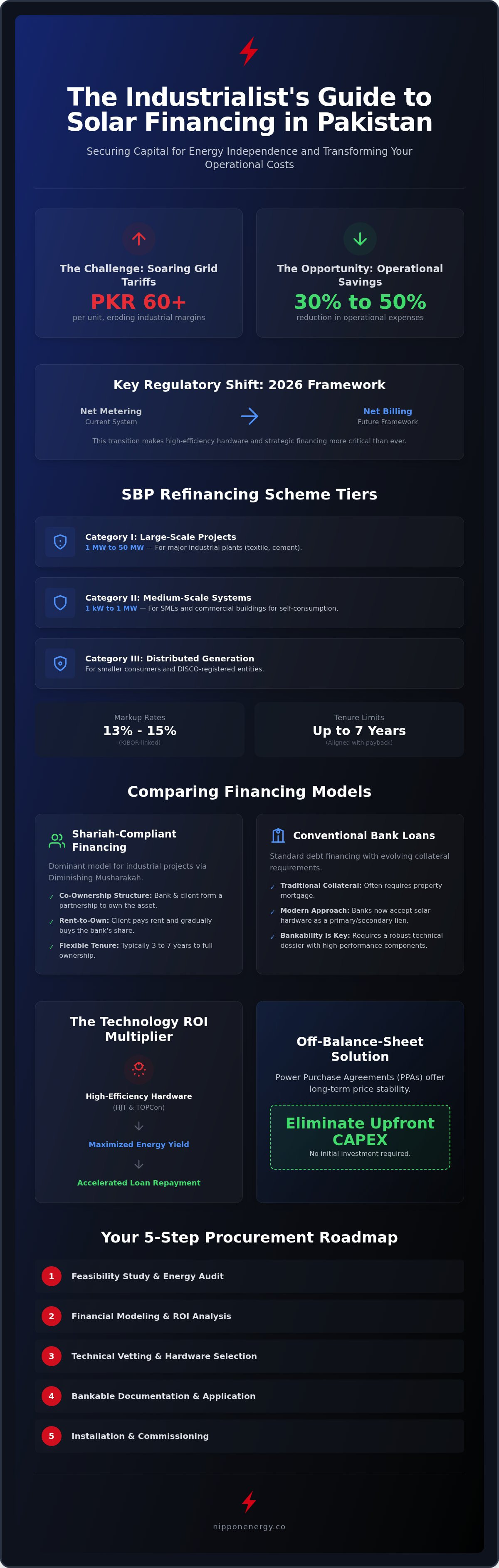
The State Bank of Pakistan (SBP) continues to anchor the renewable sector through its tiered refinancing initiatives. These schemes are designed to categorize projects based on their scale and purpose, ensuring that capital is allocated efficiently across the industrial spectrum. In 2026, the three primary categories remain the foundation of most solar debt applications:
- Category I: Dedicated to large-scale projects with a capacity ranging from 1 MW to 50 MW. This tier is essential for major textile and cement plants seeking to offset massive base loads.
- Category II: Focused on medium-scale systems between 1 kW and 1 MW, specifically for self-consumption. This is the primary vehicle for SMEs and independent commercial buildings.
- Category III: Designed for smaller consumers and DISCO-registered entities, focusing on distributed generation.
Current markup rates for these facilities typically follow a KIBOR-linked spread, often ranging from 13% to 15% depending on the specific bank and the borrower's credit profile. Tenure limits generally extend up to 7 years, providing a repayment cycle that aligns with the system's accelerated payback period.
Commercial Bank Solar Facilities
As the market matures, local commercial banks are transitioning from purely SBP-subsidized rates to independent green lending products. This shift is driven by high demand and the need for more flexible collateral requirements. While a property mortgage is often required for conventional loans, many banks now accept the solar hardware itself as a primary or secondary lien. This change reflects a growing confidence in the residual value of high-efficiency hardware. Securing these loans requires a robust technical dossier. Banks prioritize projects that utilize bankable, high-performance components, as these systems guarantee the cash flow necessary to service the debt over the long term. For a broader understanding of how different markets incentivize these cash flows, Azimuth Renewable Energy offers detailed explanations on mechanisms like SRECs that support renewable energy project bankability.
Comparing Financing Models: Shariah-Compliant vs. Conventional
Selecting a financing model for industrial energy projects in Pakistan requires a careful evaluation of capital structures and religious compliance. Most corporate boards in the country prioritize Shariah-compliant instruments, which now dominate the industrial lending landscape. This preference is supported by the State Bank of Pakistan Financing Scheme, which provides the regulatory foundation for both Islamic and conventional green energy facilities. While the underlying goal is to manage the commercial solar system cost pakistan, the structural differences between these models significantly impact the total cost of ownership (TCO) and the project's long-term internal rate of return (IRR).
Islamic Solar Financing (Diminishing Musharakah)
Diminishing Musharakah is the primary vehicle for Shariah-conscious industries. Unlike a standard loan, this structure creates a partnership where the bank and the client co-own the solar asset. The client pays rent for the bank's share of the equipment while gradually purchasing units of ownership over a period of 3 to 7 years. Institutional leaders like Meezan Bank and Faysal Bank Islami utilize this model to provide financing with profit rates often linked to the Karachi Interbank Offered Rate (KIBOR). For example, Meezan Bank currently offers profit rates around 15% per annum. This model is particularly attractive for large-scale factories because it avoids the concept of interest and aligns with the ethical mandates of many local corporate governance frameworks.
Conventional Green Energy Loans
Conventional financing remains a flexible alternative for utility-scale EPC projects and organizations without Shariah restrictions. These are typically structured as term loans with floating interest rates, often calculated as KIBOR plus a bank-specific spread. The NBP Roshan Ghar program and Bank Alfalah Green Energy facility are notable examples. Bank Alfalah offers facilities for systems up to 1000 kW with tenures reaching 5 years. Conventional models often provide more straightforward early repayment terms; this is advantageous if the company's cash flow allows for accelerated debt retirement. However, the volatility of KIBOR means that floating rates can increase the total interest paid over the loan's life, making hardware efficiency a critical buffer against rising costs.
The financial performance of any financed system depends heavily on technical bankability. High-efficiency hardware reduces the effective payback period, ensuring the energy savings outpace the monthly debt service. To ensure your project meets the technical standards required by major lenders, it's essential to partner with a specialized solar project development and EPC firm. This ensures the technical dossiers provided to the bank reflect the true resilience and yield of the installation, ultimately lowering the TCO regardless of the chosen financing model.
Off-Balance-Sheet Solutions: Solar Leasing and PPAs
Traditional energy procurement often requires a substantial capital commitment that can strain an industrial balance sheet. While the State Bank of Pakistan's Financing Scheme for Renewable Energy provides a robust framework for debt-based acquisition, many enterprises are pivoting toward "Solar-as-a-Service" models. These off-balance-sheet solutions allow businesses to modernize their energy infrastructure without the heavy burden of upfront investment. By shifting the commercial solar system cost pakistan from a capital expenditure (CAPEX) to an operational expense (OPEX), companies can preserve their credit lines for core business expansions while immediately benefiting from reduced utility overheads.
Industrial Solar PPAs in Pakistan
A Power Purchase Agreement (PPA) is a technical partnership where a third-party developer installs, owns, and operates the solar plant on your facility's roof or land. You simply purchase the generated electricity at a predetermined tariff, which is typically 20% to 30% lower than the prevailing grid rates. This model is particularly effective for energy-intensive sectors like textiles and cement, where grid volatility can disrupt production costs. Under current NEPRA regulations, these onsite PPAs provide a long-term hedge against inflation, locking in energy prices for 10 to 15 years. Because the developer's profit depends on system uptime, high-efficiency hardware and comprehensive Operation and Maintenance (O&M) are inherently integrated into the contract, ensuring maximum yield without technical risk to the manufacturer.
Operational Leasing for SMEs
For small and medium enterprises (SMEs) that desire eventual ownership but lack immediate liquidity, operational leasing offers a structured "lease-to-own" pathway. Unlike a bank loan, a solar lease is often treated as a direct operating expense, which can offer significant tax advantages by reducing taxable income. The ownership of the asset typically transfers to the business at the end of the tenure, which usually spans 5 to 7 years. To maximize the value of these leased assets, many industries are adopting the nipponhev system. This integrated architecture ensures that the hardware remains resilient and productive long after the lease term concludes. This strategic approach transforms a simple utility upgrade into a permanent, high-performance financial asset that stabilizes the facility's long-term energy outlook.
The ROI Multiplier: How Hardware Efficiency Impacts Payback
Financial institutions in Pakistan have become increasingly sophisticated in their technical appraisal of industrial solar projects. They don't view solar as a generic commodity. Instead, they prioritize high-efficiency, "Tier 1" equivalent technology because superior energy yields directly correlate with a borrower's ability to service debt. Lower annual degradation rates ensure the system remains a high-value collateral asset throughout a typical 7-year loan tenure. While the upfront commercial solar system cost pakistan is higher for advanced modules, the significant reduction in the Levelized Cost of Energy (LCOE) makes these systems far more bankable. By integrating AI-enhanced monitoring, manufacturers provide lenders with transparent, real-time yield data. This effectively de-risks the investment and often leads to more favorable loan terms.
Nippon HJT vs. TOPCon: Financial Implications
The choice between Nippon HJT and topcon solar panels carries substantial weight in a project's financial feasibility study. Both technologies feature superior temperature coefficients. This is a technical attribute that's critical in the high-heat environments of Punjab and Sindh. Standard panels often suffer significant efficiency losses as temperatures rise, but high-performance modules maintain stable output, generating more kilowatt-hours per installed kilowatt.
- Bifacial Gain: Capturing reflected light from the rear side increases energy harvest by up to 25% without increasing the total financed amount.
- Heat Resilience: Stable performance in 40°C+ ambient temperatures ensures consistent cash flow for debt servicing.
- Bridging the Gap: The efficiency gain from advanced cells often covers the entire cost of the bank's markup, essentially making the financing self-paying.
Smart Management and Storage Bankability
Bankability extends beyond the panels to the entire energy orchestration layer. Utilizing lithium ion battery storage allows factories to engage in peak-shaving. This strategy involves discharging stored energy during high-tariff periods to avoid expensive grid charges. This intelligent energy use maximizes the facility's debt repayment capacity. Additionally, smart ai solar inverters provide predictive maintenance alerts that prevent revenue loss from unexpected downtime. Banks highly value these features for project security because they guarantee operational continuity. Nippon Energy hardware is engineered for this level of precision, making it a preferred choice for commercial lenders who require reliable, high-performance assets in the Pakistani market. To ensure your project meets these rigorous technical standards, you should request a bankable energy audit from our engineering team to optimize your industrial system's ROI.
Executing Your Project: A 5-Step Procurement Roadmap
Transitioning an industrial facility to solar power requires a methodical execution strategy that aligns technical engineering with financial compliance. While the previous sections established the ROI potential of high-efficiency hardware, the actual implementation phase determines whether your project secures bank approval. A structured roadmap ensures that every technical decision supports the long-term bankability of the asset. Following these five steps allows manufacturers in Karachi and Lahore to mitigate risk and streamline the deployment of renewable infrastructure.
- Step 1: Industrial Energy Audit: Conduct a professional feasibility study to establish your baseline load profile. This data is essential for sizing the system to maximize self-consumption under the 2026 net billing framework.
- Step 2: EPC Selection: Partner with a firm that provides comprehensive engineering, procurement, and construction. A bankable partner is vital for satisfying the due diligence requirements of commercial lenders.
- Step 3: Technical Dossier Preparation: Compile detailed specifications, single-line diagrams, and yield projections. This documentation justifies the commercial solar system cost pakistan to the State Bank of Pakistan or your chosen commercial institution.
- Step 4: Regulatory Synchronization: Manage the NEPRA licensing process and net-billing synchronization. Ensuring compliance with the latest Prosumer Regulations 2026 is critical for legal grid connectivity.
- Step 5: Commissioning and Monitoring: Execute a formal handover with rigorous performance testing. Post-installation monitoring ensures the system meets the generation targets required to service the project's debt.
Selecting the Right EPC Partner
Choosing a turnkey partner is a prerequisite for commercial financing approval in the Pakistani market. Banks require assurance that the installer possesses the technical expertise to maintain the system's structural integrity over its 25-year lifespan. When evaluating solar epc services, industrial consumers must look for partners who can deliver the rigorous technical dossiers required for SBP Category I or II loans. Nippon Energy functions as a high-tech architect in this space, providing the engineering precision and hardware reliability that lenders demand. Our role in project development ensures that your energy architecture is optimized for both performance and financial bankability.
Maintenance and Asset Protection
Financial institutions often mandate solar system maintenance contracts as a condition of the loan. This requirement protects the bank's collateral by ensuring the hardware doesn't suffer from avoidable performance degradation. Remote monitoring is no longer optional; it's a prerequisite for financial reporting to lenders. By providing transparent yield data, you prove the system's ongoing ability to generate the savings necessary for repayment. To begin your transition with a technically sound foundation, you can Contact Nippon Energy for a Financing-Ready Project Feasibility Study today.
Architecting Industrial Energy Independence
Mastering the 2026 Pakistani energy landscape requires a calculated shift from grid dependence to high-performance energy architecture. While the initial commercial solar system cost pakistan represents a significant capital commitment, the integration of Nippon HJT and TOPCon high-efficiency modules transforms this expenditure into a self-servicing asset. By aligning your facility with State Bank of Pakistan (SBP) refinancing schemes or Shariah-compliant models, you secure long-term price stability against volatile utility tariffs. Success depends on the technical bankability of your energy infrastructure; this is why a robust engineering dossier is non-negotiable for lender approval.
Nippon Energy provides the full-cycle EPC expertise and technical support necessary to secure complex commercial financing pathways. Our systems are engineered for high-temperature resilience, ensuring your industrial yield remains consistent even in the harshest climates. Don't leave your energy future to chance. Take the first step toward a bankable, high-efficiency energy infrastructure today. Request a Commercial Solar Feasibility Study for Your Business and empower your enterprise with the tools for large-scale success. Your path to energy independence starts with technical precision and visionary planning.
Frequently Asked Questions
What is the current SBP solar financing rate in Pakistan for 2026?
The current SBP solar financing rates for 2026 are typically linked to KIBOR with a bank-specific spread, resulting in markup rates between 13% and 15% per annum. These rates apply to Category I, II, and III schemes designed for industrial and commercial consumers. While these rates are subsidized compared to conventional personal loans, eligibility depends on using bank-approved vendors and providing a comprehensive technical feasibility study that justifies the long-term energy savings of the project.
Can a business apply for solar financing without a NEPRA license?
A NEPRA generation license is mandatory for grid-connected systems under the 2026 net billing framework. Most commercial banks require this license as a prerequisite for loan disbursement to ensure the project's legal compliance and grid-synchronization capability. While you can initiate the financing application during the planning phase, the final approval and fund release are typically contingent upon presenting a valid license and a net-metering agreement with the relevant DISCO.
How long is the typical payback period for a commercial solar system in Pakistan?
The payback period varies significantly based on the chosen technology and system type. Under the 2026 net billing policy, hybrid systems typically achieve a payback period of 3.5 to 4.5 years due to high self-consumption. Conversely, the commercial solar system cost pakistan for pure on-grid installations may result in a longer payback of 10 to 12 years because of lower export buyback rates. High-efficiency hardware remains essential for accelerating these cycles.
What is the difference between a Solar PPA and a Solar Lease in the local market?
A Solar Power Purchase Agreement (PPA) is an OPEX model where you pay only for the electricity generated at a fixed tariff. In contrast, a Solar Lease involves fixed monthly payments for the hardware itself, leading to eventual ownership at the end of the term. PPAs are ideal for companies seeking zero CAPEX, whereas leasing is preferred by businesses that want to record the solar plant as a long-term asset on their balance sheet.
Do Pakistani banks finance lithium-ion battery storage systems for businesses?
Yes, major Pakistani banks now include Nippon Lithium-ion Battery Storage Systems in their green financing portfolios. These components are viewed as critical for energy security and peak-shaving, which enhances the borrower's ability to service debt during peak tariff hours. Banks often require a hybrid inverter and a comprehensive maintenance contract to ensure the longevity of the storage asset, making high-quality hardware like Nippon Energy’s a prerequisite for financing approval.
What documents are required for an industrial solar loan application?
Industrial solar loan applications require a robust technical and financial dossier. Essential documents include:
- A professional feasibility study and industrial energy audit
- A valid NEPRA generation license
- A signed EPC contract from a certified provider
- Three years of audited financial statements and proof of collateral
Providing a detailed yield projection using high-efficiency modules can significantly strengthen the application by demonstrating the system's capacity to generate consistent debt-servicing cash flows.
Does Nippon Energy assist with the bank technical application process?
Nippon Energy provides full-cycle EPC services that specifically include the preparation of the technical dossiers required for SBP and commercial bank approval. We assist clients by providing high-level engineering diagrams, yield simulations, and hardware certifications that satisfy the bank's due diligence requirements. Our expertise in navigating the commercial solar system cost pakistan landscape ensures that your project is positioned as a bankable, low-risk asset from the initial feasibility phase to final commissioning.
How does HJT technology affect the loan-to-value ratio of a project?
HJT technology positively impacts the loan-to-value (LTV) ratio by providing superior energy yields and lower degradation rates compared to standard modules. Banks view these high-efficiency systems as more secure collateral because they maintain their productive value longer. Because HJT panels generate more kilowatt-hours in Pakistan’s high-temperature climate, the projected cash flows are more resilient, allowing lenders to offer higher financing limits or more competitive markup rates based on the system's enhanced asset value.


