

The true commercial solar installation cost in Pakistan is no longer measured by the initial purchase price; it's defined by the system's ability to retire its own debt through superior energy yield. Many manufacturers currently face a volatile environment where unpredictable grid tariffs and fuel price adjustments (FPA) erode operational stability. It's understandable that the high upfront CAPEX required for industrial-scale transitions feels daunting, especially when technical choices between HJT and TOPCon efficiency gains seem unclear.
This strategic guide provides the technical clarity needed to navigate the 2026 energy landscape. You'll gain expert insights into securing the 6% SBP refinance scheme and utilizing bankable EPC strategies that satisfy rigorous commercial lending requirements. We'll examine how high-efficiency Nippon HJT and TOPCon modules maximize ROI, transforming your facility into an independent power hub. By the end of this analysis, you'll have a clear roadmap for reducing operational energy costs and achieving total energy independence for your manufacturing units.
Key Takeaways
- Analyze how the commercial solar installation cost pakistan is now optimized through high-efficiency N-Type modules that accelerate debt retirement for industrial facilities.
- Master the application process for the 6% SBP Refinance Scheme to minimize upfront capital requirements while maximizing operational cash flow.
- Compare the performance metrics of HJT versus TOPCon technologies to determine the most resilient configuration for Pakistan's specific climatic conditions.
- Learn why it's critical to select an AEDB-certified EPC partner to ensure your technical feasibility study meets the specific mandates of Pakistani commercial banks.
- Explore the strategic role of Lithium-ion battery storage in managing industrial demand charges and ensuring energy independence amidst evolving net-billing regulations.
The Economic Imperative: Commercial Solar Installation Cost in Pakistan (2026)
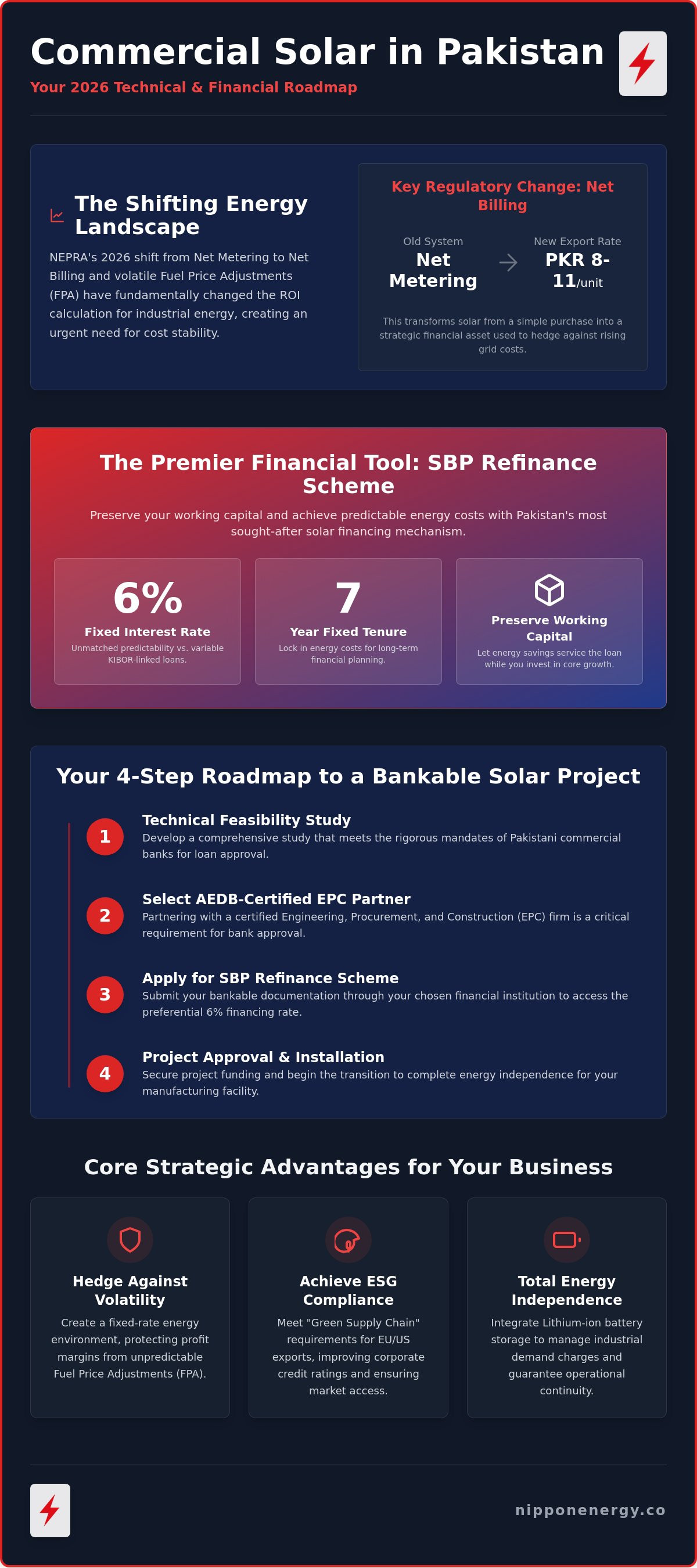
The landscape of industrial energy in Pakistan underwent a fundamental shift in February 2026. NEPRA's transition from net metering to a net billing regime has recalculated the ROI for every manufacturing unit in the country. Under this new regulatory framework, the export rate for surplus energy is approximately PKR 8 to 11 per unit. This change transforms the commercial solar installation cost pakistan from a simple procurement expense into a complex financial instrument. For industrial leaders, the primary objective is no longer just "going green." It's about securing a technical-financial hybrid where high-efficiency hardware, such as topcon solar panels, serves as a hedge against escalating utility expenditures.
Strategic manufacturing assets now require energy predictability to maintain global competitiveness. While the initial CAPEX of a solar system can be significant, the long-term OPEX reduction provides a definitive competitive edge. Modern solar infrastructure allows businesses to move away from the volatility of the national grid. This transition is supported by Solar power development in Pakistan, which continues to evolve as the government seeks to reduce the financial burden of thermal power generation. By utilizing structured financing, such as the SBP Refinance Scheme at a 6% interest rate, Pakistani enterprises can preserve their working capital for core operational growth.
Hedging Against Grid Volatility in Karachi and Lahore
In industrial hubs like Karachi and Lahore, the textile and cement sectors are disproportionately affected by Fuel Price Adjustments (FPA). These monthly fluctuations can disrupt financial forecasting and thin out profit margins. Implementing a robust solar architecture creates a fixed-rate energy environment. Fixed financing tenures, often extending up to seven years, allow industrial park stakeholders to lock in energy costs. This stability is essential for maintaining the structural integrity of long-term business plans. The integration of the nipponhev system ensures that these installations remain bankable assets throughout their operational life.
The Role of ESG in Pakistani Export Markets
Global trade compliance standards are becoming increasingly stringent, particularly for exporters to the EU and US markets. Meeting "Green Supply Chain" requirements is no longer optional for high-volume manufacturers. Renewable energy adoption directly improves corporate credit ratings in Pakistan by demonstrating a commitment to long-term sustainability and risk mitigation. This investment aligns with global ESG (Environmental, Social, and Governance) mandates, ensuring that Pakistani products remain viable in international marketplaces. Beyond simple cost savings, solar adoption acts as a technical guarantor of market access and corporate resilience.
Navigating the Landscape: Primary Solar Financing Models for Businesses
Financing serves as the critical bridge between capital expenditure and operational sustainability. For most Pakistani enterprises, the commercial solar installation cost pakistan is best managed through structured debt rather than outright cash deployment. This approach preserves working capital while allowing the energy savings to service the loan. In 2026, the financing environment has matured, offering diverse paths ranging from subsidized government schemes to private equity partnerships. Selecting the right model requires a deep understanding of your facility's energy profile and long-term fiscal objectives.
The State Bank of Pakistan's Renewable Energy Financing Scheme remains the most sought-after mechanism. It offers a fixed 6% interest rate, providing a level of predictability that commercial KIBOR-linked loans cannot match. However, access to these funds is subject to bank-specific quotas and rigorous technical audits. If you require a technical feasibility study to support your bank application, consult with our project development team for bankable documentation.
SBP Refinance Schemes for Industry (2026)
The 2026 updates to the SBP scheme maintain three distinct categories. Category I supports large-scale projects between 1 MW and 50 MW, ideal for utility-level industrial parks. Category II focuses on captive power for self-consumption, covering installations from 1 kW to 1 MW. Category III is designed for renewable energy vendors and installers. To apply, businesses must first select an AEDB-certified EPC partner. The process involves submitting a professional feasibility report to a Participating Financial Institution (PFI), which then seeks refinance from the State Bank. Successful applicants often benefit from repayment tenures extending up to seven years.
Alternative Financing: PPAs and Solar Leasing
For organizations prioritizing a "Zero-Investment" model, Power Purchase Agreements (PPAs) offer a viable alternative. Under a PPA, a third-party developer owns and maintains the system, and the business only pays for the electricity generated at a predetermined rate. This rate is typically lower than grid tariffs, providing immediate OPEX reduction without CAPEX. To find out more about how clean-energy subscription services from providers like NewSun Energy Group lower bills for businesses and franchises, researching international benchmarks is highly recommended. Alternatively, solar leasing or "Lease-to-Own" models allow businesses to pay monthly installments. Unlike PPAs, ownership transfers to the business at the end of the term. While the Levelized Cost of Energy (LCOE) is generally lower for owned systems due to the lack of third-party margins, leasing provides a balanced path for companies with constrained capital budgets.
Technology-Driven ROI: How HJT and TOPCon Hardware Influence Financing
The selection of solar hardware has evolved from a simple procurement choice into a critical pillar of project bankability. Financial institutions in Pakistan now scrutinize the technical specifications of a system to assess the risk-adjusted yield over a 25-year lifecycle. While the commercial solar installation cost pakistan remains a primary concern for CFOs, the focus has shifted toward N-Type technologies like topcon solar panels. These modules have become the industrial standard because they offer superior efficiency and lower degradation rates compared to legacy P-type PERC modules. This technological transition ensures that the energy generated remains consistent, providing the reliable cash flow required for debt servicing.
High-performance hardware acts as a technical guarantor for commercial lenders. An IEEFA analysis of net-metered solar highlights that the investment potential of PV systems is increasingly tied to long-term performance stability. By utilizing Nippon HJT technology, manufacturers can maximize yield in Pakistan's high-heat environments. HJT modules possess a superior temperature coefficient, which means they maintain higher output levels when ambient temperatures exceed 40°C. This resilience prevents the typical mid-day production drops that plague lower-tier systems, directly protecting the project's Internal Rate of Return (IRR).
HJT vs. TOPCon: Industrial Financial Performance
The financial impact of choosing between HJT and TOPCon lies in the balance of CAPEX and bifacial gain. HJT technology often provides a higher bifaciality factor, capturing more energy from the rear side of the panel, which is particularly effective on high-reflectivity industrial rooftops. TOPCon modules offer a highly competitive balance of efficiency and cost, making them ideal for large-scale captive power projects. Banks prefer these Tier-1 N-Type technologies because their lower annual degradation, often less than 0.4%, ensures the system remains a high-value collateral asset for the entire loan tenure. This technical durability reduces the lender's risk and can lead to more favorable financing terms.
The Value of Intelligent Energy Orchestration
Modern solar architecture requires more than just efficient panels; it demands intelligent management. Integrating smart ai solar inverters allows for real-time, bank-level monitoring of energy production. These systems use predictive AI to identify potential faults before they cause revenue loss, ensuring that maintenance is proactive rather than reactive. When combined with lithium ion battery storage, businesses can effectively manage peak demand charges and bridge the gap during grid outages. This integrated approach to energy orchestration secures the investment's cash flow, making the facility a more resilient and independent economic unit.
Securing Approval: A Roadmap to Commercial Solar Project Funding
Securing capital for industrial energy projects requires a transition from technical vision to financial documentation. While the commercial solar installation cost pakistan represents the primary capital requirement, banks prioritize the "bankability" of the project over the price tag alone. Lenders assess the risk of energy yield shortfall and the technical competence of the execution partner. A successful application for the SBP refinance scheme or a commercial term loan depends on a structured dossier that proves the system's ability to retire its own debt through consistent savings.
The first mandatory step is selecting an EPC partner certified by the Alternative Energy Development Board (AEDB). Banks in Pakistan typically do not extend credit for solar projects unless the vendor is approved and has a proven track record of industrial-scale installations in Lahore or Karachi. This certification acts as a primary filter for risk mitigation. Once a partner is selected, the project must navigate the NEPRA net-billing application process. Having a sanctioned load and a preliminary net-billing approval is often a prerequisite for final loan disbursement. To begin your technical audit and bankable feasibility study, partner with Nippon Energy for turnkey EPC services.
Technical Feasibility: The Foundation of Funding
Precision is mandatory during the site assessment phase. A professional technical feasibility study must include a detailed shadow analysis and an evaluation of the structural integrity of industrial rooftops. Engineers use industry-standard software like PVSyst to conduct energy yield simulations. These simulations must account for local irradiance data and the specific load profile of the business. Matching system sizing with actual consumption patterns is critical; over-sizing can lead to inefficient capital use, while under-sizing fails to maximize the reduction in operational costs.
Documenting Financial Viability
Lending institutions require a minimum of three years of audited financial statements to assess the debt-servicing capacity of the enterprise. The project report must translate technical yield into cash flow projections, demonstrating a healthy Debt Service Coverage Ratio (DSCR). In the Pakistani market, debt-to-equity ratios for solar projects typically range from 70:30 to 80:20. The EPC contract serves as a vital document here; it provides the bank with a fixed-price guarantee and a defined timeline for commissioning, which significantly reduces the execution risk associated with the commercial solar installation cost pakistan. Finalizing the collateral structure often involves a combination of the solar equipment itself and other industrial assets.
The Nippon Energy Advantage: Integrated EPC and Financial Architecture
Nippon Energy functions as a technical guarantor, providing the structural and financial architecture necessary for large-scale industrial energy transitions. Our solar epc services provide a turnkey solution that moves beyond simple panel installation to comprehensive project development. By controlling the entire value chain, we ensure that the commercial solar installation cost pakistan is optimized for bank-level performance. This holistic approach mitigates the risks of component mismatch and technical underperformance, creating a stable environment for debt retirement.
System bankability is further reinforced through the nipponhev system. This proprietary framework integrates high-efficiency hardware with intelligent orchestration to maximize energy harvest and financial transparency. For industrial stakeholders, this means every kilowatt-hour generated is tracked and verified, providing the concrete evidence required by financial auditors and corporate boards. Global engineering standards are applied to every project, ensuring that factories in Lahore and Karachi benefit from the same level of precision found in international utility-scale developments.
Engineering Excellence for Commercial ROI
Our engineering teams focus on maximizing energy density per square foot, utilizing Nippon HJT and TOPCon panels to deliver superior yield in constrained industrial spaces. We provide customized EPC solutions tailored to the specific thermal and mechanical requirements of the textile, cement, and food processing industries. These sectors demand high-load stability and resilience, which we provide through reinforced mounting structures and intelligent inverter configurations. Local support teams in Lahore and Karachi ensure that technical assistance is available immediately, maintaining the operational continuity of your facility.
Future-Proofing Your Investment
The longevity of a solar asset depends on its ability to adapt to evolving energy markets. Nippon systems are designed with modular upgradability, allowing for the seamless integration of AI-driven storage and management as demand profiles change. Consistent solar system maintenance is a core component of our service, protecting the structural integrity of the financed assets over their 25-year lifecycle. We provide transparent monitoring platforms that offer real-time data access for both stakeholders and financial auditors, ensuring that the commercial solar installation cost pakistan translates into a verifiable and high-performing financial asset.
Nippon Energy's EPC framework functions as a technical guarantor for commercial lenders, transforming high-efficiency solar hardware into a bankable financial asset through integrated engineering and real-time performance transparency.
Securing Industrial Energy Sovereignty in 2026
Navigating the 2026 energy landscape requires a transition from reactive cost management to proactive energy orchestration. The primary takeaway for industrial leaders is that the commercial solar installation cost pakistan is now an investment in debt-retiring technology rather than a simple utility expense. By aligning high-efficiency N-Type modules with the 6% SBP refinance scheme, businesses can effectively hedge against grid volatility and fuel price adjustments. Success depends on a technical-financial partnership that prioritizes long-term system bankability and rigorous site-specific engineering.
Nippon Energy provides the structural integrity and technical prowess needed for this transition. We offer proprietary HJT technology for maximum ROI and complete EPC project management in Pakistan to satisfy commercial lending requirements. Every installation features AI-integrated performance monitoring to ensure that your energy asset delivers predictable results throughout its lifecycle. Your path toward energy independence begins with a data-driven strategy that secures your manufacturing future.
Request a Bankable Solar Feasibility Study from Nippon Energy
Empower your facility with the tools for large-scale success and join the global pioneers of high-tech energy architecture.
While this analysis focuses on industrial energy sovereignty, the transition to solar is equally beneficial for private properties; readers interested in household applications can explore Residential Solar PV System Sales and Installation to see how residential systems are helping homeowners achieve energy independence.
Frequently Asked Questions
What is the maximum financing amount available under the SBP solar scheme in 2026?
The State Bank of Pakistan's Renewable Energy Financing Scheme provides limits based on project categorization rather than a single fixed amount. Category I supports large-scale projects between 1 MW and 50 MW, while Category II covers captive power systems for self-consumption up to 1 MW. Individual commercial banks may set internal caps, such as Bank Alfalah's provision for systems up to 1,000 kW, provided the technical feasibility meets their risk criteria.
Can a business in Pakistan apply for solar financing without providing collateral?
Standard commercial solar financing in Pakistan typically requires collateral to secure the lending institution's risk. Banks often utilize the solar equipment itself as primary security through a Diminishing Musharakah or Ijarah structure. However, most institutions also require supplementary collateral, such as a charge on existing industrial assets or property, to cover the full exposure of the loan during the initial years of the term.
What is the typical payback period for a commercial solar project in Pakistan?
The typical payback period for industrial solar projects in Pakistan currently ranges between three to five years, depending on the facility's load profile and grid tariff bracket. While the initial commercial solar installation cost pakistan is a factor, the accelerated ROI is driven by the avoidance of high peak-hour tariffs and fuel price adjustments. High-efficiency technologies like HJT can further shorten this window by maximizing energy harvest in local climatic conditions.
Are HJT solar panels more expensive to finance than traditional panels?
HJT panels aren't inherently more expensive to finance, although they represent a higher technology tier with a slightly higher per-watt cost compared to legacy modules. Lenders often view HJT more favorably because its lower degradation rate and superior temperature coefficient ensure a more reliable cash flow for debt servicing. The higher initial investment's offset by the increased energy yield, which strengthens the project's overall Internal Rate of Return (IRR).
Does Nippon Energy assist with the banking documentation for solar loans?
Nippon Energy provides comprehensive support for the banking documentation phase of a solar project. Our engineering teams generate the technical feasibility studies, shadow analyses, and energy yield simulations required by Participating Financial Institutions (PFIs) for SBP refinance applications. This integrated EPC approach ensures that all technical data aligns with the specific risk-assessment frameworks used by Pakistani commercial banks.
Is net-metering mandatory for securing commercial solar financing?
Securing financing for a grid-tied commercial solar system generally requires preliminary approval for net-billing or net-metering from NEPRA. Banks require this to verify that the business can legally export surplus power or offset grid consumption, which is a core component of the project's financial viability. For off-grid or zero-export systems, financing's still possible, but the bank'll focus exclusively on the savings generated through displaced grid energy.
How do I choose between a PPA and a bank loan for my factory?
Choosing between a Power Purchase Agreement (PPA) and a bank loan depends on your organization's capital strategy and tax objectives. A PPA is a zero-investment model where a third party owns the system and you pay only for the energy consumed, making it an OPEX-focused solution. A bank loan allows for full asset ownership and long-term energy independence after the debt's retired, though it requires an initial equity contribution and appears on the balance sheet as a liability.
What happens to the solar financing if my business relocates?
Solar financing agreements treat the installation as a fixed asset linked to the specific site identified in the technical feasibility study. If a business relocates, the financing must either be settled in full or the bank must approve the transfer of the system to a new location. Moving the equipment involves significant technical risk and cost, which'll likely require a new structural audit and NEPRA licensing update to maintain the bank's collateral value.


