Can your manufacturing facility survive another double-digit hike in industrial electricity tariffs while competitors are already generating power at a fixed, near-zero marginal cost? In Pakistan's volatile energy market, the relentless climb of peak-hour rates and frequent grid instability have transformed electricity from a basic utility into a strategic liability. You're likely aware that conventional energy solutions often buckle under the intense thermal degradation common in local industrial zones. Implementing a sophisticated solar power system design for factory operations is no longer an optional upgrade; it's a fundamental requirement for industrial survival in 2026.
We understand that you need more than just panels on a roof; you require a resilient infrastructure that delivers a lower Levelized Cost of Energy and absolute energy security. This guide promises to reveal the technical strategies and high-efficiency hardware architectures, such as N-type HJT modules with efficiencies exceeding 25%, that are required to slash overheads. You'll discover how to leverage AI-powered orchestration and lithium-ion storage to neutralize peak demand charges and protect your production lines from downtime. We'll provide a methodical breakdown of how to transition from grid dependence to a future-proofed, self-sustaining energy ecosystem.
Key Takeaways
- Understand how a specialized solar power system design for factory environments utilizes N-type HJT technology to neutralize volatile industrial tariffs and grid instability.
- Evaluate the performance advantages of Nippon HJT versus TOPCon panels to maximize energy density and minimize thermal degradation in Pakistan's industrial corridors.
- Learn to eliminate high demand charges by integrating lithium-ion battery storage with AI-driven inverters that autonomously optimize factory load patterns.
- Identify how structured maintenance and automated cleaning solutions mitigate soiling losses to preserve long-term Levelized Cost of Energy gains.
- Discover the benefits of a unified energy architecture through Nippon Energy and turnkey EPC services to ensure seamless industrial grid independence.
The Industrial Energy Crisis: Why Factories Need a New Power Architecture
Rising industrial electricity tariffs in Pakistan have reached a critical threshold where energy overheads now dictate the viability of manufacturing margins. In 2026, the traditional model of relying on a centralized grid is a liability rather than a utility. Most factories face a dual-layered billing structure: the energy consumption charge and the often-misunderstood 'Demand Charge.' While standard solar installations might reduce the total kWh consumed, they frequently fail to address the Demand Charge. This is the fee based on the highest level of power drawn during a single interval. Without a sophisticated solar power system design for factory applications, your facility remains exposed to these peak penalties, even on sunny days.
The shift from passive solar generation to active industrial energy orchestration is now mandatory. Grid-tied systems without storage leave factories vulnerable to utility price volatility and sudden policy shifts. Advancements in solar power technologies have moved beyond simple photovoltaics to integrated energy management. Relying on the grid as a primary source is no longer a stable operational strategy. It's a risk that compounds with every currency devaluation and tariff adjustment.
The True Cost of Industrial Electricity
Factory settings demand a granular breakdown of energy consumption versus peak demand. Traditional P-type PERC panels are no longer sufficient for industrial ROI because their higher degradation rates and poor temperature coefficients lead to significant yield losses in hot industrial corridors. Modern corporate sustainability mandates now require more than just green credentials. They demand verifiable energy independence. A robust solar power system design for factory use must account for high-temperature performance and long-term structural integrity to meet these 2026 standards. High-efficiency architectures ensure that every square meter of roof space contributes to a lower Levelized Cost of Energy (LCOE).
Solar as a Strategic Asset, Not an Expense
Transitioning from CAPEX-heavy thinking to long-term LCOE reduction transforms energy from a recurring cost into a competitive advantage. A well-architected system provides a permanent hedge against inflation and the ongoing devaluation of the local currency. By locking in a fixed cost of power for 25 years, manufacturers can stabilize their product pricing even when utility rates spike. Utilizing high-performance components like Nippon TOPCon solar panels ensures that energy production remains consistent over the system's lifespan. Integrating lithium ion battery storage further enhances this stability by providing the capacity to shift loads and avoid grid penalties.
Industrial Solar ROI is the intersection of high energy yield and aggressive peak demand mitigation.
Selecting High-Efficiency Hardware: Nippon HJT vs. TOPCon for Industrial Loads
Hardware selection determines the long-term success of any solar power system design for factory settings. In 2026, the choice between Heterojunction (HJT) and Tunnel Oxide Passivated Contact (TOPCon) technologies depends on your facility's specific thermal environment and roof dimensions. While both represent a leap forward from legacy P-type panels, their performance in the extreme heat of Pakistan's industrial zones varies significantly. Precision in component selection is what separates a standard rooftop installation from a high-performance industrial asset.
Nippon HJT: The High-Temperature Architecture
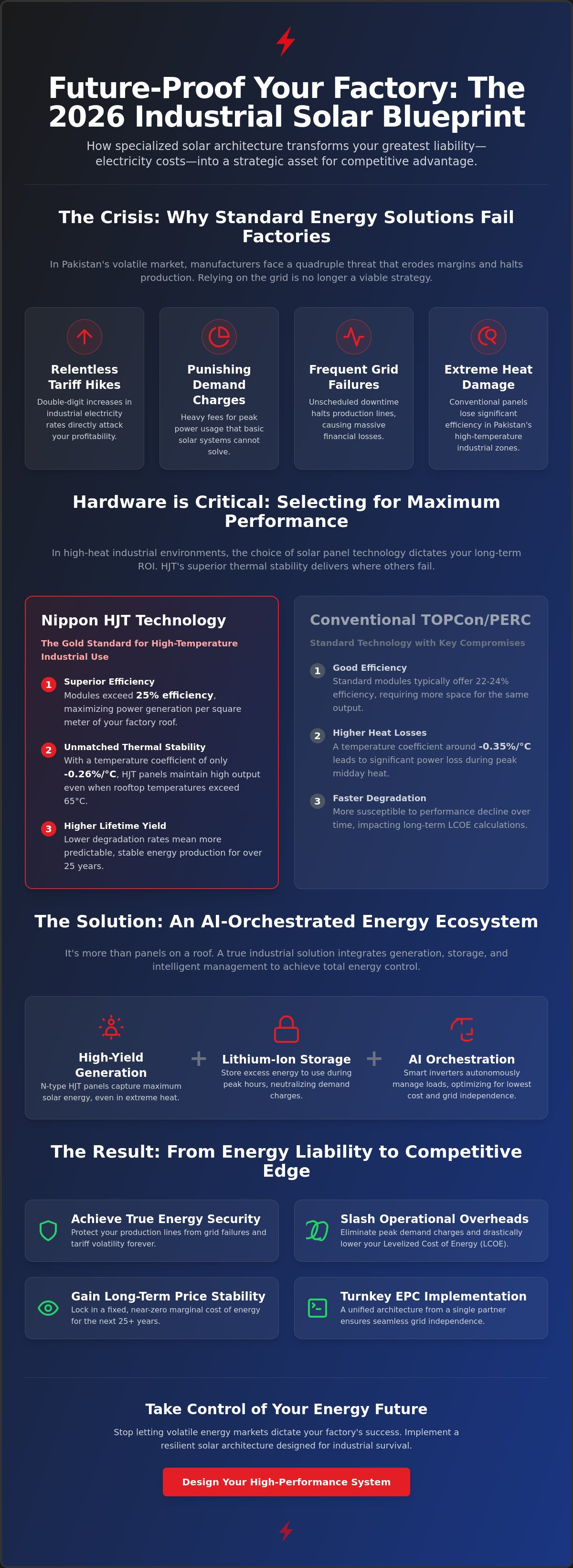
HJT technology is the gold standard for regions like Karachi or Lahore, where humidity and high ambient temperatures often degrade panel performance. Its superior temperature coefficient of -0.26%/°C ensures that power output remains stable even when rooftop temperatures exceed 65°C. This resilience minimizes midday clipping and maximizes energy harvest during the most expensive peak hours. Research into Solar for Industrial Processes confirms that high-efficiency photovoltaics are essential for meeting the massive electrical demands of modern manufacturing. HJT technology utilizes a symmetrical cell structure, which reduces mechanical stress during thermal cycling, resulting in a lower annual degradation rate. This engineering advantage ensures your facility maintains 90% power output even after 30 years of operation.
TOPCon Solar Panels for Commercial Scaling
For massive industrial complexes with expansive roof space, Nippon TOPCon solar panels offer a compelling balance of procurement cost and high efficiency. Reaching module efficiencies of 22.5% or higher in 2026, TOPCon has become the mainstream standard for commercial scaling. It provides a significant performance boost over older technologies while maintaining a lower initial capital requirement than HJT. Optimizing the solar power system design for factory footprints involves balancing these efficiency gains against your 30-year yield projections. Both architectures utilize bifacial designs to capture reflected light from factory roofs, which can boost total energy yield by up to 25% depending on the surface albedo. This additional generation is critical for achieving the aggressive LCOE targets required for industrial competitiveness in a high-tariff environment.
Determining the ideal technology for your facility requires a detailed analysis of your specific load profile and local climate. You can consult with a technical architect at Nippon Energy to evaluate which cell architecture will maximize your long-term energy yield.
Neutralizing Peak Demand with Lithium-Ion Storage and AI Orchestration
Generating high-efficiency power through HJT or TOPCon hardware is only the first phase of a resilient solar power system design for factory operations. In 2026, the true economic value of solar lies in energy orchestration. Without the ability to store and deploy energy strategically, factories remain tethered to expensive peak-hour tariffs and the unpredictable instability of the local grid. Integrating lithium ion battery storage transforms a passive generation setup into an active power plant capable of neutralizing the most aggressive utility charges.
The application of solar for industrial applications has evolved from simple net metering to complex load-shifting. In Pakistan, where grid brownouts can halt production lines instantly, storage provides a critical buffer. This architecture ensures that sensitive industrial machinery remains powered during voltage fluctuations, preventing the costly restarts and hardware damage associated with grid instability.
Peak Shaving: The Financial Engine of Industrial Solar
Peak shaving is the strategic discharge of stored energy to flatten demand spikes. This process targets the 'Maximum Demand' charges that often constitute a massive portion of an industrial electricity bill. For example, a 500kW system equipped with optimized storage frequently delivers a higher ROI than a 1MW system without it. While the larger system generates more total energy, the storage-integrated system can discharge power specifically during the highest tariff windows. This precision allows a factory to stay below its sanctioned load limit, effectively "shaving" the expensive peaks that occur when heavy motors or furnaces cycle on.
Smart AI Inverters: The Brain of the Factory
Intelligent energy management requires more than manual switching; it demands the high-speed processing found in Nippon Smart AI Inverters. These systems act as the central nervous system for the factory, analyzing real-time load patterns and predicting generation based on weather telemetry. By integrating with existing Factory Management Systems (FMS), these inverters ensure that energy is diverted to critical loads with microsecond precision.
- Predictive Load Balancing: AI algorithms learn the operational cycles of your machinery to prepare battery reserves before high-draw events.
- Power Quality Regulation: Advanced inverters stabilize frequency and voltage, protecting automated production lines from grid-induced harmonic distortion.
- Predictive Maintenance: The system identifies thermal anomalies in the string architecture, providing alerts before a component failure causes downtime.
This level of technical sophistication ensures that a solar power system design for factory use is future-proofed against rising utility costs. It moves the facility beyond simple cost-cutting and toward total energy autonomy, where the factory's power supply is as reliable and precise as the machinery it supports.
For facilities requiring the specialized IT infrastructure to manage these high-speed processing systems, you can find out more about enterprise-grade computer hardware and components.
Operational Strategies to Maximize Industrial Solar ROI
Installation marks the beginning, not the end, of the energy transition. To extract maximum value from a solar power system design for factory operations, manufacturers must adopt a rigorous operational protocol. This involves synchronizing production cycles with solar generation peaks, a strategy known as load shifting. By scheduling high-draw processes like smelting or heavy milling during peak irradiance hours, factories reduce their reliance on the grid during expensive windows. Additionally, managing power quality is essential. Industrial loads often introduce harmonic distortion; this can reduce inverter efficiency if not managed through active filtering and precise system tuning.
Industrial energy security requires a shift from a passive mindset to one of constant optimization. A sophisticated solar power system design for factory use incorporates these operational realities into the initial blueprint. It's not just about the hardware; it's about how that hardware interacts with your facility's specific electrical signature.
The 5-Step Industrial Solar Optimization Framework
Maximizing yield in a complex industrial environment requires a methodical approach to performance management. We utilize a structured framework to ensure every kilowatt-hour is accounted for:
- Step 1: Real-time monitoring of string-level performance via AI diagnostics. This allows for the immediate identification of underperforming modules before they impact the entire array's output.
- Step 2: Thermographic drone inspections for hot-spot detection. These high-resolution scans reveal internal cell damage or bypass diode failures invisible to the naked eye.
- Step 3: Automated dry-cleaning for dust-heavy industrial environments. In regions like Punjab or the industrial clusters of Karachi, particulate matter can cause substantial generation losses within days.
- Step 4: Predictive load balancing. Aligning machinery startup sequences to prevent artificial demand spikes.
- Step 5: Regular firmware updates for AI inverters. Ensuring the "brain" of the system is optimized for the latest grid conditions and tariff structures.
Mitigating Industrial Soiling and Degradation
Industrial zones in Pakistan are characterized by high concentrations of airborne particulates and chemical emissions. These substances form a stubborn layer on panel surfaces that regular rain cannot remove. Implementing a structured solar system maintenance schedule is critical for preserving the 25-year warranty and ensuring the Levelized Cost of Energy (LCOE) remains low. Specialized anti-soiling coatings can mitigate some of this adhesion, but consistent hygiene remains the primary driver of yield. Professional O&M services don't just clean panels; they verify the structural integrity of mounting systems and the health of DC cabling in corrosive environments.
Maintaining peak performance requires a partner who understands the granular details of industrial energy. You can request a technical audit from Nippon Energy to identify hidden inefficiencies in your current power architecture.
The Turnkey EPC Path: Implementing Nippon Energy Solutions
Executing a high-performance solar power system design for factory environments requires more than advanced hardware; it demands a unified engineering approach. Many industrial facilities fail to reach their projected ROI because they attempt fragmented procurement, where components from different manufacturers are forced to integrate without a cohesive architecture. Utilizing comprehensive solar epc services eliminates these integration risks by providing end-to-end accountability from initial site audit to final grid synchronization. This turnkey methodology ensures that every technical specification, from DC string sizing to AI-driven inverter logic, is optimized for the specific thermal and electrical load of your production facility.
A central component of this streamlined transition is the nipponhev system. This integrated industrial energy solution combines high-efficiency generation with intelligent storage and real-time orchestration. It's designed to act as a singular power plant for your factory, reducing the complexity of managing multiple vendors and disparate systems. By centralizing the energy architecture, manufacturers gain a transparent view of their energy lifecycle, allowing for precise forecasting of Levelized Cost of Energy (LCOE) gains over a 30-year horizon.
Navigating the regulatory landscape is a critical phase of implementation. In Pakistan, securing net-metering approvals and grid-connection licenses from NEPRA requires meticulous technical documentation and adherence to evolving safety standards. Our EPC framework handles these bureaucratic hurdles, ensuring your system is compliant with local grid codes while maximizing your ability to export excess energy during holidays or production lulls. We also prioritize future-proofing; every solar power system design for factory use is engineered for modular expansion. As your factory capacity grows, the energy infrastructure can scale in parallel without requiring a total redesign of the existing power room.
Engineering Excellence in Industrial Solar
Structural integrity is the foundation of large-scale industrial installations. We conduct comprehensive stress tests on factory roof structures to ensure they can withstand the added weight of high-density arrays and the uplift forces of high-velocity winds. Procurement is managed with military precision, sourcing only Tier-1 hardware that meets our rigorous durability standards. To prevent production bottlenecks, we implement a phased commissioning schedule. This methodical approach allows for the installation of solar assets with minimal production downtime, ensuring your facility remains operational throughout the transition. For a detailed look at how professional roofing and electrical systems are critical to energy efficiency, you can visit Underline Energy Concepts.
Taking the Next Step Toward Decarbonization
The transition from a passive energy consumer to an active prosumer is a strategic move that stabilizes your operational costs for decades. It begins with a granular understanding of your current inefficiencies and potential yield. We provide comprehensive feasibility studies and energy audits that map out the exact path to grid independence. You can contact Nippon Energy for a professional industrial energy consultation to begin the technical evaluation of your facility's solar potential.
Decarbonizing industrial operations also involves addressing energy-intensive lighting systems. For companies looking for managed solutions, Eco Light Services delivers a zero-emission lighting model that prioritizes both compliance and operational performance.
Architecting Your Industrial Energy Independence
The transition to a high-efficiency energy infrastructure is no longer a matter of corporate sustainability; it's a fundamental requirement for industrial competitiveness. This guide has detailed how achieving significant overhead reductions in 2026 demands a sophisticated solar power system design for factory environments that prioritizes resilience and intelligent orchestration. By integrating proprietary HJT and TOPCon hardware with advanced AI-driven energy management systems, manufacturers can effectively neutralize peak demand charges and stabilize their Levelized Cost of Energy (LCOE) for decades.
Our team delivers the technical expertise and end-to-end EPC services required to navigate the complexities of industrial integration in Karachi, Lahore, and Dubai. This methodical approach ensures that your facility moves beyond simple cost-cutting toward total energy autonomy. It's time to secure your production lines against grid instability and escalating tariffs with a future-proofed architecture. We're ready to engineer a solution that matches the scale of your ambition.
This level of engineering rigor is mirrored by industry leaders globally; for example, GridFree Solar applies these same high-performance principles to commercial and residential projects throughout Australia.
Request an Industrial Solar Feasibility Study from Nippon Energy to begin your transition toward a more profitable and secure energy future.
Frequently Asked Questions
How much can a factory realistically save on electricity with solar?
Factories can realistically reduce their electricity bills by 60% to 80% depending on roof space and load synchronization. This reduction targets the variable unit cost and, when paired with storage, can significantly lower fixed demand charges. A robust solar power system design for factory operations locks in energy costs for 25 years, providing a permanent hedge against the double-digit tariff hikes recently seen in Pakistan's industrial sectors.
For an initial estimate of how these savings might apply to your facility, you can use the Jelvis solar saving calculator to model your potential energy reductions.
What is the difference between HJT and TOPCon for industrial use?
HJT (Heterojunction Technology) offers a superior temperature coefficient of -0.26%/°C, making it the premium choice for high-heat industrial zones like Sindh. TOPCon (Tunnel Oxide Passivated Contact) provides high efficiency at a more accessible procurement cost for massive roof footprints. While TOPCon is the mainstream standard in 2026, HJT delivers a higher lifetime energy yield and lower annual degradation, ensuring better long-term structural integrity in harsh environments.
Can solar power run heavy industrial machinery like CNC machines or furnaces?
Solar power can effectively support high-draw machinery such as CNC machines, furnaces, and heavy motors through synchronized inverter technology. The system doesn't run these machines in isolation but works in parallel with the grid or battery reserves to ensure a stable voltage supply. Advanced AI-driven inverters manage the high startup currents and harmonic distortions common in industrial loads, protecting sensitive electronics from power quality issues during operation.
How does battery storage help in reducing industrial peak demand charges?
Lithium-ion battery storage allows factories to perform "peak shaving," which is the strategic discharge of energy during high-tariff windows. By discharging stored solar energy when the factory's load hits its peak, you avoid exceeding your sanctioned demand limit and incurring heavy penalties. This energy orchestration transforms the storage system into a financial engine that reduces the Maximum Demand charge, which often accounts for a significant portion of industrial bills.
Is solar maintenance different for factories compared to residential buildings?
Industrial solar maintenance is significantly more rigorous than residential care due to high soiling rates and corrosive factory emissions. A solar power system design for factory use requires structured O&M protocols including string-level AI diagnostics and thermographic drone inspections. Automated dry-cleaning systems are often necessary to combat the thick particulate layers found in industrial clusters, as even a thin layer of dust can reduce generation by over 15% in days.
While industrial maintenance is complex, residential and commercial systems also require expert oversight to ensure long-term efficiency; you can visit Carbon Saving Group to learn more about specialist energy-efficient solutions for these property types.
What is the typical payback period for an industrial solar project in 2026?
The typical payback period for a large-scale industrial solar project in Pakistan currently ranges between 3 to 4 years. This rapid ROI is driven by the widening gap between the fixed cost of solar generation and the rising cost of grid electricity. Once the initial capital is recovered, the facility benefits from nearly zero-cost electricity for the remaining 20 years of the system's warranted life, significantly improving long-term manufacturing margins.
How does Nippon Energy handle grid-connection and net-metering for factories?
Nippon Energy provides end-to-end management of the net-metering application process, including all technical documentation required by NEPRA and local DISCOs. We handle the procurement of bi-directional meters and ensure the system architecture complies with all safety and grid-stability regulations. This turnkey approach prevents bureaucratic delays, allowing your facility to begin exporting excess energy and earning credits against your utility bill as soon as commissioning is complete.
What happens to factory production during solar panel installation?
Production downtime is minimized through a phased commissioning strategy and non-invasive installation techniques. Most of the structural work occurs on the rooftop with zero impact on the factory floor activities. Electrical cut-overs and final grid synchronization are scheduled during planned maintenance windows or off-peak shifts to ensure that your manufacturing output remains consistent. Our EPC teams prioritize operational continuity, treating the installation as a seamless integration into your existing infrastructure.


