

Can a manufacturing plant maintain its competitive edge when grid electricity costs exceed Rs. 60 per unit while the traditional net metering model has been replaced by a restrictive net billing framework? For Pakistani industrialists, the 2026 regulatory shift means that basic industrial solar solutions pakistan are no longer sufficient to protect margins. You understand that surging tariffs and productivity losses from grid instability represent a structural threat to your operations. The harsh reality of dust and heat degradation in local environments often compromises the very systems intended to provide relief.
This guide explores how high-efficiency energy architecture is evolving through advanced HJT technology and AI-driven energy orchestration to maximize self-consumption. We examine how Japanese-engineered systems utilize superior temperature coefficients and lithium-ion storage to overcome the Rs. 11 buyback rate limitation. You'll learn how to transform your energy profile from a mounting liability into a high-performance asset that ensures long-term operational resilience and future-proofed infrastructure.
Key Takeaways
- Analyze the impact of 2026 net billing regulations on industrial ROI and why maximizing self-consumption is now the primary driver for energy independence.
- Compare HJT and TOPCon cell architectures to determine which high-efficiency technology offers the optimal temperature coefficient for Pakistan's extreme heat zones.
- Explore how integrating Smart AI Inverters with Lithium-ion Battery Storage Systems mitigates the risks of grid instability and escalating peak-hour tariffs.
- Evaluate the comprehensive EPC lifecycle required for industrial solar solutions pakistan, focusing on precision feasibility studies and structural integrity for factory roofs.
- Understand the strategic advantage of deploying Japanese-engineered hardware backed by local technical support to ensure long-term system reliability and performance.
The Industrial Energy Landscape in Pakistan: Why Solar is Mandatory in 2026
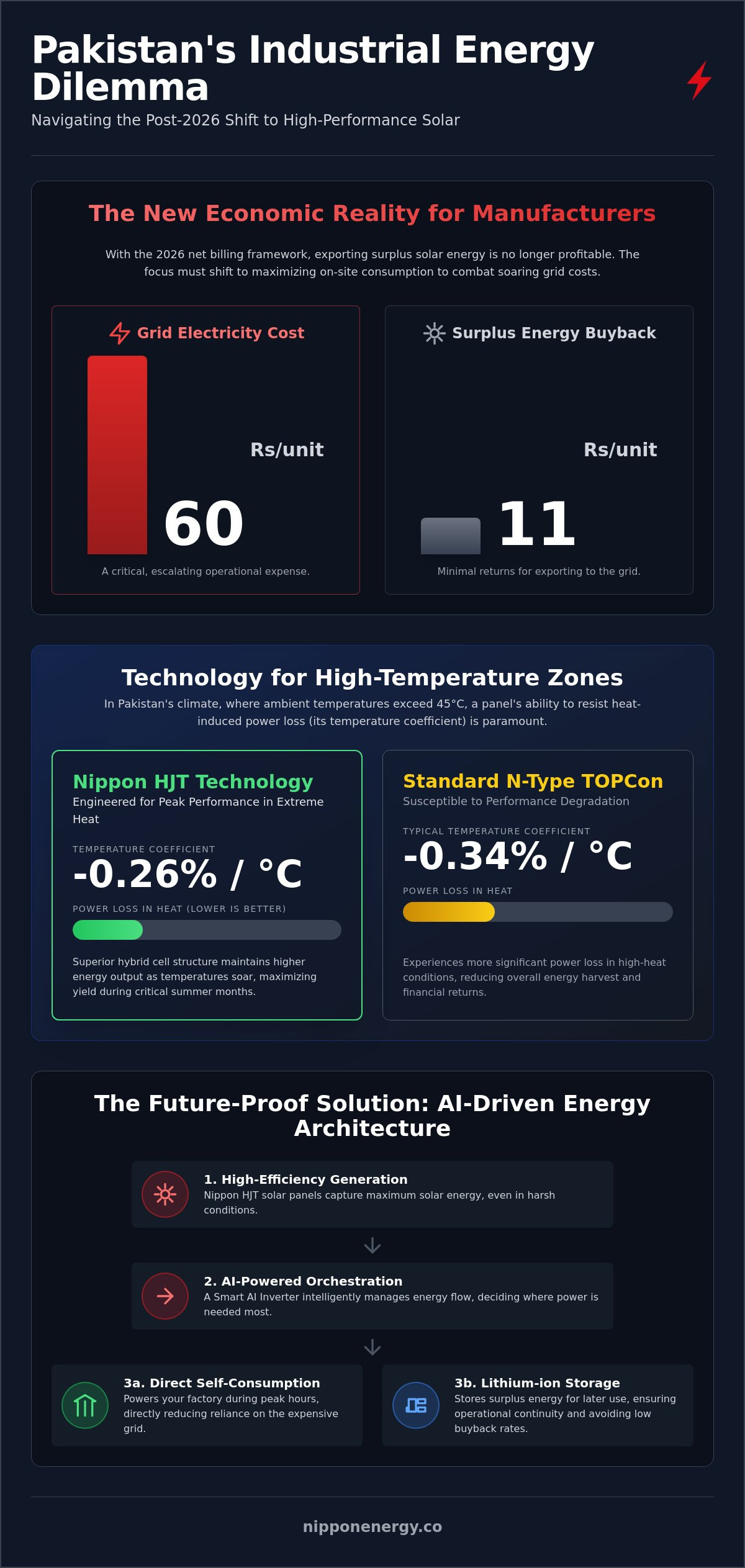
Manufacturing in Pakistan faces a dual crisis of unprecedented tariff escalation and systemic grid fragility. By July 2026, industrial electricity rates have climbed toward Rs. 60 per unit, while the buyback rate for surplus energy has dropped to approximately Rs. 11 under the new net billing framework. This massive delta forces a fundamental rethink of energy procurement. High-performance Solar power in Pakistan has transitioned from an environmental choice to a core requirement for fiscal survival. It's no longer about simple green credentials; it's about the structural integrity of your bottom line.
Grid Volatility and the Manufacturing Sector
Unstable voltage and frequent surges do more than cause downtime. They actively degrade the sensitive power electronics found in modern textile looms and cement kilns. Every unplanned outage triggers a sequence of productivity losses, material waste, and expensive machine recalibration. Deploying robust industrial solar solutions pakistan provides a stabilized local power source that acts as a primary buffer against grid-side disturbances. It's about protecting the long-term life of your capital equipment while ensuring that production schedules remain uninterrupted by external utility failures.
Regulatory Drivers and Net Metering 2.0
The regulatory environment shifted significantly on February 9, 2026, when NEPRA introduced the updated Prosumer Regulations. The transition from a "one-for-one" credit system to a net billing framework based on the National Average Energy Purchase Price (NAEPP) has altered the ROI calculation. New contracts are now limited to five years, and the installed capacity cannot exceed the sanctioned load. These constraints demand a more sophisticated engineering approach. Instead of simply exporting power, industries must prioritize energy orchestration to maximize on-site consumption during peak hours. This strategy effectively "shaves" the most expensive units from your bill, turning a volatile utility expense into a predictable, managed asset.
Global export standards, particularly in EU markets, now mandate verifiable carbon reduction. Adopting renewable infrastructure isn't just about the bill; it's about maintaining access to international supply chains. Companies looking to meet these standards can learn from high-tech innovators like Ethernetics, which provides advanced energy-saving solutions to decarbonise data centres. By achieving energy independence, a factory stops being a passive consumer of expensive grid power and becomes a self-sustaining energy architect, transforming energy into a fixed asset that drives long-term profitability.
Advanced Cell Architecture: HJT vs. TOPCon for High-Temperature Zones
Generic procurement strategies often overlook the thermodynamic reality of the Indus Valley. In regions where ambient temperatures frequently exceed 45°C, the internal cell temperature of a solar module can soar above 70°C. This thermal stress triggers a 'heat tax' that significantly reduces energy harvest. Choosing the right cell architecture is the most critical decision in designing systems that align with Pakistan's renewable energy policy and deliver on their ROI promises. For high-performance industrial solar solutions pakistan, the choice typically narrows down to N-type technologies: Heterojunction (HJT) and Tunnel Oxide Passivated Contact (TOPCon).
The temperature coefficient represents the percentage of power loss for every degree Celsius rise above the standard testing condition of 25°C. In the context of Pakistan's industrial output, a lower coefficient directly translates to higher kilowatt-hour yield during the brutal summer months when energy demand is at its peak. While traditional P-type panels struggle as temperatures climb, N-type architectures maintain structural and electrical stability.
Nippon HJT Solar Panels: Engineering for Extremes
HJT technology combines crystalline silicon with thin-film amorphous silicon to create a high-efficiency sandwich structure. This hybrid design results in a superior temperature coefficient, typically around -0.26%/°C, compared to the -0.34%/°C or higher found in older modules. Nippon HJT Solar Panels leverage this architecture to maintain high output even in the dusty, high-humidity corridors of Karachi and the intense heat of Southern Punjab. The symmetrical cell structure also minimizes Potential Induced Degradation (PID), ensuring the system remains a stable asset for decades. This precision engineering allows for maximum energy density on limited factory roof space.
Comparing Long-term Degradation and ROI
N-type silicon is inherently immune to Light-Induced Degradation (LID) because it doesn't utilize boron-oxygen pairs. Standard panels often face a 2% to 3% drop in performance in the first year alone. In contrast, advanced N-type cells maintain a linear degradation rate as low as 0.4% annually. When you factor in bifacial gain, where light reflected from industrial roof surfaces generates an additional 10% to 30% yield from the rear side, the ROI gap widens significantly. Industrial solar solutions pakistan must account for these long-term gains to move beyond simple payback periods toward true energy independence. Investing in high-efficiency hardware eliminates the hidden costs of thermal inefficiency. You can evaluate your facility's specific yield potential by consulting with a high-tech energy architect today.
AI Orchestration and Storage: The Future of Industrial Energy Management
Passive energy generation is no longer the endgame for sophisticated manufacturers. While the World Bank highlights the vast potential for solar power in the country, the real value lies in how that power is managed. Moving beyond the "install and forget" mindset is essential to navigating the 2026 energy landscape. Modern industrial solar solutions pakistan must incorporate intelligent orchestration to bridge the gap between generation and consumption. This is where AI-driven systems transform a static array of panels into a dynamic energy architect.
The Role of Nippon Smart AI Inverters
Intelligent energy orchestration requires a central brain capable of managing complex inputs. Nippon Smart AI Inverters serve this function by coordinating between solar arrays, battery banks, and the utility grid. These units provide cloud-based performance analytics that allow plant managers to see exactly where energy is being used. This level of transparency ensures that every kilowatt is accounted for and utilized at its highest potential value. Real-time monitoring also allows for rapid response to grid fluctuations, maintaining power quality for sensitive machinery.
Lithium-Ion Storage for Industrial Resilience
Grid instability remains a persistent threat to production cycles. While lead-acid batteries were once the standard, they lack the cycle life and discharge depth required for modern industrial loads. Nippon Lithium-ion Battery Storage Systems offer a more resilient alternative. These systems provide the high energy density needed for 24/7 operational continuity, allowing critical machinery to stay online during grid failures. Sizing storage correctly is a technical exercise that ensures your facility has enough reserve power to navigate peak hours without interruption.
Predictive maintenance is the final piece of the intelligence puzzle. AI algorithms monitor electrical signatures to identify potential faults before they manifest as hardware failures. This proactive approach eliminates the risk of unplanned downtime, which is often more expensive than the energy itself. When intelligence and storage work in tandem, industrial solar solutions pakistan become more than a cost-saving measure. They become a foundation for total energy independence and long-term operational security.
The EPC Lifecycle: Implementing Industrial Solar Solutions in Pakistan
Executing industrial solar solutions pakistan requires a transition from simple procurement to a rigorous engineering lifecycle. This process ensures that a multi-megawatt investment translates into a high-performance energy architecture. A fragmented approach often leads to structural failures or regulatory bottlenecks; therefore, a structured four-phase EPC (Engineering, Procurement, and Construction) framework is mandatory for industrial success in 2026. Every stage must align with the technical demands of Pakistan's climate and the latest NEPRA (Prosumer) Regulations.
Phase 1 begins with detailed feasibility studies and 3D shadow analysis. Factory roofs are complex environments where vents, chimneys, and nearby structures create dynamic shading patterns that can cripple string performance. Phase 2 focuses on structural engineering. Industrial sheds require customized mounting solutions that account for wind loads and dead-weight capacity without compromising the roof's integrity. During Phase 3, the procurement of high-efficiency HJT or TOPCon modules and Smart AI hardware is finalized to ensure component compatibility. Finally, Phase 4 involves commissioning and net billing synchronization. This includes navigating the updated NEPRA approval process and the mandatory Rs. 1,000 per kW processing fee introduced in early 2026.
Solar EPC Services: Precision Engineering
Turnkey solutions are inherently superior to piecemeal installations because they centralize accountability. Managing the supply chain for large-scale utility projects involves more than just shipping panels; it requires the precise synchronization of inverters, mounting structures, and protection gear. A professional Solar EPC Services provider manages these complexities, ensuring that the system is built to global engineering standards while meeting local utility requirements. This architectural approach minimizes the risk of component mismatch and ensures the system operates at peak efficiency from day one.
Maximizing ROI through O&M
The impact of soiling and dust on industrial solar yield in Pakistan cannot be overstated. In high-pollution industrial zones, accumulated particulate matter can reduce output by as much as 30% within weeks. Relying on reactive cleaning is insufficient for 10MW+ plants. Instead, a combination of preventive and predictive maintenance strategies is required. Utilizing the frameworks found in our Solar System Maintenance guide allows operators to identify underperforming strings through AI analytics before they impact the facility's bottom line. This methodical oversight preserves the system's lifespan and maximizes the return on energy independence. To begin your transition toward a resilient energy future, you can consult with our energy architects for a comprehensive site evaluation.
Nippon Energy: Japanese Precision for Pakistan’s Industrial Sector
Nippon Energy operates as a global pioneer in energy architecture, bridging the gap between Japanese engineering and the specific operational hurdles of the Pakistani market. We provide industrial solar solutions pakistan that are built on a foundation of proprietary hardware and methodical system design. By controlling the manufacturing of Nippon HJT Solar Panels and Nippon TOPCon Solar Panels, we eliminate the variability often found in third-party supply chains. This vertical integration ensures that every component is optimized for high-performance synergy; it delivers a level of structural integrity that standard installers cannot match.
Our presence in Karachi and Lahore provides industrial clients with local technical authority backed by international standards. Reliability isn't just a promise; it's a measurable outcome of our "High-Tech Architect" philosophy. We focus on long-term impact, ensuring that your energy infrastructure remains a resilient asset through 2026 and beyond. This commitment to excellence is reflected in our performance guarantees, which are secured by the inherent durability of our N-type cell architectures and advanced thermal management systems. We don't just build solar arrays; we construct permanent energy assets.
Why Nippon Energy for Industrial Projects?
Choosing a manufacturer-EPC hybrid provides a distinct strategic advantage for large-scale facilities. You gain direct access to high-efficiency hardware without the compounding markups of intermediate distributors. We've developed a proven track record in high-temperature climates across the Middle East and Asia, allowing us to apply localized expertise to your specific site conditions. Our team provides customized financial modeling that accounts for current NEPRA regulations, ensuring your ROI calculations are grounded in the reality of the 2026 energy landscape. We avoid rhetorical flourishes, opting instead for data-driven evidence of system performance and longevity.
Getting Started with Your Industrial Transition
The transition to energy independence begins with a granular understanding of your facility's load profile. We conduct an initial energy audit to identify peak consumption periods and potential efficiency gains. This data allows us to customize the NipponHev system for your specific manufacturing requirements. NipponHev represents the total orchestration of solar generation, AI-driven management, and lithium storage into a single, cohesive energy profile. You can secure your operational future by contacting the Nippon Energy Pakistan team for a comprehensive site assessment. Our engineers are ready to design the high-efficiency architecture your industry demands to thrive in a high-tariff environment.
Securing Your Industrial Legacy through Energy Architecture
The transition toward high-efficiency energy systems is a structural necessity for the Pakistani manufacturing sector; it's the most effective method for safeguarding margins. By prioritizing Japanese-engineered HJT panels with industry-leading temperature coefficients, you ensure your facility maintains peak output during extreme thermal peaks. Integrating these components with AI-driven monitoring and lithium storage allows you to transcend the limitations of the current grid and the 2026 net billing regulations. Implementing sophisticated industrial solar solutions pakistan transforms energy from an unpredictable utility expense into a high-performance asset.
Success requires a partner who combines global technical pedigree with deep local operational capacity. From Karachi to Lahore, our team provides full turnkey EPC services to ensure every system meets the highest engineering standards. You can take the first step toward total energy orchestration and maximum uptime today. Consult with Nippon Energy’s Pakistan Team for an Industrial Site Audit and begin the process of future-proofing your infrastructure. The future of industrial productivity belongs to those who build with precision and foresight.
Frequently Asked Questions
What is the average ROI for industrial solar solutions in Pakistan in 2026?
Under the 2026 net billing regime, the ROI for industrial solar solutions pakistan typically ranges between 3.5 and 5 years when self-consumption is maximized. Since the buyback rate is approximately Rs. 11 per unit, the primary value comes from offsetting grid tariffs that can exceed Rs. 60 per unit. Systems that incorporate AI-driven load shifting achieve the fastest payback by minimizing expensive peak-hour consumption.
How do Nippon HJT solar panels perform in the extreme heat of Sindh and Punjab?
Nippon HJT Solar Panels are engineered with a superior temperature coefficient of -0.26%/°C, making them ideal for the 50°C+ environments of Sindh and Punjab. Unlike traditional panels that lose significant efficiency as they heat up, HJT architecture maintains high energy harvest in extreme ambient temperatures. This resilience ensures that your industrial output remains stable during the most demanding summer months.
Can industrial solar systems run heavy machinery during power outages?
Industrial solar systems can power heavy machinery during grid failures if they're integrated with Nippon Lithium-ion Battery Storage Systems and hybrid AI inverters. These systems must be sized to handle the high start-up currents and surge loads characteristic of industrial motors. Proper energy orchestration ensures that critical production lines remain operational without relying on the unstable national grid.
What are the current NEPRA requirements for industrial net metering?
As of February 9, 2026, NEPRA requires all new industrial solar solutions pakistan to operate under a net billing framework. Key regulations include a mandatory processing fee of Rs. 1,000 per kilowatt and a reduced contract duration of five years. Additionally, the installed solar capacity can't exceed the sanctioned load of the facility, making precise system sizing essential for regulatory compliance.
Is lithium-ion storage worth the investment for a factory in Pakistan?
Lithium-ion storage is a strategic investment for Pakistani factories because it enables effective peak-shaving and provides high-density backup. Nippon Lithium-ion Battery Storage Systems offer a significantly longer cycle life than lead-acid alternatives, making them more cost-effective over a 10-year period. They allow industries to avoid the highest utility tariffs by discharging stored energy during peak grid hours.
How does Nippon Energy handle maintenance for industrial solar farms?
Nippon Energy manages maintenance through our Solar System Maintenance and Monitoring services, utilizing AI to identify performance dips before they cause downtime. We deploy scheduled cleaning protocols to mitigate the impact of dust and soiling, which are prevalent in local industrial zones. Predictive analytics allow our technical teams in Karachi and Lahore to provide proactive support for large-scale solar farms.
What is the difference between TOPCon and HJT for industrial use?
HJT (Heterojunction) technology generally offers better temperature coefficients and lower long-term degradation than TOPCon, though TOPCon provides a highly efficient and cost-effective alternative. Both are N-type architectures that outperform traditional P-type panels. For industries in extreme heat zones, HJT is often the preferred choice for maximizing lifetime energy yield and protecting the investment.
How long does the EPC process take for a 1MW industrial solar project?
The EPC lifecycle for a 1MW industrial project usually spans three to five months from the initial feasibility study to final commissioning. This timeline includes structural engineering for industrial sheds, procurement of Nippon hardware, and the NEPRA synchronization process. Factors such as roof complexity and the speed of utility approvals can influence the final duration of the project.


