
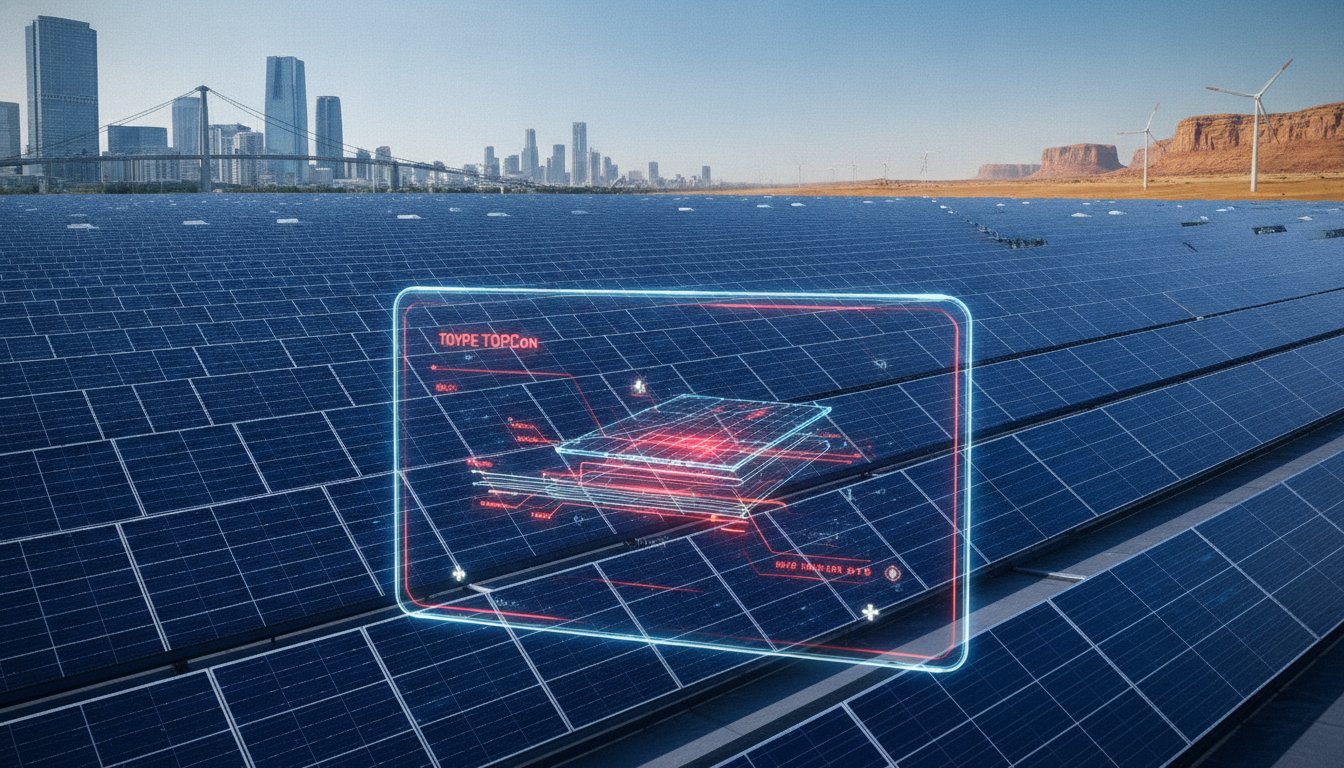
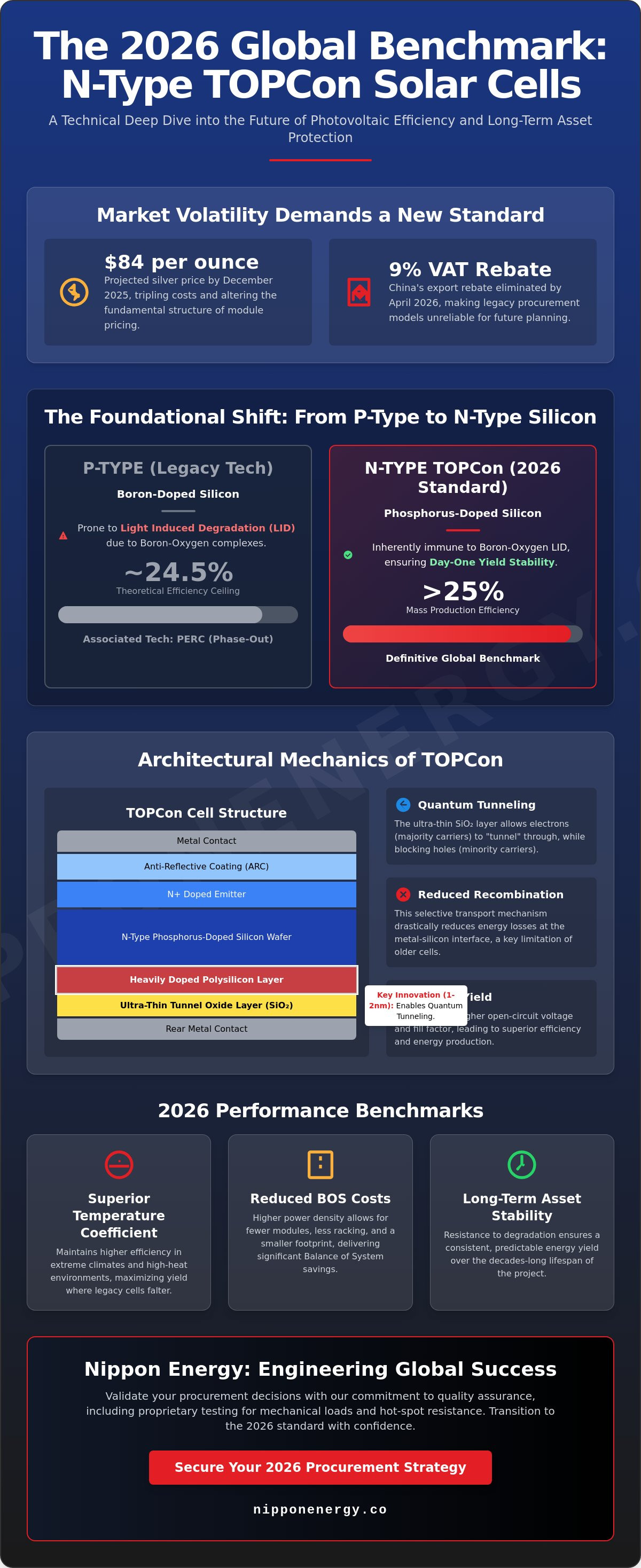
By December 2025, silver prices tripled to reach 84 dollars per ounce, fundamentally altering the cost structure of high-performance modules. This surge, combined with the April 2026 elimination of China's 9 percent VAT export rebate, means that procurement professionals can't rely on legacy pricing models. Success in this volatile environment requires a transition to n-type topcon solar cells, an architecture that balances extreme efficiency with the thermal stability required for long-term asset protection.
You recognize that technical superiority is the only viable hedge against rising material costs and shifting regulatory standards, such as the 2026 NEC updates. This guide promises to provide the technical validation necessary for your 2026 strategic planning and procurement decisions. We'll examine the current efficiency benchmarks, including the 34.76 percent record for TOPCon-based tandem cells, and provide a clear ROI framework to help you distinguish between TOPCon and HJT architectures. From mastering the passivated contact layer to understanding degradation limits in high-heat environments, this analysis establishes the foundation for your next-generation energy infrastructure.
Key Takeaways
- Analyze the transition from Boron-doped P-type to phosphorus-doped N-type silicon to understand why it is the definitive global benchmark for 2026.
- Master the architectural mechanics of the ultra-thin tunnel oxide layer and how quantum tunneling effectively reduces carrier recombination for higher yields.
- Evaluate 2026 performance benchmarks for n-type topcon solar cells, focusing on mass production efficiency records and superior temperature coefficients in extreme climates.
- Identify strategic frameworks for reducing Balance of System (BOS) costs by leveraging higher power density and precise inverter-string optimizations.
- Validate procurement decisions by understanding the Nippon Energy approach to quality assurance, including proprietary testing for mechanical load and hot-spot resistance.
The Evolution of Photovoltaic Efficiency: Defining N-Type TOPCon
The solar industry has entered a phase of radical architectural restructuring. By 2026, the transition from p-type to n-type silicon has moved from a premium option to the global industrial standard. This shift is driven by the fundamental limitations of boron-doped wafers, which have historically constrained the efficiency potential of large-scale arrays. The Evolution of Photovoltaic Efficiency has now converged on n-type topcon solar cells as the primary vehicle for achieving higher power density and long-term asset stability.
At the core of this transition is the move toward phosphorus-doped silicon. Unlike p-type cells that use boron, n-type silicon is doped with phosphorus to create an electron-rich environment. This chemical substitution provides a surplus of negative charge carriers that significantly enhance electrical conductivity. This phosphorus-based foundation allows for a higher purity ceiling, enabling manufacturers to push efficiency limits beyond what was previously possible with legacy technologies. It's a fundamental change that addresses performance at the atomic level.
Phosphorus vs. Boron: The Chemistry of Performance
In traditional p-type cells, boron atoms frequently react with oxygen during the manufacturing process to form boron-oxygen complexes. These complexes are the primary cause of Light Induced Degradation (LID), a phenomenon where cell efficiency drops immediately upon exposure to sunlight. Because n-type wafers rely on phosphorus, they're inherently immune to this specific degradation mechanism. This atomic-level stability ensures that the energy yield remains consistent from the first day of operation through the decades-long lifespan of the project. The surplus of negative charge carriers also facilitates a higher tolerance for impurities, which preserves the structural integrity of the cell under high-stress conditions.
The Death of PERC: Why the Industry Migrated
For years, Passivated Emitter and Rear Cell (PERC) technology dominated the market. However, PERC has reached its theoretical efficiency ceiling of approximately 24.5 percent. The industry has reached a consensus that legacy PERC production lines are no longer viable for new utility-scale developments. The 2026 landscape shows a definitive phase-out of these lines in favor of TOPCon architecture. By integrating a thin tunnel oxide layer, n-type topcon solar cells effectively bypass the recombination losses that limited PERC. This allows for mass production efficiencies that now routinely exceed 25 percent, providing a clear path for lower levelized cost of energy (LCOE) in commercial applications. The transition isn't just an upgrade; it's a necessary pivot for industrial survival.
The Architectural Mechanics: How TOPCon Cells Function
The architecture of n-type topcon solar cells represents a sophisticated departure from standard photovoltaic design. While traditional cells suffer from carrier recombination at the metal-silicon interface, TOPCon (Tunnel Oxide Passivated Contact) utilizes a specific layering strategy to preserve electrical potential. The core of this system is a stack consisting of an ultra-thin silicon dioxide (SiO2) layer and a heavily doped polycrystalline silicon layer. This configuration acts as a selective membrane, allowing for the efficient extraction of charge carriers while maintaining high open-circuit voltage. It's an engineering solution that addresses the physical bottleneck of surface recombination at the atomic level.
Quantum tunneling is the physical mechanism that enables this performance. The SiO2 layer is engineered to be thin enough, typically between 1 and 2 nanometers, that electrons can "tunnel" through the barrier despite the layer being an insulator. Simultaneously, the energy band structure effectively blocks the flow of holes. This selective transport mechanism is a primary reason why TOPCon technology overview assessments frequently highlight its superior efficiency over legacy architectures. By managing carrier flow at the quantum level, the cell achieves a higher fill factor and better performance under varying spectral conditions.
Passivated Contacts and Recombination Control
The SiO2 interface provides exceptional surface passivation by chemically saturating the silicon surface bonds. This reduces the "dark current," which is the internal leakage of current that occurs even without light. Minimizing this leakage directly improves low-light performance and overall spectral response. The technical synergy between the tunnel oxide and the poly-Si layer ensures that the metal contacts don't directly touch the silicon wafer. By isolating these components, the cell minimizes recombination losses and effectively maximizes the voltage output. Engineers looking to optimize system performance often choose Nippon TOPCon Solar Panels for their precise passivation engineering and structural reliability.
Bifacial Architecture and Energy Density
The structural symmetry of the TOPCon cell naturally supports high bifaciality factors, often reaching up to 85 percent. Unlike P-type structures that require heavy back-surface fields, the N-type base and passivated contacts allow for significant rear-side energy absorption. This transparency is critical for commercial projects where ground albedo, such as light reflected from sand or concrete, can contribute significantly to total yield. For a deeper analysis of how this affects project bankability, see our guide on bifacial topcon solar panels. The combination of high energy density and bifacial gain makes n-type topcon solar cells the architectural choice for future-proofed energy systems. This design doesn't just capture more light; it converts it more intelligently.
2026 Performance Benchmarks: Efficiency and Stability
In 2026, the performance of n-type topcon solar cells has reached a level of industrial maturity that redefines project bankability. Mass production efficiency now consistently ranges between 25.5 percent and 26.5 percent. While specialized tandem architectures have achieved laboratory records as high as 34.76 percent, the current commercial focus remains on the stability and scalability of mono-facial and bifacial TOPCon modules. This increased efficiency isn't just a numerical gain; it represents a fundamental improvement in electron transport efficiency across the entire solar spectrum.
These cells demonstrate a superior spectral response, particularly in the infrared and blue light wavelengths. This enables systems to begin generating power earlier at dawn and continue later into the dusk compared to legacy P-type modules. On overcast days, the reduced internal resistance of the TOPCon architecture ensures that even diffuse radiation is converted with minimal loss. This consistency in energy harvesting directly translates to a more predictable power profile for grid operators and commercial asset owners.
Thermal Stability and the Temperature Coefficient
The Pmax temperature coefficient for TOPCon in 2026 is standardized between -0.29%/°C and -0.30%/°C. This technical metric is critical for projects in high-heat environments like Pakistan or the Middle East. When ambient temperatures reach 45°C, standard solar cells often experience significant voltage drops and power output degradation. TOPCon architecture maintains higher operational voltage under thermal stress, ensuring that the system delivers maximum yield during peak demand hours. It's a structural advantage that protects the owner's investment in regions where thermal derating is a primary concern.
Long-Term Reliability: LID and LeTID Resistance
Long-term reliability is anchored in the material's inherent resistance to degradation. Because n-type topcon solar cells utilize phosphorus-doped wafers, they're naturally immune to Light-Induced Degradation (LID). The architecture also addresses Light and Elevated Temperature Induced Degradation (LeTID), which is a common failure point for PERC modules in desert climates. By 2026, the 30-year linear power warranty has become the industry standard for these modules, reflecting a degradation rate that is significantly lower than previous generations. A typical TOPCon module will retain over 87 percent of its original power after three decades, providing a stable foundation for long-term power purchase agreements.
Strategic Implementation: Maximising Yield in Commercial Projects
The transition from cell-level physics to project-level deployment requires a rigorous focus on system economics. Deploying n-type topcon solar cells in commercial utility projects fundamentally shifts the financial model by optimizing the Balance of System (BOS) costs. As module power ratings now routinely exceed 600W, the physical footprint required for a specific megawatt capacity decreases. This density allows developers to consolidate their infrastructure, which leads to immediate savings in land acquisition and site preparation. High-efficiency architectures ensure that every square meter of the project site contributes the maximum possible kilowatt-hour yield over the asset's lifecycle.
BOS Savings and LCOE Reduction
Utilizing 600W+ TOPCon modules reduces the total number of units required for a project, which directly impacts the volume of racking, mounting structures, and cabling. Fewer modules mean fewer electrical connections and a simplified installation process, which reduces labor costs and shortens construction timelines. When calculating the Levelized Cost of Electricity (LCOE) over a 25-year or 30-year window, these upfront savings are compounded by the technology's superior energy density. Large-scale utility projects benefit from this efficiency by spreading fixed operational costs across a larger volume of generated energy. This architectural advantage makes TOPCon the primary choice for investors seeking to maximize internal rates of return (IRR) in competitive energy markets.
Inverter Synergy and String Design
Successful implementation depends on the precise synchronization between the module and the power conversion system. We recommend integrating these modules with smart ai solar inverters to effectively manage the specific electrical profiles of N-type technology. One critical technical consideration is the higher short-circuit current (Isc) characteristic of n-type topcon solar cells. Procurement teams must ensure that inverter input ratings are compatible with these higher amperage levels to avoid power clipping during peak irradiance. String design should also be optimized for the module's voltage profile to maintain the inverter within its most efficient MPPT window. To maximize bifacial gain, EPCs should adjust racking heights and ground albedo, ensuring that the rear-side yield contributes effectively to the total system output.
In regions such as South Asia and the Middle East, these strategic considerations are essential for overcoming high ambient temperatures and dusty conditions. The thermal stability discussed in previous sections allows for more aggressive string sizing without risking voltage-related shutdowns. For organizations finalizing their 2026 supply chain, our topcon solar panels for sale guide offers a detailed roadmap for securing high-performance capacity. Achieving project bankability in the current landscape requires more than just high-efficiency hardware; it requires an integrated approach to system architecture. Consult with the engineering team at Nippon Energy to design an optimized photovoltaic system that leverages the full potential of TOPCon technology.
Nippon Energy TOPCon Architecture: Engineering Global Success
Nippon Energy views photovoltaic technology as a single, critical component within a larger, high-performance energy architecture. Our integration of Nippon TOPCon Solar Panels follows a methodology that prioritizes structural resilience and intelligent orchestration rather than just raw output. By 2026, the industrial application of n-type topcon solar cells has moved beyond simple power generation to become the core of sophisticated, carbon-neutral infrastructure. We ensure this transition is stable through proprietary quality assurance protocols that exceed standard IEC requirements. Every module undergoes rigorous testing for hot-spot resistance and mechanical load, utilizing electroluminescence imaging to identify potential failures before hardware reaches the site.
Our global EPC integration capabilities allow us to deploy these advanced systems across diverse geographical landscapes, from the dense urban requirements of Tokyo to the extreme thermal environments of Dubai and Lahore. We adapt our engineering framework to local irradiance profiles and grid codes, ensuring that the high-efficiency potential of N-type silicon is fully realized in every installation. The future of global energy resilience depends on the synergy between generation and storage. Combining n-type topcon solar cells with high-capacity lithium ion battery storage creates a permanent, reliable power source that operates independently of market volatility.
Integrated Energy Orchestration
Nippon Energy utilizes AI-driven monitoring to track the real-time performance and degradation of every cell within an array. This data-centric approach allows the nipponhev system to leverage the superior efficiency of N-type architecture, optimizing the balance between immediate consumption and storage reserves. To ensure these assets perform at peak capacity for decades, we provide structured solar system maintenance programs. These services are vital for preserving the integrity of the 30-year linear power warranty and maximizing the long-term ROI of the installation.
Expert Consultation and EPC Excellence
Our engineering team provides customized feasibility studies for commercial clients, evaluating the specific technical and financial advantages of TOPCon technology for their unique operations. We maintain a robust global supply chain to ensure that Nippon hardware is delivered with absolute reliability, regardless of regional logistics challenges. This commitment to precision and durability defines our role as a world-class partner in large-scale energy success. To secure your position in the 2026 energy landscape, partner with Nippon Energy for high-efficiency solar infrastructure and build a foundation for permanent progress.
Securing the 2026 Energy Architecture
The transition toward n-type topcon solar cells is a strategic necessity for developers operating in the 2026 global landscape. We've established how the tunnel oxide layer and phosphorus-doped wafers eliminate legacy degradation issues while providing a 25.5 percent mass production efficiency floor. This architecture ensures that commercial assets maintain structural integrity and consistent power output even in extreme high-heat environments. These technical advantages provide the grounded authority needed to justify large-scale procurement decisions and long-term asset management.
Success in modern energy project development requires more than high-performance hardware; it demands an integrated ecosystem designed for longevity. With a 30-year linear power warranty and engineering specifically optimized for desert performance, our technology provides the stability required for permanent success. You've now mastered the mechanics and strategic advantages necessary to future-proof your next installation. Take the next step in engineering a resilient energy future and achieving monumental impact.
Explore Nippon TOPCon Solar Panels for Your Next Project
Frequently Asked Questions
What is the primary difference between TOPCon and PERC solar cells?
The primary difference lies in the contact structure; TOPCon utilizes an ultra-thin tunnel oxide and a doped polycrystalline silicon layer to create passivated contacts. Unlike PERC, which suffers from significant recombination losses at the metal-silicon interface, this architecture allows electrons to pass through while preventing the loss of charge carriers. This structural shift enables higher open-circuit voltage and superior conversion efficiency.
Why are N-type TOPCon solar cells more efficient than P-type?
N-type silicon is doped with phosphorus, creating an electron-rich environment that is inherently more efficient than boron-doped P-type silicon. This chemical composition eliminates the boron-oxygen complexes responsible for light-induced degradation, allowing n-type topcon solar cells to reach higher mass-production efficiency ceilings. The result is a cell with better minority carrier lifetime and enhanced electrical conductivity.
How does TOPCon technology perform in high-temperature climates?
TOPCon technology excels in high-heat environments due to its superior temperature coefficient, typically ranging from -0.29%/°C to -0.30%/°C. This lower coefficient means the modules retain a higher percentage of their power output as ambient temperatures rise. This thermal stability is a critical advantage for utility-scale projects in regions like South Asia and the Middle East where heat-related power loss is a major concern.
Is TOPCon more expensive than traditional solar technology in 2026?
While TOPCon has become the industry benchmark, market factors in 2026, such as the tripling of silver prices and the elimination of China's 9 percent VAT export rebate, have influenced global procurement costs. However, the higher energy density and reduced Balance of System (BOS) costs often result in a lower Levelized Cost of Electricity (LCOE). The increased yield over the system's life typically offsets any initial capital expenditure differences.
What is the expected lifespan of an N-type TOPCon solar panel?
The expected operational lifespan of these modules is 30 years, supported by a linear power warranty that guarantees high output retention. Because the architecture is resilient against common degradation mechanisms, asset owners can expect the system to retain over 87 percent of its original capacity after three decades. This longevity makes it a preferred choice for long-term power purchase agreements and infrastructure stability.
Can TOPCon solar panels be used with standard solar inverters?
Yes, n-type topcon solar cells are compatible with standard solar inverters, though engineers must verify that the inverter's input rating can handle higher short-circuit currents (Isc). Modern systems often pair these modules with AI-driven inverters to optimize the specific electrical profile and maximize the yield from high-efficiency strings. Proper string sizing is essential to keep the system within the inverter's optimal MPPT window.
What is bifacial gain in TOPCon modules and how is it calculated?
Bifacial gain refers to the additional energy generated by the rear side of the module from reflected sunlight, known as albedo. It's calculated by multiplying the rear-side irradiance by the module's bifaciality factor, which for TOPCon can reach up to 85 percent. Factors such as mounting height and the reflectivity of the ground surface significantly influence the final energy yield per square meter.
Does TOPCon technology suffer from LID or LeTID degradation?
TOPCon technology is inherently immune to Light-Induced Degradation (LID) because it utilizes phosphorus-doped wafers instead of boron-doped ones. It also demonstrates high resistance to Light and Elevated Temperature Induced Degradation (LeTID). This resilience ensures stable performance in extreme climates where traditional cells might experience rapid efficiency loss during the initial years of operation.


